Bitcoin Bears Take The Wheel — Why $94,000 May Be The Next Critical Zone

bitcoinistPublished on 2025-06-22Last updated on 2025-06-23

Abstract

Over the past few days, the Bitcoin market has witnessed largely unimpressive price action and performance. While the premier cryptocurrency...

Trusted Editorial content, reviewed by leading industry experts and seasoned editors. Ad Disclosure

Over the past few days, the Bitcoin market has witnessed largely unimpressive price action and performance. While the premier cryptocurrency did run up to as high as $108,000 earlier in the week, the BTC price was mostly constrained to a tight range between $103,000 and $106,000.

Indeed, the flagship cryptocurrency has maintained its position above the psychological $100,000 level since early May, but it has not exactly built on this momentum. The latest on-chain data has provided insight into Bitcoin’s current reluctance to move and its possible trajectory in the coming weeks.

$95,000 Acting As A Barrier; Momentum Weakens

In a June 21 post on social media platform X, on-chain analyst Burak Kesmeci reiterated his earlier projection that the Bitcoin price could, in the short term, fall to the $93,000 to $94,000 price range. In his post, Kesmeci cited multiple technical indicators, which form the foundation of his bias.

The first of these highlighted indicators is the Fixed Range Volume Profile (FRVP) Intensive Swap Level (ISL), which is a refined support or resistance level derived from the FRVP showing key areas where buyer-seller dominance flipped with intensive volume. 

According to Kesmeci, the FRVP intensive swap level is roughly $95,000, meaning this zone is a significant resistance level. The online pundit also noted that if Bitcoin’s price were to fail to stay above this price level, it could further increase the sell pressure in the cryptocurrency market.
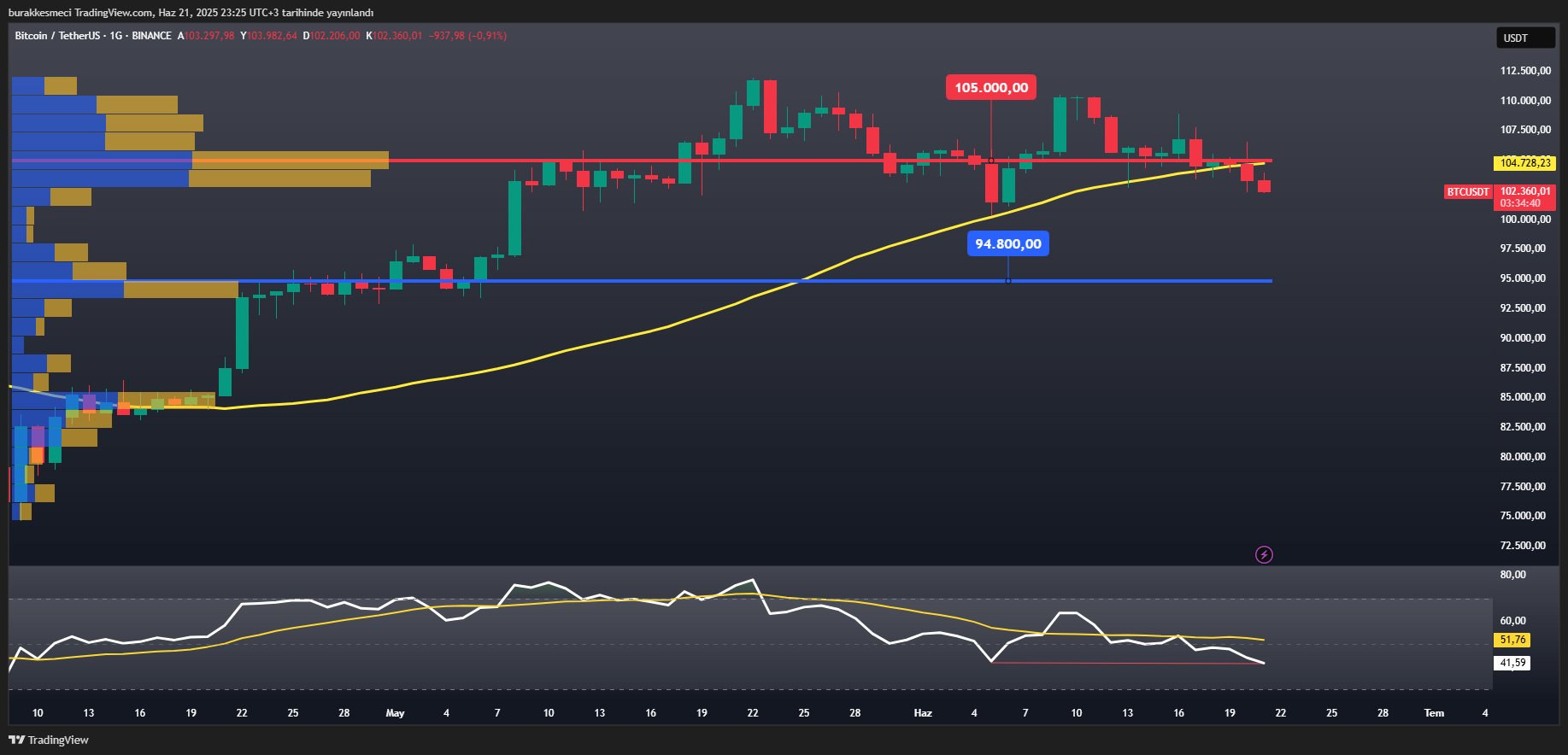
Bitcoin

Source: @burak_kesmeci on X

The analyst also identified the 50-day Simple Moving Average (SMA50) as critical to the short-term trend. Kesmeci highlighted that the SMA50 is almost at $105,000 — the same level which, interestingly, BTC is about to close below for the second time. If Bitcoin successfully closes below this SMA50, the on-chain analyst inferred that it could catalyze the downside movement of the flagship cryptocurrency.

The Relative Strength Index (RSI) also seems to support Kesmeci’s bearish stance. Currently at levels below 50 and beneath the 14-day SMA, the RSI signals that there is a loss of momentum in Bitcoin’s bullish movement.

As if it weren’t bad enough, Kesmeci also noted that lower lows are being formed in the RSI, and this stands as further proof that the market is currently seller-dominated.

‘Why I Am Waiting For $94,000’ — Kesmeci

To answer the question of why $94,000 is the next critical level to watch out for, Kesmeci explained that the VAL (Value Area Low) in the FRVP points to approximately $93,000 to $94,000. Burak made it clear that this level can act as a strong support zone to send the price back after BTC’s short-term sell-off.

Additionally, the crypto pundit referenced the 200-day Simple Moving Average (SMA200) as another confirmation of his bias. True enough, the SMA200 is observed to converge near $95,000. Amidst Bitcoin’s price fall, Burak advised that market participants stay prepared for the highlighted support zone, as good opportunities to buy might surface around it.

As of this writing, Bitcoin is valued at about $101,596, reflecting a 1.3% price decline over the past 24 hours.

Bitcoin

The price of BTC on the daily timeframe | Source: BTCUSDT chart on TradingView

Featured image from iStock, chart from TradingView
Editorial Process for bitcoinist is centered on delivering thoroughly researched, accurate, and unbiased content. We uphold strict sourcing standards, and each page undergoes diligent review by our team of top technology experts and seasoned editors. This process ensures the integrity, relevance, and value of our content for our readers.

Opeyemi Sule is a passionate crypto enthusiast, a proficient content writer, and a journalist at Bitcoinist. Opeyemi creates unique pieces unraveling the complexities of blockchain technology and sharing insights on the latest trends in the world of cryptocurrencies. Opeyemi enjoys reading poetry, chatting about politics, and listening to music, in addition to his strong interest in cryptocurrency.

Trending Cryptos

Related Reads

Claude Accused of Becoming Dumber by the Entire Internet, Anthropic Steps In to Reveal: It’s Not the Model That’s Tricking You

When users complained that Claude was "getting dumber," the root cause wasn't the AI model itself. In an official blog post, Anthropic clarified the critical difference between two key settings in Claude Code: Model and Effort. Model refers to the core "brain"—the fixed, trained weights of a specific AI (like Sonnet, Opus, or Fable). Changing the Model addresses *capability* ("can it do this?"), but its knowledge is static post-training. Effort, however, controls the AI's *approach and thoroughness* for a specific task. A higher Effort level instructs Claude to read more files, run tests, perform verification, and complete multi-step reasoning before responding, significantly increasing its "work output" for that job. Conversely, low Effort leads to quicker, less thorough replies. This distinction explains the March 2024 uproar where users experienced a sudden drop in Claude's performance. The cause was not a model change but Anthropic quietly lowering the *default* Effort setting from "high" to "medium" to reduce latency, which was later reverted. The key insight is that a smaller, capable model (like Sonnet) on high Effort can often outperform a larger, more powerful model (like Opus) on low Effort for many tasks. The article provides a practical troubleshooting framework: if Claude makes an error, first check the context and instructions. If it seems to skip necessary steps or validations, increase Effort. If it diligently attempts the task but fails conceptually or makes consistent factual errors despite good context, then consider switching to a more capable Model. The takeaway is a shift in focus: effective AI programming is less about always choosing the "strongest" model and more about intelligently *orchestrating* models and effort levels—acting like a project manager to assign the right "brain" with the right level of diligence for each job, optimizing both results and cost.

marsbit1h ago

Claude Accused of Becoming Dumber by the Entire Internet, Anthropic Steps In to Reveal: It’s Not the Model That’s Tricking You

marsbit1h ago

Will the Ethereum Foundation Evolve into a 'Mascot'? Diversified Organizations Are Fragmenting Its Functions

The Ethereum Foundation (EF) is undergoing significant internal turmoil and functional erosion. Following its largest-ever layoff of 54 staff (20% of its workforce) and a major organizational restructuring announced in June, its Protocol Support Team has been officially dissolved. This comes alongside the high-profile resignation of key figures like co-executive director Xiaowei Wang, bringing senior departures this year to at least eight. Criticism of EF's rigid structure, opaque decision-making, and perceived lack of a clear value narrative for ETH has intensified within the community. The layoffs have catalyzed the emergence of independent, non-profit organizations like Ethlabs and Ethereum Institutional, founded by former EF researchers and members. These entities are now taking on core functions such as protocol research/development and institutional adoption, effectively fragmenting the EF's traditional leadership role. Concurrently, EF's security team is adapting to technological change, deploying specialized AI agents to audit Ethereum's codebase, which successfully discovered a critical vulnerability (CVE-2026-34219). While EF states AI complements rather than replaces researchers, it signals a potential future shift in its operational model. Faced with these challenges—internal restructuring, talent drain, the rise of competing organizations, and AI integration—the Ethereum Foundation appears to be stepping back from a central commanding role. Analysts and community observers speculate it may increasingly transition towards a symbolic "ecosystem mascot" function, while decentralized initiatives drive Ethereum's future growth and institutional adoption.

marsbit1h ago

Will the Ethereum Foundation Evolve into a 'Mascot'? Diversified Organizations Are Fragmenting Its Functions

marsbit1h ago

Nearly a Hundred Players Rush into Embodied Data: With 4.47 Billion Yuan in Financing in One Year, Who Can Really Make Money by 'Selling Data'?

The domestic embodied AI data industry has attracted nearly 100 players, with 70 focused on data collection and 27 on data infrastructure. In the past year, 15 independent embodied data service providers raised approximately 4.47 billion yuan. Despite this growth, the sector remains early-stage, fragmented, and faces significant challenges. Data collection methods are diverse, categorized into four main routes: teleoperation of real robots, human demonstration without a robot (using motion capture, exoskeletons, etc.), simulation synthesis, and distillation from internet videos. Most companies (43%) adopt hybrid approaches, combining multiple routes, as no single method can meet all training needs. Teleoperation alone is pursued by 31% of players, often by state-owned platforms and robot companies, while newer firms favor asset-light, no-hardware human demonstration. Independent data service providers now form the largest player group (40%), indicating the emergence of a distinct industry segment rather than just a subsidiary function for robot makers. Two-thirds of all players are "embodied-native" startups, while one-third are companies that pivoted from fields like AI data annotation, which are more prevalent in the data infrastructure layer. Current annual industry capacity is estimated at 1.6-1.8 million hours plus 70-80 million data points, with a short-term goal to increase this 15-20 fold within 1-3 years. Data collection factories are spread across 20 provinces in China, concentrated in the Yangtze River Delta, Beijing-Tianjin-Hebei, and Pearl River Delta regions. Financially, the 4.47 billion yuan raised in the past year pales compared to the 43.8 billion yuan raised by the broader embodied intelligence sector in just the first half of 2026, highlighting that data remains a less "sexy" bet for investors. The 15 funded independent providers show clear stratification: a top tier led by a unicorn (Lightwheel Intelligence, 3.1 billion yuan), a middle tier of 11 firms raising tens to hundreds of millions, and an early-stage tier of 3 companies. Sixty-nine investment institutions have participated, but none have made concentrated bets, reflecting uncertainty about viable business models. Over half of these funded companies are less than a year old, most are at pre-A or A rounds, and profitability remains largely unproven. In summary, the embodied data industry has become an independent track creating jobs and local economic activity. However, it is still nascent, with unformed consensus, unsolved problems, and unproven business models. The coming 1-2 years will be a critical validation window to see if companies can build sustainable, profitable businesses purely by "selling data."

marsbit4h ago

Nearly a Hundred Players Rush into Embodied Data: With 4.47 Billion Yuan in Financing in One Year, Who Can Really Make Money by 'Selling Data'?

marsbit4h ago

Trading

Spot

Hot Articles

What is $BITCOIN

DIGITAL GOLD ($BITCOIN): A Comprehensive Analysis Introduction to DIGITAL GOLD ($BITCOIN) DIGITAL GOLD ($BITCOIN) is a blockchain-based project operating on the Solana network, which aims to combine the characteristics of traditional precious metals with the innovation of decentralized technologies. While it shares a name with Bitcoin, often referred to as “digital gold” due to its perception as a store of value, DIGITAL GOLD is a separate token designed to create a unique ecosystem within the Web3 landscape. Its goal is to position itself as a viable alternative digital asset, although specifics regarding its applications and functionalities are still developing. What is DIGITAL GOLD ($BITCOIN)? DIGITAL GOLD ($BITCOIN) is a cryptocurrency token explicitly designed for use on the Solana blockchain. In contrast to Bitcoin, which provides a widely recognized value storage role, this token appears to focus on broader applications and characteristics. Notable aspects include: Blockchain Infrastructure: The token is built on the Solana blockchain, known for its capacity to handle high-speed and low-cost transactions. Supply Dynamics: DIGITAL GOLD has a maximum supply capped at 100 quadrillion tokens (100P $BITCOIN), although details regarding its circulating supply are currently undisclosed. Utility: While precise functionalities are not explicitly outlined, there are indications that the token could be utilized for various applications, potentially involving decentralized applications (dApps) or asset tokenization strategies. Who is the Creator of DIGITAL GOLD ($BITCOIN)? At present, the identity of the creators and development team behind DIGITAL GOLD ($BITCOIN) remains unknown. This situation is typical among many innovative projects within the blockchain space, particularly those aligning with decentralized finance and meme coin phenomena. While such anonymity may foster a community-driven culture, it intensifies concerns about governance and accountability. Who are the Investors of DIGITAL GOLD ($BITCOIN)? The available information indicates that DIGITAL GOLD ($BITCOIN) does not have any known institutional backers or prominent venture capital investments. The project seems to operate on a peer-to-peer model focused on community support and adoption rather than traditional funding routes. Its activity and liquidity are primarily situated on decentralized exchanges (DEXs), such as PumpSwap, rather than established centralized trading platforms, further highlighting its grassroots approach. How DIGITAL GOLD ($BITCOIN) Works The operational mechanics of DIGITAL GOLD ($BITCOIN) can be elaborated on based on its blockchain design and network attributes: Consensus Mechanism: By leveraging Solana’s unique proof-of-history (PoH) combined with a proof-of-stake (PoS) model, the project ensures efficient transaction validation contributing to the network's high performance. Tokenomics: While specific deflationary mechanisms have not been extensively detailed, the vast maximum token supply implies that it may cater to microtransactions or niche use cases that are still to be defined. Interoperability: There exists the potential for integration with Solana’s broader ecosystem, including various decentralized finance (DeFi) platforms. However, the details regarding specific integrations remain unspecified. Timeline of Key Events Here is a timeline that highlights significant milestones concerning DIGITAL GOLD ($BITCOIN): 2023: The initial deployment of the token occurs on the Solana blockchain, marked by its contract address. 2024: DIGITAL GOLD gains visibility as it becomes available for trading on decentralized exchanges like PumpSwap, allowing users to trade it against SOL. 2025: The project witnesses sporadic trading activity and potential interest in community-led engagements, although no noteworthy partnerships or technical advancements have been documented as of yet. Critical Analysis Strengths Scalability: The underlying Solana infrastructure supports high transaction volumes, which could enhance the utility of $BITCOIN in various transaction scenarios. Accessibility: The potential low trading price per token could attract retail investors, facilitating wider participation due to fractional ownership opportunities. Risks Lack of Transparency: The absence of publicly known backers, developers, or an audit process may yield skepticism regarding the project's sustainability and trustworthiness. Market Volatility: The trading activity is heavily reliant on speculative behavior, which can result in significant price volatility and uncertainty for investors. Conclusion DIGITAL GOLD ($BITCOIN) emerges as an intriguing yet ambiguous project within the rapidly evolving Solana ecosystem. While it attempts to leverage the “digital gold” narrative, its departure from Bitcoin's established role as a store of value underscores the need for a clearer differentiation of its intended utility and governance structure. Future acceptance and adoption will likely depend on addressing the current opacity and defining its operational and economic strategies more explicitly. Note: This report encompasses synthesised information available as of October 2023, and developments may have transpired beyond the research period.

738 Total ViewsPublished 2025.05.13Updated 2025.05.13

What is $BITCOIN

Discussions

Welcome to the HTX Community. Here, you can stay informed about the latest platform developments and gain access to professional market insights. Users' opinions on the price of BTC (BTC) are presented below.

活动图片