美劳动力走弱,BTC 却强势上涨:加密正变成“经济晴雨表”?

ambcryptoPublished on 2025-05-26Last updated on 2025-05-26

Abstract

比特币的“数字黄金”论调愈发强烈;股市感受到压力……

在投资者轮换日益广泛的背景下,ETF 资金流入激增,比特币作为一种宏观对冲工具,获得了关注。

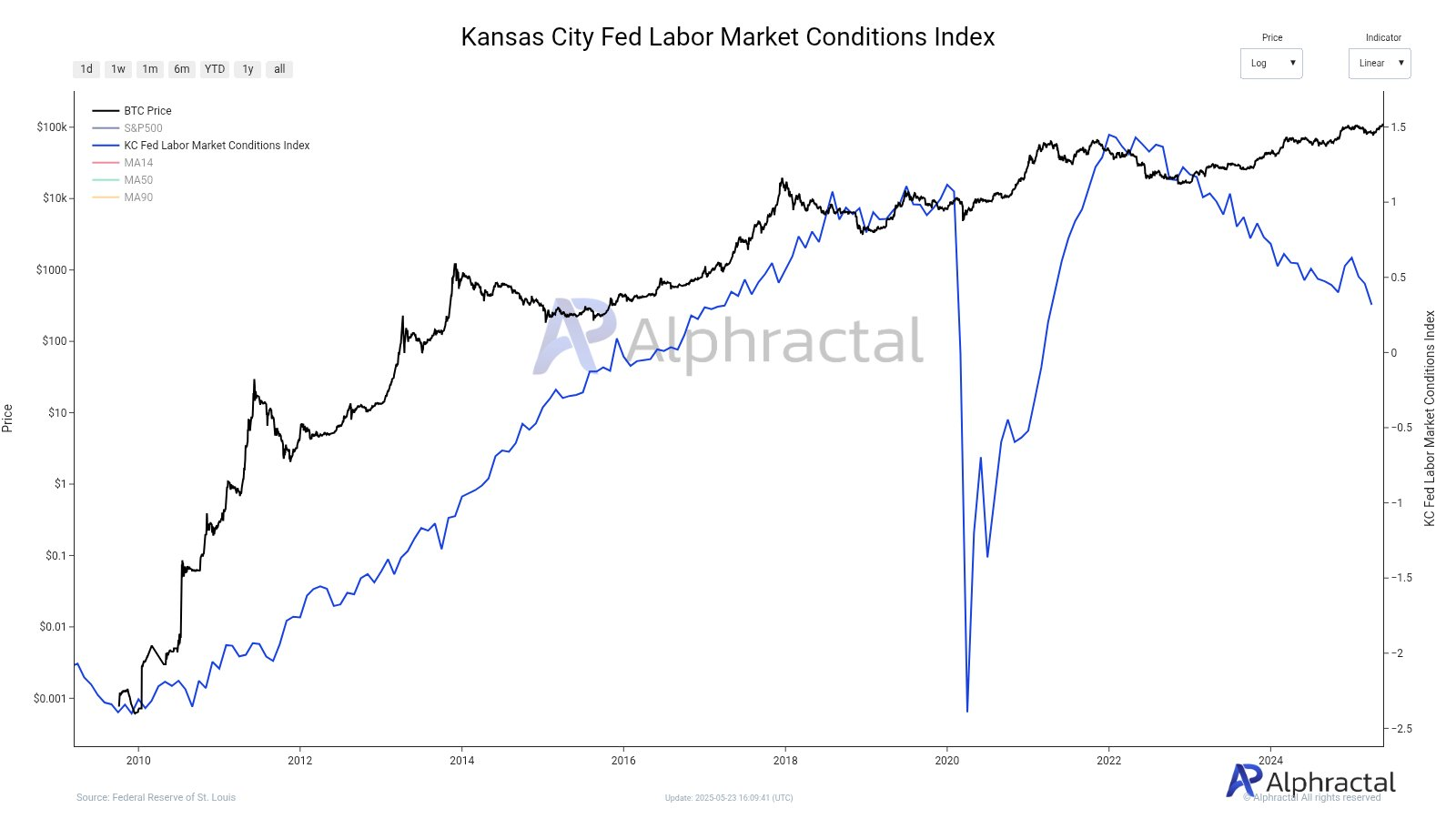
堪萨斯城联储 LMCI 指数连续第二个月下降,加剧了美国经济衰退风险的上升。

美国经济可能正陷入动荡。

  • 堪萨斯城联邦储备银行劳动力市场状况指标(LMCI)连续第二个月下降,表明就业市场更加疲软。
  • 此次下跌是一系列预示经济衰退即将来临的警告信号中的最新一个。

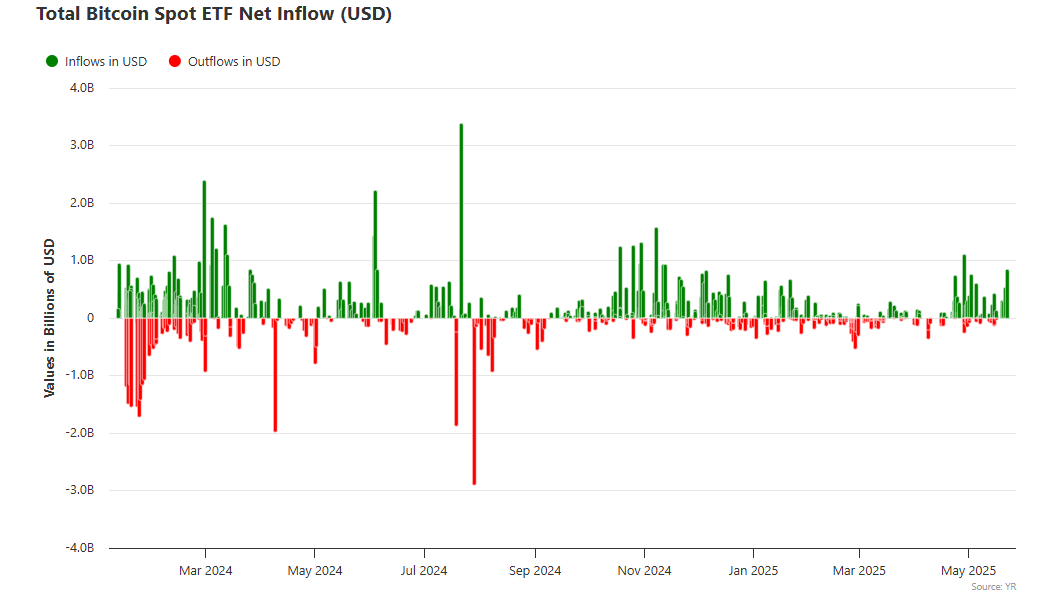
当传统市场开始不堪重负时,比特币[BTC]或许正在上涨。最新数据显示,BTC ETF 流入量激增,这表明投资者需求不断增长。

那么,数字货币的“避风港”地位是否是其随后牛市的主要驱动力?让我们来一探究竟!

劳动力市场再次亮起红灯

LMCI 是衡量美国劳动力市场势头和活动的综合指标。

LMCI 指数下降通常意味着就业岗位减少、工资增长放缓或招聘力度减弱。此次指数进一步下降,印证了劳动力状况恶化速度超预期的观点。

经济学家密切关注 LMCI,因为它通常先于整体宏观经济指标变动。

如果该指标下降,则可能表明美联储的紧缩利率政策开始对实体经济产生更深的影响。

投资者投资组合轮换的迹象

与此同时,比特币似乎正在从这种波动中获益。

BTC ETF 的最新数据显示,流入资金急剧增加,机构资金越来越多地流入该资产。

这表明投资者情绪发生了明显变化,从传统股票转向比特币等数字资产。

比特币不仅仅是一种短期对冲工具,其“数字黄金”定位正在得到新的验证。

在经济危机时期,投资者寻求供应稀缺、流动性强且分散的证券作为避难所。

BTC 适用于此,并且在宏观经济压力时期越来越多地被用作多元化投资的工具。

经济衰退加剧了比特币的需求

当然,如果劳动力指标继续下滑且宏观风险增加,投资者对比特币的兴趣可能会加速。

我们以前就见过这种剧本——就业市场萎缩常常引发对美联储降息的猜测。

如果这种讨论越来越激烈,那么 BTC 等风险资产可能会获得新的买盘,尤其是当资本从股票转向不相关的数字资产时。

随着流入 BTC ETF 的资金不断增加,市场可能正在见证全球风险再平衡的初始阶段。

Trending Cryptos

Related Reads

Building the Bright Path While Secretly Crossing Chencang: Is Walsh Paving the Way for a September "Rate Cut"?

The title "Building the Plank Road Openly While Secretly Crossing at Chencang: Is Walsh Paving the Way for a September 'Rate Cut'?" suggests Federal Reserve Chair Kevin Walsh's hawkish stance may be a deliberate smokescreen. Academy Securities analyst Peter Tchir argues in a report that markets, currently pricing a 75% chance of a September hike, are missing a potential path to a September rate cut that Walsh himself might be quietly preparing. Tchir posits that Walsh's hawkish rhetoric aims to suppress long-term yield risks (with the 10-year Treasury yield falling recently) while creating room for a narrative shift based on upcoming data. The potential political endgame, according to this view, could be rate cuts in September and October, ahead of the midterm elections. This hinges on a political logic where the Trump administration's preference for lower rates remains unchanged. A core part of Tchir's argument involves redefining inflation metrics. He contends the Fed under Walsh may deprioritize the PCE index, criticizing its lagging components like Owners' Equivalent Rent (OER). Instead, he points to alternative, more real-time indicators like the New Tenant Repeat Rent Index (NTRR) and the Truflation daily index, which shows core inflation around 1.45%. He suggests the Fed could shift its data narrative to justify policy easing. Furthermore, Tchir downplays AI-driven inflation fears. He argues that consumer price sensitivity, evidenced by negative market reactions to price hikes (e.g., Apple), contradicts persistent inflation narratives. He also separates AI/data center spending—which he sees as relatively rate-insensitive—from broader consumer affordability issues, implying rate hikes are misdirected. Based on this analysis, Tchir sees a re-pricing of rate cut expectations as likely, creating opportunities in short-duration Treasuries. He maintains a neutral-to-slightly-bullish view on the long end of the yield curve. For equities, he recommends a significant overweight in energy (especially global nuclear assets) and, within defense/security themes, an overweight in biotech/pharma versus an underweight in semiconductors, expressing caution on AI/data center valuations.

marsbit27m ago

Building the Bright Path While Secretly Crossing Chencang: Is Walsh Paving the Way for a September "Rate Cut"?

marsbit27m ago

"King of Shilling" Hayes Strikes Again, This Time Setting His Sights on Deribit

On June 29, BitMEX co-founder Arthur Hayes acquired approximately 6.16 million SYN tokens via OTC platform Flowdesk, valued at around $2.2 million. Subsequently, Hayes publicly endorsed SYN on X, calling it one of the most asymmetric investments he's seen since HYPE and declaring it time for an on-chain options DEX to challenge industry leader Deribit, naming Hypercall as that challenger. The article details the evolution of the Synapse Protocol, originally launched in 2021 as a cross-chain messaging and liquidity network. While its TVL peaked above $1 billion during the last bull market, it has since declined. The protocol's team has since built Hypercall, an on-chain options trading platform on Hyperliquid's HyperEVM, which supports trading options on "any asset" with features like 24/7 trading and defined risk limited to the premium paid. Deribit, founded in 2016, is highlighted as the dominant centralized crypto options exchange, commanding roughly 85% market share in BTC and ETH options. Its strengths include deep liquidity and professional tools, though it faces critiques over custody risk, KYC requirements, and regulatory uncertainty. The analysis suggests Hypercall's potential lies in decentralization, permissionless access, and transparency, potentially carving a niche in DeFi-native and emerging asset options. However, it faces significant challenges competing with Deribit's established network effect and liquidity depth. The piece concludes by noting Hayes's recent and mixed "call" history, referencing his previous promotion and subsequent sale of HYPE, as well as a controversial price target report for CARDS from his family office, Maelstrom, which was followed by a significant price drop for the asset. This activity has drawn criticism, with some accusing Hayes of creating exit liquidity for his followers.

Foresight News1h ago

"King of Shilling" Hayes Strikes Again, This Time Setting His Sights on Deribit

Foresight News1h ago

One Year After the Crash of Crypto Treasury Companies, Copycats Are Already Making a Comeback

One year after the collapse of digital asset treasury (DAT) companies, which wiped out up to 99% for early investors, the scheme has returned in a new guise. Recently, Triller Group announced it would become a "SpaceX treasury company," causing its market cap to surge. This follows the rebranding of another firm, LGHL, now targeting a token called HYPE. The original model, popularized by MicroStrategy (MSTR) and its "Bitcoin yield" narrative, saw companies trading at massive premiums to their underlying crypto holdings. However, most followers like TwentyOne, Metaplanet, and Nakamoto have crashed 80-95%+ from their peaks, erasing nearly all value for late investors. The author argues these structures have no fundamental reason to trade at premiums when low-fee Bitcoin ETFs or direct ownership exist. The cycle persists due to speculative demand driven by FOMO, gamification, and a belief the system is rigged, met by insiders and promoters who profit from the pump-and-dump dynamics. Drawing a parallel to the 1637 Tulip Mania, the piece concludes that such frenzies are not a bug but a recurring product of markets, where greater fools provide demand and insiders supply the schemes. Despite holding Bitcoin personally, the author condemns this specific packaging of assets into leveraged corporate vehicles marketed as innovation, a cycle seemingly unstoppable until a major crash.

marsbit1h ago

One Year After the Crash of Crypto Treasury Companies, Copycats Are Already Making a Comeback

marsbit1h ago

Trading

Spot

Hot Articles

What is $BITCOIN

DIGITAL GOLD ($BITCOIN): A Comprehensive Analysis Introduction to DIGITAL GOLD ($BITCOIN) DIGITAL GOLD ($BITCOIN) is a blockchain-based project operating on the Solana network, which aims to combine the characteristics of traditional precious metals with the innovation of decentralized technologies. While it shares a name with Bitcoin, often referred to as “digital gold” due to its perception as a store of value, DIGITAL GOLD is a separate token designed to create a unique ecosystem within the Web3 landscape. Its goal is to position itself as a viable alternative digital asset, although specifics regarding its applications and functionalities are still developing. What is DIGITAL GOLD ($BITCOIN)? DIGITAL GOLD ($BITCOIN) is a cryptocurrency token explicitly designed for use on the Solana blockchain. In contrast to Bitcoin, which provides a widely recognized value storage role, this token appears to focus on broader applications and characteristics. Notable aspects include: Blockchain Infrastructure: The token is built on the Solana blockchain, known for its capacity to handle high-speed and low-cost transactions. Supply Dynamics: DIGITAL GOLD has a maximum supply capped at 100 quadrillion tokens (100P $BITCOIN), although details regarding its circulating supply are currently undisclosed. Utility: While precise functionalities are not explicitly outlined, there are indications that the token could be utilized for various applications, potentially involving decentralized applications (dApps) or asset tokenization strategies. Who is the Creator of DIGITAL GOLD ($BITCOIN)? At present, the identity of the creators and development team behind DIGITAL GOLD ($BITCOIN) remains unknown. This situation is typical among many innovative projects within the blockchain space, particularly those aligning with decentralized finance and meme coin phenomena. While such anonymity may foster a community-driven culture, it intensifies concerns about governance and accountability. Who are the Investors of DIGITAL GOLD ($BITCOIN)? The available information indicates that DIGITAL GOLD ($BITCOIN) does not have any known institutional backers or prominent venture capital investments. The project seems to operate on a peer-to-peer model focused on community support and adoption rather than traditional funding routes. Its activity and liquidity are primarily situated on decentralized exchanges (DEXs), such as PumpSwap, rather than established centralized trading platforms, further highlighting its grassroots approach. How DIGITAL GOLD ($BITCOIN) Works The operational mechanics of DIGITAL GOLD ($BITCOIN) can be elaborated on based on its blockchain design and network attributes: Consensus Mechanism: By leveraging Solana’s unique proof-of-history (PoH) combined with a proof-of-stake (PoS) model, the project ensures efficient transaction validation contributing to the network's high performance. Tokenomics: While specific deflationary mechanisms have not been extensively detailed, the vast maximum token supply implies that it may cater to microtransactions or niche use cases that are still to be defined. Interoperability: There exists the potential for integration with Solana’s broader ecosystem, including various decentralized finance (DeFi) platforms. However, the details regarding specific integrations remain unspecified. Timeline of Key Events Here is a timeline that highlights significant milestones concerning DIGITAL GOLD ($BITCOIN): 2023: The initial deployment of the token occurs on the Solana blockchain, marked by its contract address. 2024: DIGITAL GOLD gains visibility as it becomes available for trading on decentralized exchanges like PumpSwap, allowing users to trade it against SOL. 2025: The project witnesses sporadic trading activity and potential interest in community-led engagements, although no noteworthy partnerships or technical advancements have been documented as of yet. Critical Analysis Strengths Scalability: The underlying Solana infrastructure supports high transaction volumes, which could enhance the utility of $BITCOIN in various transaction scenarios. Accessibility: The potential low trading price per token could attract retail investors, facilitating wider participation due to fractional ownership opportunities. Risks Lack of Transparency: The absence of publicly known backers, developers, or an audit process may yield skepticism regarding the project's sustainability and trustworthiness. Market Volatility: The trading activity is heavily reliant on speculative behavior, which can result in significant price volatility and uncertainty for investors. Conclusion DIGITAL GOLD ($BITCOIN) emerges as an intriguing yet ambiguous project within the rapidly evolving Solana ecosystem. While it attempts to leverage the “digital gold” narrative, its departure from Bitcoin's established role as a store of value underscores the need for a clearer differentiation of its intended utility and governance structure. Future acceptance and adoption will likely depend on addressing the current opacity and defining its operational and economic strategies more explicitly. Note: This report encompasses synthesised information available as of October 2023, and developments may have transpired beyond the research period.

504 Total ViewsPublished 2025.05.13Updated 2025.05.13
What is $BITCOIN

Discussions

Welcome to the HTX Community. Here, you can stay informed about the latest platform developments and gain access to professional market insights. Users' opinions on the price of BTC (BTC) are presented below.

活动图片