Биткоин растёт после «дня освобождения» Трампа, но Solana всё равно впереди

cryptonews.ruPublished on 2021-11-24Last updated on 2025-04-24

Биткоин не единственный актив, который оживился после того, как Дональд Трамп в начале апреля ввёл зеркальные пошлины почти против всех стран. С момента, который в криптосреде уже прозвали «днём освобождения» Трампа, лидерами роста на рынке стали Solana и BTC.

С 2 апреля Solana подорожала на 14,5%, до $145. Биткоин прибавил около 7%, достигнув отметки $91 100. При этом другие крупные токены ушли в минус. Ethereum потерял 10%, XRP 12%, Dogecoin снизился на 1%.

Эти два актива вытянули за собой весь рынок. Суммарная капитализация криптовалют с начала месяца выросла на 6% и достигла $295 трлн. На долю Solana сейчас приходится около 2% от всей этой суммы, а доля биткоина осталась стабильной — примерно 60%.
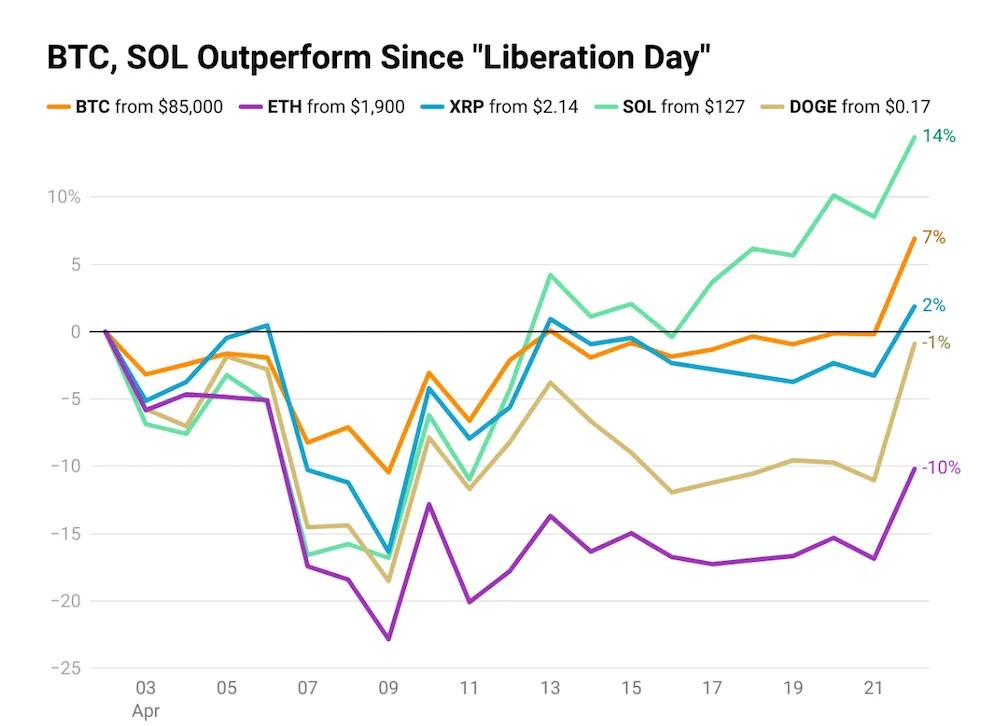
Solana и BTC показали сильный рост с начала апреля. Источник: Decrypt

По словам аналитика Messari Мэттью Нэя, дело тут не в фундаменте Solana или её потенциале как актива для хранения. Он объясняет рост тем, что актив был «перепродан», а трейдеры начали отходить от мемкоинов, на фоне чего интерес по Solana развернулся вверх. По его словам:

«Фарткоин снова в игре. Это просто символ того, что интерес к мемкоинам возвращается, а Solana остаётся главным казино крипты. Это уже не та эпоха, но на другие сети всё равно никто не ушёл».

В прошлом месяце команда, управляющая имуществом обанкротившейся FTX, получила доступ к 11 миллионам SOL на сумму $1,6 миллиарда. Это стало самым крупным анлоком Solana с января 2021 года. В один момент в оборот вышло огромное количество токенов.

Читайте также: В Franklin Templeton уверены, что DeFi на Solana имеет скрытый потенциал

Обычно такие события давят на цену. Но, по словам Мэттью Нэя, сейчас комьюнити смотрит вперёд — обсуждают предстоящие конференции и обновления сети вроде нового клиента для валидаторов Firedancer.

«Solana по-прежнему нравится людям. Просто в какой-то момент она была перепродана — вот и причина, почему сейчас мы видим такой сильный отскок», — объясняет он.

Почему биткоин воспринимается как надёжный актив

По мнению главы аналитического отдела Coinbase Institutional Дэвида Дуонга, рост биткоина сейчас связан с тем, что его всё чаще воспринимают как защитный актив. Инвесторы переходят в золото и другие независимые от государства инструменты, и BTC вписывается в эту логику.

При этом в самом криптосекторе у биткоина есть отдельные плюсы. Дуонг отмечает, что Уолл-стрит начала всерьёз принимать его, особенно после запуска спотовых ETF в США в прошлом году.

«Факт, что биткоин стал частью институциональных портфелей и появился в ETF, уже отделяет его от остальных. А снижение цены после пиков оказалось куда мягче, чем в прошлых циклах. Это говорит о том, что держатели стали увереннее и смотрят на актив в долгую», — говорит он.


Trending Cryptos

Related Reads

Beyond the Model Lies the Harness: Deepseek Enters the Arena, Why Has the Main Battlefield of China's AI Competition Shifted?

In mid-to-late May 2026, Deepseek internally established a new Harness team focused on code agent products, internally benchmarked against Anthropic's Claude Code. This move, marked by the formula "Model + Harness = Agent" in their job postings, signals a major shift in China's AI competition: the main battlefield is transitioning from developing large models to building toolchains and achieving workplace integration. Deepseek's direct involvement in Harness development aims to secure control over interface design and training data feedback loops, moving beyond open-sourcing powerful models. Harness, the runtime infrastructure for AI agents, handles everything beyond model reasoning—task orchestration, tool calling, context management, safety checks, and error recovery. It is crucial because agent products are not just outputs of model capability but also training grounds for it. Real-world task failures recorded by Harness can feed back into model training, creating a flywheel effect. Engineering Harness is more critical than optimizing prompts, as poor context management or error handling can drastically reduce agent success rates in multi-step, real-world scenarios. This shift is not isolated. Other major Chinese tech companies are also pursuing differentiated toolchain strategies. Tencent leverages its enterprise ecosystem (WeChat Work, Tencent Cloud) to build connectors for organizational-level AI collaboration and complex task delivery. Alibaba focuses on lowering automation barriers on the web with a front-end, browser-based GUI Agent framework, PageAgent. This diversification shows the industry recognizes that success lies not in a perfect general agent, but in vertically focused solutions built with robust engineering. The trend is validated by overseas success, such as Poland's Viktor, an AI coworker on Slack achieving $20M ARR by autonomously executing complex, multi-step tasks. This proves a shift in enterprise willingness to pay—from "AI-assisted generation" to "AI-autonomous execution." As Harness matures to provide safety guards and reliability, AI transitions from a human-supervised intern to an independent outsourcer. The competition now faces key engineering challenges: preventing "token explosion" through intelligent context compression, and building "thick frameworks" with features like sandbox isolation and checkpoint recovery for enterprise-grade stability. Geopolitical restrictions on tools like Claude Code further create a significant market vacuum for domestic solutions like Deepseek's Harness. For enterprises and developers, the focus must shift from comparing model benchmarks to evaluating a vendor's engineering capabilities, error recovery mechanisms, context management, and ecosystem compatibility when choosing AI products and platforms.

marsbit20m ago

Beyond the Model Lies the Harness: Deepseek Enters the Arena, Why Has the Main Battlefield of China's AI Competition Shifted?

marsbit20m ago

Soaring Export Data for Memory Chips, Market Is Redefining the Valuation Anchor for Memory Stocks

Korean storage export data for the first 20 days of June shows substantial year-on-year increases in both value and price-per-kilogram for categories like DRAM, NAND, and SSDs. This signals a potential shift beyond simple demand recovery, indicating rising prices and a product mix shift towards higher-value items, possibly influenced by AI infrastructure needs. A key point is that the surge in price-per-kilogram is not simply a uniform chip price hike. It reflects a combination of actual price increases and, more importantly, an export structure increasingly dominated by high-value-density products like HBM (High-Bandwidth Memory) and advanced DRAM, which are critical for AI servers. This suggests AI-driven demand may be spilling over from just HBM into broader memory markets. SK Hynix stands to benefit directly due to its leading HBM position. For Samsung and Micron, the implication is potential for greater margin elasticity if the tightness in high-end memory spreads to enterprise SSD and NAND prices. However, the storage sector remains cyclical. Risks include supply expansion, inventory changes, and potential slowdowns in broader AI capital expenditure. Ultimately, while the strong export data supports upward revisions for storage company earnings and fuels discussion of an "AI infrastructure bottleneck premium," a definitive valuation shift from a cyclical to a structural story depends on upcoming quarterly reports. Investors need confirmation from SK Hynix, Samsung, and Micron that improvements in average selling prices, product mix, and, crucially,毛利率 are sustained over multiple quarters.

marsbit1h ago

Soaring Export Data for Memory Chips, Market Is Redefining the Valuation Anchor for Memory Stocks

marsbit1h ago

Trading

Spot
Futures

Hot Articles

Discussions

Welcome to the HTX Community. Here, you can stay informed about the latest platform developments and gain access to professional market insights. Users' opinions on the price of SOL (SOL) are presented below.

活动图片