全面比较4大热门RWA协议:Ondo,OpenEden,Plume和Ethena

marsbitPublished on 2025-04-21Last updated on 2025-04-22

与稳定币和支付类似,RWA(实物资产代币化)是加密领域的重要增长向量,具有将万亿传统金融资产引入链上的潜力。

最近的机构发展:

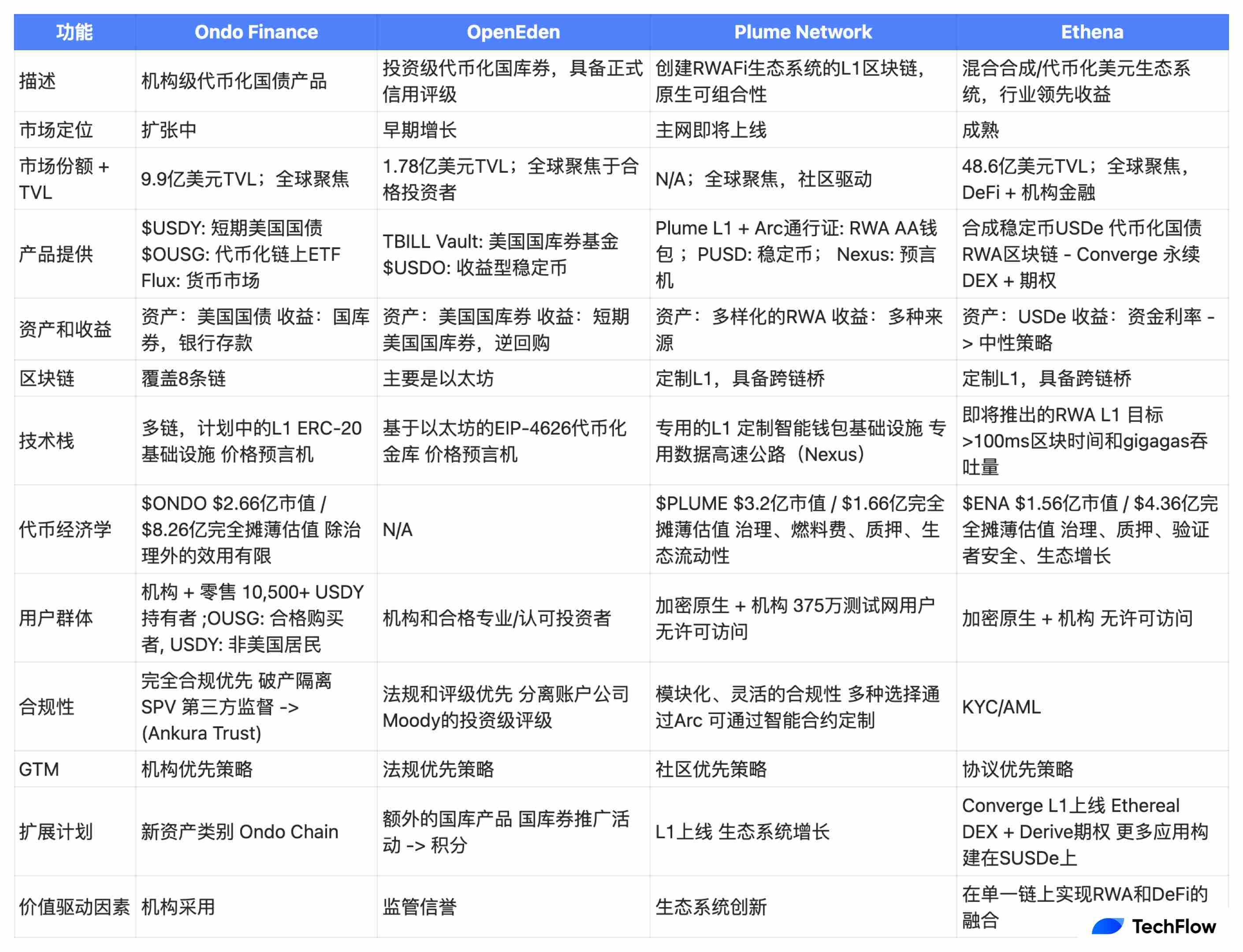
比较分析

@OndoFinance@nathanlallman

a) 核心价值主张

  • 拥有9.9亿美元的总锁定价值(TVL),提供跨八条链的机构级代币化国债产品
  • 拥有超过10,500名USDY持有者,并采用以法规为先的策略,合规地将传统金融与去中心化金融结合
  • 深厚的机构关系
  • 多链战略,并计划推出一级链以巩固其作为代币化美国国债市场领导者的地位
  • $ONDO市值为26亿美元,完全摊薄估值为82亿美元。除了治理外,实用性有限,希望看到更多价值回流至代币

b) 挑战

  • 地理限制(USDY不向美国投资者开放)
  • OUSG的进入门槛高(仅限合格购买者和合格投资者)
  • 资产多样性和可用性有限,仅限于美国国债
  • 来自传统金融机构推出自身解决方案的竞争

c) 行之有效的市场策略

  • 通过与主要金融机构合作,采用自上而下的策略,首先专注于机构用户,然后再扩展至零售市场。

@OpenEden_X(@jeremyng777)

a) 核心价值主张

  • 提供投资级别的代币化国库券,由穆迪(Moody's)提供正式的信用评级支持。
  • 其以法规为优先的策略专注于合格投资者
  • 专注于美国国库券,使持有者的收益直接反映基础美国国库组合的表现
  • $USDO是一种收益型稳定币,由美国国库券完全抵押
  • 目前正在进行国库券推广活动作为市场策略

b) 挑战

  • 相较于竞争对手,生态系统和市场影响力较小
  • 链多样性较少(主要集中于以太坊)
  • 社区发展不够成熟

c) 行之有效的市场策略

  • 首先建立监管信誉(获得穆迪的投资级评级)

@plumenetwork (@chriseyin)

a) 核心价值主张

  • 专门为RWAFi(实物资产金融)构建一个专用的一级链(定义类别)
  • 全套生态系统方法:RWA AA钱包 + Arc(将任何资产链上化)+ pUSD稳定币 + nexus oracle(数据高速公路)
  • 以社区为先的策略,并强烈关注可组合性和可编程性
  • $PLUME市值为3.2亿美元,完全摊薄估值为16亿美元。用于治理、gas费、质押和生态系统流动性

b) 挑战

  • 新技术堆栈和RWAFi生态系统尚未经过验证
  • 相较于Ondo,机构认可度较低
  • 在竞争激烈的区块空间环境中,一级链生态系统的成功至关重要

c) 行之有效的市场策略

  • 以社区为先的策略,在主网启动之前建立一个专注于RWA的协议和dApp的大型生态系统。首先专注于加密原生用户,然后扩展至机构用户。

@ethena_labs (@gdog97_)

a) 核心价值主张

  • 作为领先的混合玩家,拥有约100亿美元的总锁定价值(TVL)和资产管理规模(AUM),其中Ethena产品占64亿美元,Securitize代币化资产占40亿美元
  • 丰富的产品组合:USDe稳定币 + Ethereal永续合约去中心化交易所(DEX)+ Derive期权 + 构建Converge一级链
  • $ENA市值为15亿美元,完全摊薄估值为43亿美元。用于治理、质押、验证者安全、生态增长

b) 挑战

  • 合成美元模型依赖于中心化交易所(CEX)进行永续期货交易(存在对手风险)
  • Converge一级链基础设施差异化有限
  • 盈利能力依赖于正向资金利率

c) 行之有效的市场策略

  • 双管齐下的策略,既满足链上DeFi巨鲸的需求,又吸引机构用户,通过高收益进行扩展,将USDe整合到dApps和CEX中,并通过战略合作伙伴关系建立机构信誉

可以看到每个协议都在开辟自己的细分市场,同时形成可能从根本上重塑全球资本市场的基础设施。
策略

Trending Cryptos

Related Reads

The Trillion-Dollar Credit Market Leveraged by Stablecoins, Stuck in Off-Chain Risk Control

**Stablecoins Fueling Trillion-Dollar Private Credit Market, Hampered by Off-Chain Risk Management** This article examines how interest-bearing stablecoins are replicating the business model of money market funds to democratize access to the $2 trillion private credit market, while highlighting the significant risks posed by inadequate off-chain risk controls. Historically, private credit investments had high minimums (e.g., $1 million+) due to costly due diligence and loan servicing. Stablecoins like Apollo's ACRED and Figure's YLDS are bridging this gap. They tokenize institutional credit funds, allowing small investors to gain exposure and enabling new functionalities like using these tokens as collateral in DeFi for leveraged yield. The on-chain private credit market has grown 15x in a year to $5.87 billion, yet remains a tiny fraction of the global total. However, the core challenge is not blockchain technology but managing the inherent risks of lending, which occur off-chain. The failure of Goldfinch, a pioneer in on-chain private credit, serves as a stark warning. It raised funds in crypto (USDC) to lend to small businesses in markets like Kenya and Nigeria. While smart contracts handled fund distribution, critical functions—local due diligence, monitoring loan use, and debt collection—relied on off-chain partners. A major breach, where a local partner misappropriated nearly 40% of funds, went undetected for months. When borrowers defaulted, crypto depositors had no effective legal recourse or means to seize assets, leaving $56 million trapped in non-performing loans with a projected 8-15 year recovery timeline. The article concludes that tokenization addresses only 10% of the credit business—the distribution. The remaining 90%—rigorous risk assessment and collection infrastructure—is expensive and localization-dependent. Without solving these fundamental off-chain challenges, the sector risks repeating Goldfinch's collapse.

Foresight News7m ago

The Trillion-Dollar Credit Market Leveraged by Stablecoins, Stuck in Off-Chain Risk Control

Foresight News7m ago

Solana Expands Validator Power With Launch of On-Chain Governance

Solana has formally launched its on-chain governance system, empowering token holders and validators with a more open and decentralized way to influence major protocol decisions. Governance debates and voting are now conducted entirely on-chain using the new Solana Governance Proposals (SGP) framework, supported by stake-weighted voting and cryptographic verification. Validators with at least 100,000 SOL in delegated stake can submit an SGP. To proceed to a formal vote, a proposal must first gain support from at least 15% of the network's total staked SOL, ensuring only ideas with significant backing move forward. SGPs serve a distinct purpose from the technical Solana Improvement Documents (SIMDs). While SIMDs focus on *how* to implement protocol upgrades, SGPs determine *whether* the broader ecosystem believes a proposal should proceed, via an on-chain, stake-weighted vote. This separation allows core developers to continue building effectively while reserving community-wide votes for impactful decisions. A key feature grants delegators greater control: they can now override their validator's governance vote. If a validator votes against a delegator's preference or abstains, the delegator can cast a vote directly using their own stake weight through Solana's governance portal. The voting process is secured using Merkle proofs to verify participant stakes against an on-chain consensus snapshot. With this implementation, Solana aims to broaden community participation in governance without hindering development, combining decentralized decision-making with efficient protocol evolution.

TheNewsCrypto37m ago

Solana Expands Validator Power With Launch of On-Chain Governance

TheNewsCrypto37m ago

Trillion-Won Bet on Semiconductors: Is South Korea Really Panicking This Time?

**Summary:** South Korea, traditionally adept at "counter-cyclical" investments during industry downturns, has launched an unprecedented trillion-dollar (approximately 6.4 trillion RMB) semiconductor investment plan during a current AI-driven boom. This shift signals deep strategic anxiety, driven by the rapid rise of China's memory chip challengers. The article traces this dynamic through the history of East Asian semiconductor competition. In the 1980s, Japan used a "national system + industrial capital" model to surpass the US in DRAM, only to be overtaken in the 1990s by South Korea employing the same aggressive, efficiency-focused tactics—most notably massive, loss-tolerant investments during downturns to crush competitors like Japan's Elpida. Now, China's memory giants, Yangtze Memory (YMTC) and ChangXin Memory Technologies (CXMT), are employing a strikingly similar playbook. Starting from near-zero a decade ago, they've used a combination of government-backed capital, strategic technology acquisition (e.g., CXMT leveraging Qimonda's legacy), and innovative architectural leaps (e.g., YMTC's Xtacking) to achieve rapid technological catch-up. Crucially, during the severe industry downturn of 2023, while Korean and US giants cut production, the Chinese firms expanded capacity and competed on price, rapidly gaining global market share (reaching ~11% in NAND and ~7.67% in DRAM by 2025). South Korea's current massive investment, therefore, is a defensive move born of fear. The historical pattern suggests that once a technological gap closes, scale and integrated supply chain advantages—areas where China holds significant potential—can determine the leader. Having used counter-cyclical strategies to become the incumbent, South Korea now faces the prospect of a formidable challenger using those very same tactics. This investment marks not just a bet on the AI cycle, but the opening chapter in a new battle for dominance in the memory industry.

marsbit47m ago

Trillion-Won Bet on Semiconductors: Is South Korea Really Panicking This Time?

marsbit47m ago

Trading

Spot

Hot Articles

How to Buy ONDO

Welcome to HTX.com! We've made purchasing OndoFinance (ONDO) simple and convenient. Follow our step-by-step guide to embark on your crypto journey.Step 1: Create Your HTX AccountUse your email or phone number to sign up for a free account on HTX. Experience a hassle-free registration journey and unlock all features.Get My AccountStep 2: Go to Buy Crypto and Choose Your Payment MethodCredit/Debit Card: Use your Visa or Mastercard to buy OndoFinance (ONDO) instantly.Balance: Use funds from your HTX account balance to trade seamlessly.Third Parties: We've added popular payment methods such as Google Pay and Apple Pay to enhance convenience.P2P: Trade directly with other users on HTX.Over-the-Counter (OTC): We offer tailor-made services and competitive exchange rates for traders.Step 3: Store Your OndoFinance (ONDO)After purchasing your OndoFinance (ONDO), store it in your HTX account. Alternatively, you can send it elsewhere via blockchain transfer or use it to trade other cryptocurrencies.Step 4: Trade OndoFinance (ONDO)Easily trade OndoFinance (ONDO) on HTX's spot market. Simply access your account, select your trading pair, execute your trades, and monitor in real-time. We offer a user-friendly experience for both beginners and seasoned traders.

5.1k Total ViewsPublished 2024.03.29Updated 2026.06.02

How to Buy ONDO

Discussions

Welcome to the HTX Community. Here, you can stay informed about the latest platform developments and gain access to professional market insights. Users' opinions on the price of ONDO (ONDO) are presented below.

活动图片