We Asked AI For The Best Crypto to Buy Now, and It Said Solaxy

bitcoinistPublished on 2025-02-19Last updated on 2025-02-19

Abstract

AI has become integral to our lives, take it or leave it. Some use it to find new recipes for...

AI has become integral to our lives, take it or leave it.

Some use it to find new recipes for dinner, others–for relationship advice. We asked AI what the best crypto to buy now was, and it picked Solaxy ($SOLX).
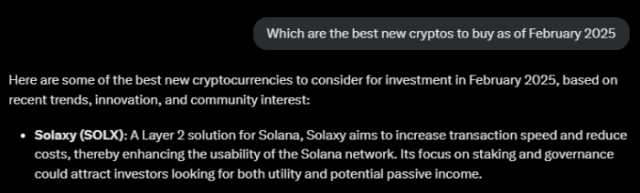
AI picked Solaxy as the best new crypto

While ChatGPT’s reasoning is sometimes dubious, this time, the reply makes perfect sense. Solana is expanding rapidly, and the community is bullish.

Yet, network congestion and outages during peak activity remain a problem. Solaxy could be the solution the Solana ecosystem needs to thrive.

Let’s unpack why.

Solana Tokens Surge 9X in a Year, But the Network Isn’t Ready

The cumulative market cap of Solana ecosystem tokens grew from $160B in January 2024 to $903B in January 2025. A nine-fold increase in a year.
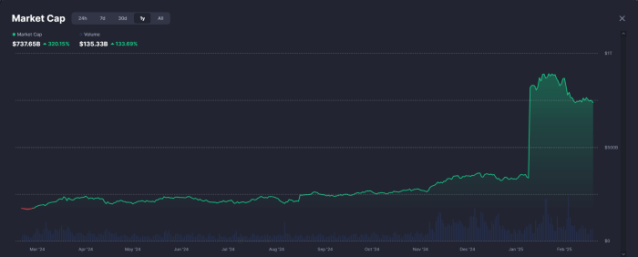
Solana ecosystem growth

For context, the Ethereum ecosystem now has a $933B valuation, so Solana goes neck and neck with the largest network.

This surge happened partially due to no-code launchpads like Pump.fun and partially due to Solana’s efficiency.

Ethereum is mostly reserved for ‘serious’ projects because it offers advanced developer tools but struggles with enormous gas fees.

Solana, on the other hand, can process transfers in seconds at a fraction of a cent. That’s why it became a hotbed for meme coins and DeFi platforms.

Still, Solana is far from its theoretical peak of 65K TPS (transactions per second) and often suffers congestion, which takes away from an otherwise exceptional blockchain.

If we count in another rise in demand due to upcoming $SOL ETFs (exchange-traded funds) from Coinbase, the conclusion becomes painfully clear–Solana needs a reliable scaling solution.

Solaxy ($SOLX) Merges Ethereum’s Rollups with Solana’s Speed for Next-Gen Scaling

Solaxy ($SOLX) is the world’s first Layer-2 network for Solana.

It uses Ethereum’s rollup architecture to offload bundled transactions from the Solana mainnet. Solaxy would then process them off-chain while maintaining the Layer-1 network’s security.

This way, Solaxy could increase Solana’s processing speeds, reduce fees, and prevent failed transactions.

Solaxy’s modular infrastructure with plug-and-play components also simplifies the development of new applications on Solana, from meme coins to complex financial platforms and AI agents.

Due to its efficiency, Solaxy is particularly well-suited for high-frequency apps that deal with real-time interactions or microtransactions.

And, as an Ethereum-based solution, Solaxy bridges Solana with Ethereum for smooth cross-chain transfers of app data and funds.

$SOLX is the network’s utility token, necessary to pay processing fees and grant developers access to Solaxy’s toolbox.
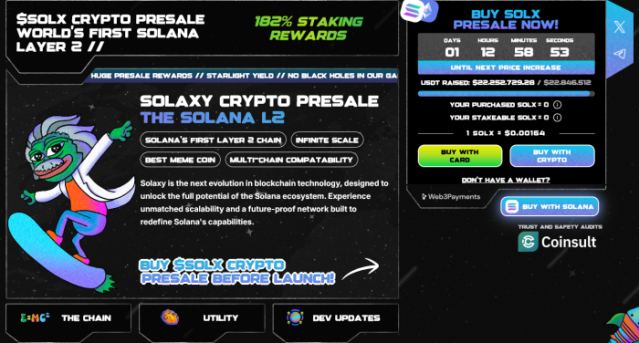
Solaxy presale

The token presale kicked off in December and has raised over $22.2M so far. Early adopters get to buy $SOLX at a discounted price of $0.00164 (set to increase in mere hours) and stake their tokens at 182% APY.

Analysts predict $SOLX to hit $0.032 after the project team deploys the Layer-2 network. As the ecosystem expands, the demand for $SOLX as its native token will only grow, so we can expect $SOLX to reach $0.02 by 2026 if the project follows its roadmap.

Could Solaxy Push Solana Ecosystem Beyond $1T?

If the Solana ecosystem continues to grow at the same rate, it will soon surpass a $1T market cap. Solaxy might be the scaling solution Solana needs to challenge Ethereum’s dominance and become the largest blockchain.

Given its supportive role in Solana’s success, Solaxy is also positioned for a bullish year. Follow Solaxy on X and Telegram to stay informed about updates to the presale and Layer-2 network launch.

To buy $SOLX, visit Solaxy’s official presale website, connect your wallet, and pay with $USDT, $ETH, $BNB, or a bank card.

Remember that the crypto market is volatile, and even projects with strong fundamentals don’t guarantee returns. Always DYOR and only invest as much as you can afford to lose.

Bitcoinist

Bitcoinist

Bitcoinist is the ultimate news and review site for the crypto currency community!

Related Reads

When Futu Turns into a Matchmaking Corner: Overseas Identity Becomes the Hard Currency for the Middle Class

When Futu Becomes a Matchmaking Corner: Overseas Status as the New Hard Currency for China's Middle Class Following a severe penalty announcement from Chinese regulators on May 22nd targeting offshore brokerages like Futu, its app community unexpectedly transformed into an impromptu matchmaking platform. Users posted相亲 (matchmaking) requests, explicitly seeking partners with overseas residency or citizenship, revealing a stark new reality: for China's middle class, an overseas identity has become a crucial asset. The regulatory crackdown, which restricts mainland Chinese residents from opening new accounts to buy overseas securities like US stocks, has sharply escalated the value of a foreign passport or permanent residency. This status now acts as a gateway to global asset allocation—including US equities, offshore property, and foreign currency deposits—effectively becoming a new form of "hard currency." Its scarcity, non-transferability (except through marriage, inheritance, etc.), and role as a hedge against domestic uncertainty have driven its premium. The article traces the evolution of how China's middle class views overseas resources: from an investment for opportunity (2000s), to risk diversification (2010s), and now to a mandatory "insurance policy" for financial access. With the regulatory window closing for many, the demand is shifting towards securing such status for the next generation through international education. The surreal scene of high-performing investors posting dating resumes underscores a 2026 where financial talent can be secondary to the right passport.

marsbit8m ago

When Futu Turns into a Matchmaking Corner: Overseas Identity Becomes the Hard Currency for the Middle Class

marsbit8m ago

Understanding Bound in One Article: The "Multi-signature + Timelock" Escape Mechanism and the Off-Chain Matching Black Box

**Title**: Understanding Bound: The Escape Mechanism of "Multi-Sig + Time Lock" and the Off-Chain Matching Black Box **Summary**: Bound Exchange, evolved from the earlier radFi platform, introduces a novel approach to Bitcoin trading by combining self-custody security with exchange-like speed. Its core mechanism relies on a 2-of-2 multi-signature (multi-sig) address for user deposits. One private key is held by the user via a passkey, and the other is held by Bound. This setup requires both keys to sign any transaction, preventing Bound from unilaterally accessing user funds (non-custodial). To address the risk of Bound becoming unavailable, a 3-month timelock is integrated into the Bitcoin script. After this period, users can withdraw their assets with just their single signature, ensuring an escape hatch. For trading, Bound operates a concentrated liquidity AMM. However, as Bitcoin L1 lacks smart contracts, the AMM curve, liquidity management, and trade price calculations occur off-chain in Bound's backend database. On-chain Bitcoin transactions serve only as final settlement receipts for pre-determined amounts. This creates a centralization point: the critical sequence of trade execution—which determines the exact price along the curve for each order—is managed off-chain by Bound in a non-transparent "black box." While the 2-of-2 setup protects user本金 (principal), the pricing and ordering of trades introduce potential operational MEV risks, as the order processing is invisible and unverifiable on-chain. In practice, users can also connect external wallets (like Unisat) for fully self-custodied trading, but this requires manually signing every transaction. The platform currently supports deposits of BTC and Runes only.

marsbit13m ago

Understanding Bound in One Article: The "Multi-signature + Timelock" Escape Mechanism and the Off-Chain Matching Black Box

marsbit13m ago

Technology Has No Barriers, 24/7 Trading is the Key to Hyperliquid's Success

The article argues that Hyperliquid's competitive edge lies not in technological superiority but in its 24/7 trading model, which fundamentally challenges traditional finance's fixed market hours. Based in Singapore with an 11-person team, Hyperliquid has generated significant revenue and trading volume. Its core advantage is the ability to facilitate trading continuously, including during weekends when major exchanges like the CME are closed. This was demonstrated when Hyperliquid listed a SpaceX pre-IPO perpetual contract on a Sunday, allowing the market to price the company hours before traditional institutions opened. This disruption has drawn regulatory scrutiny from traditional giants like CME and ICE, who cite risks like lack of KYC and market manipulation. However, the article suggests their concern stems from Hyperliquid eroding the "time monopoly" of established markets. The piece contrasts Hyperliquid's synthetic derivatives—pure price-betting contracts with no underlying asset or centralized issuer—with other models like PreStocks (dependent on real股权) and Ondo (licensed but targetable). Hyperliquid's code-based, decentralized structure makes it resilient to takedowns, even if founders face legal action. Ultimately, the author concludes that while it raises legitimate regulatory questions, Hyperliquid's "unforgeable" competitive barrier is the time advantage of non-stop trading, a feature legacy systems cannot replicate.

marsbit19m ago

Technology Has No Barriers, 24/7 Trading is the Key to Hyperliquid's Success

marsbit19m ago

New Information Laundering in Prediction Markets: How Secrets Blend into Investment Signals

"The New Information Laundering in Prediction Markets: How Secrets Infiltrate Investment Signals In late February 2026, nine linked anonymous wallets on Polymarket placed over 80 bets on specific details of a US-Iran war, winning over $2.4 million with a 98% win rate. This exemplifies 'information laundering'—a destructive flaw inherent to prediction markets. These markets function by aggregating trader supply and demand on an order book to set prices, which represent collective probability estimates. This makes them valuable real-time sentiment indicators for institutions. However, the system cannot distinguish between public information and stolen secrets. Confidential information enters one end, and 'clean' market prices—bearing no trace of their illicit origin—emerge from the other. For example, an insider knowing of an imminent strike can buy contracts at low odds, pushing the price up and disguising the secret as a savvy market signal, then profit massively when the event occurs. Analysts can sometimes uncover these schemes due to the blockchain's transparency, as seen with Bubblemaps. Paradoxically, this same transparency can inadvertently broadcast secrets to adversarial observers, providing them with low-cost intelligence. Current laws, like insider trading regulations focused on corporate information, fail to address this issue, especially concerning events like military actions with no 'issuer.' Jurisdictional challenges are amplified as platforms operate offshore, easily bypassing national bans with VPNs. Recent US congressional investigations and proposed bills aim to ban war betting and trading on non-public information by officials. The core issue is that information laundering is not a bug but a feature: a market that perfectly converts knowledge into price will inherently reward those with the best information, including those who obtained it illicitly. As prediction markets grow, potentially reaching hundreds of billions in volume, society must confront whether it can tolerate a machine that profitably transforms its most guarded secrets into public, tradable numbers."

链捕手28m ago

New Information Laundering in Prediction Markets: How Secrets Blend into Investment Signals

链捕手28m ago

Trading

Spot
Futures

Hot Articles

Discussions

Welcome to the HTX Community. Here, you can stay informed about the latest platform developments and gain access to professional market insights. Users' opinions on the price of AI (AI) are presented below.

活动图片