«Ралли монстров» впереди? Аналитик прогнозирует рост Кардано (ADA)

cryptonews.ruPublished on 2020-12-06Last updated on 2025-02-06

  • Али Мартинес предсказал, что в ближайшем будущем ADA увидит «монстрическое параболическое ралли».
  • Мартинес подчеркнул фрактальную модель, которую альткойн сформировал в 2021 году, что привело к огромному росту.
  • Соучредитель Vortex Глеб подтвердил, что доверие китов к токену ADA ослабевает.

По мнению криптоаналитика Али Мартинеса, ADA может рассчитывать на значительный рост в ближайшем будущем. ADA сталкивается с сильным сопротивлением уровню цен в 1 доллар, но Мартинес утверждает, что криптовалюта ожидает «чудовищное параболическое ралли».

В сообщении на X (ранее Twitter) Мартинес опубликовал график ценового действия ADA, подчеркнув, что криптовалюта формирует паттерны, аналогичные бычьему ралли на криптовалютном рынке в 2021 году. Аналитик показал фрактальную фигуру на графике, где ADA ранее консолидировалась в диапазоне, прежде чем взорваться в 2021 году. Похожая фаза накопления, по-видимому, сформировалась недавно, отмеченная прорывом ключевого уровня сопротивления.
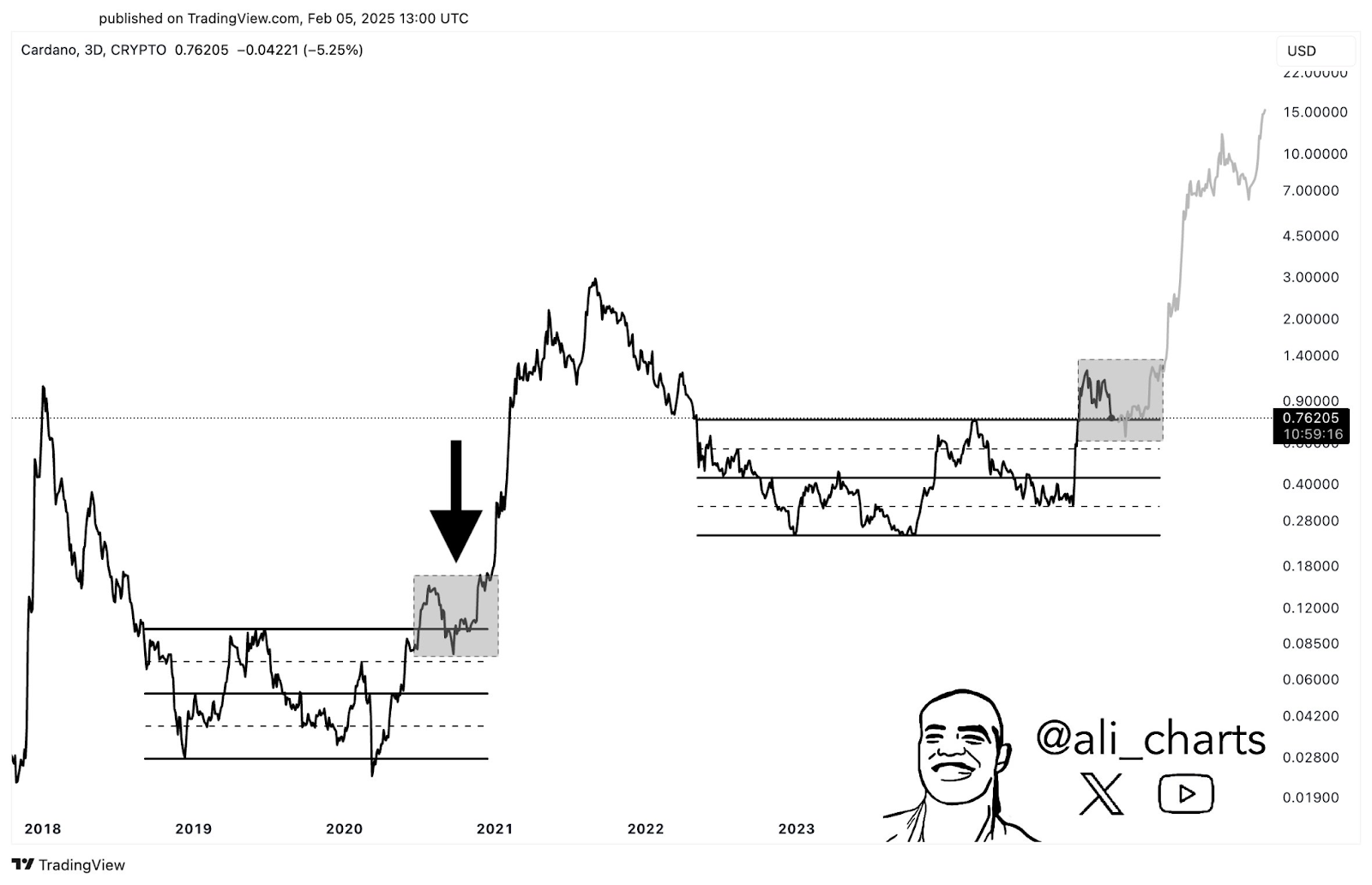
Заштрихованные области и черная стрелка подчеркивают сходство между прошлыми и нынешними ценовыми структурами. Если история повторится, ADA может оказаться на грани сильного роста, что потенциально может привести к значительному повышению цен. Это связано с тем, что прошлые рыночные циклы часто влияют на будущие тенденции технического анализа.

Активность китов: медвежий знак?

С другой стороны, существуют определенные медвежьи индикаторы, на которые следует обратить внимание ценовому действию ADA. Хотя альткойн остается в топ-10, киты ADA отступили: чистый поток упал на 90% всего за неделю. Соучредитель алгоритмического маркет-мейкера Vortex Глеб заявил на X, что когда крупные держатели, владеющие более чем 0,1% предложения криптовалюты, начинают снижать свою активность, «это сигнализирует о снижении доверия».

Not many people are talking about Cardano $ADA lately, but it’s still top 10 in the market, so here’s my quick analysis.

ADA’s whales have pulled back, with netflow dropping by 90% in just a week.

That’s a huge red flag 🚨 pic.twitter.com/t9iE6W8QSU

— Gleb (@glebgora) February 5, 2025

Связанный: Зашифрованное заявление Чарльза Хоскинсона: что задумал Cardano?

Глеб пояснил, что снижение активности означает меньшее количество транзакций, что, в свою очередь, означает снижение ликвидности и повышение волатильности. Предприниматель считает, что если так будет продолжаться, «цена ADA может столкнуться с серьезным давлением».

Анализ цен ADA: смешанные сигналы

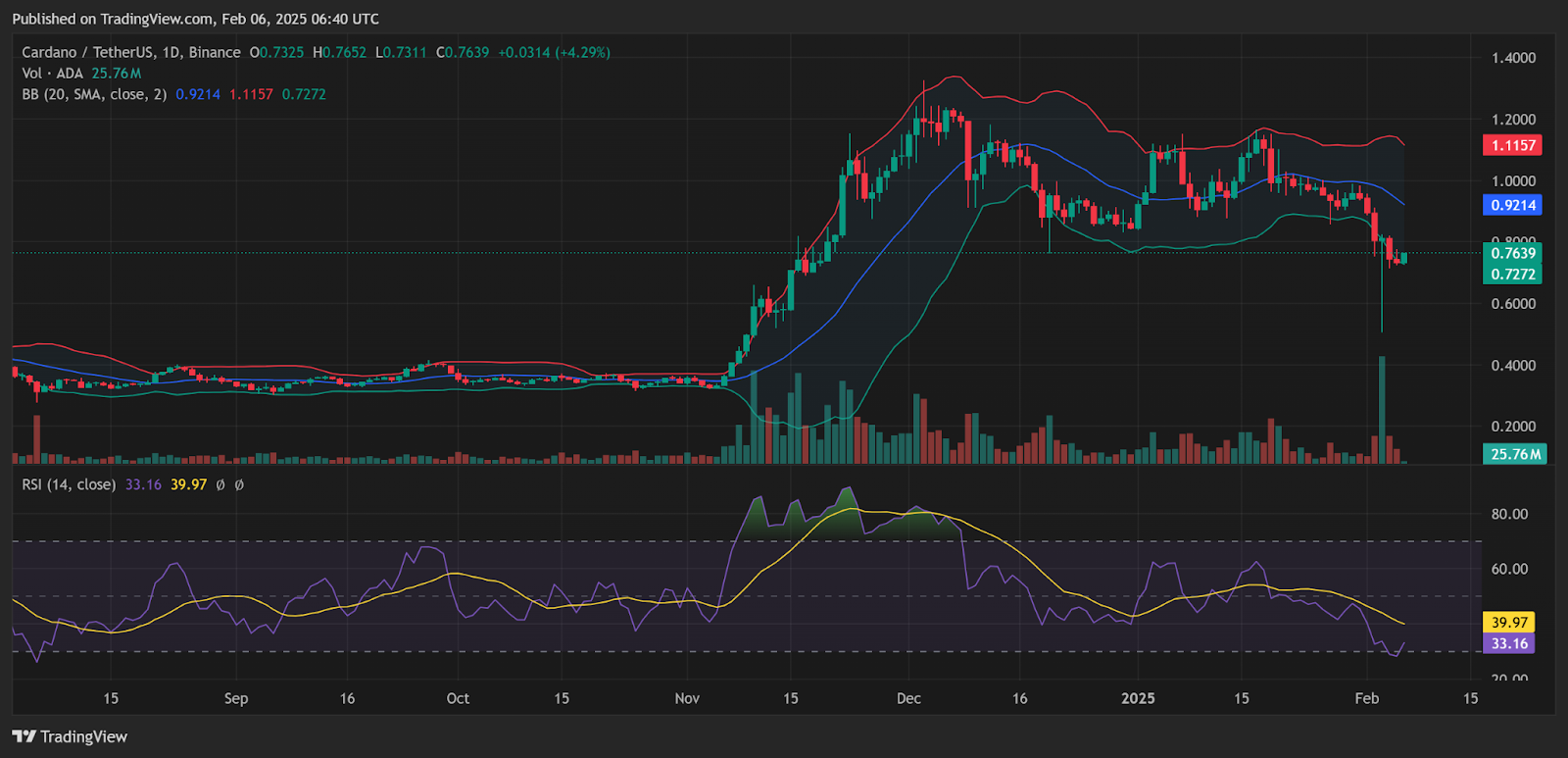
График цен ADA ниже показывает, что цена цифрового актива вошла в область перепроданности, но быстро восстановилась, составив на момент публикации значение 33,16. Наклон линии предполагает небольшой всплеск давления покупателей и увеличение шансов на попытку пробить отметку в доллар.
Связанный: Переход Кардано к полностью децентрализованному управлению – ADA на подъеме?

Ценовое действие ADA упало до нижней границы полос Боллинджера и несколько дней назад пробилось ниже нижней линии тренда полос. Тем не менее, нижняя линия тренда по-прежнему остается поддержкой для альткойна.


Trending Cryptos

Related Reads

STRC Unpegged by 11%, Can Strategy's Perpetual Motion Machine Keep Turning?

STRC, the perpetual preferred stock of MicroStrategy, is experiencing a persistent de-pegging from its target par value of $100, with the discount recently widening to over 11%. This de-anchoring challenges the core design of STRC, which was intended as a stable, income-oriented security operating near $100. As a crucial funding engine for MicroStrategy's Bitcoin acquisition strategy, STRC's price reflects market confidence in the company's entire capital model. The company's "capital flywheel" relies on issuing STRC at or above $100 via an At-the-Market (ATM) program to raise cash for buying Bitcoin, thereby boosting company equity and theoretically supporting STRC's value. A monthly adjustable dividend mechanism was designed to maintain this peg. Despite raising the dividend to 11.5% and increasing payment frequency, the de-pegging persists. Market concerns extend beyond technical factors like leveraged arbitrage unwinding. Analysts point to MicroStrategy's limited cash reserves relative to its ~$1.7 billion annual dividend obligation for preferred shares. While the company counters that its vast Bitcoin holdings could cover decades of payments, this argument hinges on the potential need to sell Bitcoin—a shift from its longstanding "hodl" narrative. The company's recent sale of a small amount of BTC, framed as a test, amplified these liquidity and strategy concerns. If STRC remains discounted, impairing MicroStrategy's ability to raise cheap capital, fears may grow that the company could sell more Bitcoin to meet obligations. This scenario could transform MicroStrategy from a major market buyer into a potential seller, posing significant downside risk for Bitcoin. The re-pegging of STRC is thus a key indicator for the health of MicroStrategy's capital structure and its market impact.

Odaily星球日报5m ago

STRC Unpegged by 11%, Can Strategy's Perpetual Motion Machine Keep Turning?

Odaily星球日报5m ago

Silicon Valley's Most Sought-After New Role Has Emerged

Silicon Valley's New Most Wanted Job: The Rise of the Forward Deployment Engineer The AI industry is witnessing a significant shift. The focus has moved from developing cutting-edge models to deploying them effectively within enterprises. This has made the "Forward Deployment Engineer" (FDE) a critical and highly sought-after role at major firms like OpenAI, Anthropic, and Google. For the past three years, the industry prioritized model scientists. However, companies are now facing a harsh reality: purchasing powerful AI tools does not guarantee productivity gains or organizational change. The biggest hurdle is not the technology itself, but integrating it into complex legacy systems, workflows, and corporate cultures. This includes challenges like data silos, compliance requirements, and internal resistance. The FDE role, pioneered by Palantir Technologies, addresses this "last-mile" problem. FDEs are deployed on-site with clients for extended periods. Their job is to deeply understand the client's specific organizational structure, processes, and pain points, then tailor and implement the AI solution accordingly. They combine skills in technology, project management, and organizational change. A clear signal of this trend emerged in May 2026 when three AI giants made major moves. Anthropic launched a $1.5B joint venture for enterprise deployment. OpenAI formed an independent deployment subsidiary, DeployCo, with over $4B in commitments and acquired a deployment consultancy. Google Cloud's CEO publicly announced a large-scale recruitment drive for FDEs. This shift represents a fundamental change in the software business model: from selling tools to selling guaranteed outcomes. FDEs are the agents of this change, responsible for delivering a working system within the production environment, not just a demo. Real-world cases, such as challenges at Goldman Sachs (compliance barriers) and Target (internal cultural resistance), illustrate that the primary obstacles to AI adoption are organizational, not technical. An FDE's value lies in navigating these human and procedural complexities to facilitate a successful "AI migration." In essence, as core AI technology becomes more accessible and affordable, the true premium is shifting to the human expertise required to understand organizations and drive change—making the FDE role pivotal for the next phase of the AI revolution.

marsbit5m ago

Silicon Valley's Most Sought-After New Role Has Emerged

marsbit5m ago

When the World Cup Collides with Agents: From Web2 to Web3, How Are Wallets Evolving into Agentic Wallets?

World Cup as a Catalyst for Agentic Wallets: From Web2 to Web3 This article explores how the World Cup provides a real-world scenario for observing the evolution of digital wallets from simple asset managers towards "Agentic Wallets"—intelligent, AI-powered interfaces. Using the example of prediction markets like Polymarket, it illustrates how AI Agents can lower the barrier to Web3 interaction. Instead of navigating complex DApps, users can express intent in natural language (e.g., "I think Portugal will win") within platforms like Discord or web pages. The Agent then interprets this intent, finds the relevant market, and seamlessly guides the user through the on-chain transaction via their wallet. The core shift is from wallets as mere "function menus" for signing transactions to "intent interpreters" that understand user goals. The article highlights parallel developments in traditional finance, such as Mastercard's "Agent Pay" and WeChat Pay's AI tests, which focus on granting AI controlled, authorized, and auditable payment capabilities. This underscores a broader trend of AI entering the financial layer. However, the article emphasizes that the primary challenge for Agentic Wallets in Web3 is not automation but establishing clear security boundaries. Unlike traditional systems with chargebacks, on-chain transactions are often irreversible. Therefore, future wallets must ensure users retain ultimate control and comprehension. They need to transparently communicate an Agent's permissions, spending limits, authorized durations, and provide easy ways to pause or revoke access. The World Cup experiments represent early steps toward wallets that are not just applications but ubiquitous, intelligent interfaces that simplify Web3 while keeping users securely in control.

marsbit1h ago

When the World Cup Collides with Agents: From Web2 to Web3, How Are Wallets Evolving into Agentic Wallets?

marsbit1h ago

Options Don't Work in DeFi? Vitalik Might Not Agree

For years, the prevailing view has been that options struggle to gain traction in DeFi due to complexity, fragmented liquidity, and lack of natural demand compared to products like perpetual futures. However, a recent algorithmic stablecoin design proposed by Vitalik Buterin presents a different perspective, using options not as a standalone trading product, but as foundational infrastructure for other financial instruments. In this design, one unit of ETH is split into two components: a "stable" side (P) that retains value up to a specified strike price, and an "upside" side (N) that captures all appreciation above that strike. Combined, they always equal one ETH, eliminating debt, margin, and liquidation risks inherent in typical collateralized debt position (CDP) stablecoins. The stable component essentially mimics the payoff of a covered call option. To function as a stablecoin, this structure requires continuously rolling deep in-the-money calls, which introduces challenges like rollover slippage, predictable transaction flow vulnerable to front-running, and persistent liquidity needs. A core hurdle is finding consistent buyers for the leveraged ETH upside exposure (N). While it offers leverage without funding rates or liquidation, it must compete with simpler alternatives like direct call options or perpetuals. The system's scalability depends on a sustained demand for this specific form of leverage. The author draws parallels to their experience with Rysk, where earlier versions of DeFi options protocols struggled. The breakthrough came with Rysk V12, which aligns incentives: asset holders generate yield by selling covered calls against their holdings, while market makers efficiently acquire the desired option exposure. This demonstrates that options can find product-market fit when embedded as a risk distribution and pricing engine within structured products, stablecoins, or yield-generating assets, rather than marketed as a complex direct trading instrument. Vitalik's proposal reinforces this architectural approach—using fully collateralized, non-custodial, and physically settled options as a fundamental building block. The real opportunity for options in DeFi may lie not in becoming the next perpetual swap, but in powering the next generation of on-chain financial products.

marsbit2h ago

Options Don't Work in DeFi? Vitalik Might Not Agree

marsbit2h ago

Trading

Spot
Futures

Hot Articles

Discussions

Welcome to the HTX Community. Here, you can stay informed about the latest platform developments and gain access to professional market insights. Users' opinions on the price of ADA (ADA) are presented below.

活动图片