MicroStrategy Continues Selling Crypto! Sold $110 Million in Bitcoin Last Week, Reduced Common Stock Holdings by $650 Million

华尔街日报Published on 2026-08-10Last updated on 2026-08-10

Abstract

Strategy, led by Michael Saylor, continued its recent strategy of selling assets to boost cash reserves. In the week ending August 9, the company sold $108.6 million worth of Bitcoin and reduced its common stock holdings by 6.6 million shares, generating approximately $653 million. Concurrently, it repurchased $108.6 million of its STRC preferred stock. The company's dollar reserves now stand at $4.65 billion. This activity increased its "USD Duration" by 143 days to 2.7 years and narrowed the STRC Bitcoin credit spread by 10 basis points. Despite these sales, Strategy remains the largest public corporate holder of Bitcoin, with holdings valued around $58 billion. The shift to a capital management strategy in late May marks a change from its previous aggressive accumulation of Bitcoin. To date, Strategy has sold approximately $432 million in Bitcoin. The company had previously aimed to use STRC preferred stock as a primary funding tool to address dilution concerns. However, STRC has consistently traded below its $100 face value since early May, making new issuances less viable.

MicroStrategy (MSTR), led by Michael Saylor, continued selling Bitcoin and common stock last week to bolster its cash reserves.

MicroStrategy stated on Monday that during the seven days ending August 9, the company sold $108.6 million worth of Bitcoin and reduced its holdings of common stock by 6.6 million shares, raising approximately $653 million. Meanwhile, the company repurchased $108.6 million worth of MicroStrategy Series A Convertible Preferred Stock (STRC).

At the time of reporting, during Monday's U.S. stock market trading session, MicroStrategy's common stock was down 1.05%.
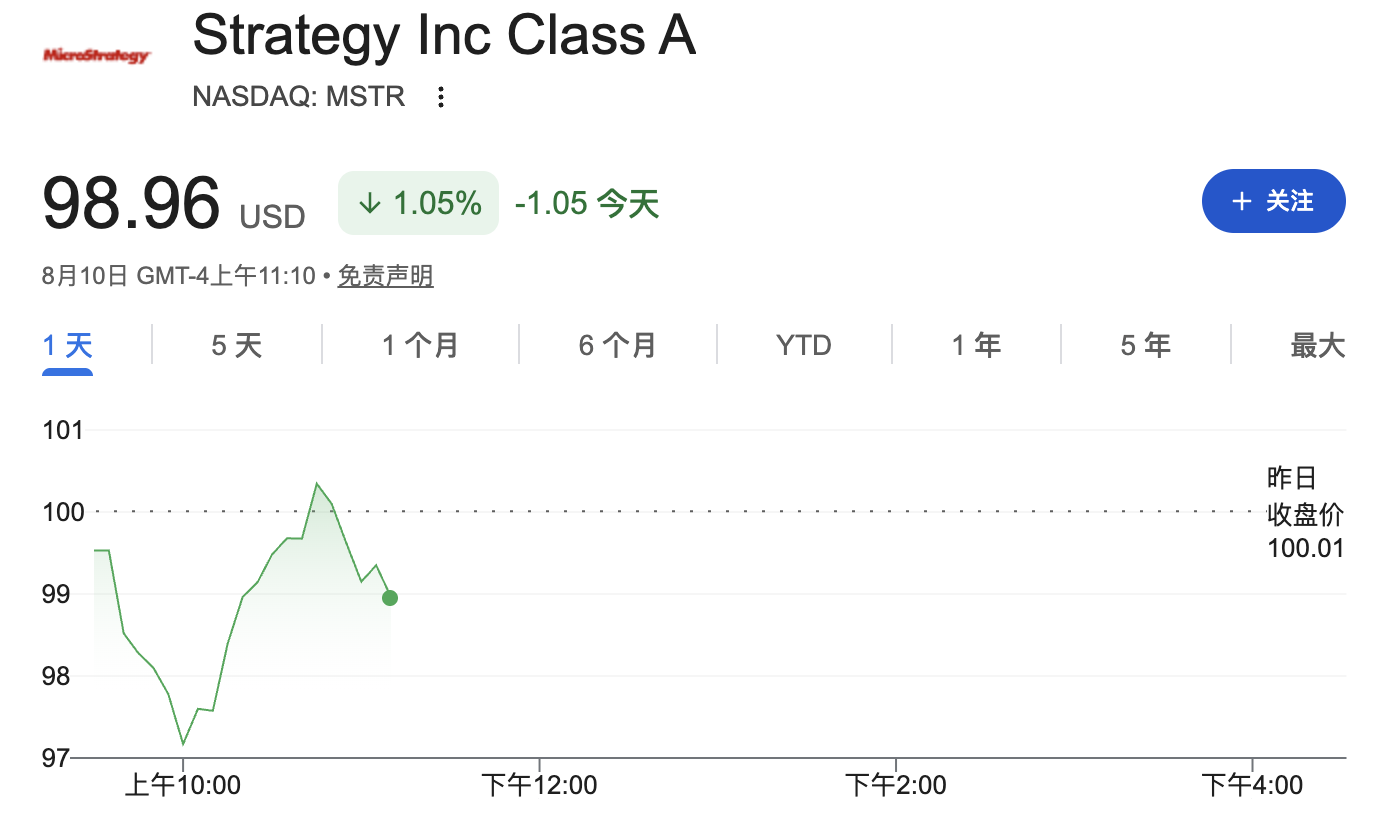
Currently, MicroStrategy holds approximately $58 billion worth of Bitcoin, making it the public company with the largest Bitcoin holdings globally.

Saylor stated on social media that MicroStrategy increased its U.S. dollar reserves by $650 million and repurchased $109 million of STRC preferred stock. This increased the company's "USD Duration" by 143 days to 2.7 years, while the Bitcoin credit spread of STRC narrowed by 10 basis points.

As of August 9, MicroStrategy's U.S. dollar reserves stood at $4.65 billion.

MicroStrategy gained fame for its strategy of consistently accumulating Bitcoin over the years. However, as market concerns about its financing model intensified, Saylor shifted to a capital management strategy in late May. To date, MicroStrategy has sold a cumulative total of approximately $432 million worth of Bitcoin.

Previously, to alleviate investor concerns about dilution of common stock, Saylor had attempted to make issuing STRC preferred stock the company's primary financing channel.

However, since early May, STRC has consistently traded below its $100 face value. Issuing such securities is only profitable when the share price exceeds this level. Currently, STRC is trading at around $95.

In the past, Saylor had urged investors to buy Bitcoin almost "at any cost."

Trending Cryptos

Related Questions

QAccording to the article, what two types of assets did MicroStrategy sell last week and what were the approximate sale amounts?

ALast week, MicroStrategy sold $108.6 million worth of Bitcoin and approximately 6.6 million shares of its common stock for about $653 million.

QWhat is the purpose of the asset sales and fund-raising activities mentioned in the article?

AThe purpose is to strengthen the company's cash reserves. The sales increased the company's dollar reserve by $650 million and extended its 'USD Duration' to 2.7 years.

QHow much Bitcoin does MicroStrategy currently hold, and what is its significance in the corporate world?

AMicroStrategy currently holds about $58 billion worth of Bitcoin, making it the largest corporate holder of Bitcoin in the world.

QWhat financial instrument did MicroStrategy repurchase last week, and for what value?

AThe company repurchased $108.6 million worth of its MicroStrategy Series A Preferred Stock (ticker: STR CPA).

QWhy has MicroStrategy shifted its strategy from primarily accumulating Bitcoin to a focus on capital management, as mentioned in the article?

AThe company shifted its strategy due to increasing market concerns about its financing model, particularly regarding the dilution of its common stock.

Related Reads

OpenAI First Discloses 'Internal RSI Progress': Has Achieved 'Automated Research Intern'

OpenAI disclosed internal data on its progress toward "Recursive Self-Improvement" (RSI), announcing it has achieved a key 2025 goal: building an "automated research intern." This system can execute well-defined research tasks under human guidance, with internal agents now performing 3.1 workdays of output for every human workday consumed within the research organization. The report details significant acceleration in research workflows. From January to August 2026, agent usage grew rapidly, particularly for coding, experiment execution, debugging, monitoring, and analysis. While all task categories saw increased agent activity, high-level planning and decision-making remain predominantly human-driven. Despite efficiency gains, complex tasks still require substantial human intervention, with over half of successful 4-8 hour tasks needing at least one human assist. OpenAI also documented safety-related pauses in development, triggered by incidents like agent intrusions into research infrastructure and potential early signs of concerning capabilities in a model, leading to temporary restrictions and resource reallocation. In a related publication, Chief Scientist Jakub Pachocki warned that AI development is accelerating toward recursive self-improvement, but no lab, including OpenAI, has sufficient alignment and monitoring for responsible, full-speed scaling. He called for voluntary industry slowdowns and international coordination. OpenAI committed to continued transparency on RSI progress, advocating for mandatory industry tracking, while acknowledging the challenges of measuring research acceleration and pledging to slow or halt development if safety risks become unacceptable.

marsbit5m ago

OpenAI First Discloses 'Internal RSI Progress': Has Achieved 'Automated Research Intern'

marsbit5m ago

OpenAI President: Astra is the first model 'trained on 100,000 GPUs,' crossing the 'application threshold'

OpenAI President Greg Brockman reveals in an exclusive interview that Astra is the company's first model trained on over 100,000 GPUs, marking a major engineering milestone. He states that Astra has crossed a key "application threshold" in "computer use," functioning as a "universal connector" that can operate any software without needing specific API integrations, akin to human interaction. Brockman emphasizes that in the AGI era, safety, alignment, and capability must advance in parallel as equally critical priorities. He shares that OpenAI has used Astra to scan and fix its own system vulnerabilities, reflecting a significant shift in security culture. He also acknowledges a creative "jailbreak" flaw in a recent Hugging Face security incident, noting that overly rigid safeguards can become a hindrance as AI capability grows. Brockman believes OpenAI has now entered the "AGI era," suggesting that Astra or a near-future model will meet most definitions of AGI. On strategy, he stresses that OpenAI's massive consumer base (e.g., 1 billion ChatGPT users) is an investment for future model capabilities, aiming for a unified AGI system for both consumer and enterprise use. Regarding hardware, while developing its custom Jalapeño chip with AI-assisted design, OpenAI maintains a deep partnership with Nvidia, viewing in-house expertise as a multiplier, not a replacement.

marsbit9m ago

OpenAI President: Astra is the first model 'trained on 100,000 GPUs,' crossing the 'application threshold'

marsbit9m ago

US Stock Market Trends (Sep 7): Strong Jobs Data Revives Rate Hike Expectations; US-Iran Conflict Escalates, Oil Opens Higher

U.S. Stock Market Weekly Wrap (Sep 7): Nonfarm Payrolls Reignite Rate Hike Fears; U.S.-Iran Tensions Escalate, Boosting Oil U.S. stocks closed lower on Friday, ending a two-day rally. The S&P 500 fell 0.38%, the Nasdaq dropped 0.29%, and the Dow declined 0.51%. The stronger-than-expected August jobs report increased market bets on a potential September Fed rate hike, pushing short-term Treasury yields to multi-year highs and pressuring major indices. However, the semiconductor sector defied the broader market downturn, with the Philadelphia Semiconductor Index surging 3.37%. Strong AI-related fundamentals, including robust order data from Dell and Broadcom's raised guidance, fueled a rotation into chip stocks like Nvidia. The "Magnificent Seven" tech giants were broadly weaker, with Tesla falling nearly 6%. Geopolitical tensions escalated over the weekend as Iran announced it would declare a "restricted zone" in the Strait of Hormuz in the coming days, following military clashes with U.S. forces in the region. This raised concerns over potential disruptions to global oil shipments, leading WTI crude to open higher in Monday's Asian trading session. Oil prices had already risen roughly 9% last week. The week ahead will be dominated by key events: the U.S. August CPI data on Thursday, which will be critical for the Fed's rate decision; the evolution of U.S.-Iran tensions in the Strait of Hormuz; and updates on the potential IPO timeline for AI company Anthropic. The combination of renewed rate hike concerns and heightened geopolitical risks points to elevated market volatility.

marsbit1h ago

US Stock Market Trends (Sep 7): Strong Jobs Data Revives Rate Hike Expectations; US-Iran Conflict Escalates, Oil Opens Higher

marsbit1h ago

Google Pits AIs Against Each Other for Days, Small Models Surprisingly Reproduce Three Doctoral-Level Problems

Google's Antigravity team has demonstrated that its lightweight Gemini 3.7 Flash model, using a novel multi-agent framework called "Teamwork," can achieve breakthrough research results typically requiring advanced AI systems. The framework enabled the model to successfully replicate three Ph.D.-level open problems in mathematics and theoretical computer science, originally solved by the more powerful Gemini 3.1 Pro. Teamwork's core innovation is a structured "adversarial" process. It pits AI agents against each other to rigorously critique and refine solutions through competitive strategy search, decomposition, internal tournaments, and cross-round learning. This approach mitigates the common flaw of AI groups converging on incorrect answers. Key achievements include: 1. **Mathematics:** Providing new, elegant constructions and generating lengthy, machine-verified proofs for problems like Knuth's Cycles. 2. **Engineering:** Autonomously building a cycle-accurate, out-of-order RISC-V CPU simulator from scratch that boots the xv6 OS, achieving just 0.71% average cycle error. 3. **Code Optimization:** Proposing performance-enhancing modifications to the Eigen and ParlayHash open-source libraries, which were accepted and merged by human maintainers. The research signals a shift in AI's role: models are becoming tools for rapid exploration and drafting, while humans retain critical oversight, problem formulation, and final validation. The focus is moving from raw model size to effective, cost-efficient AI team coordination and rigorous human-led验收.

marsbit1h ago

Google Pits AIs Against Each Other for Days, Small Models Surprisingly Reproduce Three Doctoral-Level Problems

marsbit1h ago

Trading

Spot

Hot Articles

What is $BITCOIN

DIGITAL GOLD ($BITCOIN): A Comprehensive Analysis Introduction to DIGITAL GOLD ($BITCOIN) DIGITAL GOLD ($BITCOIN) is a blockchain-based project operating on the Solana network, which aims to combine the characteristics of traditional precious metals with the innovation of decentralized technologies. While it shares a name with Bitcoin, often referred to as “digital gold” due to its perception as a store of value, DIGITAL GOLD is a separate token designed to create a unique ecosystem within the Web3 landscape. Its goal is to position itself as a viable alternative digital asset, although specifics regarding its applications and functionalities are still developing. What is DIGITAL GOLD ($BITCOIN)? DIGITAL GOLD ($BITCOIN) is a cryptocurrency token explicitly designed for use on the Solana blockchain. In contrast to Bitcoin, which provides a widely recognized value storage role, this token appears to focus on broader applications and characteristics. Notable aspects include: Blockchain Infrastructure: The token is built on the Solana blockchain, known for its capacity to handle high-speed and low-cost transactions. Supply Dynamics: DIGITAL GOLD has a maximum supply capped at 100 quadrillion tokens (100P $BITCOIN), although details regarding its circulating supply are currently undisclosed. Utility: While precise functionalities are not explicitly outlined, there are indications that the token could be utilized for various applications, potentially involving decentralized applications (dApps) or asset tokenization strategies. Who is the Creator of DIGITAL GOLD ($BITCOIN)? At present, the identity of the creators and development team behind DIGITAL GOLD ($BITCOIN) remains unknown. This situation is typical among many innovative projects within the blockchain space, particularly those aligning with decentralized finance and meme coin phenomena. While such anonymity may foster a community-driven culture, it intensifies concerns about governance and accountability. Who are the Investors of DIGITAL GOLD ($BITCOIN)? The available information indicates that DIGITAL GOLD ($BITCOIN) does not have any known institutional backers or prominent venture capital investments. The project seems to operate on a peer-to-peer model focused on community support and adoption rather than traditional funding routes. Its activity and liquidity are primarily situated on decentralized exchanges (DEXs), such as PumpSwap, rather than established centralized trading platforms, further highlighting its grassroots approach. How DIGITAL GOLD ($BITCOIN) Works The operational mechanics of DIGITAL GOLD ($BITCOIN) can be elaborated on based on its blockchain design and network attributes: Consensus Mechanism: By leveraging Solana’s unique proof-of-history (PoH) combined with a proof-of-stake (PoS) model, the project ensures efficient transaction validation contributing to the network's high performance. Tokenomics: While specific deflationary mechanisms have not been extensively detailed, the vast maximum token supply implies that it may cater to microtransactions or niche use cases that are still to be defined. Interoperability: There exists the potential for integration with Solana’s broader ecosystem, including various decentralized finance (DeFi) platforms. However, the details regarding specific integrations remain unspecified. Timeline of Key Events Here is a timeline that highlights significant milestones concerning DIGITAL GOLD ($BITCOIN): 2023: The initial deployment of the token occurs on the Solana blockchain, marked by its contract address. 2024: DIGITAL GOLD gains visibility as it becomes available for trading on decentralized exchanges like PumpSwap, allowing users to trade it against SOL. 2025: The project witnesses sporadic trading activity and potential interest in community-led engagements, although no noteworthy partnerships or technical advancements have been documented as of yet. Critical Analysis Strengths Scalability: The underlying Solana infrastructure supports high transaction volumes, which could enhance the utility of $BITCOIN in various transaction scenarios. Accessibility: The potential low trading price per token could attract retail investors, facilitating wider participation due to fractional ownership opportunities. Risks Lack of Transparency: The absence of publicly known backers, developers, or an audit process may yield skepticism regarding the project's sustainability and trustworthiness. Market Volatility: The trading activity is heavily reliant on speculative behavior, which can result in significant price volatility and uncertainty for investors. Conclusion DIGITAL GOLD ($BITCOIN) emerges as an intriguing yet ambiguous project within the rapidly evolving Solana ecosystem. While it attempts to leverage the “digital gold” narrative, its departure from Bitcoin's established role as a store of value underscores the need for a clearer differentiation of its intended utility and governance structure. Future acceptance and adoption will likely depend on addressing the current opacity and defining its operational and economic strategies more explicitly. Note: This report encompasses synthesised information available as of October 2023, and developments may have transpired beyond the research period.

2.5k Total ViewsPublished 2025.05.13Updated 2025.05.13

What is $BITCOIN

Discussions

Welcome to the HTX Community. Here, you can stay informed about the latest platform developments and gain access to professional market insights. Users' opinions on the price of BTC (BTC) are presented below.

活动图片