В JPMorgan спрогнозировали продолжение доминирования биткоина над Ethereum и альткоинами

cryptonews.ruPublished on 2024-09-17Last updated on 2025-01-17

  • Эксперты JPMorgan заявили, что доминирование биткоина над Ethereum и альткоинами сохранится в 2025 году.
  • Они назвали восемь причин, почему так произойдет.

Доминирование биткоина над Ethereum и альткоинами сохранится в 2025 году. Об этом сообщает The Block со ссылкой на аналитиков JPMorgan.

Эксперты прогнозируют, что доминирование первой криптовалюты или процент общей рыночной капитализации, которую занимает биткоин по сравнению с другими криптовалютами, сохранится в 2025 году. В частности, они назвали восемь факторов, которые могут способствовать этому, а именно:

  • нарратив о биткоине как средстве защиты от инфляции. В JPMorgan считают, что актив может быть цифровым компонентом «антиинфляционной стратегии» вроде золота. Эксперты добавили, что биткоин продолжает привлекать значительные инвестиции в спотовые биткоин-ETF, тогда как интерес к фондам на базе Ethereum остается умеренным;
  • MicroStrategy. По словам аналитиков, компания реализовала лишь часть плана по приобретению биткоинов стоимостью $42 млрд;
  • национальные криптовалютные резервы. Будущие криптовалютные резервы штатов, правительств или центральных банков США, вероятно, будут сосредоточены исключительно на биткоине, считают в JPMorgan;
  • развитие L2-сетей на базе биткоина;
  • блокчейн-приложения переходят на частные сети. Эксперты объяснили, что приложения на базе блокчейна все чаще переходят на частные сети, поскольку последние обеспечивают большую конфиденциальность и возможность кастомизации. По их мнению, это снижает привлекательность публичных блокчейнов, таких, как Ethereum, для крупных игроков;
  • проекты все реже выпускают токены. Новые проекты отдают приоритет развитию инфраструктуры, а не выпуску токенов, что знаменует собой отход от токеноцентричных стратегий бычьего рынка 2021-2022 годов, говорится в заявлении;
  • слабый интерес к децентрализованным проектам. Аналитики привели пример децентрализованных социальных медиаплатформ, таких, как Friend.tech, Farcaster и Lens, которые «пытались удержать популярность», но быстро столкнулись со спадом активности пользователей;
  • регулирование сектора в США. Эксперты считают, что более четкое и дружественное к криптовалютам законодательство США может улучшить настроения инвесторов. Однако они предостерегли, что остается неопределенным вопрос о том, насколько эти изменения будут способствовать развитию публичных блокчейнов, таких, как Ethereum, отмечают аналитики.

«Крипторынок остается в фазе консолидации, поскольку ожидает регуляторной ясности от новой администрации США. Однако для реализации этой политики может потребоваться время, поскольку первоочередное внимание администрации, вероятно, будет сосредоточено на тарифах и иммиграции. Задержка с регуляторной ясностью может затянуть фазу консолидации, что сделает рынок очень чувствительным к движениям в технологическом секторе фондовых рынков», — подытожили в JPMorgan.

Отметим, на момент написания доминирование биткоина на крипторынке составляет 57,63%:
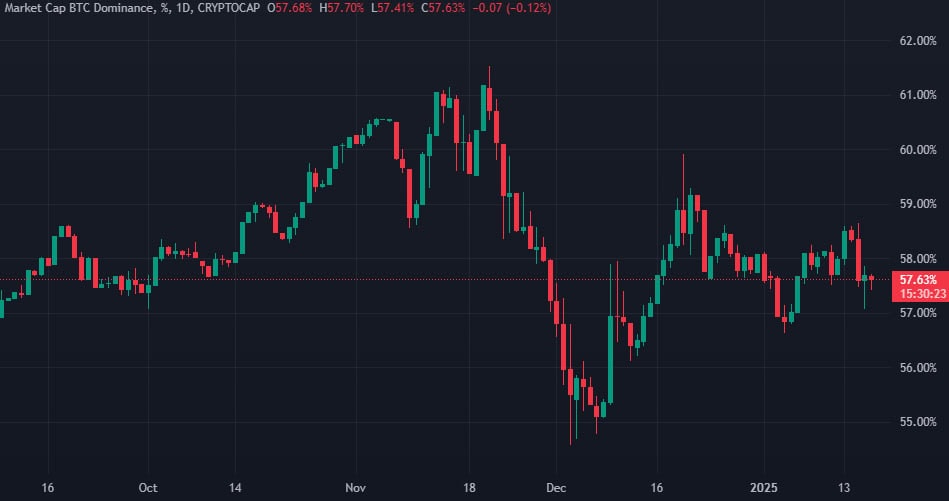
Доминирование биткоина. Данные: TradingView.

Напомним, ранее эксперты QCP Capital заявили, что сигналом о начале альтсезона будет падение доминирования биткоина ниже 58%, однако инвесторы еще не готовы к нему.


Trending Cryptos

Related Reads

Tiger Research: Zuckerberg Begins Betting on Prediction Markets, While Asian Nations Still View Them as Gambling

This article examines the rise of prediction markets, contrasting their growing institutional acceptance in the West with their restrictive regulation in Asia. It details how prediction markets, which originated from informal political betting and academic experiments like the Iowa Electronic Market, aggregate crowd wisdom into probabilistic prices through binary contracts. Their growth accelerated around 2020, reaching over $14 billion in monthly volume. A key driver is the "skin in the game" principle, where users risk their own capital, leading to high accuracy in predicting events like Fed rate decisions and elections, as demonstrated by platforms like Polymarket. Meta's entry, with Mark Zuckerberg reportedly leading the development of the Arena app, signals the market's maturation. In the U.S., court rulings have distinguished prediction markets from gambling, facilitating entry by traditional financial institutions. However, most Asian jurisdictions still classify them as gambling, focusing on social control rather than financial innovation. The article argues this stance creates three problems for Asia: 1) regulatory arbitrage pushes users to riskier offshore platforms, 2) loss of sovereign information infrastructure as valuable social sentiment data accumulates abroad, and 3) abandonment of user protection. It concludes that Asia needs a policy shift from prohibition to constructive regulation, integrating these markets into the formal system to harness their data as a national asset, as initiatives like Limitless Research are beginning to do.

marsbit1h ago

Tiger Research: Zuckerberg Begins Betting on Prediction Markets, While Asian Nations Still View Them as Gambling

marsbit1h ago

Ethereum's Next Decade in the Eyes of Vitalik

"Lean Ethereum" Long-Term Roadmap Unveiled by Vitalik Buterin On July 5, 2026, Vitalik Buterin published the "Lean Ethereum" roadmap, positioning it as Ethereum's third major evolution following the Merge. This multi-year, multi-phase upgrade aims to fundamentally transform Ethereum's core protocol through staged network upgrades extending to 2029. Key goals include achieving 1 gigagas per second L1 throughput (a massive increase from the current ~32 TPS), near-instant finality, and quantum-resistant cryptography. The plan involves transitioning Ethereum's security model from full transaction re-execution by all nodes to native verification via recursive STARK proofs. A major proposed change is replacing the EVM with a proof-friendly architecture like RISC-V or leanISA, though this remains a point of contention, especially with L2s like Arbitrum favoring alternatives like WASM. Other planned upgrades include a restructured state model with a large, cheap "warehouse" storage layer to drastically reduce fees for migrated applications, multi-dimensional gas pricing, and a new focus on making privacy a first-class, native protocol feature. While the roadmap significantly raises Ethereum's long-term technical ceiling, analysts note it does not directly address ETH's mid-term token economics or value capture. The plan's multi-year timeline means near-term price impact will likely depend on observable progress milestones, such as the successful deployment of the upcoming Glamsterdam gas limit increase, growth in L2 activity and blob usage, and trends in L1 fee revenue and ETH burn.

链捕手3h ago

Ethereum's Next Decade in the Eyes of Vitalik

链捕手3h ago

In Just 11 Days, Claude Rewrote Millions of Lines of Code, an Epic AI Engineering Feat Sparks Fury

In just 11 days, Bun's founder Jarred Sumner used Anthropic's Claude AI models to rewrite its million lines of code from Zig to Rust. This move sparked significant controversy, particularly from Zig's creator, Andrew Kelley, who publicly criticized Sumner's engineering practices and the decision to use AI for such a massive rewrite. Bun, a high-performance JavaScript/TypeScript runtime and rival to Node.js, was originally written in Zig. After Anthropic acquired Bun, the team encountered persistent stability and memory safety bugs in the Zig codebase. These issues, combined with Zig's strict policy against LLM-generated code, led to the decision to rewrite in Rust. The rewrite was executed using Claude AI tools at an estimated API cost of $165,000, dramatically reducing the expected time and financial cost. Andrew Kelley's response was scathing. He blamed the original bugs on poor engineering habits, calling Bun's Zig code a collection of "hacks on top of hacks." He expressed relief that Bun was no longer associated with Zig, fearing it would misrepresent the language and attract low-quality, AI-generated contributions. The tech community is divided; some view Kelley's critique as unprofessional, while others see it as a defense of engineering integrity. A major concern about the AI-driven rewrite is the resulting code quality. The translation from Zig left approximately 27,000 lines of unsafe Rust code, raising fears about long-term maintainability and technical debt. The debate centers on whether this project is a milestone in AI-assisted development or a future maintenance nightmare.

marsbit4h ago

In Just 11 Days, Claude Rewrote Millions of Lines of Code, an Epic AI Engineering Feat Sparks Fury

marsbit4h ago

Trading

Spot

Hot Articles

Discussions

Welcome to the HTX Community. Here, you can stay informed about the latest platform developments and gain access to professional market insights. Users' opinions on the price of ETH (ETH) are presented below.

活动图片