Эти две метрики свидетельствуют о возможном росте цены Solana (SOL)

cryptonews.ruPublished on 2021-05-26Last updated on 2024-10-26

Цена Solana (SOL) выросла на 12% за последнюю неделю. Показания индекса относительной силы (RSI) намекают на то, что у альткоина еще есть пространство для роста.

Активность пользователей платформы для создания мемкоинов Pump.fun — одном из крупнейших приложений Solana, также может стать ключевым фактором для роста цены в ближайшие дни.

RSI SOL находится ниже уровня перекупленности

Индекс относительной силы (RSI) SOL упал с отметки 70 до 61, покинув зону перекупленности. Теперь, когда RSI находится ниже этого критического порога, цена может продолжить свое восходящее движение даже несмотря на недавний рост на 12%.

Читайте также: Что такое Solana (SOL). Обзор проекта и его перспектив
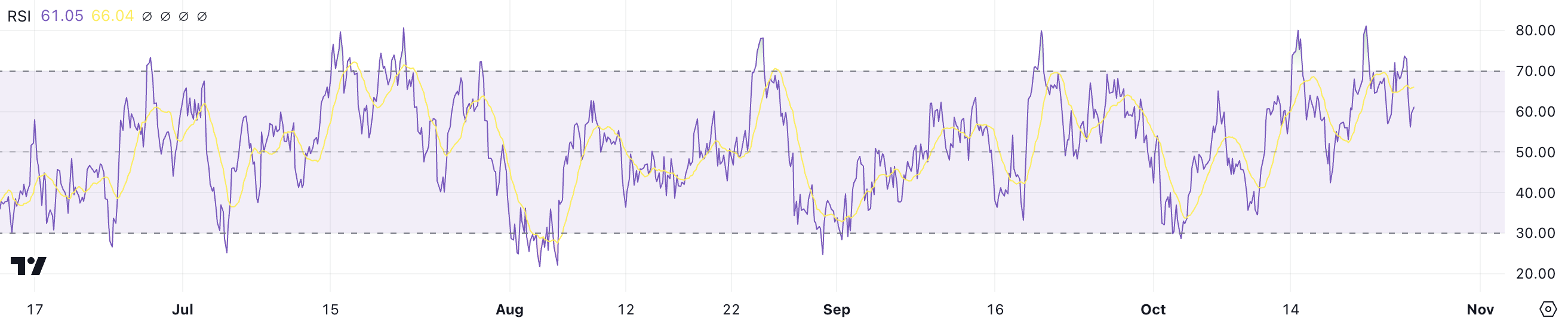
RSI SOL. Источник: TradingView

Индекс относительной силы измеряет скорость и изменение ценовых движений. Он варьируется от 0 до 100, при этом значения выше 70 указывают на перекупленность, а значения ниже 30 — на перепроданность. Падение RSI ниже 70 может говорить о том, что у SOL еще есть значительный запас для роста.

Может ли активность Pump.fun стимулировать рост Solana?

Pump.fun — одно из ведущих приложений в экосистеме Solana, которое устанавливает один рекорд за другим. С 14 октября на платформе запускается более 20 000 новых токенов, а 22 октября этот показатель достиг пика в 34 094 монеты. Таким образом, Pump.fun теперь обеспечивает почти 50% ежедневных транзакций на Solana.
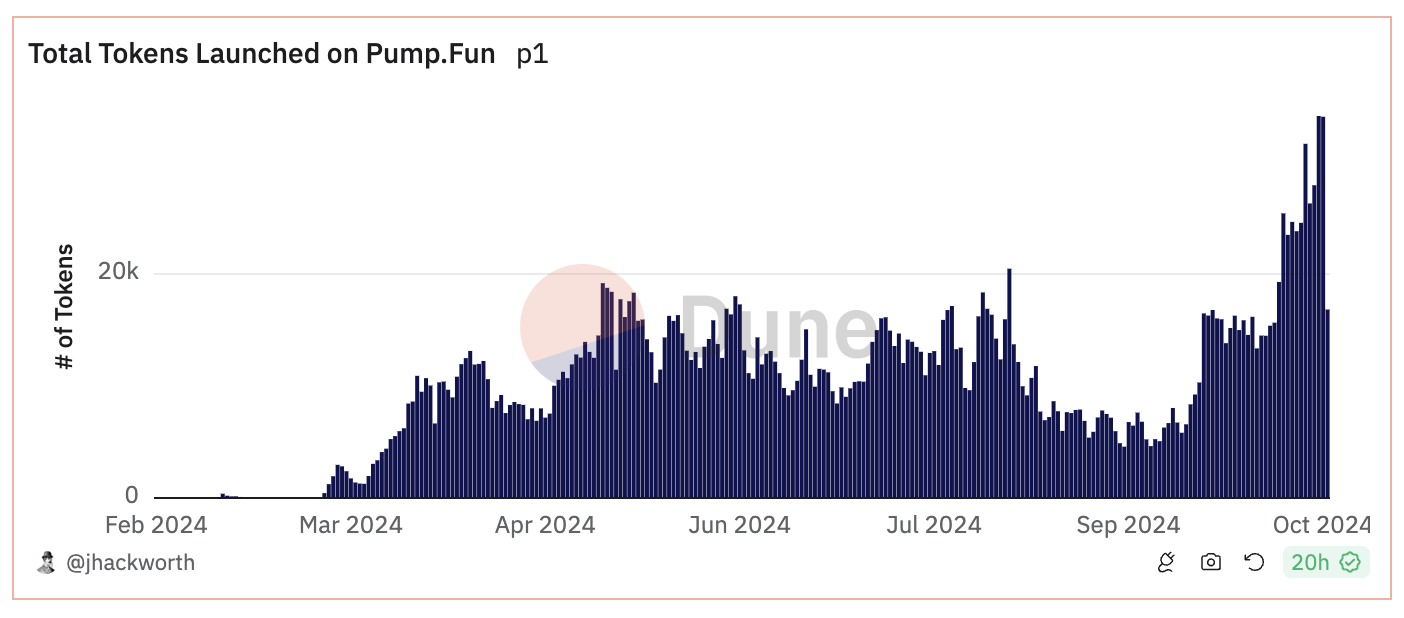
Ежедневные запуски токенов на PumpFun. Источник: Dune

Такой уровень активности может спровоцировать ралли SOL, подобно тому, что произошло между мартом и апрелем. Тогда резкий рост запуска монет на Pump.fun совпал со скачком цены с $107 до $209 всего за три недели.

Прогноз цены SOL: возврат к $194

SOL сейчас торгуется выше всех линий EMA, что указывает на сильный бычий тренд. Краткосрочная EMA служит непосредственной поддержкой, подтверждая, что покупатели активно действуют при небольших откатах.

Если SOL преодолеет отметку в $182,46, то может скоро достичь $194,04, самой высокой цены с июля. Уровни поддержки находятся на $165,37 и $147,55 — оба они критически важны для поддержания текущего восходящего тренда.

Читайте также: Компания VanEck добавила вознаграждения за стейкинг в свой Solana ETN
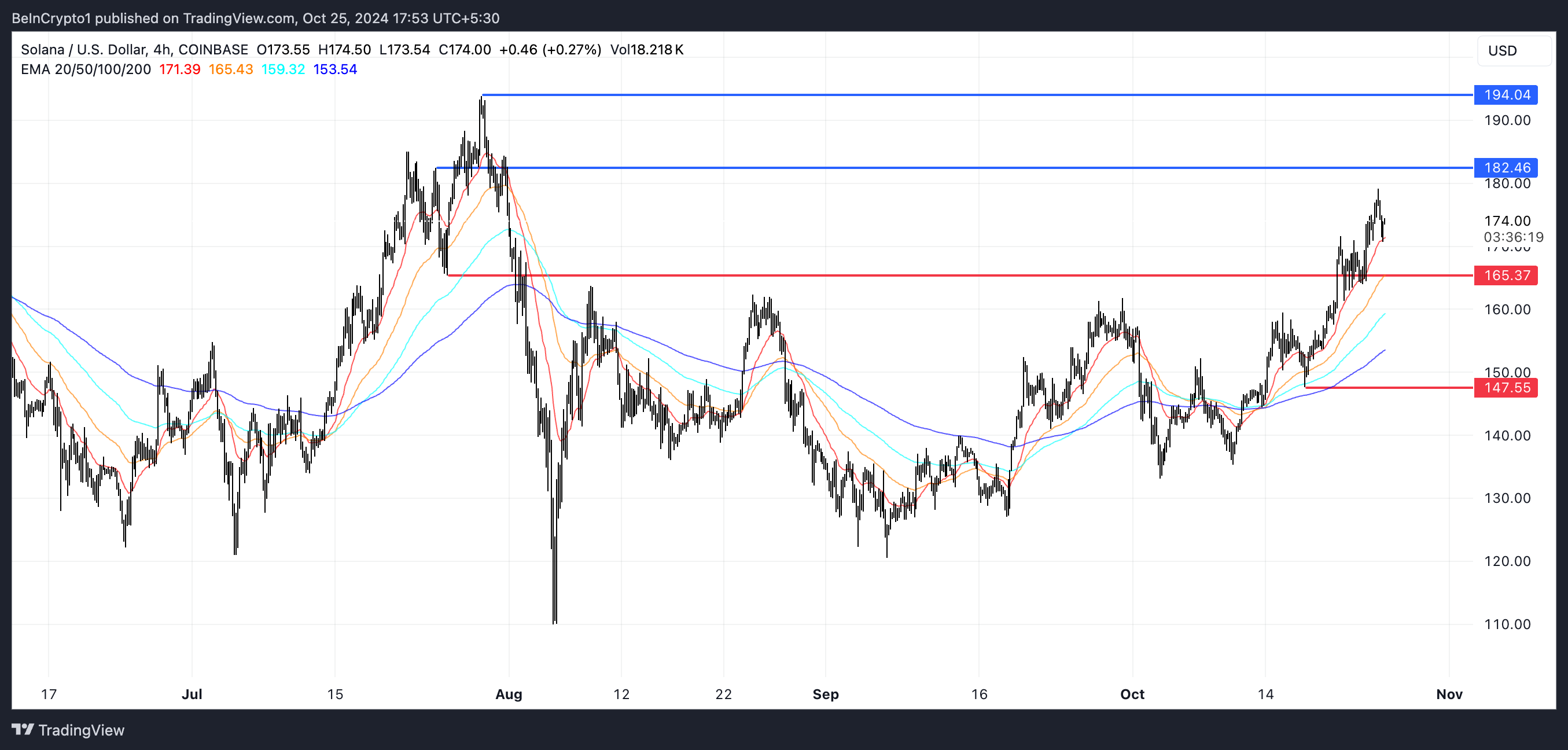
Линии EMA SOL и уровни поддержки и сопротивления. Источник: TradingView

Конфигурация EMA в сочетании с этими уровнями поддержки и сопротивления подтверждает, что бычий тренд все еще актуален и предоставляет возможности для дальнейшего роста, если восходящий импульс сохранится.


Trending Cryptos

Related Reads

Ethereum Q1 2026 Report: Fees Decline, Users and Transaction Volume Hit New Highs

Ethereum Q1 2026 Report: Fees Down, Users & Transactions Hit New Highs Token Terminal's Q1 2026 report on Ethereum presents a pivotal development: the network achieved record highs in monthly active users (13.2M, +85.9% YoY), total transactions (200.4M, +81.5% YoY), and throughput (25.78 TPS), while transaction fees on the mainnet plummeted by 47.9% quarter-over-quarter. This shift is attributed to the network's strategic move into a "low fees for scale" phase, exemplified by the Fusaka upgrade which increased data capacity and lowered block space costs, releasing pent-up demand (a manifestation of Jevons's Paradox). The report highlights a core narrative shift for Ethereum: from a DeFi-centric blockchain to a global financial settlement layer. It maintains a dominant position in tokenized assets, holding majority market shares among top chains in stablecoins (61.8%), tokenized funds (73.0%), and tokenized commodities (84.0%). Growth in tokenized funds (+73.1% YoY) and commodities (+325.9% YoY) was particularly strong, driven by institutions like BlackRock and JPMorgan entering the space. Contrasting these usage gains, several USD-denominated value metrics declined in Q1: fully diluted market cap fell 30.3% QoQ, total value locked (TVL) dropped 11.0%, and ecosystem transaction volume decreased 24.0%. The report interprets this as Ethereum prioritizing long-term network expansion and cementing its role as the default settlement layer for finance over short-term fee capture. The commentary from Etherealize argues that, much like the early internet, Ethereum's open, permissionless model is poised to win over closed alternatives as institutional tokenization accelerates.

marsbit31m ago

Ethereum Q1 2026 Report: Fees Decline, Users and Transaction Volume Hit New Highs

marsbit31m ago

He Just Raised 2.7 Billion, and Li Fei-Fei Also Invested

Pete Florence, a former senior research scientist at Google DeepMind and a key contributor to the Vision-Language-Action (VLA) model architecture, is deliberately distancing his startup, Generalist AI, from the trendy "world model" label. He argues that the industry should prioritize concrete goals over buzzwords. His goal is to create robots that can perform a vast range of unseen tasks with high speed and success rates, without needing task-specific training data. Recently, his company raised $400 million (¥2.7 billion) at a $2 billion valuation. Notable investors include NVIDIA's NVentures, Bezos Expeditions, NFDG, as well as Xiaomi co-founder Lin Bin, Zoom founder Eric Yuan, and renowned AI scientist Fei-Fei Li. Florence's approach stems from his academic background at MIT under Professor Russ Tedrake, focusing on understanding the physical world. After joining DeepMind, he developed models like Transporter Network and co-created the VLA framework. He left in 2025 to found Generalist AI. The company has launched two models: GEN-0, which demonstrated that scaling laws apply to physical motion, and GEN-1. GEN-1 was trained on over 500,000 hours of physical interaction data collected via a specialized wearable device. It achieves a 99% success rate on precise mechanical tasks like folding boxes and maintains performance three times faster than its predecessor. Florence believes GEN-1 is reaching a commercial utility threshold similar to the GPT-3 inflection point. The substantial funding round, following GEN-1's release, signifies strong investor confidence in Generalist AI's practical, goal-driven path to creating versatile, useful robots, regardless of the "world model" terminology.

marsbit37m ago

He Just Raised 2.7 Billion, and Li Fei-Fei Also Invested

marsbit37m ago

Two Legends Lost in Three Days: Is Google's AI Talent Dam Cracking?

In three days, Google lost two AI legends. On June 18, Noam Shazeer, co-author of the seminal "Attention is All You Need" paper and Gemini co-lead, left for OpenAI. Just 48 hours later, John Jumper, 2024 Nobel laureate and AlphaFold lead, departed DeepMind for Anthropic. This follows Andrej Karpathy joining Anthropic in May. These moves highlight a structural trend: top AI talent is concentrating at mission-driven, pre-IPO firms like OpenAI and Anthropic, while Google becomes a primary source. The exodus stems from a core mission mismatch. Google's ad-centric model often subordinates AI research to product and revenue goals, creating friction for pioneers like Shazeer, who returned in 2024 only to leave again. In contrast, OpenAI and Anthropic offer singular focus on pushing AI boundaries, whether towards AGI or safety-aligned models, which deeply appeals to top researchers like Jumper. Financial incentives amplify the pull. With both OpenAI and Anthropic nearing IPO, employees stand to gain immensely from equity, an upside Google's mature stock cannot match. Furthermore, the 2023 merger of Google Brain and DeepMind, intended to consolidate strength, has instead created cultural tension and slowed the path from research to product, as evidenced by Gemini's pace. This talent redistribution is reshaping the AI landscape. While Google retains vast data and compute resources, its true crisis is the quiet, continuous loss of the people who define the field's future. The real moat in AI is not infrastructure, but the concentration of brilliant minds—a battle Google is currently losing.

marsbit2h ago

Two Legends Lost in Three Days: Is Google's AI Talent Dam Cracking?

marsbit2h ago

Behind the AI Report Card, Lies a Chinese 'Exam Setter'

Beyond the familiar performance charts like MMLU-Pro and MMMU, which major AI models strive to ace, stands a key "examiner": Chinese-Canadian researcher Wenhu Chen. An assistant professor at the University of Waterloo and founder of TIGERLab, Chen addresses the crucial need for more rigorous AI evaluation. As models like GPT-4 began scoring near-perfect results on older benchmarks like MMLU, it became difficult to distinguish their true capabilities. In response, Chen introduced MMLU-Pro in 2024, featuring harder, more reasoning-focused questions with more answer choices, successfully reintroducing meaningful performance gaps. His work extends to multi-modal evaluation with MMMU and its enhanced version, MMMU-Pro. These benchmarks test a model's ability to understand and reason with complex information from images, charts, and text across diverse academic subjects, exposing the significant challenges even top models face in genuine comprehension. Chen's background in complex QA, table reasoning, and his experience at Google DeepMind on projects like Gemini inform his approach. He understands that effective benchmarks must anticipate how models might "cheat" by memorizing data or avoiding visual analysis. His lab also actively researches video understanding and generation models (e.g., UniVideo, Vamba), ensuring his evaluation work is grounded in practical model-building challenges. Now at Meta's Super Intelligence Lab, Chen continues his focus on multi-modal data and evaluation, representing the deep yet often unseen contributions of Chinese talent in shaping the fundamental tools of the AI industry.

marsbit2h ago

Behind the AI Report Card, Lies a Chinese 'Exam Setter'

marsbit2h ago

Trading

Spot
Futures

Hot Articles

Discussions

Welcome to the HTX Community. Here, you can stay informed about the latest platform developments and gain access to professional market insights. Users' opinions on the price of SOL (SOL) are presented below.

活动图片