Crypto Inflows Hit New Heights As Ethereum Funds Break Losing Streak—Bull Run Here?

bitcoinistPublished on 2024-10-01Last updated on 2024-10-01

Abstract

Global crypto investment products have surged, recording $1.2 billion in net inflows over the past week. This marks the third...

Global crypto investment products have surged, recording $1.2 billion in net inflows over the past week. This marks the third consecutive week of positive inflows and a notable shift in market sentiment, as highlighted by the latest report from CoinShares, a leading digital asset investment firm.

Coinshares revealed that the upward trend in inflows reflects “investor confidence” in digital assets amidst expectations of “dovish monetary policy” in the US. In addition, it is also seen as a reaction to improving “price momentum.”

According to CoinShares’ Head of Research, James Butterfill, this week’s positive performance is the largest in the last ten weeks, with total assets under management rising by 6.2%. The inflow largely stemmed from increased interest in Bitcoin-focused investment products.

Additionally, after weeks of declining performance, Ethereum-based investment funds recorded a resurgence, attracting net weekly inflows and marking a turnaround in investor sentiment toward the asset.

Bitcoin Dominates Inflows as Spot ETF Approval Boosts Market

The primary driver behind last week’s inflows was Bitcoin, which accounted for $1.1 billion of global net inflows.

According to Butterfill, the approval for the listing and trading options for BlackRock’s spot Bitcoin exchange-traded fund (ETF) by the US Securities and Exchange Commission (SEC) contributed significantly to market optimism.

The Head of Research at CoinShares disclosed that this regulatory development set a positive tone for investors, even though trading volumes saw a minor decline, decreasing by 3.1% compared to the previous week.

Meanwhile. investment funds based in the US were the major contributors to the inflows, with spot Bitcoin ETFs making up the majority. The US-based funds generated a net inflow of $1.2 billion, a substantial portion of which — $1.1 billion — came from Bitcoin-focused products.

Additionally, Switzerland-based crypto funds drew in net inflows of $84 million. However, this positive trend was not uniform across all regions, as funds in Germany and Brazil experienced net outflows of $21 million and $3 million, respectively.
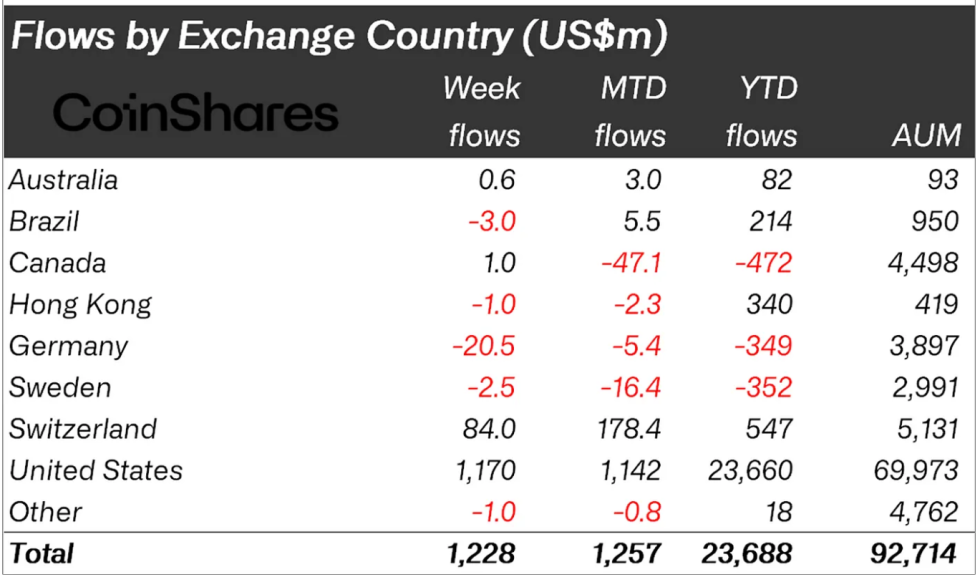
Crypto asset flows by region
Crypto asset flows by region. | Source: CoinShares

The week also saw a contrasting movement in short Bitcoin investment products, which recorded net inflows of $8.8 million amid the price increase for Bitcoin.

Ethereum Sees Rebound, Solana Ends Positive Streak

One of the noteworthy developments was the reversal of a five-week negative trend in Ethereum-based investment products. These funds attracted net inflows of $87 million globally, with US-based spot Ethereum ETFs contributing $85 million.

This marks the largest net weekly inflow for Ethereum funds since August and suggests renewed confidence in the asset’s medium-term prospects.
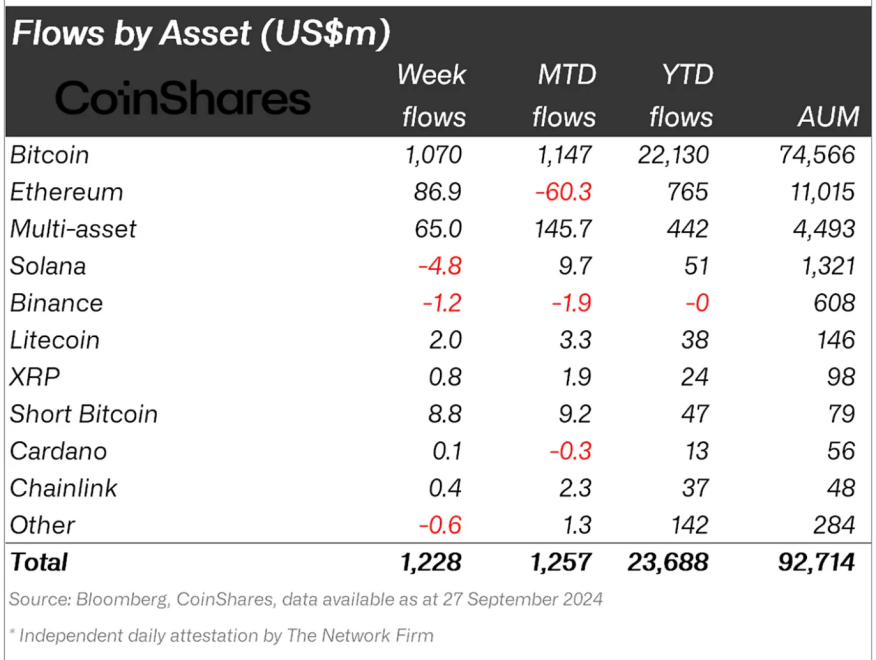
Crypto asset flows
Crypto asset flows. | Source: CoinShares

In contrast, Solana-based investment products ended their five-week streak of net inflows. During the last week, $4.8 million was withdrawn from Solana funds globally.

While Solana has seen a period of growth and positive sentiment, the reversal indicates that investors may be looking to shift their focus to more established assets like Bitcoin and Ethereum in the short term.

Crypto TOTAL Market Cap on TradingView.com
The global digital currency market cap value on the 1-day chart. Source: Crypto TOTAL Market Cap on TradingView.com

Featured image created with DALL-E, Chart from TradngView

Samuel Edyme

Samuel Edyme

Edyme is a writer, a content writer that specialises in writing about the crypto realm. Asides Bitcoinist and NewsBTC, Edyme's writing has been featured in top sites such as Blockchain.News, CoinMonk, Blockchain Reporter, Bitcoin Insider among others.

Trending Cryptos

Related Reads

In the AI Era, What's Left for Bitcoin?

As Bitcoin falls below $60,000, the author reflects on the relationship between AI and Bitcoin, seeing them as two sides of the same coin. In the AI era, the cost of generating content has plummeted, making fake text, images, and videos increasingly easy and cheap to produce. This has led to a fundamental shift: while AI dramatically lowers the cost of information production, it also undermines trust and authenticity online. What becomes truly valuable is not more content, but the ability to verify what is real—"verifiability." This perspective offers a new lens for Bitcoin. Its massive energy consumption, often criticized as wasteful, is reinterpreted. While AI burns energy to enhance "capability" and efficiency, Bitcoin burns energy to produce "verifiability." Its purpose is not to be trusted but to enable a system where no trust in intermediaries—banks, platforms, or developers—is needed. Every transaction and the entire ledger's history is secured by cryptography and a decentralized network of nodes, making it independently verifiable. AI cannot forge a transaction on the Bitcoin network because the system is designed for proof, not generation. The author draws a historical parallel to the Renaissance: the printing press drastically reduced the cost of copying knowledge, while double-entry bookkeeping reduced the cost of trust in commerce. Today, AI is the new printing press, reducing content creation costs to near zero. Blockchain, and Bitcoin as its pioneer, may be the modern equivalent of double-entry bookkeeping—a foundational technology for verifying digital asset ownership and historical records without centralized authorities. Thus, AI and blockchain are not competitors. AI lowers the cost of creation; blockchain lowers the cost of verification. In an age where AI can generate anything, true scarcity may lie not in more content, but in independently verifiable facts. Whether the market will reprice Bitcoin accordingly remains uncertain, but its core value proposition as a "machine for producing verifiability" becomes strikingly relevant.

marsbit1h ago

In the AI Era, What's Left for Bitcoin?

marsbit1h ago

In the Age of AI, What's Left for Bitcoin?

Author: Sevclub, Seven Research Amid Bitcoin's recent drop below $60k, the author reflects on a growing sense that AI and Bitcoin are two sides of the same coin. Today, encountering any content triggers a new default question: "Was this made by AI?" The cost of generating convincing text, images, and video is now negligible. While the internet lowered information *distribution* costs, AI is crashing information *production* costs to near zero. The consequence is a flood of content where truth and falsehood are increasingly indistinguishable. In this environment, what becomes truly valuable is not more information, but the ability to verify what is real—"verifiability." This reframes the common criticism that Bitcoin "wastes electricity." AI consumes power to produce "capability" (e.g., more powerful models). Bitcoin consumes power to produce something else: "verifiability." Bitcoin's core purpose isn't about belief or trust in any institution, developer, or even its creator. It's about enabling independent verification. Every bitcoin's origin, every transaction, and the integrity of the entire ledger are secured by mathematics, cryptography, and a global network of nodes. AI can fabricate convincing media, but it cannot falsify a transaction on the Bitcoin network. The expended energy makes篡改历史 (tampering with history) prohibitively expensive, purchasing a globally verifiable ledger. The author draws a historical parallel to the Renaissance. The printing press drastically reduced the cost of copying knowledge, while double-entry bookkeeping reduced the cost of trust in commerce—one enabled creation, the other verification. Today, AI is the new printing press, driving content production costs toward zero. The question becomes: what is this era's "double-entry bookkeeping"? Blockchain appears to be the leading candidate. It doesn't verify which news is true or which image is real, but it provides a foundational layer for independently verifying asset ownership and historical records in the digital realm without centralized authorities. Therefore, AI and blockchain are not in competition. AI lowers the cost of *generation*. Blockchain (and Bitcoin as a prime example) lowers the cost of *verification*. One creates, the other proves. Whether Bitcoin ultimately succeeds remains uncertain, facing potential challenges from quantum computing, regulation, and technical evolution. However, the author now sees it less as a "machine for making bitcoin" and more as a "machine for making verifiability." In an age where AI can generate anything, true scarcity may no longer be "more content," but "more independently verifiable facts." Whether the market will price this accordingly is a separate question.

链捕手1h ago

In the Age of AI, What's Left for Bitcoin?

链捕手1h ago

Trading

Spot

Hot Articles

Discussions

Welcome to the HTX Community. Here, you can stay informed about the latest platform developments and gain access to professional market insights. Users' opinions on the price of ETH (ETH) are presented below.

活动图片