Bitcoin Forms Inverse Head And Shoulders Pattern, Next Bullish Rally Imminent?

bitcoinistPublished on 2024-09-26Last updated on 2024-09-26

Abstract

The much-anticipated rally for Bitcoin could be upon us as the largest crypto asset has formed an inverse head and...

The much-anticipated rally for Bitcoin could be upon us as the largest crypto asset has formed an inverse head and shoulders pattern, a bullish technical indicator, signaling a potential breakout on the upside. Given the growing market optimism and improving sentiment currently, the pattern may serve as the impetus for BTC’s next rally.

Head And Shoulders Pattern Sparks Upside Breakout For Bitcoin

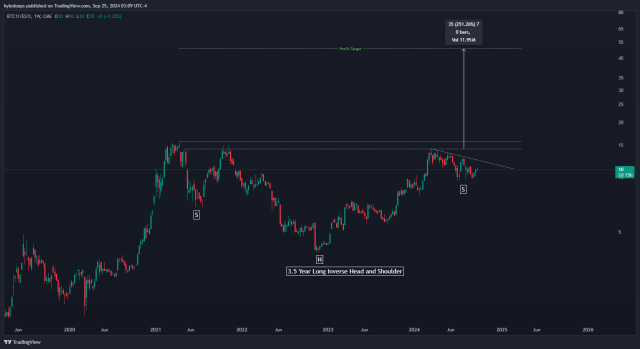
Market expert and host of the Crypto Banter show, Kyle Doops, has cited an inverse head and shoulders formation on the Bitcoin chart, which has captured the interest of crypto enthusiasts who speculate that a huge upward shift in BTC’s price in the short-term.

An inverse head and shoulders formation denotes the end of a declining trend. This simply means that Bitcoin might be preparing for a possible price breakout to mark the complete end of the current consolidation phase. According to the market expert, for more than 2 and half years, BTC has been forming the inverse head and shoulders pattern against the S&P 500 (SPX), hinting at a bullish move in the near future.

Kyle Doops pointed out that the current development of the right shoulder suggests that there has not been a proper Bitcoin bull run in the past 3.5 years. In addition, returns of the flagship crypto asset in relation to the SPX have not been altered since 2021.
Bitcoin
Bitcoin forms an inverse head and shoulders formation | Source: Kyle Doops on X

Considering these developments, the market expert is confident about BTC’s prospects in the short and long term as he expects a breakout in Q4 of this year, possibly igniting the “real bull run” against legacy markets.

The analyst also points to an impending price surge for Bitcoin based on the Short-Term holder’s and Long-Term holder’s Realized Price metric. This metric, which shows the average price at which various categories of holders are buying and selling BTC is presently depicting increasing market confidence.

Kyle Doops highlighted that the realized price for short-term holders has officially broken out above after 3 months of resistance, suggesting that a Bitcoin surge might be imminent. However, consolidation is essential to validate this trend reversal.

Thus, the expert has underlined a crucial key support level at $62,000 for investors to watch out for and a rising peak to increase demand and confidence as they navigate the volatile market.

Is BTC’s Renewed Strength Waning?

Today, BTC faced a setback that caused its price to fall from $64,000 to the $62,500 level. However, the crypto asset is gradually experiencing an upward movement, recovering to the $63,800 price mark.

At the time of writing, BTC has rebounded to $63,828, indicating a mere increase of 0.07% in the past day. In other longer time frames like the 7-day and 1-month time frame, the coin has risen by about 2.77% and 1.48% respectively.

Nevertheless, BTC’s trading volume market cap is demonstrating a worrisome trend, falling by over 17% and 0.01% respectively in the past day according to data from CoinMarketCap.

Bitcoin
BTC trading at $63,833 on the 1D chart | Source: BTCUSDT on Tradingview.com
Featured image from Unsplash, chart from Tradingview.com
Godspower Owie

Godspower Owie

Godspower Owie is my name, and I work for the news platforms NewsBTC and Bitcoinist. I sometimes like to think of myself as an explorer since I enjoy exploring new places, learning new things, especially valuable ones, and meeting new people who have an impact on my life, no matter how small. I value my family, friends, career, and time. Really, those are most likely the most significant aspects of every person's existence. Not illusions, but dreams are what I pursue.

Trending Cryptos

Related Reads

AGI Countdown: OpenAI's Chief Research Officer Makes Major Statement — The Window for Humanity is 'Very Small'

The countdown to AGI has begun, according to OpenAI's Chief Scientist Mark Chen, who states the window for human-centric progress is "very small." Chen argues that AI is reaching a point where models can perform "self-sustaining research," autonomously driving innovation in fields from mathematics to programming. He points to the proliferation of AI's "superhuman" insights—akin to AlphaGo's legendary "Move 37"—across disciplines as evidence of this shift. Chen firmly dismisses claims that scaling laws are plateauing or that pre-training is dead, asserting the field remains on an exponential curve. He cites OpenAI's successful bet on reasoning models like o1 as proof that fundamental breakthroughs are still possible. The future of research, he suggests, lies with "Vibe Researchers"—humans who provide high-level direction and "taste" while AI handles execution and orchestration of complex, long-horizon tasks. However, significant hurdles remain. Chen highlights a "benchmarking crisis," where models can overfit to existing tests without gaining true generalization. He also notes the "jagged frontier" of AI capabilities, where systems excel at advanced reasoning but struggle with contextual, continual learning from everyday experiences. Despite these challenges, he expresses confidence that these gaps will be closed. In a personal reflection, Chen shares that post-AGI, his wish is to open a noodle shop—a metaphor emphasizing that when AI masters knowledge and innovation, uniquely human experiences, warmth, and storytelling will become the ultimate form of value.

marsbit4m ago

AGI Countdown: OpenAI's Chief Research Officer Makes Major Statement — The Window for Humanity is 'Very Small'

marsbit4m ago

China's No.1, Closing in on OpenAI, Mysterious "Sweeping Monk" Rises to Top Seven Globally

A mysterious Chinese AI project named "MopMonk" (meaning "Sweeping Monk") has achieved a top-ranking result on the globally recognized CyberGym cybersecurity benchmark. With a 73.1% success rate, it ranks seventh worldwide and first among Chinese entries, performing closely behind OpenAI. The significance lies in the benchmark itself. CyberGym, created by UC Berkeley, is considered a premier "Olympics" for AI security. It tests models on over 1500 real-world software vulnerabilities, requiring them to not just identify but actually generate working exploits (PoCs) in a complex, offline environment. This moves beyond simple knowledge to testing an AI's practical "execution" capabilities. MopMonk's approach is notable. It uses the open-source MiniMax M3 model from Shanghai as its powerful reasoning "brain," leveraging its strong coding skills and long context window. However, the key to its performance is a custom-built, multi-agent security framework—its "Harness." This system uses structured "vulnerability memory" to efficiently guide the search for exploits, allowing multiple agents to explore in parallel while sharing lessons learned from failures. This engineering layer effectively translates the model's intelligence into actionable, iterative testing steps. The project remains highly secretive, with no official website or team information, embodying the "dark horse" spirit of its literary namesake. Its success highlights a potential industry shift: beyond simply scaling model size, the engineering of specialized agent systems (the Harness) is becoming a critical differentiator for real-world AI application performance, especially in complex domains like cybersecurity.

marsbit32m ago

China's No.1, Closing in on OpenAI, Mysterious "Sweeping Monk" Rises to Top Seven Globally

marsbit32m ago

Will History Repeat Itself? Fidelity Lists Five Catalysts to End the Crypto Winter

Fidelity's new report suggests that the current crypto winter for Bitcoin may be nearing its end, identifying five potential catalysts that could drive a market turnaround based on historical patterns. First, Bitcoin's approximately four-year cycle, driven by its halving mechanism, historically marks peaks and troughs. The last bottom was in November 2022, potentially pointing to the next around November 2026, though cycle length can vary. Second, clearer regulation has often preceded past bull markets. The focus is now on the CLARITY Act, which aims to clarify US digital asset oversight between the SEC and CFTC. Its passage could unlock domestic activity currently held back by legal uncertainty. Third, Federal Reserve monetary policy plays a role. A shift to lower interest rates tends to correlate with rising crypto prices by reducing borrowing costs and boosting risk appetite, though markets may price this in well ahead of any official change. Fourth, the emergence of breakthrough applications can fuel investor interest. Current trends like real-world asset tokenization, AI-related crypto infrastructure, and stablecoins are being watched, but history shows the biggest catalysts are often unexpected. Fifth, a new wave of institutional adoption could be a trigger. While ongoing adoption in 2026 hasn't sparked a new bull run, a major unexpected move—like a significant purchase by a tech giant or adoption as a hedge in a global crisis—could create a powerful new narrative. Fidelity concludes that while the market is in a downturn, historical turning points have often resulted from a combination of such factors, and the next phase for Bitcoin may depend on which of these catalysts materializes first.

Foresight News40m ago

Will History Repeat Itself? Fidelity Lists Five Catalysts to End the Crypto Winter

Foresight News40m ago

US CFTC Launches Broad Investigation into Polymarket, Is the Prediction Market Party Coming to an End?

The U.S. Commodity Futures Trading Commission (CFTC) is conducting a broad investigation into the prediction market platform Polymarket, focusing on its business practices including social media promotions. This follows a bipartisan letter from U.S. senators urging the CFTC to probe alleged fraudulent marketing tactics used to promote gambling-like products. The action coincides with a period of explosive growth for the prediction market sector, driven by events like the World Cup, with platforms like Kalshi and Robinhood reporting record trading volumes and revenue. The investigation signals a potential end to the sector's unregulated expansion and may lead to clearer federal oversight, particularly regarding investor protection and distinguishing prediction markets from traditional sports betting. The CFTC's move has also intensified a jurisdictional conflict with multiple U.S. states (including Kentucky and New York), which have sued platforms like Polymarket and Kalshi, accusing them of operating illegal sports betting and threatening state gambling tax revenues. Furthermore, the CME Group has sued the CFTC, challenging its approval of certain prediction market products. The report also highlights the political and capital interests intertwined with the industry. Donald Trump Jr. holds advisory and investment roles in both Kalshi and Polymarket, and the Trump administration has previously emphasized federal regulatory authority over these markets. The CFTC's investigation into Polymarket is framed as a step towards formalizing the industry's regulatory landscape, moving it from a phase of "wild growth" towards a more structured future.

marsbit2h ago

US CFTC Launches Broad Investigation into Polymarket, Is the Prediction Market Party Coming to an End?

marsbit2h ago

Trading

Spot

Hot Articles

What is $BITCOIN

DIGITAL GOLD ($BITCOIN): A Comprehensive Analysis Introduction to DIGITAL GOLD ($BITCOIN) DIGITAL GOLD ($BITCOIN) is a blockchain-based project operating on the Solana network, which aims to combine the characteristics of traditional precious metals with the innovation of decentralized technologies. While it shares a name with Bitcoin, often referred to as “digital gold” due to its perception as a store of value, DIGITAL GOLD is a separate token designed to create a unique ecosystem within the Web3 landscape. Its goal is to position itself as a viable alternative digital asset, although specifics regarding its applications and functionalities are still developing. What is DIGITAL GOLD ($BITCOIN)? DIGITAL GOLD ($BITCOIN) is a cryptocurrency token explicitly designed for use on the Solana blockchain. In contrast to Bitcoin, which provides a widely recognized value storage role, this token appears to focus on broader applications and characteristics. Notable aspects include: Blockchain Infrastructure: The token is built on the Solana blockchain, known for its capacity to handle high-speed and low-cost transactions. Supply Dynamics: DIGITAL GOLD has a maximum supply capped at 100 quadrillion tokens (100P $BITCOIN), although details regarding its circulating supply are currently undisclosed. Utility: While precise functionalities are not explicitly outlined, there are indications that the token could be utilized for various applications, potentially involving decentralized applications (dApps) or asset tokenization strategies. Who is the Creator of DIGITAL GOLD ($BITCOIN)? At present, the identity of the creators and development team behind DIGITAL GOLD ($BITCOIN) remains unknown. This situation is typical among many innovative projects within the blockchain space, particularly those aligning with decentralized finance and meme coin phenomena. While such anonymity may foster a community-driven culture, it intensifies concerns about governance and accountability. Who are the Investors of DIGITAL GOLD ($BITCOIN)? The available information indicates that DIGITAL GOLD ($BITCOIN) does not have any known institutional backers or prominent venture capital investments. The project seems to operate on a peer-to-peer model focused on community support and adoption rather than traditional funding routes. Its activity and liquidity are primarily situated on decentralized exchanges (DEXs), such as PumpSwap, rather than established centralized trading platforms, further highlighting its grassroots approach. How DIGITAL GOLD ($BITCOIN) Works The operational mechanics of DIGITAL GOLD ($BITCOIN) can be elaborated on based on its blockchain design and network attributes: Consensus Mechanism: By leveraging Solana’s unique proof-of-history (PoH) combined with a proof-of-stake (PoS) model, the project ensures efficient transaction validation contributing to the network's high performance. Tokenomics: While specific deflationary mechanisms have not been extensively detailed, the vast maximum token supply implies that it may cater to microtransactions or niche use cases that are still to be defined. Interoperability: There exists the potential for integration with Solana’s broader ecosystem, including various decentralized finance (DeFi) platforms. However, the details regarding specific integrations remain unspecified. Timeline of Key Events Here is a timeline that highlights significant milestones concerning DIGITAL GOLD ($BITCOIN): 2023: The initial deployment of the token occurs on the Solana blockchain, marked by its contract address. 2024: DIGITAL GOLD gains visibility as it becomes available for trading on decentralized exchanges like PumpSwap, allowing users to trade it against SOL. 2025: The project witnesses sporadic trading activity and potential interest in community-led engagements, although no noteworthy partnerships or technical advancements have been documented as of yet. Critical Analysis Strengths Scalability: The underlying Solana infrastructure supports high transaction volumes, which could enhance the utility of $BITCOIN in various transaction scenarios. Accessibility: The potential low trading price per token could attract retail investors, facilitating wider participation due to fractional ownership opportunities. Risks Lack of Transparency: The absence of publicly known backers, developers, or an audit process may yield skepticism regarding the project's sustainability and trustworthiness. Market Volatility: The trading activity is heavily reliant on speculative behavior, which can result in significant price volatility and uncertainty for investors. Conclusion DIGITAL GOLD ($BITCOIN) emerges as an intriguing yet ambiguous project within the rapidly evolving Solana ecosystem. While it attempts to leverage the “digital gold” narrative, its departure from Bitcoin's established role as a store of value underscores the need for a clearer differentiation of its intended utility and governance structure. Future acceptance and adoption will likely depend on addressing the current opacity and defining its operational and economic strategies more explicitly. Note: This report encompasses synthesised information available as of October 2023, and developments may have transpired beyond the research period.

524 Total ViewsPublished 2025.05.13Updated 2025.05.13

What is $BITCOIN

Discussions

Welcome to the HTX Community. Here, you can stay informed about the latest platform developments and gain access to professional market insights. Users' opinions on the price of BTC (BTC) are presented below.

活动图片