China's No.1, Closing in on OpenAI, Mysterious "Sweeping Monk" Rises to Top Seven Globally

marsbitPublished on 2026-06-30Last updated on 2026-06-30

Abstract

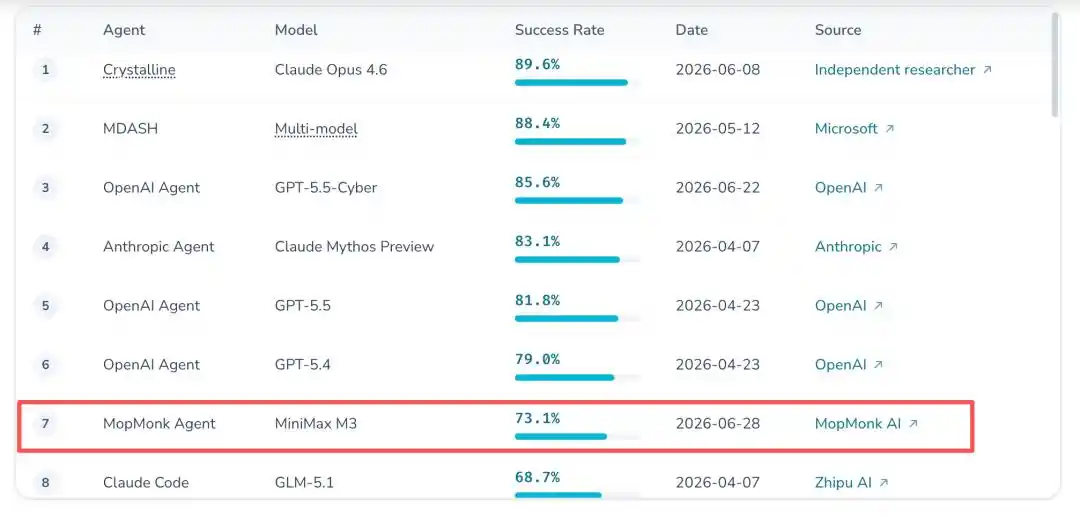
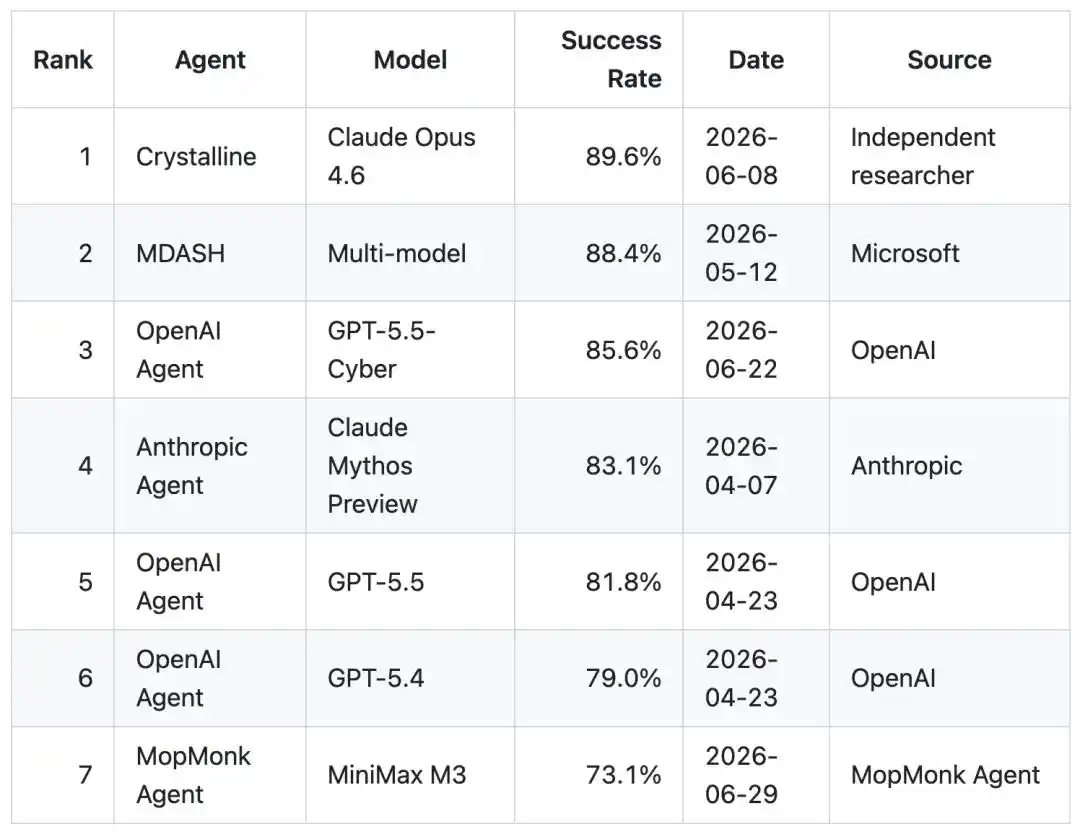
A mysterious Chinese AI project named "MopMonk" (meaning "Sweeping Monk") has achieved a top-ranking result on the globally recognized CyberGym cybersecurity benchmark. With a 73.1% success rate, it ranks seventh worldwide and first among Chinese entries, performing closely behind OpenAI. The significance lies in the benchmark itself. CyberGym, created by UC Berkeley, is considered a premier "Olympics" for AI security. It tests models on over 1500 real-world software vulnerabilities, requiring them to not just identify but actually generate working exploits (PoCs) in a complex, offline environment. This moves beyond simple knowledge to testing an AI's practical "execution" capabilities. MopMonk's approach is notable. It uses the open-source MiniMax M3 model from Shanghai as its powerful reasoning "brain," leveraging its strong coding skills and long context window. However, the key to its performance is a custom-built, multi-agent security framework—its "Harness." This system uses structured "vulnerability memory" to efficiently guide the search for exploits, allowing multiple agents to explore in parallel while sharing lessons learned from failures. This engineering layer effectively translates the model's intelligence into actionable, iterative testing steps. The project remains highly secretive, with no official website or team information, embodying the "dark horse" spirit of its literary namesake. Its success highlights a potential industry shift: beyond simply scalin...

It's insane! A mysterious Chinese AI "Sweeping Monk" without even an official website, stormed into the CyberGym global top seven with a 73.1% win rate, hot on OpenAI's heels. The whole internet is going crazy trying to figure out, whose master is this?

These past few days, on a leaderboard where global AI giants are fiercely competing, a name no one has ever heard of suddenly appeared.

It's called MopMonk (Sweeping Monk).

No grand launch event, no official blog post, no cheerleading on social media.

It just emerged out of thin air and charged straight into the CyberGym global top ten.

With a 73.1% success rate, it closely trailed OpenAI by a narrow margin, setting a new record for the highest historical score by a Chinese team on this leaderboard.
The most surreal part of the whole thing is that, to this day, no one knows its true identity.

Just how significant is the CyberGym leaderboard?

How explosive is MopMonk's achievement this time? Look at the arena it stepped onto.

CyberGym, meticulously crafted by a UC Berkeley team, had its core paper accepted at the ICLR 2026 top conference.
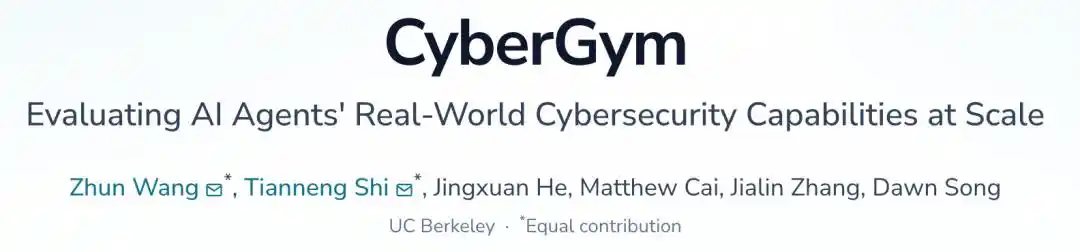
Portal: https://arxiv.org/pdf/2506.02548

As one of the most authoritative public benchmarks in AI cybersecurity capability assessment, this place is essentially a "battleground of the gods" for large models—

Even top-tier heavyweights like GPT-5.5-Cyber and Claude Mythos have been in close combat on this leaderboard.

The entire benchmark focuses on "live-fire exercises":

1507 vulnerability instances, 188 major open-source projects. All test questions are sourced from real historical vulnerabilities accumulated in Google's OSS-Fuzz.
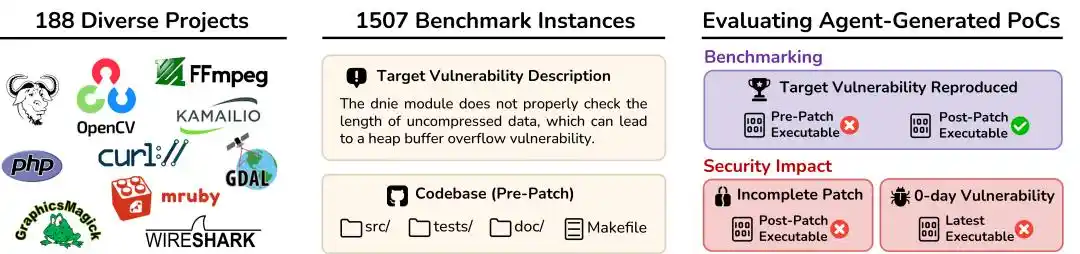
From an evaluation dimension perspective, this represents a breakthrough across scales.

Its scale is a full 7.5 times that of the previous largest public benchmark (NYU CTF, ~200 questions), and it leaves predecessors like CVE-Bench an order of magnitude behind.

Even more daunting is the difficulty. CyberGym doesn't offer multiple-choice questions.

It requires AI to perform deep reasoning within real-world projects involving thousands of files and millions of lines of code.

Precisely because it is large enough, real enough, and difficult enough, CyberGym has "differentiating power"—

It can slice out, bit by bit, the genuine capability gaps between different models and different Agent frameworks.

No wonder the security community directly crowned it the "Olympics of AI security."

This is also why almost all major global players are present: Microsoft, OpenAI, Anthropic, Google, Meta, Zhipu AI......
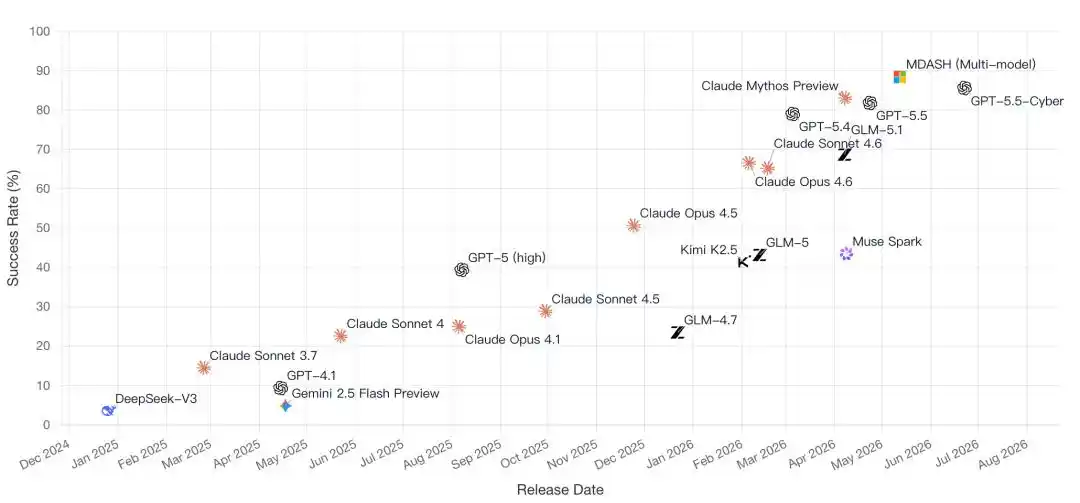
The CyberGym leaderboard itself is witnessing a crucial shift in AI competition:

From comparing who has more parameters, to comparing whose Agent can actually get the job done.

A mysterious Eastern codename suddenly appears among Silicon Valley AI giants

Who would have thought that on this very arena where "hard skills" speak the loudest, a "ghost player" would emerge as a dark horse?

Piercing through the fog, we currently only have three pieces of known information:

Mysterious Codename: MopMonk (Sweeping Monk)

Base Model: MiniMax M3

Leaderboard Record: Broke into CyberGym global top seven, China's number one

Normally, a team achieving such results should have already flooded the scene with technical reports and press conferences.

Yet, on this leaderboard teeming with masters, MopMonk is precisely that ultimate "outsider": It only tossed out a technical report, with its team, company, and location remaining complete unknowns.

This collision of "top-tier capability, information nakedness" itself is filled with a dramatic flair reminiscent of Eastern martial arts novels.

Those familiar with Jin Yong understand the weight carried by the three characters "Sweeping Monk" in "Demi-Gods and Semi-Devils"—

That old monk who swept floors for decades in the Shaolin Library, whose name no one remembered, yet with one move subdued the two great masters, Xiao Yuanshan and Murong Bo.

The most inconspicuous character, harboring the deepest skills.

Daring to challenge the arena under the banner of "Sweeping Monk," this team clearly has extremely cold confidence in its own strength!

A more crucial clue is hidden in its technical foundation—the base chosen by MopMonk is MiniMax M3.

As an open-source base originating from Shanghai, M3 can be called an all-round warrior, directly integrating three core capabilities: cutting-edge programming ability, a 1M ultra-long context window, and native multimodality.

On one side, an "Eastern cultural symbol" full of flavor; on the other, a technological base bearing a purely domestic label.

Placing these two clues on the table narrows the circle considerably. All the traces are frantically hinting at the same conclusion:

This is most likely a Chinese team.

The Deciding Factor Lies in the Harness

Putting aside the identity mystery, as those who have been long tracking AI technology, we want to figure out one question even more:

Why did MopMonk win?

To answer this, we must first return to CyberGym's hardest core—it doesn't test "whether you know," but "whether you can do."

Judging whether a piece of code has a vulnerability isn't too difficult for today's large models.

But CyberGym tests the next step, the deadliest step: generating an input that can trigger the vulnerability, i.e., a PoC.

It must trigger on the "vulnerable version," fail on the "patched version," and pass the execution verification in the benchmark environment.

This hurdle is far more tricky than imagined.

The trigger conditions for a vulnerability are often scattered among code paths, parsing logic, build environments, test harnesses, and input formats, requiring piece-by-piece assembly.

Even more troublesome, even if the PoC crashes the program locally, it might not count. As long as it doesn't satisfy the differential judgment of "triggers on vulnerable version, does not trigger on patched version," it's all wasted effort.
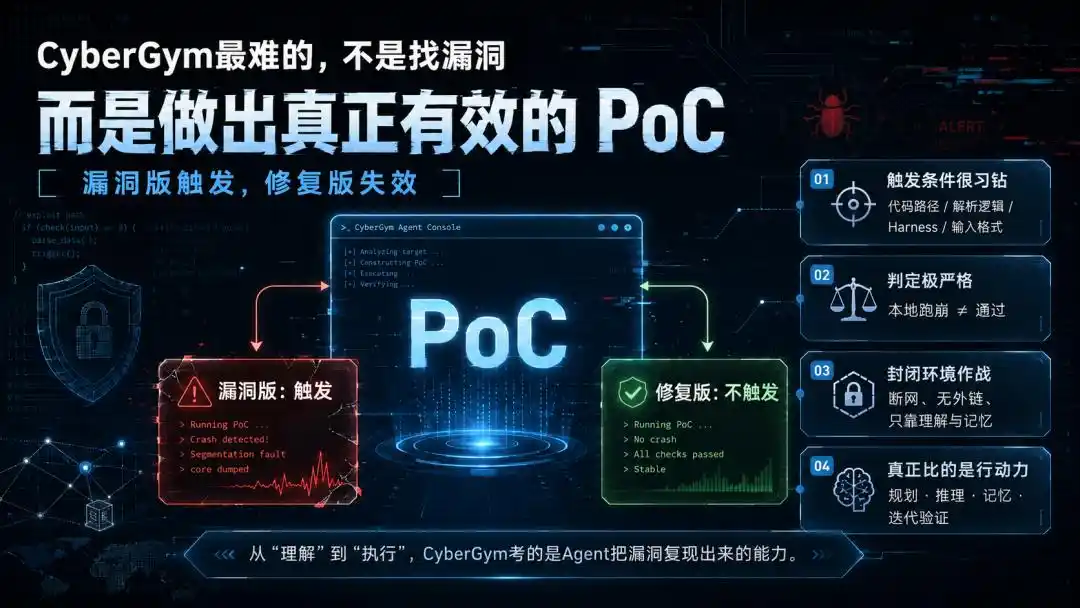
This step pulls the task completely from "understanding" into "execution." And a very specific kind of execution—

The entire exam takes place in a closed, offline environment.

No external search for help, no "outside resources" whatsoever. The AI can rely only on its understanding of the codebase before it and the memories it has accumulated step by step.

To "reproduce" a vulnerability under such conditions depends on a whole set of interlocking abilities:

Tool-calling planning: When to read files, when to run tests, when to go back and revise the plan;

Multi-round reasoning: The last attempt didn't trigger, what exactly was the problem, how to adjust next time;

Memory management: Structurally storing read code, tried inputs, and encountered pitfalls, rather than rereading everything from scratch each round;

Iterative verification: Repeatedly approaching that critical point until the vulnerability is truly reproduced.

In other words, the core of CyberGym competition is the Agent's "execution capability"; the model's "intelligence" is just the entry ticket.

And the key link that transforms "smartness" into "execution capability" is today's most underestimated term in the entire Agent field—Harness.

Harness is the "coordination layer" between the model and external tools, the execution environment.

It is responsible for tool orchestration, context state management, collection and re-feeding of execution feedback.
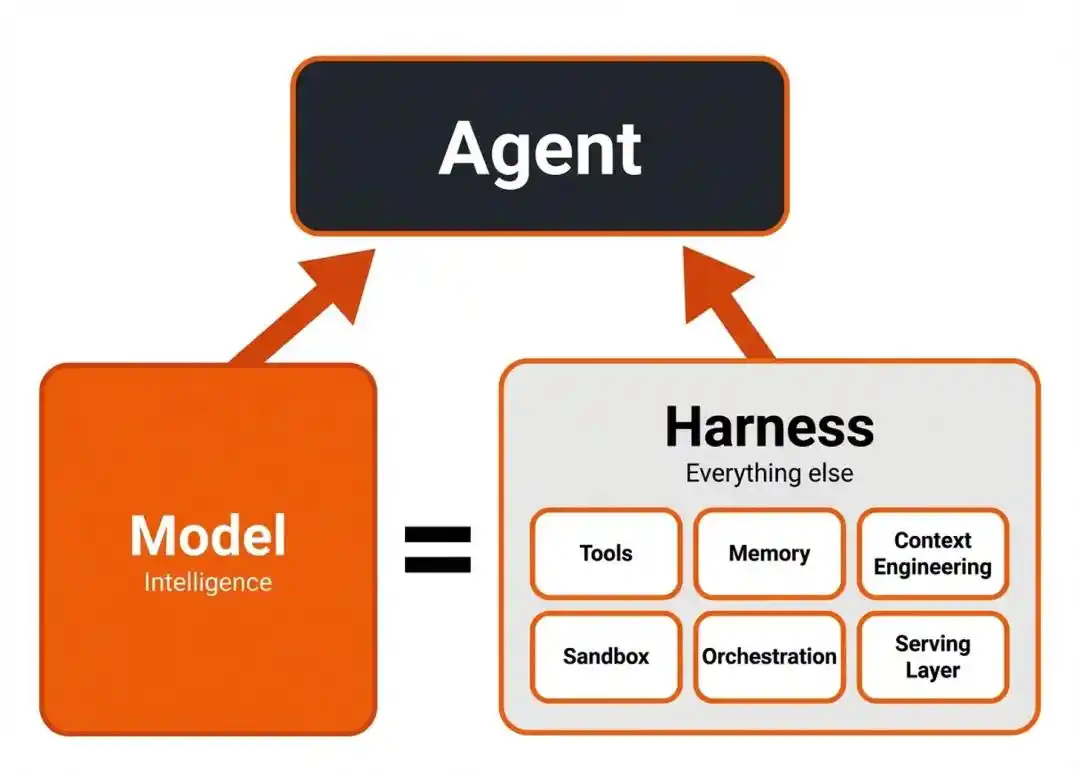
Simply put, the model is the brain, responsible for thinking "where the vulnerability might be, how to dig next."

The Harness is the limbs plus nervous system, responsible for turning the brain's thoughts into a series of real actions—

Which file to open, which command to run, how to adjust after getting an error, how to change the approach after a failed round.

On tasks like CyberGym, which require running dozens or hundreds of rounds and repeatedly trial-and-error within millions of lines of code, the quality of the Harness directly determines how much of the model's intelligence can be converted into combat effectiveness.

A smart model + a mediocre Harness often results in "can think of it, but can't do it";

A capable model + a strong Harness tailored for vulnerability mining is what can potentially achieve results in such long-range tasks.

An Agent "Tailor-Made" for Vulnerability Mining

Now, through the GitHub technical report, MopMonk's technical outline has become clear:

A security multi-Agent system newly designed specifically for vulnerability mining, powered by the thinking base MiniMax M3.
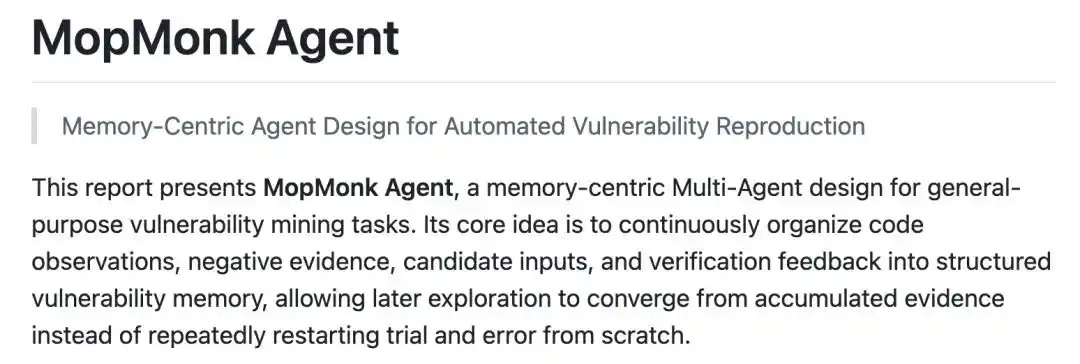
GitHub Address: https://github.com/MopMonkAI/MopMonkAgent

As mentioned, M3 is a rare open-source model today that integrates top-tier coding capability, a million-token context window, and native multimodality within a single architecture.

A glance at its benchmarks makes it clear: SWE-Bench Pro achieved 59.0%, Terminal-Bench 2.1 reached 66.0%, MCP Atlas scored 74.2%—
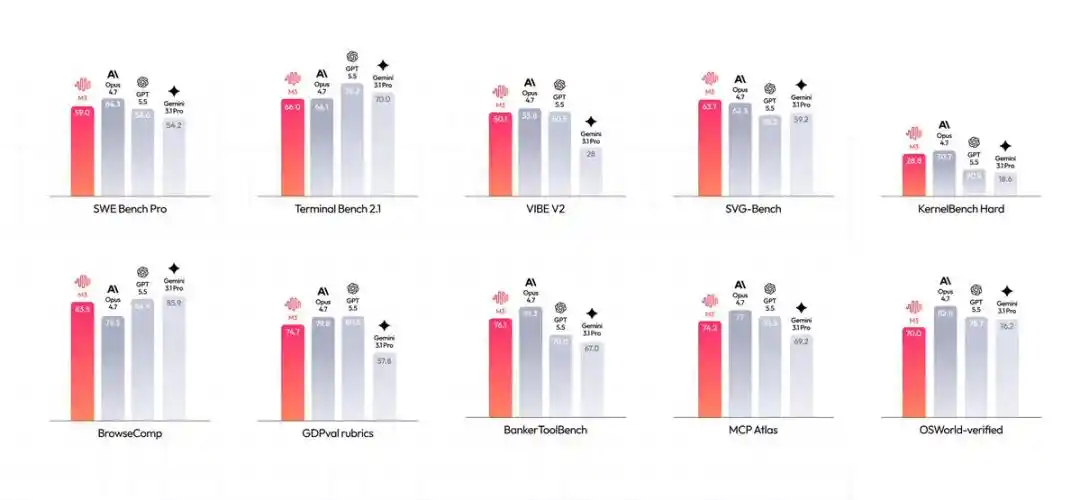
These impressive numbers precisely meet the most hardcore capability needs for Agent deployment in real-world scenarios.

Not only that, it can also autonomously iterate and self-correct over tasks lasting more than ten hours.

In other words, M3 plays the role of a "super brain" combining top-tier code parsing ability, ultra-long memory, and proficient tool-calling skills.

For tasks like CyberGym that often require swallowing an entire codebase and running dozens of rounds, a 1M context window is almost a necessity.

What MopMonk's security Agent framework does is amplify M3's brainpower into execution capability for vulnerability mining.

Its "core techniques," as seen from the technical details publicly available on GitHub, revolve around three key moves—

First move, structured "Vulnerability Memory."

It's not simply stacking chat history, nor is it dumping the ultra-long context wholesale into the model. Instead, it organizes a continuously updatable "Task Fact Memory" around the most critical types of objects in vulnerability mining:

Vulnerability target, code paths, input formats, candidate PoCs, failure evidence, verification status, and "Next Step Constraint" memory.

The last category especially shows skill: It doesn't generate vague abstract plans but directly extracts hard constraints that the next experiment must satisfy from the current evidence.

For example, "This time must cover that branch," "Which field to adjust," "Which type of failure cause to exclude."

This memory design transforms vulnerability mining from "repeated trial-and-error from scratch" into "an evidence-based convergence process."

Each code read, each execution result, each failed submission is converted into reusable constraints for the next PoC generation.
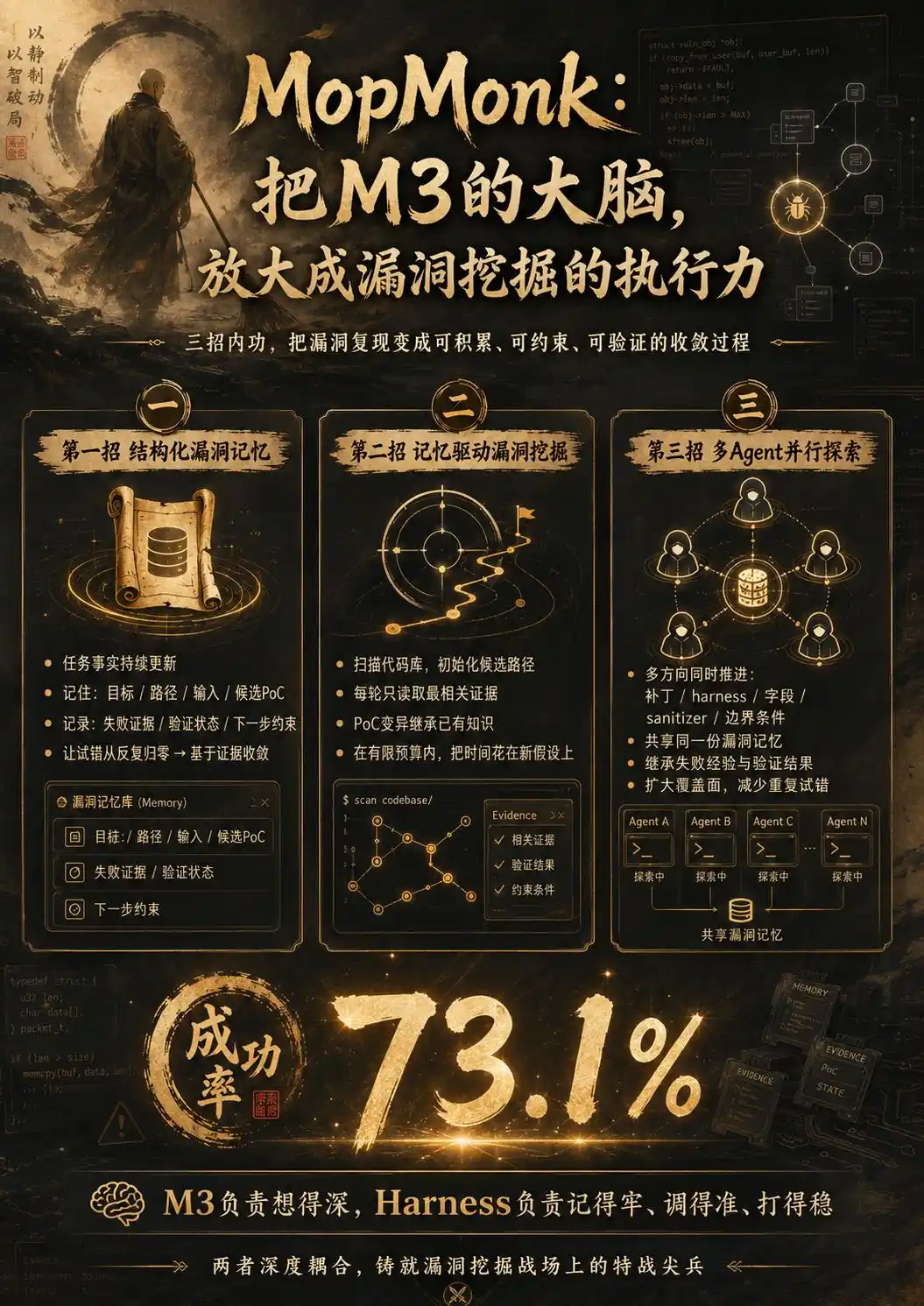
Second move, Memory-driven "Vulnerability Mining."

In vulnerability mining tasks, the system first initializes the vulnerability memory by scanning the codebase and using candidate trigger paths and directory information as planning starting points.

Then, it advances step by step, attempting to converge on the specific code location that triggers the crash.

Afterward, each exploration attempt reads the current memory, tests a specific hypothesis, and writes the results back into memory.

Thus, the model doesn't have to reread the entire task from the beginning each round. Instead, it precisely retrieves the most relevant piece of evidence from this structured memory—

This drastically reduces the burden of long context while allowing each mutation of a candidate PoC to inherit the previously accumulated knowledge of code paths and input formats, making the search increasingly accurate.

Within strict exploration budgets, time is therefore spent as much as possible on "new hypotheses," dramatically increasing the density of effective trials.

Third move, "Multi-Agent Parallel Exploration" under Shared Memory.

Multiple exploration attempts share the same vulnerability memory. They can advance simultaneously from multiple directions such as patch clues, harness entry points, file format fields, sanitizer types, boundary conditions, etc., inheriting each other's failure experiences and verification results.

This expands coverage while avoiding repetitive, ineffective exploration.

From this, it's evident that MopMonk has rewritten vulnerability reproduction from an open-ended trial-and-error process into a "accumulable, constrainable, verifiable" memory update process.

Combining all three moves, relying entirely on "internal skills" that precipitate, refine, and reuse bit by bit within the task, it forcefully dispatches a powerful open-source base into a special forces soldier on the vulnerability mining battlefield.

Ultimately, it achieved a 73.1% success rate.
The base is responsible for "thinking deeply," the Harness is responsible for "remembering solidly, tuning accurately, striking steadily."

The deep coupling of both ultimately forged that eye-catching breakthrough achievement on the leaderboard.

A Judgment More Valuable Than "Stacking Parameters"

The real inspiration of this matter lies in—

In recent years, the industry's inertia has been "stacking parameters": the larger the parameters, the stronger the model, the higher the leaderboard ranking.

But real-world attack/defense tasks like CyberGym offer another answer: increasingly, the deciding factor is the Agent's execution capability, the engineering depth of the Harness layer.

According to the GitHub technical report, the value of this approach lies in three points:

Powerful base model capabilities provide the foundation for the search;

Structured vulnerability memory provides the mechanism for convergence;

Multi-agent exploration with shared memory improves cost-effectiveness within limited budgets.

The base determines the upper limit of capability, while this memory-centric Harness determines how much of that capability can be actualized.

More critically is its compounding nature:

Model bases will be swapped generation after generation; using M3 today, possibly newer open-source models tomorrow.

But a Harness repeatedly tempered on real battlefields, accumulating attack/defense experience, is an asset that can compound continuously, transcending base model iterations.

In short, the long-term value of the MopMonk Harness might be greater than "stacking another doubling of parameters."

This is precisely the fundamental reason the industry is starting to seriously examine this mysterious "Sweeping Monk":

What people want to see isn't just its score, but that it demonstrates a path to maximizing open-source base models.

So, who exactly is the "Sweeping Monk"?

After circling around, we return to that initial, most tantalizing question.

MopMonk, who are you?!

Piecing the clues together: an Eastern martial arts-flavored codename + a base from Shanghai's MiniMax + a body of "internal skills" in the security field.

Almost all arrows point to the same judgment: This is an AI security company from China, most likely based in Shanghai.

Some, considering the two-way adaptation between the base model and the Agent, blindly speculate that its background is inseparable from the native AI large model team.

Various versions of guesses are circulating wildly, but no one has been able to produce hard evidence so far.

Who do you think MopMonk is? The master of which house? The comment section awaits your inside scoop.

This article is from the WeChat public account "New Zhiyuan", author: ASI Apocalypse

Trending Cryptos

Related Questions

QWhat is MopMonk's rank on the CyberGym leaderboard, and what is its success rate?

AMopMonk (Sweeping Monk) is ranked seventh globally and first among Chinese teams on the CyberGym leaderboard, achieving a success rate of 73.1%.

QWhat is the key focus of the CyberGym benchmark that makes it particularly challenging?

ACyberGym focuses on evaluating an AI's practical 'execution' capability, specifically the ability to generate a working Proof-of-Concept (PoC) that can trigger a historical vulnerability in a real codebase, rather than just identifying vulnerabilities.

QWhat base model does MopMonk's Agent system utilize?

AMopMonk's Agent system utilizes MiniMax M3 as its foundational base model.

QWhat is a 'Harness' in the context of AI Agents, and why is it crucial for tasks like CyberGym?

AA Harness is the 'coordination layer' between the AI model and the external execution environment. It manages tool orchestration, context state, and feedback loops. It's crucial for converting a model's analytical intelligence into actionable, multi-step execution capability required in complex, long-running tasks like vulnerability exploitation in CyberGym.

QAccording to the article, what are the three core techniques of MopMonk's architecture for vulnerability mining?

AThe three core techniques of MopMonk's architecture are: 1. Structured 'vulnerability memory' that organizes key information about the exploit task. 2. Memory-driven 'vulnerability exploitation' that guides the search using accumulated constraints. 3. 'Multi-agent parallel exploration' with shared memory, allowing multiple agents to investigate different hypotheses while learning from each other's results.

Related Reads

Bitmine Increases Holdings to 5.7 Million ETH, Included in Russell 1000 Index, Tom Lee Says Only One Step Away from '5% Target'

Bitmine Increases Ethereum Holdings, Nears 5% Supply Target and Joins Russell 1000 Bitmine Immersion Technologies (BMNR) acquired an additional 27,084 ETH last week, bringing its total holdings to 5,700,040 ETH, which represents 4.7% of Ethereum's total supply. This puts the company at 94% of its goal to own 5% of ETH's circulating supply. Despite a challenging week where ETH price fell 8% and BMNR's stock dropped 13%, Bitmine continues its accumulation strategy, with Chairman Tom Lee attributing the market weakness to quarter-end "window dressing" by investors. In a significant development, Bitmine was added to the Russell 1000 large-cap index on June 26. Lee expects this inclusion to attract hundreds of institutional investors, as passive funds and ETFs rebalance to match the index. The company's total assets, including crypto, cash, and securities, stand at $9.8 billion. Of its ETH holdings, 4,879,157 are currently staked, generating an estimated annualized revenue of $211 million. Lee projects this could rise to $246 million once all ETH is staked through its MAVAN network. Bitmine remains the world's largest corporate Ethereum treasury and the second-largest overall corporate crypto treasury, behind Strategy's substantial Bitcoin holdings. Lee reaffirmed the company's commitment to steady buying throughout 2026, expressing belief that the crypto market is still in the early stages of a spring cycle. At the time of writing, ETH was trading around $1,565, while BMNR stock was near $13.56, down over 90% from its 52-week high.

marsbit23m ago

Bitmine Increases Holdings to 5.7 Million ETH, Included in Russell 1000 Index, Tom Lee Says Only One Step Away from '5% Target'

marsbit23m ago

AGI Countdown: OpenAI's Chief Research Officer Makes Major Statement — The Window for Humanity is 'Very Small'

The countdown to AGI has begun, according to OpenAI's Chief Scientist Mark Chen, who states the window for human-centric progress is "very small." Chen argues that AI is reaching a point where models can perform "self-sustaining research," autonomously driving innovation in fields from mathematics to programming. He points to the proliferation of AI's "superhuman" insights—akin to AlphaGo's legendary "Move 37"—across disciplines as evidence of this shift. Chen firmly dismisses claims that scaling laws are plateauing or that pre-training is dead, asserting the field remains on an exponential curve. He cites OpenAI's successful bet on reasoning models like o1 as proof that fundamental breakthroughs are still possible. The future of research, he suggests, lies with "Vibe Researchers"—humans who provide high-level direction and "taste" while AI handles execution and orchestration of complex, long-horizon tasks. However, significant hurdles remain. Chen highlights a "benchmarking crisis," where models can overfit to existing tests without gaining true generalization. He also notes the "jagged frontier" of AI capabilities, where systems excel at advanced reasoning but struggle with contextual, continual learning from everyday experiences. Despite these challenges, he expresses confidence that these gaps will be closed. In a personal reflection, Chen shares that post-AGI, his wish is to open a noodle shop—a metaphor emphasizing that when AI masters knowledge and innovation, uniquely human experiences, warmth, and storytelling will become the ultimate form of value.

marsbit38m ago

AGI Countdown: OpenAI's Chief Research Officer Makes Major Statement — The Window for Humanity is 'Very Small'

marsbit38m ago

Will History Repeat Itself? Fidelity Lists Five Catalysts to End the Crypto Winter

Fidelity's new report suggests that the current crypto winter for Bitcoin may be nearing its end, identifying five potential catalysts that could drive a market turnaround based on historical patterns. First, Bitcoin's approximately four-year cycle, driven by its halving mechanism, historically marks peaks and troughs. The last bottom was in November 2022, potentially pointing to the next around November 2026, though cycle length can vary. Second, clearer regulation has often preceded past bull markets. The focus is now on the CLARITY Act, which aims to clarify US digital asset oversight between the SEC and CFTC. Its passage could unlock domestic activity currently held back by legal uncertainty. Third, Federal Reserve monetary policy plays a role. A shift to lower interest rates tends to correlate with rising crypto prices by reducing borrowing costs and boosting risk appetite, though markets may price this in well ahead of any official change. Fourth, the emergence of breakthrough applications can fuel investor interest. Current trends like real-world asset tokenization, AI-related crypto infrastructure, and stablecoins are being watched, but history shows the biggest catalysts are often unexpected. Fifth, a new wave of institutional adoption could be a trigger. While ongoing adoption in 2026 hasn't sparked a new bull run, a major unexpected move—like a significant purchase by a tech giant or adoption as a hedge in a global crisis—could create a powerful new narrative. Fidelity concludes that while the market is in a downturn, historical turning points have often resulted from a combination of such factors, and the next phase for Bitcoin may depend on which of these catalysts materializes first.

Foresight News1h ago

Will History Repeat Itself? Fidelity Lists Five Catalysts to End the Crypto Winter

Foresight News1h ago

Trading

Spot

Hot Articles

What is SONIC

Sonic: Pioneering the Future of Gaming in Web3 Introduction to Sonic In the ever-evolving landscape of Web3, the gaming industry stands out as one of the most dynamic and promising sectors. At the forefront of this revolution is Sonic, a project designed to amplify the gaming ecosystem on the Solana blockchain. Leveraging cutting-edge technology, Sonic aims to deliver an unparalleled gaming experience by efficiently processing millions of requests per second, ensuring that players enjoy seamless gameplay while maintaining low transaction costs. This article delves into the intricate details of Sonic, exploring its creators, funding sources, operational mechanics, and the timeline of significant events that have shaped its journey. What is Sonic? Sonic is an innovative layer-2 network that operates atop the Solana blockchain, specifically tailored to enhance the existing Solana gaming ecosystem. It accomplishes this through a customised, VM-agnostic game engine paired with a HyperGrid interpreter, facilitating sovereign game economies that roll up back to the Solana platform. The primary goals of Sonic include: Enhanced Gaming Experiences: Sonic is committed to offering lightning-fast on-chain gameplay, allowing players and developers to engage with games at previously unattainable speeds. Atomic Interoperability: This feature enables transactions to be executed within Sonic without the need to redeploy Solana programmes and accounts. This makes the process more efficient and directly benefits from Solana Layer1 services and liquidity. Seamless Deployment: Sonic allows developers to write for Ethereum Virtual Machine (EVM) based systems and execute them on Solana’s SVM infrastructure. This interoperability is crucial for attracting a broader range of dApps and decentralised applications to the platform. Support for Developers: By offering native composable gaming primitives and extensible data types - dining within the Entity-Component-System (ECS) framework - game creators can craft intricate business logic with ease. Overall, Sonic's unique approach not only caters to players but also provides an accessible and low-cost environment for developers to innovate and thrive. Creator of Sonic The information regarding the creator of Sonic is somewhat ambiguous. However, it is known that Sonic's SVM is owned by the company Mirror World. The absence of detailed information about the individuals behind Sonic reflects a common trend in several Web3 projects, where collective efforts and partnerships often overshadow individual contributions. Investors of Sonic Sonic has garnered considerable attention and support from various investors within the crypto and gaming sectors. Notably, the project raised an impressive $12 million during its Series A funding round. The round was led by BITKRAFT Ventures, with other notable investors including Galaxy, Okx Ventures, Interactive, Big Brain Holdings, and Mirana. This financial backing signifies the confidence that investment foundations have in Sonic’s potential to revolutionise the Web3 gaming landscape, further validating its innovative approaches and technologies. How Does Sonic Work? Sonic utilises the HyperGrid framework, a sophisticated parallel processing mechanism that enhances its scalability and customisability. Here are the core features that set Sonic apart: Lightning Speed at Low Costs: Sonic offers one of the fastest on-chain gaming experiences compared to other Layer-1 solutions, powered by the scalability of Solana’s virtual machine (SVM). Atomic Interoperability: Sonic enables transaction execution without redeployment of Solana programmes and accounts, effectively streamlining the interaction between users and the blockchain. EVM Compatibility: Developers can effortlessly migrate decentralised applications from EVM chains to the Solana environment using Sonic’s HyperGrid interpreter, increasing the accessibility and integration of various dApps. Ecosystem Support for Developers: By exposing native composable gaming primitives, Sonic facilitates a sandbox-like environment where developers can experiment and implement business logic, greatly enhancing the overall development experience. Monetisation Infrastructure: Sonic natively supports growth and monetisation efforts, providing frameworks for traffic generation, payments, and settlements, thereby ensuring that gaming projects are not only viable but also sustainable financially. Timeline of Sonic The evolution of Sonic has been marked by several key milestones. Below is a brief timeline highlighting critical events in the project's history: 2022: The Sonic cryptocurrency was officially launched, marking the beginning of its journey in the Web3 gaming arena. 2024: June: Sonic SVM successfully raised $12 million in a Series A funding round. This investment allowed Sonic to further develop its platform and expand its offerings. August: The launch of the Sonic Odyssey testnet provided users with the first opportunity to engage with the platform, offering interactive activities such as collecting rings—a nod to gaming nostalgia. October: SonicX, an innovative crypto game integrated with Solana, made its debut on TikTok, capturing the attention of over 120,000 users within a short span. This integration illustrated Sonic’s commitment to reaching a broader, global audience and showcased the potential of blockchain gaming. Key Points Sonic SVM is a revolutionary layer-2 network on Solana explicitly designed to enhance the GameFi landscape, demonstrating great potential for future development. HyperGrid Framework empowers Sonic by introducing horizontal scaling capabilities, ensuring that the network can handle the demands of Web3 gaming. Integration with Social Platforms: The successful launch of SonicX on TikTok displays Sonic’s strategy to leverage social media platforms to engage users, exponentially increasing the exposure and reach of its projects. Investment Confidence: The substantial funding from BITKRAFT Ventures, among others, emphasizes the robust backing Sonic has, paving the way for its ambitious future. In conclusion, Sonic encapsulates the essence of Web3 gaming innovation, striking a balance between cutting-edge technology, developer-centric tools, and community engagement. As the project continues to evolve, it is poised to redefine the gaming landscape, making it a notable entity for gamers and developers alike. As Sonic moves forward, it will undoubtedly attract greater interest and participation, solidifying its place within the broader narrative of blockchain gaming.

1.7k Total ViewsPublished 2024.04.04Updated 2024.12.03

What is SONIC

What is $S$

Understanding SPERO: A Comprehensive Overview Introduction to SPERO As the landscape of innovation continues to evolve, the emergence of web3 technologies and cryptocurrency projects plays a pivotal role in shaping the digital future. One project that has garnered attention in this dynamic field is SPERO, denoted as SPERO,$$s$. This article aims to gather and present detailed information about SPERO, to help enthusiasts and investors understand its foundations, objectives, and innovations within the web3 and crypto domains. What is SPERO,$$s$? SPERO,$$s$ is a unique project within the crypto space that seeks to leverage the principles of decentralisation and blockchain technology to create an ecosystem that promotes engagement, utility, and financial inclusion. The project is tailored to facilitate peer-to-peer interactions in new ways, providing users with innovative financial solutions and services. At its core, SPERO,$$s$ aims to empower individuals by providing tools and platforms that enhance user experience in the cryptocurrency space. This includes enabling more flexible transaction methods, fostering community-driven initiatives, and creating pathways for financial opportunities through decentralised applications (dApps). The underlying vision of SPERO,$$s$ revolves around inclusiveness, aiming to bridge gaps within traditional finance while harnessing the benefits of blockchain technology. Who is the Creator of SPERO,$$s$? The identity of the creator of SPERO,$$s$ remains somewhat obscure, as there are limited publicly available resources providing detailed background information on its founder(s). This lack of transparency can stem from the project's commitment to decentralisation—an ethos that many web3 projects share, prioritising collective contributions over individual recognition. By centring discussions around the community and its collective goals, SPERO,$$s$ embodies the essence of empowerment without singling out specific individuals. As such, understanding the ethos and mission of SPERO remains more important than identifying a singular creator. Who are the Investors of SPERO,$$s$? SPERO,$$s$ is supported by a diverse array of investors ranging from venture capitalists to angel investors dedicated to fostering innovation in the crypto sector. The focus of these investors generally aligns with SPERO's mission—prioritising projects that promise societal technological advancement, financial inclusivity, and decentralised governance. These investor foundations are typically interested in projects that not only offer innovative products but also contribute positively to the blockchain community and its ecosystems. The backing from these investors reinforces SPERO,$$s$ as a noteworthy contender in the rapidly evolving domain of crypto projects. How Does SPERO,$$s$ Work? SPERO,$$s$ employs a multi-faceted framework that distinguishes it from conventional cryptocurrency projects. Here are some of the key features that underline its uniqueness and innovation: Decentralised Governance: SPERO,$$s$ integrates decentralised governance models, empowering users to participate actively in decision-making processes regarding the project’s future. This approach fosters a sense of ownership and accountability among community members. Token Utility: SPERO,$$s$ utilises its own cryptocurrency token, designed to serve various functions within the ecosystem. These tokens enable transactions, rewards, and the facilitation of services offered on the platform, enhancing overall engagement and utility. Layered Architecture: The technical architecture of SPERO,$$s$ supports modularity and scalability, allowing for seamless integration of additional features and applications as the project evolves. This adaptability is paramount for sustaining relevance in the ever-changing crypto landscape. Community Engagement: The project emphasises community-driven initiatives, employing mechanisms that incentivise collaboration and feedback. By nurturing a strong community, SPERO,$$s$ can better address user needs and adapt to market trends. Focus on Inclusion: By offering low transaction fees and user-friendly interfaces, SPERO,$$s$ aims to attract a diverse user base, including individuals who may not previously have engaged in the crypto space. This commitment to inclusion aligns with its overarching mission of empowerment through accessibility. Timeline of SPERO,$$s$ Understanding a project's history provides crucial insights into its development trajectory and milestones. Below is a suggested timeline mapping significant events in the evolution of SPERO,$$s$: Conceptualisation and Ideation Phase: The initial ideas forming the basis of SPERO,$$s$ were conceived, aligning closely with the principles of decentralisation and community focus within the blockchain industry. Launch of Project Whitepaper: Following the conceptual phase, a comprehensive whitepaper detailing the vision, goals, and technological infrastructure of SPERO,$$s$ was released to garner community interest and feedback. Community Building and Early Engagements: Active outreach efforts were made to build a community of early adopters and potential investors, facilitating discussions around the project’s goals and garnering support. Token Generation Event: SPERO,$$s$ conducted a token generation event (TGE) to distribute its native tokens to early supporters and establish initial liquidity within the ecosystem. Launch of Initial dApp: The first decentralised application (dApp) associated with SPERO,$$s$ went live, allowing users to engage with the platform's core functionalities. Ongoing Development and Partnerships: Continuous updates and enhancements to the project's offerings, including strategic partnerships with other players in the blockchain space, have shaped SPERO,$$s$ into a competitive and evolving player in the crypto market. Conclusion SPERO,$$s$ stands as a testament to the potential of web3 and cryptocurrency to revolutionise financial systems and empower individuals. With a commitment to decentralised governance, community engagement, and innovatively designed functionalities, it paves the way toward a more inclusive financial landscape. As with any investment in the rapidly evolving crypto space, potential investors and users are encouraged to research thoroughly and engage thoughtfully with the ongoing developments within SPERO,$$s$. The project showcases the innovative spirit of the crypto industry, inviting further exploration into its myriad possibilities. While the journey of SPERO,$$s$ is still unfolding, its foundational principles may indeed influence the future of how we interact with technology, finance, and each other in interconnected digital ecosystems.

73 Total ViewsPublished 2024.12.17Updated 2024.12.17

What is $S$

What is AGENT S

Agent S: The Future of Autonomous Interaction in Web3 Introduction In the ever-evolving landscape of Web3 and cryptocurrency, innovations are constantly redefining how individuals interact with digital platforms. One such pioneering project, Agent S, promises to revolutionise human-computer interaction through its open agentic framework. By paving the way for autonomous interactions, Agent S aims to simplify complex tasks, offering transformative applications in artificial intelligence (AI). This detailed exploration will delve into the project's intricacies, its unique features, and the implications for the cryptocurrency domain. What is Agent S? Agent S stands as a groundbreaking open agentic framework, specifically designed to tackle three fundamental challenges in the automation of computer tasks: Acquiring Domain-Specific Knowledge: The framework intelligently learns from various external knowledge sources and internal experiences. This dual approach empowers it to build a rich repository of domain-specific knowledge, enhancing its performance in task execution. Planning Over Long Task Horizons: Agent S employs experience-augmented hierarchical planning, a strategic approach that facilitates efficient breakdown and execution of intricate tasks. This feature significantly enhances its ability to manage multiple subtasks efficiently and effectively. Handling Dynamic, Non-Uniform Interfaces: The project introduces the Agent-Computer Interface (ACI), an innovative solution that enhances the interaction between agents and users. Utilizing Multimodal Large Language Models (MLLMs), Agent S can navigate and manipulate diverse graphical user interfaces seamlessly. Through these pioneering features, Agent S provides a robust framework that addresses the complexities involved in automating human interaction with machines, setting the stage for myriad applications in AI and beyond. Who is the Creator of Agent S? While the concept of Agent S is fundamentally innovative, specific information about its creator remains elusive. The creator is currently unknown, which highlights either the nascent stage of the project or the strategic choice to keep founding members under wraps. Regardless of anonymity, the focus remains on the framework's capabilities and potential. Who are the Investors of Agent S? As Agent S is relatively new in the cryptographic ecosystem, detailed information regarding its investors and financial backers is not explicitly documented. The lack of publicly available insights into the investment foundations or organisations supporting the project raises questions about its funding structure and development roadmap. Understanding the backing is crucial for gauging the project's sustainability and potential market impact. How Does Agent S Work? At the core of Agent S lies cutting-edge technology that enables it to function effectively in diverse settings. Its operational model is built around several key features: Human-like Computer Interaction: The framework offers advanced AI planning, striving to make interactions with computers more intuitive. By mimicking human behaviour in tasks execution, it promises to elevate user experiences. Narrative Memory: Employed to leverage high-level experiences, Agent S utilises narrative memory to keep track of task histories, thereby enhancing its decision-making processes. Episodic Memory: This feature provides users with step-by-step guidance, allowing the framework to offer contextual support as tasks unfold. Support for OpenACI: With the ability to run locally, Agent S allows users to maintain control over their interactions and workflows, aligning with the decentralised ethos of Web3. Easy Integration with External APIs: Its versatility and compatibility with various AI platforms ensure that Agent S can fit seamlessly into existing technological ecosystems, making it an appealing choice for developers and organisations. These functionalities collectively contribute to Agent S's unique position within the crypto space, as it automates complex, multi-step tasks with minimal human intervention. As the project evolves, its potential applications in Web3 could redefine how digital interactions unfold. Timeline of Agent S The development and milestones of Agent S can be encapsulated in a timeline that highlights its significant events: September 27, 2024: The concept of Agent S was launched in a comprehensive research paper titled “An Open Agentic Framework that Uses Computers Like a Human,” showcasing the groundwork for the project. October 10, 2024: The research paper was made publicly available on arXiv, offering an in-depth exploration of the framework and its performance evaluation based on the OSWorld benchmark. October 12, 2024: A video presentation was released, providing a visual insight into the capabilities and features of Agent S, further engaging potential users and investors. These markers in the timeline not only illustrate the progress of Agent S but also indicate its commitment to transparency and community engagement. Key Points About Agent S As the Agent S framework continues to evolve, several key attributes stand out, underscoring its innovative nature and potential: Innovative Framework: Designed to provide an intuitive use of computers akin to human interaction, Agent S brings a novel approach to task automation. Autonomous Interaction: The ability to interact autonomously with computers through GUI signifies a leap towards more intelligent and efficient computing solutions. Complex Task Automation: With its robust methodology, it can automate complex, multi-step tasks, making processes faster and less error-prone. Continuous Improvement: The learning mechanisms enable Agent S to improve from past experiences, continually enhancing its performance and efficacy. Versatility: Its adaptability across different operating environments like OSWorld and WindowsAgentArena ensures that it can serve a broad range of applications. As Agent S positions itself in the Web3 and crypto landscape, its potential to enhance interaction capabilities and automate processes signifies a significant advancement in AI technologies. Through its innovative framework, Agent S exemplifies the future of digital interactions, promising a more seamless and efficient experience for users across various industries. Conclusion Agent S represents a bold leap forward in the marriage of AI and Web3, with the capacity to redefine how we interact with technology. While still in its early stages, the possibilities for its application are vast and compelling. Through its comprehensive framework addressing critical challenges, Agent S aims to bring autonomous interactions to the forefront of the digital experience. As we move deeper into the realms of cryptocurrency and decentralisation, projects like Agent S will undoubtedly play a crucial role in shaping the future of technology and human-computer collaboration.

752 Total ViewsPublished 2025.01.14Updated 2025.01.14

What is AGENT S

Discussions

Welcome to the HTX Community. Here, you can stay informed about the latest platform developments and gain access to professional market insights. Users' opinions on the price of S (S) are presented below.

活动图片