Новая сертификация узлов может привлечь больше учреждений к стекингу Ethereum

cryptonews.ruPublished on 2023-12-28Last updated on 2024-08-28

Консорциум криптокомпаний, включая Coinbase и Blockdaemon, запустил новый стандарт операторов узлов под названием NORS — с целью привлечения большего количества институциональных инвесторов к стейкингу Ethereum.

В объявлении от 27 августа компании объявили о запуске стандарта риска операторов узлов (NORS), который дает операторам узлов Ethereum (ETH) возможность пройти сертификацию в соответствии со строгими критериями.

Эван Вайс, главный операционный директор Alluvial, одной из компаний, стоящих за NORS, сообщил, что цель заключалась в том, чтобы дать институциональным инвесторам уверенность в том, что потенциальные риски были снижены.

«В то время, когда крупные, сложные финансовые учреждения все больше вовлекаются в публичные блокчейн-сети, создание стандартов безопасности, соответствующих институциональным ожиданиям, имеет решающее значение для упрощения процесса подключения и внедрения этой технологии», — сказал он.

По словам Вайса, операторы узлов, которые хотят получить сертификацию в соответствии с NORS, будут оцениваться независимыми аудиторами по шести категориям в матрице контроля рисков (RCM).

Кандидатам необходимо будет предоставить документацию, подтверждающую, что они устранили каждый фактор риска, включая сокращение, контроль изменений, аварийное восстановление/непрерывность бизнеса, контроль на уровне субъекта, инфраструктуру и управление закрытыми ключами.

Нерешительность институциональных инвесторов в отношении стекинга

Хотя в конце июля в США были запущены биржевые фонды (ETF) на основе эфира, стекинг в конечном итоге был исключен из предложений.

По данным Beacon Chain, количество Ethereum в стекинге продолжает расти с каждым годом и увеличилось более чем на 6 миллионов в течение 2024 года.
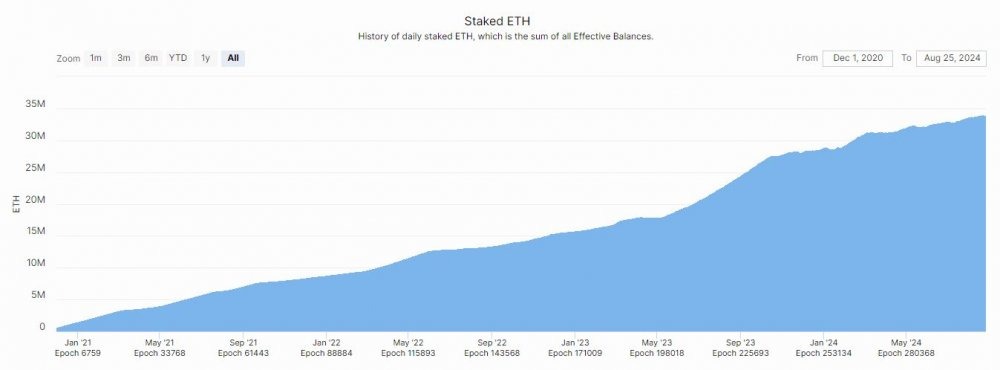

Стекинг Ethereum постепенно увеличивается с каждым годом с 2021 года. Источник: Beacon Chain.

Лаклан Фини, основатель и генеральный директор компании Labrys, занимающейся инфраструктурой Ethereum, сообщил, что институциональный интерес к стекингу может все еще отставать из-за других активов, дающих более высокую доходность с потенциально меньшим риском.

«Текущий годовой процент доходности стейкинга Ether на Coinbase составляет 2,06%. Это на 3% меньше, чем вы можете заработать «без риска» на некоторых казначейских облигациях США», — сказал он.

«В последние годы биткоин генерировал более высокую доходность инвестиций с меньшим риском, и поэтому именно туда был направлен капитал — и бонусная доходность ETH в размере 2% не сдвинет ситуацию с мертвой точки».

«После 15 лет существования учреждения только начинают осознавать BTC как цифровое золото/имущество и понимать, что ему есть место в их портфелях», — добавил Фини.

Джейдип Корде, генеральный директор Launchnodes, некастодиального сервиса стекинга Ethereum, говорит, что учреждения еще не «погружаются в стекинг Ethereum», потому что им не хватает понимания технологии.

Он говорит, что навигация по лучшим практикам хранения цифровых активов по-прежнему является серьезной проблемой для многих учреждений, добавляя еще один уровень сложности.

«Стекинг — это новый рубеж, и многие институциональные инвесторы все еще пытаются понять, чем он отличается от традиционных активов», — сказал Корде.

Новая сертификация NORS была запущена коллективной группой криптофирм, включая Alluvial, Blockdaemon, Chainproof, Coinbase, DV Labs, Eigen Labs, Figment, Galaxy, Nexus Mutual и другие.

«До разработки NORS не существовало заверенной сертификации, которая могла бы продемонстрировать, что оператор узла соответствует институциональным требованиям для снижения конкретных рисков работы узлов стекинга ETH», — говорится в заявлении компаний.

Операторы узлов могут получить сертификацию после получения индивидуального отчета об аттестации от любого оценщика, квалифицированного NORS.

Сертификация, как утверждается, отвечает потребностям аудиторских фирм Большой четверки и традиционным институциональным сертификациям, а также соответствует стандартам аудита AICPA, за которыми следуют SOC1 и другие широко распространенные стандарты проверки.

Trending Cryptos

Related Reads

A Former ByteDance Employee's Account: How I Started with Two Pinduoduo Hard Drives and Made a 600% Profit with Seagate to Achieve Financial Freedom?

Summary: A former ByteDance employee describes how a personal observation led to a highly profitable investment in Seagate Technology ($STX). Needing hard drives for a personal data project in August, he noticed their prices on Pinduoduo were rising consistently. Investigating further using price-tracking tools, he confirmed a broader, sustained price increase for high-capacity HDDs. He traced this to surging AI demand, as data centers require massive, cost-effective storage for model training and data, favoring high-capacity enterprise HDDs like those from Seagate. This demand was squeezing consumer supply. After initial research and a small purchase, he waited for confirmation from institutional 13F filings. Seeing a clear multi-quarter trend of increasing institutional ownership in Seagate, he significantly increased his position. From an entry around $150, Seagate's stock price rose over sixfold to approximately $965. He attributes the success to a methodology of identifying anomalies in everyday life (e.g., product shortages/price hikes), researching the underlying structural cause, identifying the publicly-traded beneficiary, and using 13F data to confirm institutional interest over multiple quarters. He cautions that this was one successful case among others that failed and is not offering investment advice.

链捕手22m ago

A Former ByteDance Employee's Account: How I Started with Two Pinduoduo Hard Drives and Made a 600% Profit with Seagate to Achieve Financial Freedom?

链捕手22m ago

BTC Hits Its Lowest Point Since 2024, But Is It Still Not the Right Time to Buy the Dip?

**Summary:** Bitcoin (BTC) has plunged to new lows in 2024, dropping over 50% from its all-time high to around $57,800, while Ethereum and Solana also show significant weakness. The market sentiment is at "extreme fear." The primary headwinds are identified as massive and sustained net outflows from US spot Bitcoin ETFs since May 2026, creating significant selling pressure, and the evaporation of expectations for a US Federal Reserve interest rate cut in 2026, which makes holding cash and bonds more attractive than risk assets like crypto. Analysts are actively debating the potential bottom. Key predictions include: * **glassnode's Rafael:** Suggests a bottom between $46,000 and $54,000, based on on-chain metrics like Realized Price and CVDD. He notes that institutional demand (via ETFs) is currently a net seller, not a buyer. * **BIT Analysis:** Argues the bear market is in its final stage, with a potential bottoming zone between $50,000 and $55,000, possibly aligning with the 2026 FIFA World Cup period (June-July). * **Wintermute:** Believes the market is in the late stages of a bear market but cautions the true bottom may not arrive until September-October 2026, contingent on renewed capital inflows. * **Liquid Capital's JackYi:** Posits that July-August 2026 could be the final capitulation and the best accumulation window, with potential bottom prices ranging from $51,000 to $43,000. * **Jiang Zhuo'er (BTC.TOP):** Predicts a bottom between $42,000 and $44,000 in October-December 2026, based on cycle analysis and MSTR's mNAV metric. * **Prediction Markets:** Polymarket data indicates a 79% chance BTC falls below $55,000 in 2026, a 65% chance below $50,000, and a 30% chance below $40,000. The consensus is that while bearish conditions are severe, the exact timing and price level of the ultimate bottom remain uncertain and depend on factors like ETF flows, macroeconomic policy, and potential market shocks.

Foresight News22m ago

BTC Hits Its Lowest Point Since 2024, But Is It Still Not the Right Time to Buy the Dip?

Foresight News22m ago

YouTube Crypto Channel Views Drop 70% by 2026, Retail Attention Crisis Reshaping Next Cycle

Major cryptocurrency YouTube channels are experiencing a severe decline in viewership, signaling a potential crisis in retail investor attention for the next market cycle. Analysis of six top channels shows monthly view counts have plummeted 27% to 79% compared to January 2025, with four channels down approximately 75%. While subscriber counts remain high (e.g., Coin Bureau with 2.72M, Altcoin Daily with 1.65M), current engagement tells a different story. Recent 30-day view counts are significantly lower: Coin Bureau at 1.24M views, Crypto Banter at 1.06M, with Altcoin Daily and Benjamin Cowen performing relatively better at 1.79M and 1.8M respectively. The core issue is that subscriber numbers are cumulative and reflect past interest, while views measure current demand. The dramatic drop indicates a fragmented and more selective retail audience. This contrasts sharply with the 2021 bull market, where channels reportedly garnered 3-4 million daily views. Now, daily views for major channels range from roughly 35,000 to 60,000. This divergence suggests a new type of market cycle. Bitcoin's price can be sustained by ETFs and institutional activity, but without strong retail engagement via content channels, the dynamics of the next bull run will be fundamentally different. The real signal for a retail resurgence will be a sustained increase in daily and monthly view counts, not subscriber growth. If viewership fails to recover, long-form YouTube content may become a lagging indicator, with retail attention shifting to other, faster formats.

marsbit2h ago

YouTube Crypto Channel Views Drop 70% by 2026, Retail Attention Crisis Reshaping Next Cycle

marsbit2h ago

Trading

Spot

Hot Articles

Discussions

Welcome to the HTX Community. Here, you can stay informed about the latest platform developments and gain access to professional market insights. Users' opinions on the price of ETH (ETH) are presented below.

活动图片