Ex-Mt. Gox CEO Unveils New Bitcoin-Related Business: Here’s What It Is

bitcoinistPublished on 2024-08-23Last updated on 2024-08-24

Abstract

Mark Karpelès, the former CEO of the now-defunct Mt. Gox cryptocurrency exchange, has re-entered the Bitcoin space with a new...

Mark Karpelès, the former CEO of the now-defunct Mt. Gox cryptocurrency exchange, has re-entered the Bitcoin space with a new venture named EllipX. Karpelès announced this development today via a post on X, unveiling the EllipX Wallet—a product aimed at transforming the security and accessibility of crypto management.

Karpelès New Bitcoin Venture

The first announcement regarding EllipX appeared on August 6 on X, with a post encouraging the crypto community to follow their progress. Today, Karpelès provided a deeper look into the company’s first product through a detailed blog post. The EllipX Wallet is described as a groundbreaking solution employing Multi-Party Computation (MPC) to enhance security by dividing a user’s private key across multiple custodians: the user, their device, and EllipX’s secure environment.

The wallet uses a threshold signature scheme (TSS), an advanced cryptographic method for managing digital signatures. This technology allows multiple parties to jointly sign transactions without exposing their entire private key, minimizing the risk of theft or loss. “This launch marks a significant step towards our mission to develop products that shape the future of crypto and make it accessible to everyone,” the EllipX blog stated.

EllipX Wallet is touted as the world’s first user-oriented MPC-based crypto mobile wallet, which stands out by eliminating the need for traditional seed phrases typically required for wallet recovery. The wallet will support Ethereum (ETH) at launch with plans to add Bitcoin (BTC), Bitcoin Cash (BCH), ERC-20 tokens, and other assets.

The wallet’s design allows users to manage various cryptocurrencies, send payments without transaction fees and securely interact with decentralized applications (dApps) through an upcoming in-app browser.

A significant aspect of EllipX Wallet is its focus on security. The wallet utilizes the hardware security of the user’s device, combined with biometric data, and EllipX’s own authentication technology to safeguard private keys. Karpelès emphasized the innovative approach via X, “With the goal of making crypto more accessible and safer, the first step comes with the EllipX Wallet, a MPC wallet that splits private keys in 3 parts between yourself, your device and EllipX.”

Community Reaction

This venture marks a pivotal return for Karpelès, whose career was marred by the collapse of Mt. Gox in 2014 after a massive hack led to the loss of 850,000 Bitcoins. The incident had far-reaching consequences on the global perception of crypto security.

In light of the catastrophic end of Mt. Gox, the community reactions were mixed. While many wished for much success with his business, there were also some critics. Users commented for example “Congrats Mark, but I hope the irony isn’t lost on you either :-) and “You got balls. I’ll give you that.”

Notably, Mark Karpelès played a central and controversial role in the demise of Mt. Gox, once the world’s largest bitcoin exchange with 70% of all Bitcoin transactions. Under his leadership, Mt. Gox suffered from multiple security breaches. Karpelès attributed the 2014 hack to a software flaw, though investigations suggested poor security practices and possible internal fraud.

In 2015, Karpelès was arrested in Japan on charges of embezzlement and data manipulation, leading to a trial where he was found guilty of falsifying financial records but received a suspended sentence. His role in the collapse of Mt. Gox is controversial, seen by some as a result of negligence.

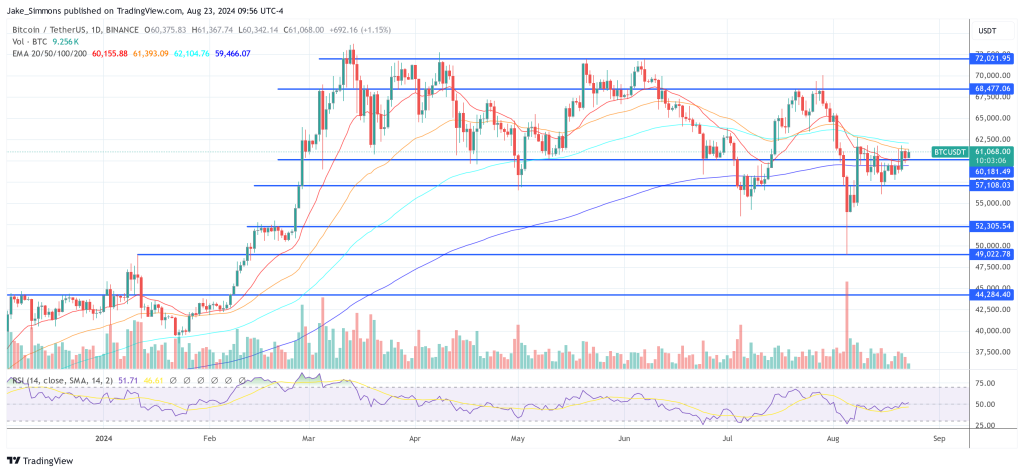
At press time, BTC traded at $61,068.
Bitcoin price
Bitcoin hovers above $61,000, 1-day chart | Source: BTCUSDT on TradingView.com
Featured image from The Seatle Times, chart from TradingView.com
Jake Simmons

Jake Simmons

Jake Simmons has been a Bitcoin enthusiast since 2016. Ever since he heard about Bitcoin, he has been studying the topic every day and trying to share his knowledge with others. His goal is to contribute to Bitcoin's financial revolution, which will replace the fiat money system. Besides BTC and crypto, Jake studied Business Informatics at a university. After graduation in 2017, he has been working in the blockchain and crypto sector. You can follow Jake on Twitter at @realJakeSimmons.

Trending Cryptos

Related Reads

Aave Founder Dismisses Reports Of Payward’s ‘70% Discount’ Stake Purchase

Aave founder Stani Kulechov has dismissed reports claiming that Kraken's parent company, Payward, was negotiating to purchase a 15% stake in Aave Group at a steep 70% discount. The reported deal proposed a $71 million investment at a $385 million valuation, which was framed as a significant discount compared to AAVE's fully diluted token valuation. Kulechov rejected this narrative, stating AAVE would not be sold at such a discount, and highlighted Aave's protocol revenue. The article clarifies the distinction between different entities within the Aave ecosystem—Aave Group, Aave Labs, Aave DAO, and AAVE token holders—noting that an equity discussion in a related company does not equate to selling the protocol or transferring DAO control. It underscores the sensitivity of major DeFi protocols to strategic investment rumors and the importance of accurate terminology to avoid misleading readers. While strategic discussions are common in the crypto sector, Kulechov specifically denied the discounted sale framing. The situation highlights that future developments should be monitored via official Aave channels, and market reactions may depend on whether token holders view the denial as value-supportive or focus on potential future distributions. The key takeaway is the founder's rejection of the 70% discount story, while leaving room for strategic partnerships under different terms.

bitcoinist4h ago

Aave Founder Dismisses Reports Of Payward’s ‘70% Discount’ Stake Purchase

bitcoinist4h ago

Trading

Spot

Hot Articles

What is $BITCOIN

DIGITAL GOLD ($BITCOIN): A Comprehensive Analysis Introduction to DIGITAL GOLD ($BITCOIN) DIGITAL GOLD ($BITCOIN) is a blockchain-based project operating on the Solana network, which aims to combine the characteristics of traditional precious metals with the innovation of decentralized technologies. While it shares a name with Bitcoin, often referred to as “digital gold” due to its perception as a store of value, DIGITAL GOLD is a separate token designed to create a unique ecosystem within the Web3 landscape. Its goal is to position itself as a viable alternative digital asset, although specifics regarding its applications and functionalities are still developing. What is DIGITAL GOLD ($BITCOIN)? DIGITAL GOLD ($BITCOIN) is a cryptocurrency token explicitly designed for use on the Solana blockchain. In contrast to Bitcoin, which provides a widely recognized value storage role, this token appears to focus on broader applications and characteristics. Notable aspects include: Blockchain Infrastructure: The token is built on the Solana blockchain, known for its capacity to handle high-speed and low-cost transactions. Supply Dynamics: DIGITAL GOLD has a maximum supply capped at 100 quadrillion tokens (100P $BITCOIN), although details regarding its circulating supply are currently undisclosed. Utility: While precise functionalities are not explicitly outlined, there are indications that the token could be utilized for various applications, potentially involving decentralized applications (dApps) or asset tokenization strategies. Who is the Creator of DIGITAL GOLD ($BITCOIN)? At present, the identity of the creators and development team behind DIGITAL GOLD ($BITCOIN) remains unknown. This situation is typical among many innovative projects within the blockchain space, particularly those aligning with decentralized finance and meme coin phenomena. While such anonymity may foster a community-driven culture, it intensifies concerns about governance and accountability. Who are the Investors of DIGITAL GOLD ($BITCOIN)? The available information indicates that DIGITAL GOLD ($BITCOIN) does not have any known institutional backers or prominent venture capital investments. The project seems to operate on a peer-to-peer model focused on community support and adoption rather than traditional funding routes. Its activity and liquidity are primarily situated on decentralized exchanges (DEXs), such as PumpSwap, rather than established centralized trading platforms, further highlighting its grassroots approach. How DIGITAL GOLD ($BITCOIN) Works The operational mechanics of DIGITAL GOLD ($BITCOIN) can be elaborated on based on its blockchain design and network attributes: Consensus Mechanism: By leveraging Solana’s unique proof-of-history (PoH) combined with a proof-of-stake (PoS) model, the project ensures efficient transaction validation contributing to the network's high performance. Tokenomics: While specific deflationary mechanisms have not been extensively detailed, the vast maximum token supply implies that it may cater to microtransactions or niche use cases that are still to be defined. Interoperability: There exists the potential for integration with Solana’s broader ecosystem, including various decentralized finance (DeFi) platforms. However, the details regarding specific integrations remain unspecified. Timeline of Key Events Here is a timeline that highlights significant milestones concerning DIGITAL GOLD ($BITCOIN): 2023: The initial deployment of the token occurs on the Solana blockchain, marked by its contract address. 2024: DIGITAL GOLD gains visibility as it becomes available for trading on decentralized exchanges like PumpSwap, allowing users to trade it against SOL. 2025: The project witnesses sporadic trading activity and potential interest in community-led engagements, although no noteworthy partnerships or technical advancements have been documented as of yet. Critical Analysis Strengths Scalability: The underlying Solana infrastructure supports high transaction volumes, which could enhance the utility of $BITCOIN in various transaction scenarios. Accessibility: The potential low trading price per token could attract retail investors, facilitating wider participation due to fractional ownership opportunities. Risks Lack of Transparency: The absence of publicly known backers, developers, or an audit process may yield skepticism regarding the project's sustainability and trustworthiness. Market Volatility: The trading activity is heavily reliant on speculative behavior, which can result in significant price volatility and uncertainty for investors. Conclusion DIGITAL GOLD ($BITCOIN) emerges as an intriguing yet ambiguous project within the rapidly evolving Solana ecosystem. While it attempts to leverage the “digital gold” narrative, its departure from Bitcoin's established role as a store of value underscores the need for a clearer differentiation of its intended utility and governance structure. Future acceptance and adoption will likely depend on addressing the current opacity and defining its operational and economic strategies more explicitly. Note: This report encompasses synthesised information available as of October 2023, and developments may have transpired beyond the research period.

467 Total ViewsPublished 2025.05.13Updated 2025.05.13

What is $BITCOIN

Discussions

Welcome to the HTX Community. Here, you can stay informed about the latest platform developments and gain access to professional market insights. Users' opinions on the price of BTC (BTC) are presented below.

活动图片