BTC连续拉涨,空头三振出局了?劝割3天损失1个BTC“不中用”

币界网Published on 2024-08-09Last updated on 2024-08-09

币界网报道:

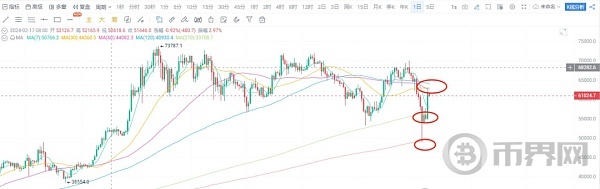
隔夜BTC继续拉涨,急破6万刀,“过了黄洋界,险处不须看”,一度逼近63k,目前暂于61-62k区间休整。从8月5日极限插针下探49k,仅仅3天多时间,就连续拉涨到了61k,总涨幅接近25%。不知道这种3天拉涨25%的机会,一年里能有几次,一个人的整个投资生涯中又能满仓把握住几次?
get?code=ZTQxNjY5YzRjZGQ5MGQ4OTUyMDlkNTA0ODhjZDA4NjYsMTcyMzE5MDQ2MDgzMA==

现在有的CEO在高位卖,有的CEO在低位接。散户则喜欢高位冲,低位斩,因为韭菜的双眼是忍不住盯着价格的。会玩牌的要盯着底牌,要算筹码,而不要被牌面上吓住。

什么是筹码?

算入场和没入场买卖对手盘可能变化,比如美股HF、卖期权的全逃顶了。现在都成了抄底多头,但是CTA程序化强制卖出,下跌是做空乘势推动。后面的变化是,CTA卖盘将力竭,抄底、卖vol可能追杀空头,比如币圈7万时多头几乎全埋,现在冲高极难。如果能缓跌就是区间震荡。冲高再杀下来,就没有额外抄底力量了。

大饼回6w2,不要急着追多/冷静点。无数次的牛回无数次的打脸,不如耐心等趋势走出来再操作。

比特币的走势已经脱离了以往大家熟悉的走势,砸盘/拉盘都走的很急,该回调的地方没有回调,该横盘震荡的地方不去震荡。一而再再而三脱离认知框架的时候,我们就要冷静了。

做交易,我们说要相信自己的眼睛,而不是脑补的画面。无论是7月8日从5w4开始的那段冲顶,还是昨天的爆拉,大饼并没有给市场带来明显的造富效应。山寨依然萎靡不振,昨天有些山寨的涨幅还不如大饼。没有火车头效应,很难再说"牛回"。冷静客观的看事实,每一次大饼借着消息猛拉/爆砸,除了一堆爆仓数据外,似乎什么都没有留下。

我在在8月5号暴跌恐慌之际,于当日文章币圈暴跌原因:市场在洗牌,谁先救市?短期跌幅影响不了未来上涨趋势!中直言不讳地写道:

劝人割肉,非蠢即坏。

get?code=ZTI3MjRhNTYxNTkyMTVmNzVhNDQ3NTBiODU3YTcxNTQsMTcyMzE5MDQ2MDgzMA==

如果一个小白,害怕之时听了割肉的鼓动,在49k清仓,那么仅仅3天后,在61k买回,就立即损失接近1/5的BTC,也就是损失了20%的仓位。5个BTC割肉,3天之后还剩4个BTC。

3天损失1个BTC。

而如果他不买回,那么随着BTC的继续拉涨,他的损失将越来越大。等BTC升至98k,他将损失一半的BTC。但就算BTC再次探低到49k,他可能依旧不敢买回,因为那个时候,一定会有更多的声音告诉他,BTC还将继续下跌,30k、20k、……

最后的结局,很可能是他永远失去仓位,失去BTC。

这段时间还有因为暴跌,抄底的、入市补保证金的,都在着急买u,这一度把u给买出了高溢价,都推高到7.45了。而usd/cnh则因为美元暴跌,cnh大幅走强,一度都破位7.10了。真的就是很夸张,这个教训还不值得牢记?

我认为真的的牛回只能看以下这两种场景:

1.大饼突破7w,继而创新高,彻底走出结构行情

2.大饼能够带着山寨疯狂表演,回到我们以前熟悉的逻辑除此之外,盲目追多/抄底,结果都是被埋。一遍遍的试,一遍遍的错。真正牛回也不差这点涨幅,反复被闷杀,被套会严重影响自己的心态。不如先看戏,看大饼到底要怎么走。

说一个极为大胆的假设:

空头是否已三振出局?

8.5暴跌也许并非“519”,而是“722”?

在“信仰-怀疑”阶段,多空观点的交锋必然是激烈的。自从2024年3月13-14日BTC局部触顶73.8k之后,至今已经洗盘5个月。如果参考当年黄金ETF上市后,局部触顶后长达10个月的洗盘期那么目前BTC依然是“半渡”。

其实不管是三振也好,五振也罢,可以几乎肯定的是,空头对3万刀甚至2.5万刀乃至于本轮牛市已结束的幻想,是终将要随着BTC的不断续创新高而被击得粉碎的了。

Trending Cryptos

Related Reads

A Guide to Grayscale’s ‘Bottom Fishing’: Using Cash Flow to Assess Cryptocurrency Value

**Title:** Grayscale's Guide to Bottom-Fishing: Valuing Cryptoassets Using Cash Flows **Summary:** This report by Grayscale Research presents a fundamental valuation framework for cryptocurrency assets, moving beyond pure speculation to analyze those with underlying cash flows. It distinguishes between "commodity-like" assets (e.g., Bitcoin) and "cash-flow" assets, primarily within DeFi. Using the leading decentralized lending protocol Aave as a case study, the analysis applies traditional financial methodologies like Discounted Cash Flow (DCF) and Price-to-Earnings (P/E) multiples. Key findings indicate that AAVE tokens are currently undervalued. Despite recent challenges, the protocol's strong revenue growth, ~50% net profit margin, and diversified treasury support a fundamental valuation range of $80-$100 per token (compared to a ~$75 market price at the time of writing). In a base-case scenario driven by stablecoin adoption and regulatory clarity, the fair value could rise to around $175 within a year. The report emphasizes that protocol success does not automatically translate to token value. It critically examines the "value capture" mechanisms—such as buybacks, burns, and staking rewards—that channel protocol profits to token holders. Furthermore, it addresses the legal and governance complexities of Decentralized Autonomous Organizations (DAOs), noting their difference from traditional corporate equity but highlighting how robust, transparent governance can align protocol economics with holder interests. The conclusion is that the crypto market is maturing, with capital increasingly flowing towards projects with demonstrable fundamentals, real adoption, and disciplined capital allocation, creating opportunities for value-based investors.

marsbit49m ago

A Guide to Grayscale’s ‘Bottom Fishing’: Using Cash Flow to Assess Cryptocurrency Value

marsbit49m ago

After semiconductors lead the gains, are funds buying into AI orders or a macroeconomic rebound?

After US-Iran talks led to a temporary ceasefire and framework for reopening the strategic Strait of Hormuz, U.S. stocks rose on June 18, with the Nasdaq gaining 1.9%. The semiconductor and AI hardware sectors outperformed. This rally stemmed primarily from reduced geopolitical risk, which lowered oil prices and inflation expectations, easing discount rate pressure on high-valuation growth stocks like tech. The key question is not whether tech rebounded, but the nature of the rebound. The market appears to be selectively repricing AI infrastructure plays rather than broadly chasing AI narratives. Gains were concentrated in chips, optical interconnects, memory, and domestic manufacturing—segments tied to tangible data center build-outs and capital expenditure. Intel's ~10% surge, fueled by a Trump statement about potential Apple collaboration, exemplifies this mixed dynamic. It reflects policy catalysts and domestic manufacturing sentiment more than confirmed fundamentals. Meanwhile, strong earnings from companies like Astera Labs (revenue up 93% YoY) provided concrete evidence of AI-driven demand in hardware. In essence, the rally represents a risk-premium recalibration. Lower Middle East tensions opened a valuation repair window, and capital flowed first into AI infrastructure segments with visible near-term revenue streams. The sustainability of this move hinges on upcoming Q2 earnings, specifically continued strength in cloud provider capex, AI server orders, and hardware company guidance. Policy hopes alone are insufficient; the cycle needs validation from orders and financials.

marsbit54m ago

After semiconductors lead the gains, are funds buying into AI orders or a macroeconomic rebound?

marsbit54m ago

The Entire Internet Hails Noam's Joining, But OpenAI's Loss Bill Just Got Thicker

While the AI community celebrates Noam Shazeer, co-author of the "Attention Is All You Need" paper, joining OpenAI as Head of Architectural Research, the company's audited financials reveal a starkly different reality. In 2025, OpenAI reported $13.07 billion in revenue but a massive $20.92 billion operating loss. Even excluding a one-time accounting charge, the cash burn is severe, with $3.7 billion consumed in Q1 2026 alone. This high-profile hiring occurs against a backdrop of significant internal research talent drain, with key founders and researchers departing as the company's focus shifts from exploratory research to product iteration. Meanwhile, OpenAI's fundamental business model faces a deep crisis. It paid Microsoft $10.59 billion for compute in 2025, while its vast user base of 9 billion weekly actives includes only 50 million paying customers, making growth a direct driver of escalating costs. The article argues Shazeer's recruitment is less about technical necessity and more about crafting a compelling narrative for OpenAI's upcoming IPO, aiming to justify a rumored $1 trillion valuation to future public market investors. It contrasts OpenAI's strategy with Anthropic's reported path to profitability, which relies on a strong enterprise customer base and cost control, rather than star-powered narratives. Ultimately, the piece concludes that while Shazeer's architectural work may take 1-2 years to materialize, OpenAI's financial clock is ticking much faster, with its massive losses undercutting the celebratory headlines.

marsbit2h ago

The Entire Internet Hails Noam's Joining, But OpenAI's Loss Bill Just Got Thicker

marsbit2h ago

Trading

Spot
Futures

Hot Articles

What is $BITCOIN

DIGITAL GOLD ($BITCOIN): A Comprehensive Analysis Introduction to DIGITAL GOLD ($BITCOIN) DIGITAL GOLD ($BITCOIN) is a blockchain-based project operating on the Solana network, which aims to combine the characteristics of traditional precious metals with the innovation of decentralized technologies. While it shares a name with Bitcoin, often referred to as “digital gold” due to its perception as a store of value, DIGITAL GOLD is a separate token designed to create a unique ecosystem within the Web3 landscape. Its goal is to position itself as a viable alternative digital asset, although specifics regarding its applications and functionalities are still developing. What is DIGITAL GOLD ($BITCOIN)? DIGITAL GOLD ($BITCOIN) is a cryptocurrency token explicitly designed for use on the Solana blockchain. In contrast to Bitcoin, which provides a widely recognized value storage role, this token appears to focus on broader applications and characteristics. Notable aspects include: Blockchain Infrastructure: The token is built on the Solana blockchain, known for its capacity to handle high-speed and low-cost transactions. Supply Dynamics: DIGITAL GOLD has a maximum supply capped at 100 quadrillion tokens (100P $BITCOIN), although details regarding its circulating supply are currently undisclosed. Utility: While precise functionalities are not explicitly outlined, there are indications that the token could be utilized for various applications, potentially involving decentralized applications (dApps) or asset tokenization strategies. Who is the Creator of DIGITAL GOLD ($BITCOIN)? At present, the identity of the creators and development team behind DIGITAL GOLD ($BITCOIN) remains unknown. This situation is typical among many innovative projects within the blockchain space, particularly those aligning with decentralized finance and meme coin phenomena. While such anonymity may foster a community-driven culture, it intensifies concerns about governance and accountability. Who are the Investors of DIGITAL GOLD ($BITCOIN)? The available information indicates that DIGITAL GOLD ($BITCOIN) does not have any known institutional backers or prominent venture capital investments. The project seems to operate on a peer-to-peer model focused on community support and adoption rather than traditional funding routes. Its activity and liquidity are primarily situated on decentralized exchanges (DEXs), such as PumpSwap, rather than established centralized trading platforms, further highlighting its grassroots approach. How DIGITAL GOLD ($BITCOIN) Works The operational mechanics of DIGITAL GOLD ($BITCOIN) can be elaborated on based on its blockchain design and network attributes: Consensus Mechanism: By leveraging Solana’s unique proof-of-history (PoH) combined with a proof-of-stake (PoS) model, the project ensures efficient transaction validation contributing to the network's high performance. Tokenomics: While specific deflationary mechanisms have not been extensively detailed, the vast maximum token supply implies that it may cater to microtransactions or niche use cases that are still to be defined. Interoperability: There exists the potential for integration with Solana’s broader ecosystem, including various decentralized finance (DeFi) platforms. However, the details regarding specific integrations remain unspecified. Timeline of Key Events Here is a timeline that highlights significant milestones concerning DIGITAL GOLD ($BITCOIN): 2023: The initial deployment of the token occurs on the Solana blockchain, marked by its contract address. 2024: DIGITAL GOLD gains visibility as it becomes available for trading on decentralized exchanges like PumpSwap, allowing users to trade it against SOL. 2025: The project witnesses sporadic trading activity and potential interest in community-led engagements, although no noteworthy partnerships or technical advancements have been documented as of yet. Critical Analysis Strengths Scalability: The underlying Solana infrastructure supports high transaction volumes, which could enhance the utility of $BITCOIN in various transaction scenarios. Accessibility: The potential low trading price per token could attract retail investors, facilitating wider participation due to fractional ownership opportunities. Risks Lack of Transparency: The absence of publicly known backers, developers, or an audit process may yield skepticism regarding the project's sustainability and trustworthiness. Market Volatility: The trading activity is heavily reliant on speculative behavior, which can result in significant price volatility and uncertainty for investors. Conclusion DIGITAL GOLD ($BITCOIN) emerges as an intriguing yet ambiguous project within the rapidly evolving Solana ecosystem. While it attempts to leverage the “digital gold” narrative, its departure from Bitcoin's established role as a store of value underscores the need for a clearer differentiation of its intended utility and governance structure. Future acceptance and adoption will likely depend on addressing the current opacity and defining its operational and economic strategies more explicitly. Note: This report encompasses synthesised information available as of October 2023, and developments may have transpired beyond the research period.

395 Total ViewsPublished 2025.05.13Updated 2025.05.13

What is $BITCOIN

Discussions

Welcome to the HTX Community. Here, you can stay informed about the latest platform developments and gain access to professional market insights. Users' opinions on the price of BTC (BTC) are presented below.

活动图片