Ronin Bridge被盗1200万美元,是小BUG还是大麻烦?

Odaily星球日报Published on 2024-08-07Last updated on 2024-08-07

Abstract

不幸中的万幸,黑客已归被盗资产。

原创 | Odaily星球日报(@OdailyChina

作者 | Asher(@Asher_ 0210 

Ronin Bridge被盗1200万美元,是小BUG还是大麻烦?

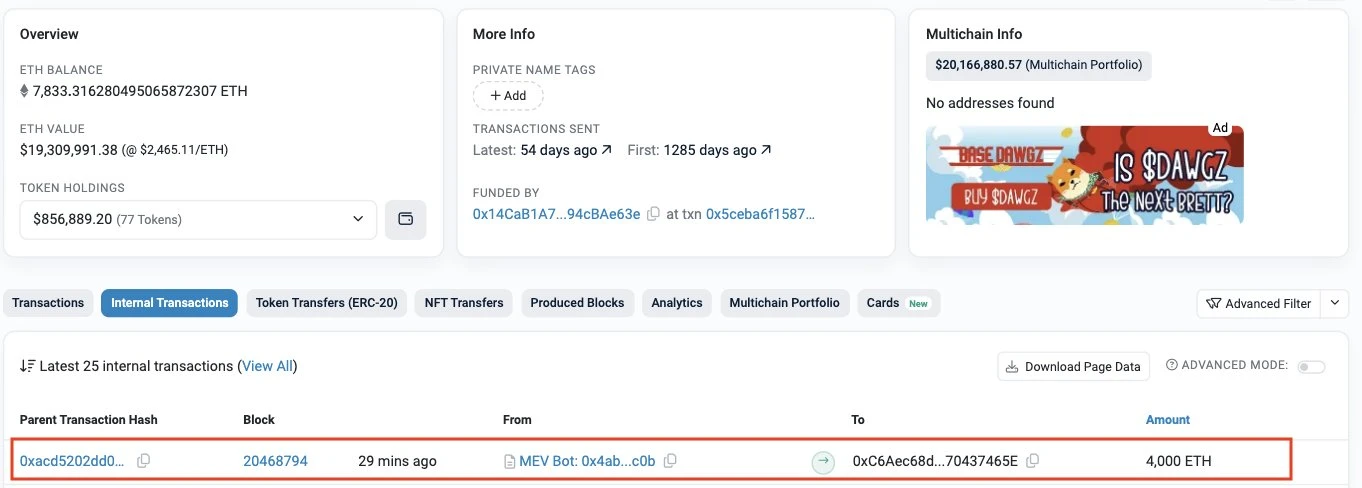
昨日(8 月 6 日)下午,据派盾监测,游戏区块链 Ronin 疑似被黑客攻击,被盗约 4000 枚 ETH 和 200 万 USDC,价值约 1200 万美元。
Ronin Bridge被盗1200万美元,是小BUG还是大麻烦?

被盗 4000 枚 ETH

Ronin Bridge被盗1200万美元,是小BUG还是大麻烦?

被盗约 200 万枚 USDC

Ronin 竟然又被盗了?各个社区第一时间的反应更多是不敢相信,“大家都在期待 Ronin 生态再次上线像 Pixels 这样的爆款游戏,怎么会在这个时候发生盗窃事件?”更有人开玩笑说:“是不是可以趁机低价买入,毕竟他们不太可能在一年内遭遇两次攻击吧!”

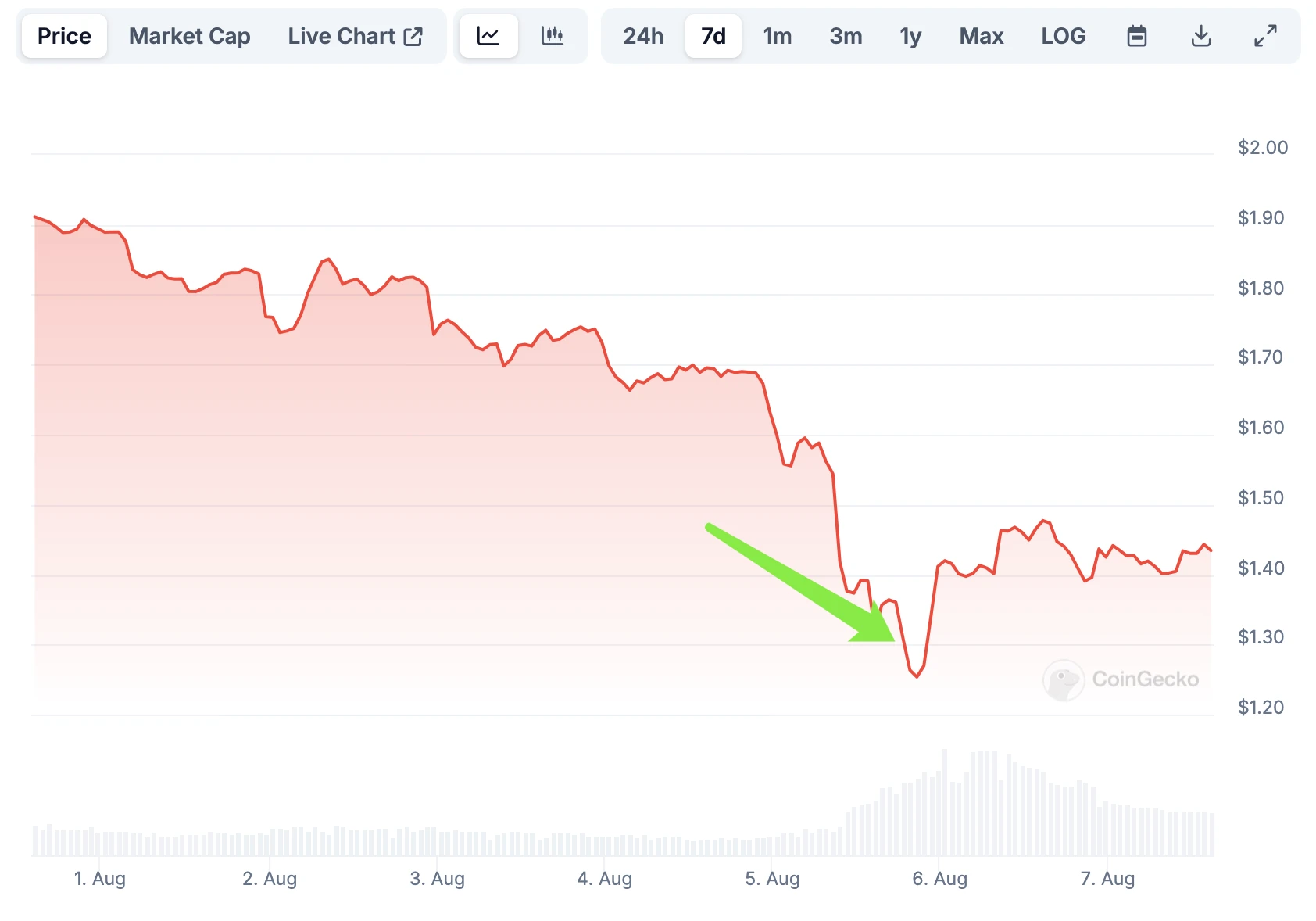
被盗事件在社区中迅速传播后,RON 的价格在原本下跌的趋势中进一步下滑,最低跌至 1.25 美元,短时间内跌幅超 8%。
Ronin Bridge被盗1200万美元,是小BUG还是大麻烦?

图源:coingecko

团队第一时间回应:Ronin Bridge 已暂时停用,后续发布更多信息

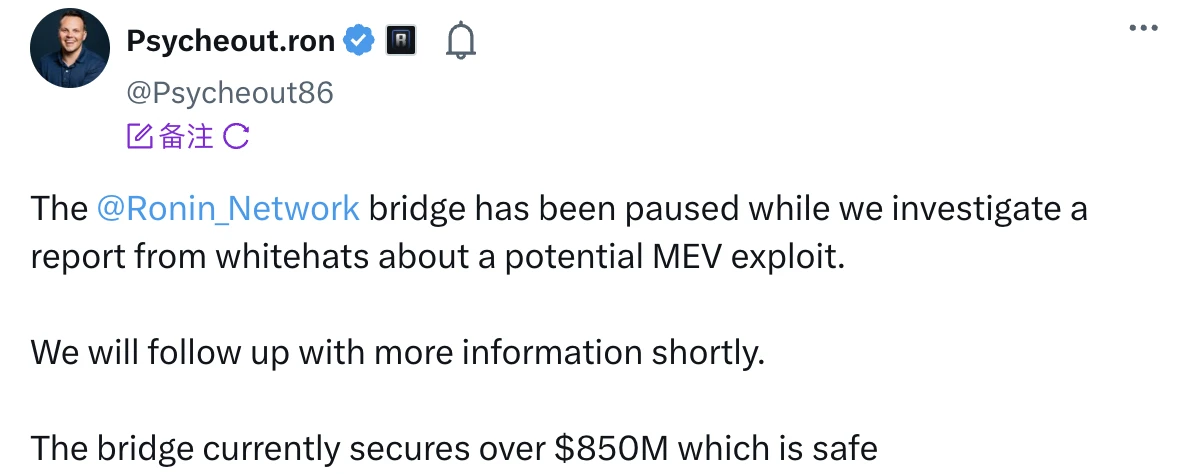
针对社区关心的 Ronin Bridge 被攻击一事,Ronin COO Psycheout 第一时间在 X 平台发文表示,当我们调查白帽黑客关于潜在 MEV 漏洞的报告时,Ronin Network 桥已暂停。团队将很快发布更多信息,并且强调 Ronin 桥目前安全保障了超过 8.5 亿美元的资金。
Ronin Bridge被盗1200万美元,是小BUG还是大麻烦?

Ronin COO 对被盗事件的回应

同时,Ronin 也在 X 平台发文表示,今天早些时候,白帽通知 Ronin 可能存在漏洞。在核实报告后,Ronin 桥在发现第一个链上操作后约 40 分钟暂停。攻击者提取了约 4000 枚 ETH 和 200 万 USDC,价值约 1200 万美元,这是单笔交易提款中可以从桥中提取的最大 ETH 和 USDC 金额,桥接限额是提高大额资金提款安全性的重要保障,并有效防止了此漏洞造成的进一步损害。

Ronin 称,由于桥梁升级在经过治理流程部署后,引入了一个问题,导致跨链桥误解了提取资金所需的桥接运营商投票门槛。目前正在努力寻找根本原因的解决方案,桥接更新将接受严格审核,然后由桥接运营商投票决定是否部署。目前正在与这些看似白帽黑客的行为者进行谈判,他们已经做出了善意回应,无论谈判结果如何,所有用户资金都是安全的,任何短缺资金都将在桥梁开放时重新存入,将在下周分享事后分析结果,其中介绍技术细节和计划措施,以防止将来发生类似事件。

漏洞原因:Ronin Bridge 漏洞系权重被修改为意外值,资金无需多签同意即可提取

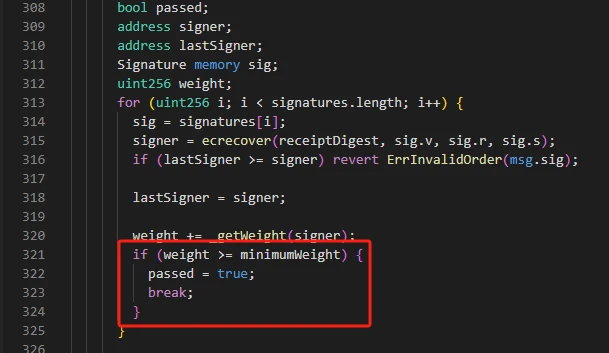
在被盗事件发生后,据 Beosin 安全团队分析,此次异常行为的根本原因在于项目方升级合约时,未正常初始化配置跨链交易确认所需的 operator 权重,导致合约中的 minimumVoteWeight 参数为零,从而使得任何人的签名都能通过跨链验证。目前,Ronin bridge 已经流失 3996 枚 ETH,资金存放在 0xc6aec68dd6272efcbc74fb5308fe7f070437465e(该地址是 MEV bot,故推测可能是白帽行为)。
Ronin Bridge被盗1200万美元,是小BUG还是大麻烦?

Ronin bridge 漏洞分析

不幸中的万幸,这次 Ronin 上的黑客攻击确实是白帽黑客,根据 Ronin 在 X 平台发布的相关信息,白帽黑客已归还约 1000 万美元的 ETH 以及 200 万枚 USDC,并且表示漏洞赏金计划将奖励白帽 50 万美元的赏金。同时,Ronin 桥接在重新开放前将接受审计,并且会在审计进展时提供最新消息。

确保资金安全始终是首要任务

Ronin 这次的盗窃事件在社区中引发了强烈的负面情绪,原因在于 Ronin 链之前已多次遭遇黑客攻击,进一步加剧了大家对安全问题的敏感和恐慌。幸运的是,此次事件仅涉及白帽黑客的攻击,并且 Ronin 链上的用户资金是安全的。

然而,根据区块链情报公司 TRM Labs 最近发布的报告, 2024 年上半年黑客窃取的加密货币(按美元价值计算)是 2023 年上半年的两倍多。数据显示,截至今年 6 月 24 日,加密货币盗窃总额达 13.8 亿美元,而 2023 年同期为 6.57 亿美元。今年迄今为止的五起最大黑客事件占被盗总金额的 70% 。可以看出,随着 Web3 行业的快速发展,被盗金额显著增加。因此,无论是用户还是项目方,确保资金安全始终是首要任务。对于项目方来说,一次被盗就会导致大量真实用户流失;而对于用户而言,一次被盗可能意味着“一年白干”。


Trending Cryptos

Related Reads

Latin America's Payments Landscape Is Not What You Think It Is

This report challenges common misconceptions about Latin America's payment landscape, based on over 500 hours of firsthand research. Key findings include: 1) Crypto card transaction volume primarily comes from high-net-worth individuals receiving USDT salaries, not retail spending. 2) QR code payments (e.g., Brazil's Pix, Argentina's Mercado Pago) are the dominant payment method across most emerging markets, not cards. 3) A major untapped opportunity lies in enabling cross-border interoperability between domestic instant payment systems. 4) Payment competition is shifting from customer acquisition to owning the settlement layer (e.g., acquiring banks). 5) Latin America is not a single market; Brazil, Mexico, Argentina, and smaller "forgotten five" countries (e.g., Guatemala, Honduras) have vastly different dynamics. 6) Stablecoin-to-fiat conversion margins are collapsing toward zero, pushing companies to build value-added services on top. 7) Future payment winners will be multi-country brands, not single-corridor specialists. 8) Marketing must target specific user segments (e.g., digital nomads, unbanked immigrants) with tailored messaging, not a generic "Brazilian" audience. 9) Contrary to perception, Latin American regulators are often ahead of the US in creating frameworks for digital assets and instant payments, with clear licensing deadlines. The core takeaway is that the region's payment rules are being rewritten, moving beyond cards and stablecoin arbitrage towards integrated, cross-border QR-based solutions.

链捕手2m ago

Latin America's Payments Landscape Is Not What You Think It Is

链捕手2m ago

Vitalik's Algorithmic Stablecoin Vision: Interpreting the Mechanism and Challenges from an Options Perspective

Vitalik Buterin's recent algorithmic stablecoin proposal envisions using an option-like mechanism to create a stablecoin without the liquidation risks inherent in traditional collateralized debt position (CDP) models. The design splits one unit of ETH into two components: a 'stable' leg (P) that maintains value up to a certain strike price, and an 'upside' leg (N) that captures any appreciation above that price. Together, they always sum to one ETH, eliminating the need for debt or liquidation mechanisms. From an options perspective, the stable leg essentially functions as a synthetic, covered call position. However, significant challenges exist. For the stable asset to maintain its peg, it must continuously roll deep in-the-money call options, leading to potential rollover slippage, predictable trading paths vulnerable to front-running, and liquidity issues. Crucially, the system's scalability depends on a constant demand for the upside leg—a form of leveraged ETH long position without funding rates or liquidation risk. It's unclear if such persistent, specific demand will materialize from speculators or market makers who have simpler alternatives like perpetual swaps. The author, drawing from experience with Rysk, argues that DeFi options have struggled as standalone trading products due to complexity and fragmented liquidity. Their potential lies instead as foundational infrastructure underpinning more complex financial primitives like stablecoins, structured yields, or index products—transforming from a direct product into a core pricing and risk distribution engine for the next generation of on-chain finance.

marsbit1h ago

Vitalik's Algorithmic Stablecoin Vision: Interpreting the Mechanism and Challenges from an Options Perspective

marsbit1h ago

GPT-5.6 Countdown: Abandon the Illusion of a Single API, Computational Iteration Can't Outpace a Single Page of Compliance

In mid-June, three seemingly independent industry events—the compliance-driven throttling of Fable 5, the open-sourcing of GLM-5.2, and the leaked release timeline for GPT-5.6—are pushing the global AI industry toward a watershed moment. These shifts signal a fundamental restructuring of the industry's underlying logic. First, **"usability" has substantially overtaken "advanced capabilities"** as the primary weight, pushing the global large language model (LLM) supply chain into a "dual-track" phase of controlled closed-source and local open-source coexistence. Second, **the competitive moats of closed-source giants are shifting**. Their technical focus is moving from "language intelligence" toward "spatial intelligence (world models)"—a domain heavily reliant on computing power. Third, faced with常态化 transnational compliance risks, **a "model-agnostic" decoupled design has become a survival necessity for application-layer developers to maintain business continuity.** The article details how Anthropic's Fable 5, despite its advanced engineering feats, was restricted for non-U.S. citizens within 72 hours of launch, highlighting how geopolitical compliance can instantly limit even the most advanced models. In response, the open-source camp, exemplified by Zhipu AI's MIT-licensed GLM-5.2, is gaining market share by offering stable performance improvements and significant cost advantages (up to 70% savings for enterprises), while achieving full adaptation with domestic semiconductor platforms. Meanwhile, closed-source leaders like OpenAI are pivoting. The anticipated GPT-5.6 reportedly shifts focus from language to spatial intelligence and world models, aiming to rebuild a generational gap in areas like 3D understanding, simulation, and industrial design that demand immense compute. The core conclusion is that the LLM supply chain's logic has changed. Enterprises must now evaluate infrastructure based on a composite of technical performance and policy compliance. For developers, complete reliance on a single closed-source API poses unacceptable risk. Implementing a truly model-agnostic architecture—enabling swift switches to compliant, locally deployable open-source alternatives—is no longer just good practice but a fundamental baseline for business continuity.

marsbit4h ago

GPT-5.6 Countdown: Abandon the Illusion of a Single API, Computational Iteration Can't Outpace a Single Page of Compliance

marsbit4h ago

Trading

Spot
Futures

Hot Articles

How to Buy RONIN

Welcome to HTX.com! We've made purchasing Ronin (RONIN) simple and convenient. Follow our step-by-step guide to embark on your crypto journey.Step 1: Create Your HTX AccountUse your email or phone number to sign up for a free account on HTX. Experience a hassle-free registration journey and unlock all features.Get My AccountStep 2: Go to Buy Crypto and Choose Your Payment MethodCredit/Debit Card: Use your Visa or Mastercard to buy Ronin (RONIN) instantly.Balance: Use funds from your HTX account balance to trade seamlessly.Third Parties: We've added popular payment methods such as Google Pay and Apple Pay to enhance convenience.P2P: Trade directly with other users on HTX.Over-the-Counter (OTC): We offer tailor-made services and competitive exchange rates for traders.Step 3: Store Your Ronin (RONIN)After purchasing your Ronin (RONIN), store it in your HTX account. Alternatively, you can send it elsewhere via blockchain transfer or use it to trade other cryptocurrencies.Step 4: Trade Ronin (RONIN)Easily trade Ronin (RONIN) on HTX's spot market. Simply access your account, select your trading pair, execute your trades, and monitor in real-time. We offer a user-friendly experience for both beginners and seasoned traders.

3.5k Total ViewsPublished 2024.04.30Updated 2026.06.02

How to Buy RONIN

Discussions

Welcome to the HTX Community. Here, you can stay informed about the latest platform developments and gain access to professional market insights. Users' opinions on the price of RONIN (RONIN) are presented below.

活动图片