BTC恐贪指数刷新18个月低点,大底信号显现?

Odaily星球日报Published on 2024-07-10Last updated on 2024-07-10

Abstract

恐慌“阴魂不散”!BTC恐贪指数跌至18个月以来最低。

原文作者:比推 BitPush

周二,美联储主席鲍威尔对通胀前景改善的积极论调缓和了市场紧张情绪,鲍威尔发表讲话后,交易员押注 9 月份降息的概率从上周的 68% 上升至 73% ,但在本周消费者物价指数 (CPI) 和生产者物价指数 (PPI) 报告公布前仍保持谨慎。

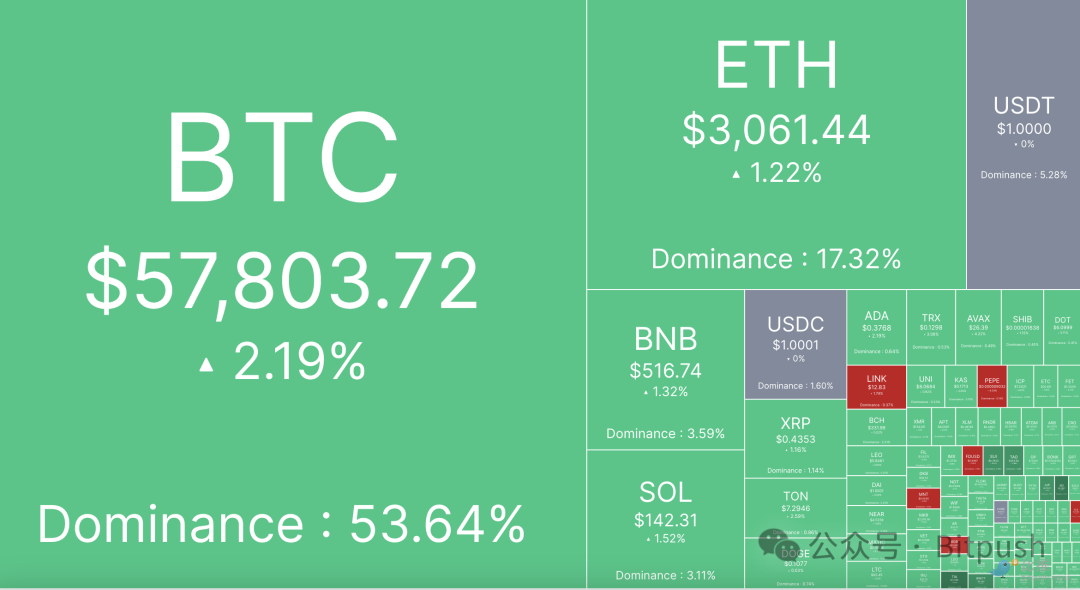
比推数据显示,加密货币总市值上涨 2.5% ,比特币多空力量展开角逐,多头力量将 BTC 从 56, 700 美元一路推送至 58, 312 美元的日内高点,截至发稿时比特币交易价格为 57, 804 美元, 24 小时涨幅 2.19% 。

山寨币市场大部分反弹,市值排名前 200 位的代币中约有 90% 实现上涨。
BTC恐贪指数刷新18个月低点,大底信号显现?

Mog Coin(MOG)涨幅居前,约合 18.1% ,其次是 Sei(SEI)上涨 17% ,Celestia(TIA)上涨 16.8% 。aelf(ELF)跌幅最大,下跌 6% ,Pepe(PEPE)下跌 4.4% ,Axelar(AXL)下跌 3.5% 。

目前加密货币整体市值为 2.12 万亿美元,比特币的市场占有率为 53.7% 。

美股收盘时,标普 500 指数和纳斯达克 500 指数分别上涨 0.07% 和 0.14% ,道琼斯指数则下跌 0.13% 。

比特币恐惧与贪婪指数跌至 2023 年 1 月以来的最低水平

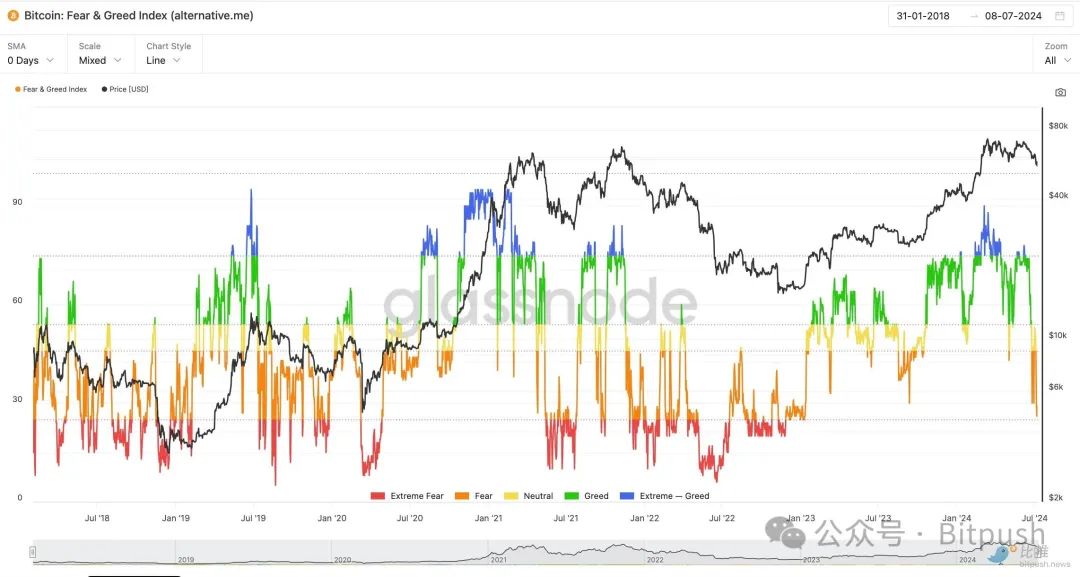
根据 Glassnode 的数据,BTC 恐惧与贪婪指数(一种跟踪相对市场情绪的指标)已跌至 2023 年 1 月以来的最低水平,于 7 月 9 日跌至 27 。
BTC恐贪指数刷新18个月低点,大底信号显现?

指数的较低水平表明投资者情绪消极,而较高水平则表明市场火热,投资者害怕错失盈利机会。

2023 年 1 月是加密货币交易所 FTX 崩盘后仅两个月的时间。当月初,加密货币恐惧与贪婪指数为 26 ,比特币的交易价格约为 16, 500 美元。然后到月底反弹至大约 22, 000 美元。
BTC恐贪指数刷新18个月低点,大底信号显现?

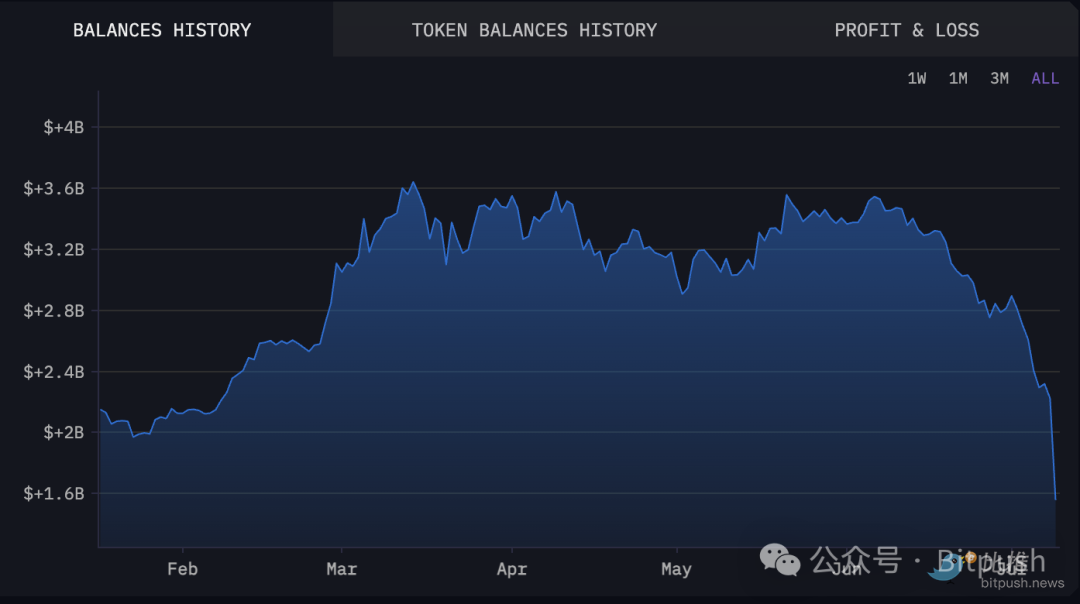
一些分析师认为,最近的调整可能归因于德国政府出售之前扣押的价值超过 30 亿美元的比特币以及 Mt.Gox 债权返还所引起的恐慌。Mt. Gox 的比特币还款额接近 80 亿美元,尽管时间仍不确定,债权人可能会选择持有而不是在市场上出售。与此同时,截至 7 月 9 日,德国政府钱包中的 50, 000 比特币中超过 50% 已经转移到交易所。

10x Research 创始人 Markus Thielen 在周二的市场更新中表示,BTC 的上涨势头可能会持续一段时间,可能达到 60, 000 美元,但这种上涨将是短暂的,预计短期内不会出现战术性看涨逆势反弹。

他补充道:“我们预计比特币可能回升至近 60, 000 美元,然后再次下跌至 50, 000 美元的低位,从而形成复杂的交易环境。”

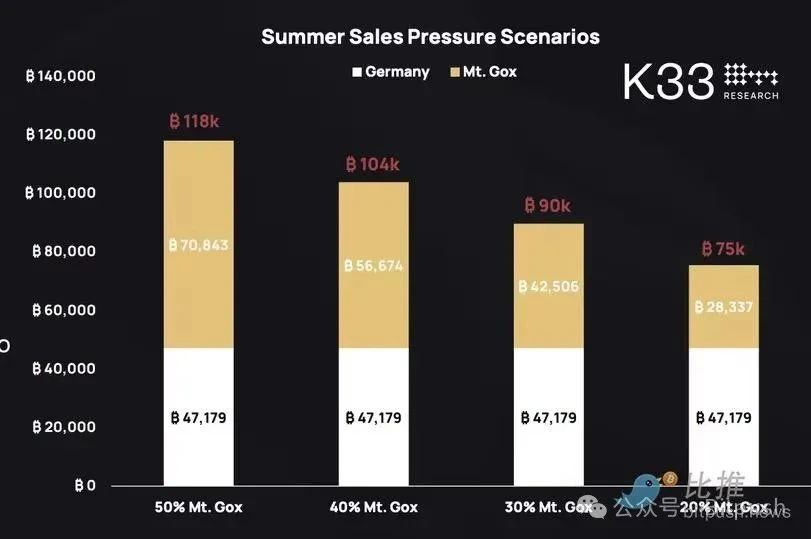
K 33 Research 高级分析师 Vetle Lunde 周二指出,季节性趋势也无助于比特币,从历史上看,第三季度的回报率往往最低。
BTC恐贪指数刷新18个月低点,大底信号显现?

他补充说,季节性疲软叠加德国政府出售扣押资产以及 Mt. Gox 退款的持续分发,这对价格造成了压力。根据 K 33 Research 的估计,预计这些抛压将对未来几个月的走势造成影响,而且市场波动状况将持续到十月份。

转机迹象

市场下行之际,技术和基本面分析师为下一步走势提供了一些思路。

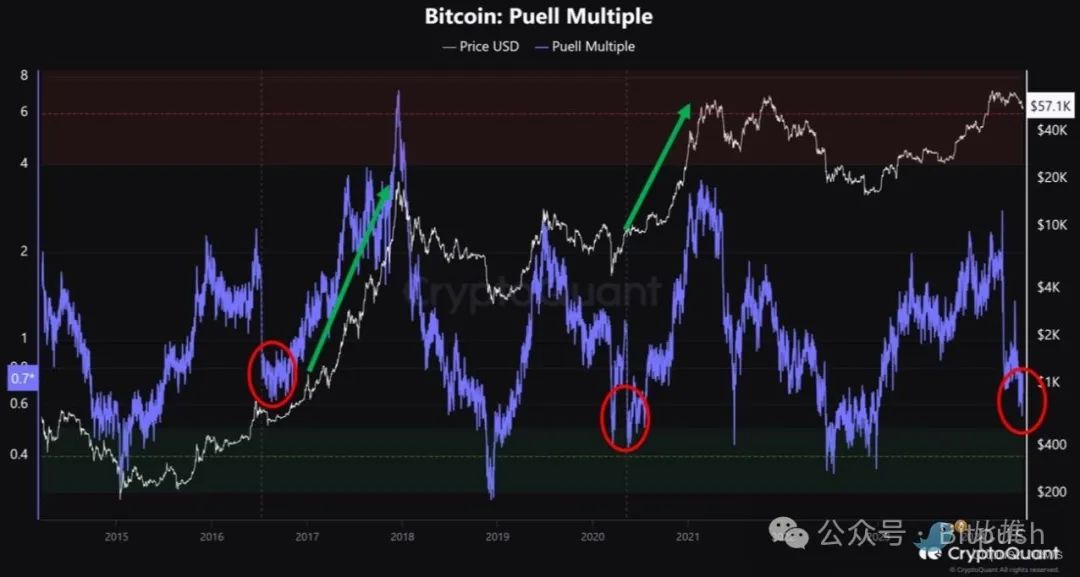
根据 CryptoQuant 分析师 Crypto Dan 的说法,比特币 Puell 倍数“通常适合寻找熊市的底部,但也可以预测牛市中调整期的结束。”
BTC恐贪指数刷新18个月低点,大底信号显现?

他解释称,上图红色圈出的区域是牛市周期中矿工盈利能力迅速下降、Puell 倍数指标暴跌的情况,该指标在 2016 年和 2020 年的牛市周期中大幅下降,随后比特币开始强劲上涨。

Crypto Dan 表示:“目前,已经发现了类似的动向,虽然很难确定调整期的确切结束时间,但可以预计它不会太远。我们很可能会在 2024 年第三季度内看到牛市恢复。”
BTC恐贪指数刷新18个月低点,大底信号显现?

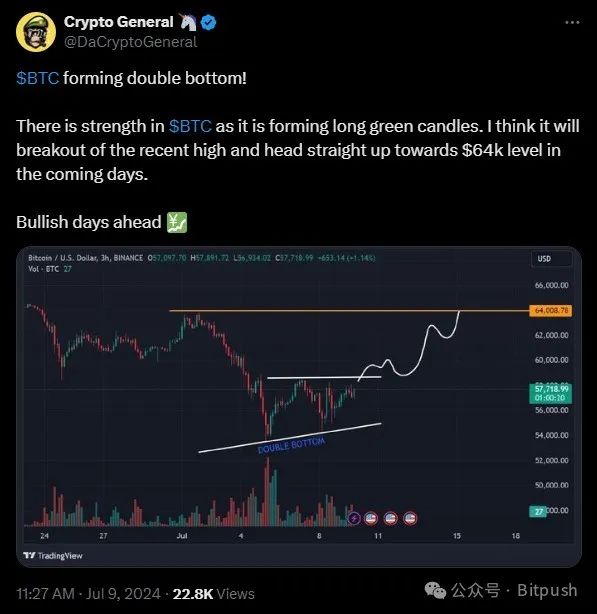
在比特币最近跌破 55, 000 美元之后,加密市场分析师 Crypto General 在 X 平台指出“双底”模式正在形成,并预测短期内将反弹至 64, 000 美元,他认为,比特币要想延续涨势,就需要在 4 h 50 EMA 保持支撑,该水平目前接近 58, 000 美元。

Trending Cryptos

Related Reads

Base Halts for Two Hours: A Single Invalid Block Reveals the Centralized Reality of L2s

Base, an Ethereum Layer-2 Rollup, experienced a two-hour network outage starting around 00:03 UTC on June 26. The halt was caused by a consensus issue that led to an invalid block being sequenced, which prevented the generation of new blocks after block 47806542. The team identified the problem, restored block sequencing by 01:51 UTC, and confirmed full recovery of ecosystem infrastructure synchronization shortly after. This incident highlights the operational reality for many L2s: while they leverage Ethereum for security and data availability, their day-to-day usability heavily depends on their sequencer and internal systems. Base employs a high-availability sequencer system with one active leader, but this setup did not prevent the outage when a consensus-level problem arose. This follows a previous 33-minute outage in August 2025 related to a faulty sequencer handover process. The downtime occurred near the scheduled activation window for the "Beryl" network upgrade, which has since been postponed. Beryl introduces the native B20 token standard, among other improvements. The incident has sparked renewed discussion about Base potentially launching its own network token in the future, shifting the conversation from mere speculation to questions about how a token might relate to sequencer decentralization, governance, and accountability in such failure scenarios.

Foresight News18m ago

Base Halts for Two Hours: A Single Invalid Block Reveals the Centralized Reality of L2s

Foresight News18m ago

STRC Must Re-Anchor for a BTC Bull Market to Happen

Title: STRC's Depegging Threatens MicroStrategy's Bitcoin-Buying Machine, and Thus the BTC Bull Run Summary: The sustained depegging of MicroStrategy's priority share STRC (trading ~25% below its $100 target) is severely disrupting the company's core business model and poses a major risk to Bitcoin (BTC) price support. STRC was MicroStrategy's most efficient and low-cost funding tool, designed to allow continuous capital raises near its $100 par value to fuel relentless BTC accumulation. Its depegging has effectively blocked this primary funding channel. The situation creates a severe cash flow crisis. STRC and other priority shares now obligate MicroStrategy to pay approximately $1.7 billion in annual cash dividends, while the company's cash reserves are only about $1.4 billion — insufficient to cover one year of payments. To raise cash, MicroStrategy is increasingly resorting to issuing common stock (MSTR) through ATM offerings. However, recent raises show most proceeds (around 90% in one week) are now used to bolster cash reserves rather than buy Bitcoin. This dilutes the key metric of Bitcoin per MSTR share, eroding the fundamental value proposition for equity investors. The company faces grim alternatives: issuing high-cost debt or selling its massive Bitcoin holdings. The latter, though hinted at, would likely trigger significant negative market reactions. Conclusion: As BTC's largest corporate holder and a major marginal buyer, MicroStrategy's funding woes mean reduced, and potentially reversing, institutional buy-side pressure. The company has shifted from being a guaranteed source of BTC demand to a significant overhang on the market. The article argues that without STRC re-anchoring to restore its funding engine, a sustained BTC bull market is in jeopardy.

marsbit38m ago

STRC Must Re-Anchor for a BTC Bull Market to Happen

marsbit38m ago

No Bull Market for BTC Without STRC Re-pegging

Summary: The sustained de-pegging of MicroStrategy's (MSTR) Strategy Preferred Shares (STRC) poses a severe threat to Bitcoin (BTC) and could prevent a bull market. STRC, designed to trade near a $100 target, has plunged to around $75, effectively shutting down MicroStrategy's cheapest and most efficient funding channel. This channel was critical for its "raise funds, buy BTC" business model. More critically, MicroStrategy now faces a massive cash outflow from these preferred shares. With approximately $10.49 billion of STRC outstanding at an 11.5% dividend yield, the annual cash obligation exceeds $1.2 billion. Combined with other preferred shares, the total annual payout nears $1.7 billion, depleting its current ~$1.4 billion cash reserve within a year. To address this, MicroStrategy is increasingly relying on common stock (MSTR) offerings via its ATM program. However, recent sales show most raised capital is now used to bolster cash reserves rather than buy more Bitcoin. This dilutes the key metric of BTC per share for common stockholders, eroding the foundation of its premium valuation. If STRC cannot re-peg, this costly dilution may continue. Worse, if cash pressure intensifies, selling Bitcoin becomes a real risk. As the largest corporate BTC holder (~847,363 BTC), any significant sales could crash the market. Thus, MicroStrategy is transforming from BTC's most reliable institutional buyer into a major potential seller, casting a significant shadow over Bitcoin's price prospects.

Odaily星球日报39m ago

No Bull Market for BTC Without STRC Re-pegging

Odaily星球日报39m ago

Trading

Spot
Futures

Hot Articles

What is $BITCOIN

DIGITAL GOLD ($BITCOIN): A Comprehensive Analysis Introduction to DIGITAL GOLD ($BITCOIN) DIGITAL GOLD ($BITCOIN) is a blockchain-based project operating on the Solana network, which aims to combine the characteristics of traditional precious metals with the innovation of decentralized technologies. While it shares a name with Bitcoin, often referred to as “digital gold” due to its perception as a store of value, DIGITAL GOLD is a separate token designed to create a unique ecosystem within the Web3 landscape. Its goal is to position itself as a viable alternative digital asset, although specifics regarding its applications and functionalities are still developing. What is DIGITAL GOLD ($BITCOIN)? DIGITAL GOLD ($BITCOIN) is a cryptocurrency token explicitly designed for use on the Solana blockchain. In contrast to Bitcoin, which provides a widely recognized value storage role, this token appears to focus on broader applications and characteristics. Notable aspects include: Blockchain Infrastructure: The token is built on the Solana blockchain, known for its capacity to handle high-speed and low-cost transactions. Supply Dynamics: DIGITAL GOLD has a maximum supply capped at 100 quadrillion tokens (100P $BITCOIN), although details regarding its circulating supply are currently undisclosed. Utility: While precise functionalities are not explicitly outlined, there are indications that the token could be utilized for various applications, potentially involving decentralized applications (dApps) or asset tokenization strategies. Who is the Creator of DIGITAL GOLD ($BITCOIN)? At present, the identity of the creators and development team behind DIGITAL GOLD ($BITCOIN) remains unknown. This situation is typical among many innovative projects within the blockchain space, particularly those aligning with decentralized finance and meme coin phenomena. While such anonymity may foster a community-driven culture, it intensifies concerns about governance and accountability. Who are the Investors of DIGITAL GOLD ($BITCOIN)? The available information indicates that DIGITAL GOLD ($BITCOIN) does not have any known institutional backers or prominent venture capital investments. The project seems to operate on a peer-to-peer model focused on community support and adoption rather than traditional funding routes. Its activity and liquidity are primarily situated on decentralized exchanges (DEXs), such as PumpSwap, rather than established centralized trading platforms, further highlighting its grassroots approach. How DIGITAL GOLD ($BITCOIN) Works The operational mechanics of DIGITAL GOLD ($BITCOIN) can be elaborated on based on its blockchain design and network attributes: Consensus Mechanism: By leveraging Solana’s unique proof-of-history (PoH) combined with a proof-of-stake (PoS) model, the project ensures efficient transaction validation contributing to the network's high performance. Tokenomics: While specific deflationary mechanisms have not been extensively detailed, the vast maximum token supply implies that it may cater to microtransactions or niche use cases that are still to be defined. Interoperability: There exists the potential for integration with Solana’s broader ecosystem, including various decentralized finance (DeFi) platforms. However, the details regarding specific integrations remain unspecified. Timeline of Key Events Here is a timeline that highlights significant milestones concerning DIGITAL GOLD ($BITCOIN): 2023: The initial deployment of the token occurs on the Solana blockchain, marked by its contract address. 2024: DIGITAL GOLD gains visibility as it becomes available for trading on decentralized exchanges like PumpSwap, allowing users to trade it against SOL. 2025: The project witnesses sporadic trading activity and potential interest in community-led engagements, although no noteworthy partnerships or technical advancements have been documented as of yet. Critical Analysis Strengths Scalability: The underlying Solana infrastructure supports high transaction volumes, which could enhance the utility of $BITCOIN in various transaction scenarios. Accessibility: The potential low trading price per token could attract retail investors, facilitating wider participation due to fractional ownership opportunities. Risks Lack of Transparency: The absence of publicly known backers, developers, or an audit process may yield skepticism regarding the project's sustainability and trustworthiness. Market Volatility: The trading activity is heavily reliant on speculative behavior, which can result in significant price volatility and uncertainty for investors. Conclusion DIGITAL GOLD ($BITCOIN) emerges as an intriguing yet ambiguous project within the rapidly evolving Solana ecosystem. While it attempts to leverage the “digital gold” narrative, its departure from Bitcoin's established role as a store of value underscores the need for a clearer differentiation of its intended utility and governance structure. Future acceptance and adoption will likely depend on addressing the current opacity and defining its operational and economic strategies more explicitly. Note: This report encompasses synthesised information available as of October 2023, and developments may have transpired beyond the research period.

459 Total ViewsPublished 2025.05.13Updated 2025.05.13

What is $BITCOIN

Discussions

Welcome to the HTX Community. Here, you can stay informed about the latest platform developments and gain access to professional market insights. Users' opinions on the price of BTC (BTC) are presented below.

活动图片