不再是「捡钱」时代,2024上半年最赚钱的加密赛道是什么?

Odaily星球日报Published on 2024-06-25Last updated on 2024-06-25

Abstract

毫无疑问Meme币在2024年至今是最赚钱的赛道,最高平均回报率达到了2405.1% 。

原文作者:Biteye 核心贡献者 Viee

原文编译:Biteye 核心贡献者 Crush

今年上半年就快过去了,BTC 自从突破上一轮牛市新高涨到 7 万后,再也没出现激动人心的辉煌。

最近几个月行情反反复复震荡,年初立下的好好赚钱 flag 也在微微动摇。不管怎么说,牛市主升浪一定还未到来,还会有遍地是机会的时候,莫要着急。

在此节点很适合反思复盘,本篇文章即是对 2024 至今不同加密赛道回报率的统计和比较。不再是「捡钱」的时代,什么赛道最赚钱呢?看完这篇你就知道了。

01 不同加密赛道,年初至今收益表现如何?

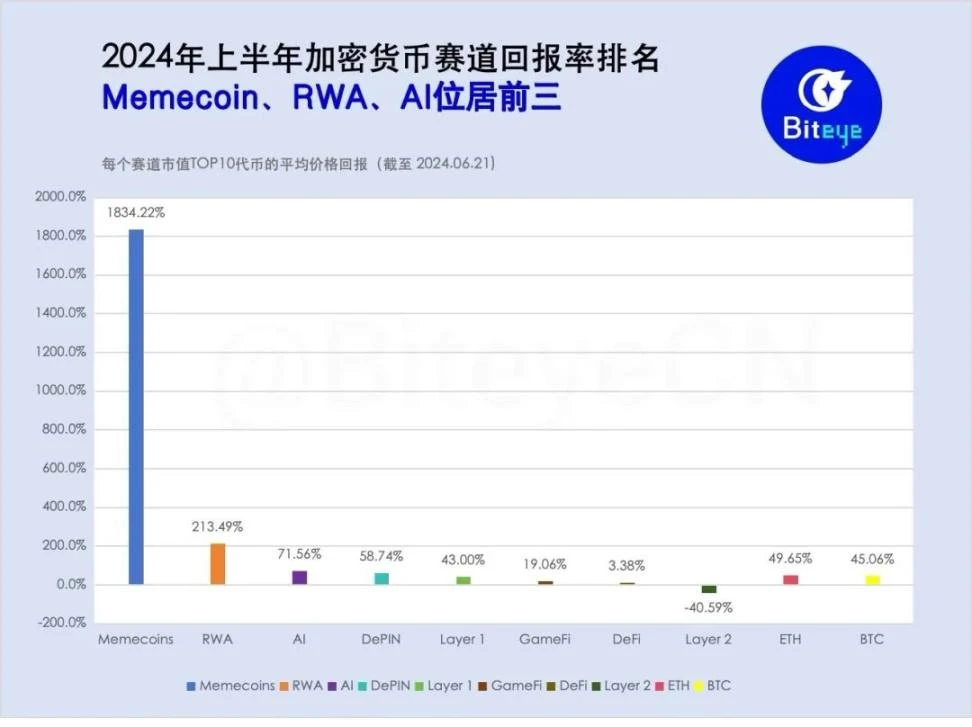
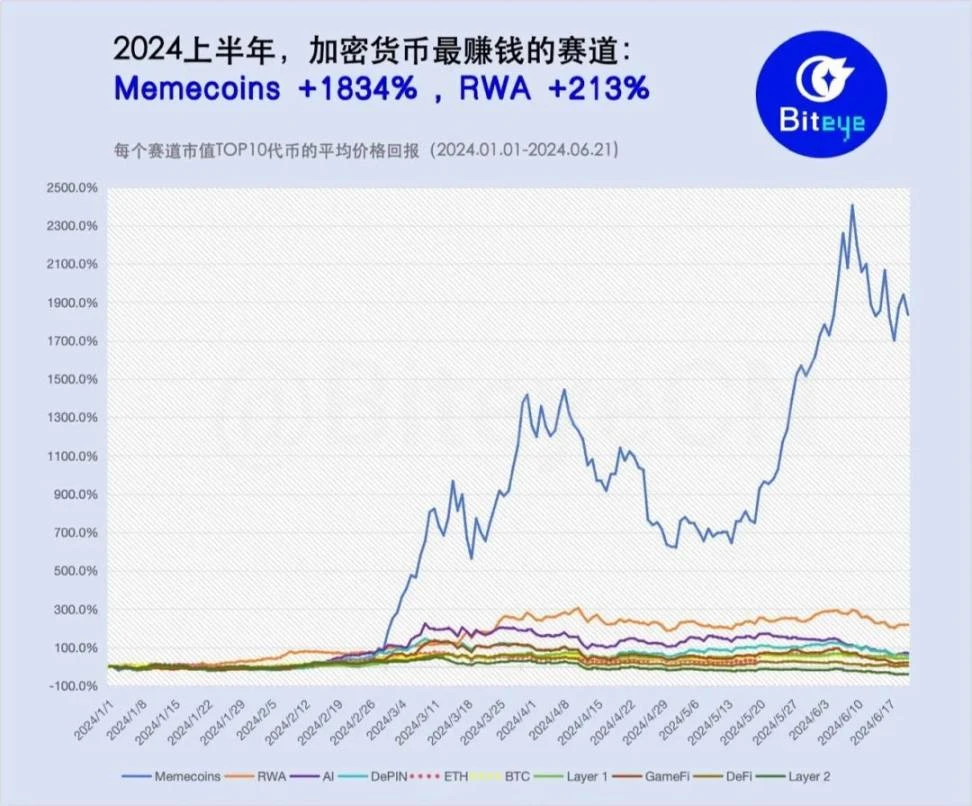
按照每个赛道前 10 大代币的平均 YTD(2024 年 1 月 1 日至 2024 年 6 月 21 日)价格回报率排名,数据来源为 CoinGecko。2024 年上半年加密货币赛道表现如下图。
不再是「捡钱」时代,2024上半年最赚钱的加密赛道是什么?

Meme 币成为最赚钱的赛道

最近几个月,「价值投资一场空,梭哈 MEME 住皇宫」已经逐渐成为本轮牛市的「炒币心经」之一。

经过统计,毫无疑问 Meme 币在 2024 年至今是最赚钱的赛道,最高平均回报率达到了 2405.1% 。截至 6 月 19 日,市值最大的 10 个 Meme 币中,有 3 个是在 3 月 -4 月左右新推出的代币:Brett(BRETT)、BOOK OF MEME(BOME)和 DOG•GO•TO•THE•MOON (DOG)。

其中,BRETT 的回报率最高,较其发行价上涨了 14353.54% ;dogwifhat(WIF)在 2024 至今(YTD)上涨了 933.93% ,引发了当时的 Meme 币狂潮。

值得注意的是,Meme 币的盈利能力是第二大盈利赛道 RWA 的 8.6 倍,是盈利最少的 DeFi 赛道的 542.5 倍。

(注:实际排名最后的 Layer 2 赛道回报率为负,不进行倍数比较)
不再是「捡钱」时代,2024上半年最赚钱的加密赛道是什么?

第二大盈利赛道 RWA 在 2024 年至今的回报率为 213.5% 

RWA(Real World Assets,真实世界资产)这一概念近几个月议论声不断,各大巨头机构在此赛道布局,包括贝莱德基金。

也因此,RWA 在 2 月曾短暂成为最赚钱的赛道,回报率排第一,但随后被 Meme 币和 AI 赛道超越,直到 3 月末再次超过 AI 叙事,在 6 月初表现也不错。

市值靠前的 RWA 代币中,MANTRA(OM)和 Ondo(ONDO)涨幅最大,分别为 1123.8% 和 451.12% YTD,而 XDC Network(XDC)则表现最差,下跌了 44.38% 。除了一些老牌 DeFi 外,RWA 项目整体偏早期,可以多多关注。

AI 赛道紧随其后,回报率为 71.6% 

早在 2023 年底,AI 赛道就已经频频出现在各大投资机构的年度展望中。正如 Messari 在 2024 年投资预测中所言,AI 成了科技领域的新宠。的确不负所望, 2024 年至今 AI 赛道平均回报率为 71.6% ,排名第三。

其中 Arkham(ARKM)涨幅最高,为 215.50% 。其次是 AIOZ Network(AIOZ),上涨 192.19% 。上半年关注度高的代币 Render(RNDR)和 Fetch.ai(FET)回报率分别为 57.47% 和 116.00% ,表现也不错。

DePIN 和 Layer 1 实现稳健增长

DePIN 在第一季度前半段回报率基本为负,从 3 月以来开始扭转颓势,至今回报率达到 58.7% 。

大市值 DePIN 代币中表现最好的是 JasmyCoin(JASMY),涨幅为 323.42% ,其次是 Arweave(AR)和 Livepeer(LPT),YTD 涨幅分别为 174.07% 和 116.06% 。

相比之下,Helium(HNT)表现不佳,是唯一下跌超 50% 的大市值 DePIN 代币,回报率为 -50.94% 。

DePIN 也是本轮牛市资本押注的赛道之一,如果 DeFi 的总市值增长 10 倍,而 DePIN 的总市值达到 DeFi 的一半,那么 DePIN 的总市值将达到 5000 亿美元,至少有 20 倍的增长空间。

Layer 1 (L1)赛道在 2024 年至今的回报率为 43.0% 。尽管 Solana(SOL)作为诞生众多高潜力 Meme 的公链受到了大量关注,YTD 涨幅为 22.91% ,但相比 3 月中旬 85.05% 的回报率,整体还是跌了不少。

表现最好的大市值 L1 加密货币实际上是 Toncoin(TON)和币安币(BNB),涨幅分别为 204.72% 和 86.10% 。

相比之下,比特币(BTC)在创下新高后较年初涨幅为 45.06% ,而以太坊(ETH)尽管通过 ETF 申请预期高涨,YTD 涨幅也只有 49.65% ,和 BTC 不相上下。

GameFi、DeFi 和 Layer 2 表现落后

GameFi 赛道回报率为 19.1% ,属于年初至今行情轮动比较少的赛道,整体融资不少,却还没跑出爆款。

大市值 GameFi 代币中表现最好的分别是 FLOKI(FLOKI),涨幅为 362.79% ,Ronin(RON)为 21.16% ,以及 Echelon Prime(PRIME) 5.27% YTD,其他大市值代币回报率都为负数,包括 GALA(GALA)为 -13.43% ,Immutable(IMX)为 -32.02% 。

DeFi 赛道在第一季度表现尚可,受到 2 月末 Uniswap(UNI)费用转换提案获得了提振,但进入二季度略有些发力不足,年初至今回报率跌到了 3.4% 。回报率高的大市值 DeFi 代币是 Maker(MKR),YTD 涨幅达到了 49.88% 。

Layer 2 (L2)赛道是当中表现最差的,回报率为 -40.59% 近乎腰斩。在大市值 L2 代币中,AEVO(AEVO)和 Starknet(STRK)表现最差,回报率分别为 -85.40% 和 -63.16% 。

主流以太坊 L2 表现也不佳:Optimism(OP)回报率为 -54.64% ,Arbitrum(ARB)为 -53.71% 。比较值得关注的是,Mantle(MNT)一骑绝尘,YTD 回报率为 26.09% 。

02 计算方法

本研究根据 CoinGecko 的数据,研究了从 2024 年 1 月 1 日至 6 月 21 日期间最受关注的加密货币赛道表现,基于每个赛道前 10 大市值代币的平均每日价格回报率与季度初价格的对比。对于季度期间推出的代币而言,则与其首日价格数据对比。

每个赛道中的代表性代币(前 10 大市值代币)是按季度最后一天的市值排名选择的。

为了更好地满足本研究的目的,特定链的赛道、拥有少量大市值代币的赛道或与其他赛道高度重叠的赛道被排除在外。

本研究仅供参考,并不构成投资建议。在投资任何加密货币或金融资产时,请务必进行自己的研究并谨慎行事。

Trending Cryptos

Related Reads

Former Nvidia AI Director Overturns Transformer, Creates 5 Trillion-Context Physical AI That Can Simulate the Entire Universe

Former NVIDIA AI Director Anima Anandkumar and her co-founder Benedikt Jenik have unveiled a groundbreaking "Physical AI" model through their startup, Accelerated Understanding. This model departs entirely from the dominant Transformer architecture, instead utilizing "Neural Operators" to directly understand and simulate physical phenomena in their full 4D spacetime (3D space + time). It achieves a staggering inference-time context window of over 5 trillion tokens—reportedly 5 million times larger than current top LLMs—enabling it to generate complete 4D trajectories of complex physical systems in a single, one-shot inference without subsampling or chunking. The model, pre-trained with 1 trillion parameters and scaled to 35 trillion in experiments, functions as a universal physics simulator capable of handling diverse domains from weather to materials science. It establishes a "simulate → improve → simulate" loop for reality validation. The founders notably turned down a lavish offer from Jeff Bezos's Project Prometheus, which included 35% equity, a $2M salary, and over $20B in committed funding. Industry speculation points to NVIDIA CEO Jensen Huang, who previously championed Anandkumar's work, as a potential key supporter behind the scenes. This development signals a paradigm shift from language/image-centric AI to physics-first intelligence.

marsbit18m ago

Former Nvidia AI Director Overturns Transformer, Creates 5 Trillion-Context Physical AI That Can Simulate the Entire Universe

marsbit18m ago

NVIDIA Earnings Report Quick Read: Quarterly Revenue on the Verge of Breaking the $100 Billion Mark, Can Still Grow 70% Next Year

NVIDIA Q2 FY2027 Earnings Report: Record Revenue Nears $100 Billion, Projects 70% Growth for Next Year NVIDIA reported exceptional Q2 FY2027 results, with revenue reaching $96.22 billion (up 106% YoY) and non-GAAP net income of $53.95 billion (up 118% YoY). Q3 revenue guidance of $108 billion signals the company's imminent entry into a "quarterly $100 billion revenue" era. The most striking projection came from the CFO, who forecasted approximately 70% revenue growth for FY2028, significantly above Wall Street's 45% expectation, and notably stated this outlook excludes any data center revenue from China. The data center segment remained the core driver, generating $89 billion (up 117% YoY), representing over 90% of total revenue. Growth continues to be primarily fueled by capital expenditures from hyperscale cloud providers like Amazon, Microsoft, Google, and Meta. A key product milestone was the confirmation that the Vera Rubin platform has entered full-scale production and begun shipments. Management stated that every 1 GW of Vera Rubin compute deployed represents a roughly $40 billion revenue opportunity, with the platform expected to contribute about 20% of data center revenue in Q3. CEO Jensen Huang noted its ramp-up is the fastest in company history, providing confidence for the strong future outlook. Management emphasized that AI demand is not slowing but accelerating and broadening into new areas like inference, enterprise AI, and robotics. The primary constraint on growth is now supply, not demand. Huang indicated that without supply limitations, the FY2028 outlook would be "much higher." Bottlenecks include components like HBM, advanced packaging, and data center power. In response, NVIDIA is expanding its role, collaborating with financial firms to mobilize over $500 billion in third-party capital for AI infrastructure and securing key resources like land and power. Crossing the $100 billion quarterly revenue mark represents a new scale for NVIDIA, while the 70% growth projection for next year suggests it may just be the starting point for the next phase.

Odaily星球日报21m ago

NVIDIA Earnings Report Quick Read: Quarterly Revenue on the Verge of Breaking the $100 Billion Mark, Can Still Grow 70% Next Year

Odaily星球日报21m ago

Trading

Spot

Hot Articles

What is $BITCOIN

DIGITAL GOLD ($BITCOIN): A Comprehensive Analysis Introduction to DIGITAL GOLD ($BITCOIN) DIGITAL GOLD ($BITCOIN) is a blockchain-based project operating on the Solana network, which aims to combine the characteristics of traditional precious metals with the innovation of decentralized technologies. While it shares a name with Bitcoin, often referred to as “digital gold” due to its perception as a store of value, DIGITAL GOLD is a separate token designed to create a unique ecosystem within the Web3 landscape. Its goal is to position itself as a viable alternative digital asset, although specifics regarding its applications and functionalities are still developing. What is DIGITAL GOLD ($BITCOIN)? DIGITAL GOLD ($BITCOIN) is a cryptocurrency token explicitly designed for use on the Solana blockchain. In contrast to Bitcoin, which provides a widely recognized value storage role, this token appears to focus on broader applications and characteristics. Notable aspects include: Blockchain Infrastructure: The token is built on the Solana blockchain, known for its capacity to handle high-speed and low-cost transactions. Supply Dynamics: DIGITAL GOLD has a maximum supply capped at 100 quadrillion tokens (100P $BITCOIN), although details regarding its circulating supply are currently undisclosed. Utility: While precise functionalities are not explicitly outlined, there are indications that the token could be utilized for various applications, potentially involving decentralized applications (dApps) or asset tokenization strategies. Who is the Creator of DIGITAL GOLD ($BITCOIN)? At present, the identity of the creators and development team behind DIGITAL GOLD ($BITCOIN) remains unknown. This situation is typical among many innovative projects within the blockchain space, particularly those aligning with decentralized finance and meme coin phenomena. While such anonymity may foster a community-driven culture, it intensifies concerns about governance and accountability. Who are the Investors of DIGITAL GOLD ($BITCOIN)? The available information indicates that DIGITAL GOLD ($BITCOIN) does not have any known institutional backers or prominent venture capital investments. The project seems to operate on a peer-to-peer model focused on community support and adoption rather than traditional funding routes. Its activity and liquidity are primarily situated on decentralized exchanges (DEXs), such as PumpSwap, rather than established centralized trading platforms, further highlighting its grassroots approach. How DIGITAL GOLD ($BITCOIN) Works The operational mechanics of DIGITAL GOLD ($BITCOIN) can be elaborated on based on its blockchain design and network attributes: Consensus Mechanism: By leveraging Solana’s unique proof-of-history (PoH) combined with a proof-of-stake (PoS) model, the project ensures efficient transaction validation contributing to the network's high performance. Tokenomics: While specific deflationary mechanisms have not been extensively detailed, the vast maximum token supply implies that it may cater to microtransactions or niche use cases that are still to be defined. Interoperability: There exists the potential for integration with Solana’s broader ecosystem, including various decentralized finance (DeFi) platforms. However, the details regarding specific integrations remain unspecified. Timeline of Key Events Here is a timeline that highlights significant milestones concerning DIGITAL GOLD ($BITCOIN): 2023: The initial deployment of the token occurs on the Solana blockchain, marked by its contract address. 2024: DIGITAL GOLD gains visibility as it becomes available for trading on decentralized exchanges like PumpSwap, allowing users to trade it against SOL. 2025: The project witnesses sporadic trading activity and potential interest in community-led engagements, although no noteworthy partnerships or technical advancements have been documented as of yet. Critical Analysis Strengths Scalability: The underlying Solana infrastructure supports high transaction volumes, which could enhance the utility of $BITCOIN in various transaction scenarios. Accessibility: The potential low trading price per token could attract retail investors, facilitating wider participation due to fractional ownership opportunities. Risks Lack of Transparency: The absence of publicly known backers, developers, or an audit process may yield skepticism regarding the project's sustainability and trustworthiness. Market Volatility: The trading activity is heavily reliant on speculative behavior, which can result in significant price volatility and uncertainty for investors. Conclusion DIGITAL GOLD ($BITCOIN) emerges as an intriguing yet ambiguous project within the rapidly evolving Solana ecosystem. While it attempts to leverage the “digital gold” narrative, its departure from Bitcoin's established role as a store of value underscores the need for a clearer differentiation of its intended utility and governance structure. Future acceptance and adoption will likely depend on addressing the current opacity and defining its operational and economic strategies more explicitly. Note: This report encompasses synthesised information available as of October 2023, and developments may have transpired beyond the research period.

2.3k Total ViewsPublished 2025.05.13Updated 2025.05.13

What is $BITCOIN

Discussions

Welcome to the HTX Community. Here, you can stay informed about the latest platform developments and gain access to professional market insights. Users' opinions on the price of BTC (BTC) are presented below.

活动图片