今年仅有一次降息?鲍威尔再放「鹰」,BTC回吐涨幅

Odaily星球日报Published on 2024-06-13Last updated on 2024-06-13

Abstract

尽管美联储决定维持利率稳定,但全球趋势是降息,美国央行降息只是时间问题。

原文作者:Mary Liu,比推 BitpushNews

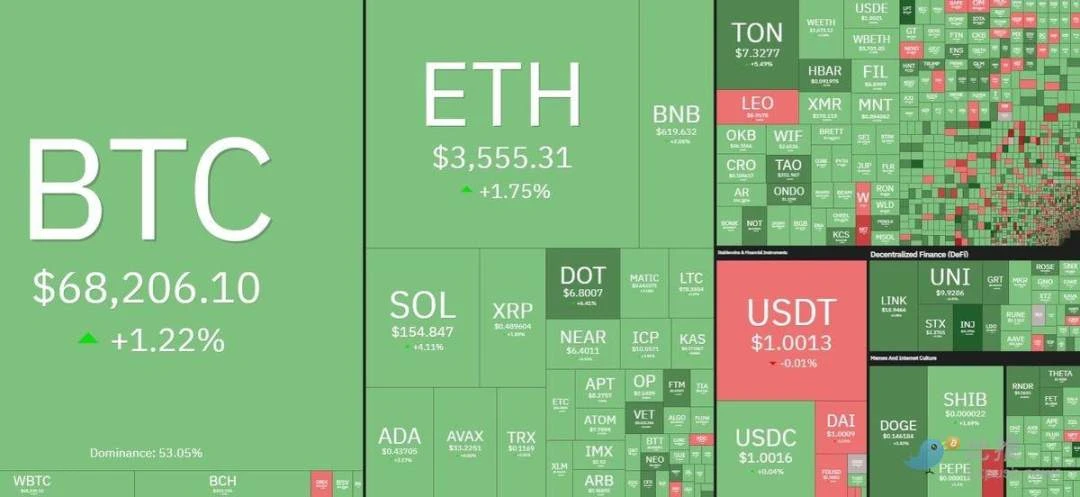
周三早盘时段,美劳工部公布的 5 月份消费者价格指数 (CPI) 低于预期,加密市场飙升,比特币价格反弹至 70, 000 美元以上,但在美联储维持利率不变并暗示今年可能仅降息一次后,涨势迅速回落。截至发稿时,比特币交易价格为 68, 250 美元, 24 小时涨幅 1.5% 。

山寨币表现积极,市值排名前 200 位的代币中的大多数价格都出现上涨。

较新的 DePIN 代币 Io.net (IO) 表现最佳,涨幅达 35% ,其次是 Livepeer (LPT),上涨 19.3% ,以及 Injective (INJ),上涨 12.6% 。Akash Network (AKT) 跌幅最大,下跌 10.5% , FLOKI (FLOKI) 下跌 7.9% ,MANTRA (OM) 下跌 5.3% 。

目前加密货币整体市值为 2.48 万亿美元,比特币的市场占有率为 54.1% 。

美股市场无视鲍威尔言论,截至周三收盘,道指初步收跌 30 点或 0.09% ,标普 500 指数涨 0.85% ,纳指涨 1.53% ,后两者连续 3 个交易日创下收盘新高。英伟达 (NVDA.O) 收涨 3.5% ,苹果 (AAPL.O) 涨 2.86% ,盘中一度重夺全球市值第一头衔。

今年仅有一次降息?鲍威尔再放「鹰」,BTC回吐涨幅

今年仅一次降息?鲍威尔讲话偏「鹰」

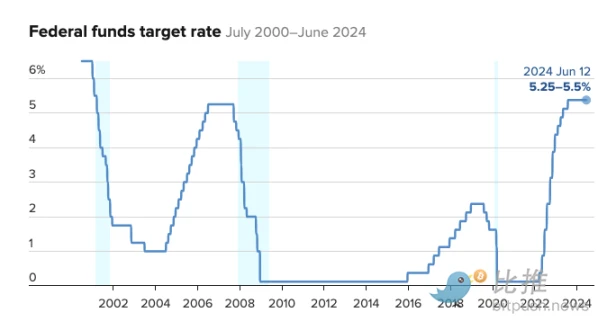
美联储今日继续将利率维持在目前的 5.25% 至 5.5% 区间,但将降息预期下调至 2024 年仅降息一次。决策者指出, 2% 的通胀目标已「取得进一步进展」。

今年仅有一次降息?鲍威尔再放「鹰」,BTC回吐涨幅

然而美联储主席杰罗姆·鲍威尔在新闻发布会上指出,尽管通胀已从峰值水平回落,但目前还没有信心降息,更没有到公布降息日期的阶段。

鲍威尔表示:「我们认为今天的(CPI)报告取得了进展,并且增强了信心。但我们认为自己目前还没有足够的信心开始放松政策。」

鲍威尔还认为,美联储对货币政策的限制性立场正在对通胀产生预期的效果,但他补充说,央行官员仍在等待看到足够的进展。

鲍威尔表示:「随着时间的推移,我们将会知道它是否具有足够的限制性。但我认为,出于我在上次新闻发布会和其他地方谈到的原因,我认为证据非常清楚,政策具有限制性,而且正在产生我们所希望的效果。」

此外,多数美联储官员并不急于降息。前美联储官员 Laurence Meyer 表示:「CPI 数据不错,我认为美联储可能在 9 月份降息。因在 9 月中旬的会议之前,他们将有三个月度的经济报告。」

一些分析师表示,考虑到 CPI 温和,美联储今天的预测看起来有些过时,不过这也可能反映出其不愿根据一次数据就改变预测。鲍威尔也在讲话中表示,美联储提供的通胀前景是「一个相当保守的预测」,可能不会得到未来数据的证实,还可能会进行修正。

分析师:比特币可能会在当前水平附近盘整或温和上涨

Bitfinex 分析师表示,维持利率稳定的决定表明美联储对通胀仍持谨慎态度,因为美联储需要平衡通胀控制与经济稳定。

分析师指出:「从历史上看,降息和维持利率不变的决定都会对资产流动和市场价格产生重大影响。例如,过去的降息决定通常会导致资产价格上涨和 ETF 资金流入,就像黄金市场的情况一样。加密货币市场也会出现类似的情况。最近八次 CPI 和 FOMC 事件都导致波动性增加,至少在日内或周内是如此。然而,自 3 月以来,这种波动性增加是短暂的。」

尽管美联储决定维持利率稳定,但全球趋势是降息,美国央行降息只是时间问题。

分析师写道:「全球各国央行已经开始降息,这表明货币宽松的趋势正在扩大。很明显,英国央行和美联储将在未来几个月效仿。全球流动性周期表明,货币供应量可能会增加,这可以支撑包括加密货币在内的资产价格。」

短期内加密市场的波动性可能会增加。分析师表示: 「由于美联储决定维持当前利率,随着市场根据消息做出调整,比特币(BTC)可能会经历短期波动。不过,总体趋势可能保持积极,特别是如果整体经济前景继续改善的话。」

他们指出:「从历史上看,过去四次 CPI 数据中有三次也导致比特币价格出现局部高点,这表明此类公告可能会带来波动。由于投资者对今年晚些时候的降息仍持乐观态度,比特币可能会在当前水平附近盘整或出现温和上涨。」

Ionic Digital 首席执行官 Matt Prusak 表示:「随着美联储试图实现软着陆,比特币的任何实质性下跌都可能为长期投资者带来有吸引力的积累机会。」

Trending Cryptos

Related Reads

The War Without a Unified Name: The Domestic Tech Giants' World Model Landscape

The article outlines the diverse and fragmented landscape of "World Models" in China's tech industry, where major players are pursuing similar goals under different names like world foundational models, physical AI, or integrated within autonomous driving and embodied intelligence systems. The core aim is to enable AI to create an internal, dynamic environment for simulation, reasoning, and learning, reducing reliance on infinite real-world data. This "data engine" allows for unlimited generation, experimentation, and iteration. The report categorizes the approaches of different companies: * **Internet Giants:** Alibaba is developing models for linguistic, virtual, and physical worlds (Qwen-AgentWorld, HappyOyster, Qwen-RobotWorld). Tencent's HY-World focuses on 3D, game, and social scenarios. ByteDance leverages its vast video data for a potential "digital twin" model. Huawei integrates its model into industrial applications like smart cars and robotics without separately branding it. Baidu embeds world model capabilities within its Apollo autonomous driving and Ernie systems. * **Automakers:** Companies like NIO, Li Auto, XPeng, and Geely are using world models as virtual "driving schools" and "testing grounds." They generate complex scenarios (e.g., rain, snow) to train and validate autonomous driving systems in simulation, aiming for more capable and safer AI drivers. * **Autonomous Driving Suppliers:** Firms such as Momenta, Horizon Robotics, Haomo.ai, and DeepRoute.ai are building the underlying "world engines." They focus on large-scale video generation for simulation, reinforcement learning, and enhancing end-to-end autonomous driving models, often integrating these capabilities into commercial products. While startups bring focus and innovation, they face challenges like limited data, compute resources, and deployment channels. Large companies possess these advantages and are rapidly transitioning world models from research projects into core business infrastructure powering products in vehicles, games, and industry. The conclusion is that world models represent an evolution and convergence of existing AI fields into crucial industrial infrastructure, moving the competition from simply building a model to effectively deploying it to understand and interact with the physical world.

marsbit12m ago

The War Without a Unified Name: The Domestic Tech Giants' World Model Landscape

marsbit12m ago

The Crypto Industry Enters the 'Show Me' Era: Vision Alone Is No Longer Enough

The crypto industry has entered a "Show Me" era, where grand visions and white papers are no longer sufficient to gain traction. This shift is driven by increased skepticism, high-profile bad actors, and notably, the serious entry of traditional finance (TradFi) institutions like BlackRock, Fidelity, and JPMorgan Chase, which are launching real, scaled products such as tokenized funds and blockchain-based settlement. This raises the bar for what constitutes a credible project. The communication dynamic has fundamentally changed. The focus is no longer on "what you are building" but on "what you have built and who is using it." Startups must now provide a "proof stack": verifiable data like mainnet transaction volume and active wallets, genuine partnerships with signed contracts, and evidence of organic product-market fit from real users, not just investors. Announcements must be backed by concrete, chain-verifiable evidence. For communication strategies, this means leading with proven facts and hard data—even if modest—rather than speculative narratives. A compelling story must be grounded in demonstrated results. While vision remains important, the balance has inverted from 80% vision/20% substance to the opposite. This higher threshold ultimately benefits builders with genuine traction, filtering out noise and allowing their real signals to stand out clearly. The "Show Me" era is a permanent maturation, demanding that communication strategies prove value, not just promise it.

链捕手44m ago

The Crypto Industry Enters the 'Show Me' Era: Vision Alone Is No Longer Enough

链捕手44m ago

Meta Follows the Trend into Prediction Markets: Can It Avoid Repeating the Failure of the Metaverse?

Meta, the tech giant behind Facebook, has reportedly formed a team to develop "Arena," a new application focused on prediction markets. Users would use platform points to place bets on outcomes in politics, sports, and global events. This move follows Meta's massive, nearly $900 billion, losses from its heavily-invested metaverse division, Reality Labs. The prediction market industry is already showing strong demand, with leading platforms like Kalshi and Polymarket facilitating hundreds of billions in annual volume. Meta, with its 3.56 billion daily active users across its apps, possesses the unprecedented scale to bring this niche activity to a mainstream audience, similar to its past success in cloning features like Stories and Reels. However, Arena faces significant hurdles. Meta plans to start with a points-based system to avoid strict financial regulations, but this may dilute the core incentive of accurate prediction that real-money markets provide. More critically, Meta enters the space with a major trust deficit stemming from its past regulatory battles, notably the failed Libra/Diem stablecoin project, and its controversial history with political content and misinformation. The prediction market sector itself is under increasing regulatory scrutiny, with recent CFTC actions including fines and the first-ever insider trading case. While Meta's vast user base offers a unique opportunity to expand the market, its success hinges on navigating complex regulations and rebuilding the credibility necessary for a platform dealing with sensitive topics like elections. The outcome could range from Meta dramatically growing the industry to Arena becoming a high-profile regulatory target before it can scale.

Foresight News1h ago

Meta Follows the Trend into Prediction Markets: Can It Avoid Repeating the Failure of the Metaverse?

Foresight News1h ago

Trading

Spot
Futures

Hot Articles

What is $BITCOIN

DIGITAL GOLD ($BITCOIN): A Comprehensive Analysis Introduction to DIGITAL GOLD ($BITCOIN) DIGITAL GOLD ($BITCOIN) is a blockchain-based project operating on the Solana network, which aims to combine the characteristics of traditional precious metals with the innovation of decentralized technologies. While it shares a name with Bitcoin, often referred to as “digital gold” due to its perception as a store of value, DIGITAL GOLD is a separate token designed to create a unique ecosystem within the Web3 landscape. Its goal is to position itself as a viable alternative digital asset, although specifics regarding its applications and functionalities are still developing. What is DIGITAL GOLD ($BITCOIN)? DIGITAL GOLD ($BITCOIN) is a cryptocurrency token explicitly designed for use on the Solana blockchain. In contrast to Bitcoin, which provides a widely recognized value storage role, this token appears to focus on broader applications and characteristics. Notable aspects include: Blockchain Infrastructure: The token is built on the Solana blockchain, known for its capacity to handle high-speed and low-cost transactions. Supply Dynamics: DIGITAL GOLD has a maximum supply capped at 100 quadrillion tokens (100P $BITCOIN), although details regarding its circulating supply are currently undisclosed. Utility: While precise functionalities are not explicitly outlined, there are indications that the token could be utilized for various applications, potentially involving decentralized applications (dApps) or asset tokenization strategies. Who is the Creator of DIGITAL GOLD ($BITCOIN)? At present, the identity of the creators and development team behind DIGITAL GOLD ($BITCOIN) remains unknown. This situation is typical among many innovative projects within the blockchain space, particularly those aligning with decentralized finance and meme coin phenomena. While such anonymity may foster a community-driven culture, it intensifies concerns about governance and accountability. Who are the Investors of DIGITAL GOLD ($BITCOIN)? The available information indicates that DIGITAL GOLD ($BITCOIN) does not have any known institutional backers or prominent venture capital investments. The project seems to operate on a peer-to-peer model focused on community support and adoption rather than traditional funding routes. Its activity and liquidity are primarily situated on decentralized exchanges (DEXs), such as PumpSwap, rather than established centralized trading platforms, further highlighting its grassroots approach. How DIGITAL GOLD ($BITCOIN) Works The operational mechanics of DIGITAL GOLD ($BITCOIN) can be elaborated on based on its blockchain design and network attributes: Consensus Mechanism: By leveraging Solana’s unique proof-of-history (PoH) combined with a proof-of-stake (PoS) model, the project ensures efficient transaction validation contributing to the network's high performance. Tokenomics: While specific deflationary mechanisms have not been extensively detailed, the vast maximum token supply implies that it may cater to microtransactions or niche use cases that are still to be defined. Interoperability: There exists the potential for integration with Solana’s broader ecosystem, including various decentralized finance (DeFi) platforms. However, the details regarding specific integrations remain unspecified. Timeline of Key Events Here is a timeline that highlights significant milestones concerning DIGITAL GOLD ($BITCOIN): 2023: The initial deployment of the token occurs on the Solana blockchain, marked by its contract address. 2024: DIGITAL GOLD gains visibility as it becomes available for trading on decentralized exchanges like PumpSwap, allowing users to trade it against SOL. 2025: The project witnesses sporadic trading activity and potential interest in community-led engagements, although no noteworthy partnerships or technical advancements have been documented as of yet. Critical Analysis Strengths Scalability: The underlying Solana infrastructure supports high transaction volumes, which could enhance the utility of $BITCOIN in various transaction scenarios. Accessibility: The potential low trading price per token could attract retail investors, facilitating wider participation due to fractional ownership opportunities. Risks Lack of Transparency: The absence of publicly known backers, developers, or an audit process may yield skepticism regarding the project's sustainability and trustworthiness. Market Volatility: The trading activity is heavily reliant on speculative behavior, which can result in significant price volatility and uncertainty for investors. Conclusion DIGITAL GOLD ($BITCOIN) emerges as an intriguing yet ambiguous project within the rapidly evolving Solana ecosystem. While it attempts to leverage the “digital gold” narrative, its departure from Bitcoin's established role as a store of value underscores the need for a clearer differentiation of its intended utility and governance structure. Future acceptance and adoption will likely depend on addressing the current opacity and defining its operational and economic strategies more explicitly. Note: This report encompasses synthesised information available as of October 2023, and developments may have transpired beyond the research period.

449 Total ViewsPublished 2025.05.13Updated 2025.05.13
What is $BITCOIN

Discussions

Welcome to the HTX Community. Here, you can stay informed about the latest platform developments and gain access to professional market insights. Users' opinions on the price of BTC (BTC) are presented below.

活动图片