Solana Proposals Could Lead to Reduction in Staking Yields to 2.25% and Cut Emissions by $1.5 Billion

cryptonews.ruPublished on 2026-08-27Last updated on 2026-08-27

Abstract

Solana is moving towards a stricter monetary model that could lead to a SOL deficit and significantly reduce staking rewards for holders. Two governance proposals drive these changes. SIMD-550, currently under vote, would double Solana's annual disinflation rate from 15% to 30%, accelerating the timeline to reach a final inflation rate of ~1.5% to the first half of 2029. The second, SIMD-553 (already approved), introduces additional token burning tied to computational units used on the network. Together, these measures could reduce SOL emission by an estimated $1.4-$1.5 billion over six years. The immediate impact would be lower staking yields, potentially falling from the current ~5.25% to approximately 4.34% in year one, 3% in year two, and 2.25% by year three. Analyst Matt Mena from 21Shares suggests inflation should be tied to economic metrics to help offset this decline. The changes also raise concerns for validator economics, with some potentially becoming unprofitable as inflation rewards decrease and voting costs may rise. However, the lower passive yield might push a significant portion of the 67.9% staked SOL into Solana's DeFi ecosystem for activities like lending and trading. This shift could boost network fee revenue to compensate for lower inflation rewards. The proposals aim to trade lower yield today for less dilution tomorrow, betting that network growth and usage will make this a worthwhile trade-off for SOL holders.

Solana is moving towards a stricter monetary model, which could lead to a $SOL supply deficit while simultaneously reducing one of the network's main attractions for holders: staking yield.

Two proposals are defining the direction of these changes. SIMD-550, proposed by Helius and currently under governance vote, would double Solana's annual disinflation rate from 15% to 30%. As of now, major validators, including Forward Industries and Blueshift, have voted in favor of the proposal, while Everstake and P2P.org have voted against it.

Proposal SIMD-553, introduced by Temporal and approved in July, introduces an additional token burn tied to requested compute units. According to estimates by Matt Mena, Senior Cryptocurrency Research Strategist at 21Shares, these changes combined could reduce $SOL issuance by $1.4 to $1.5 billion over six years.

The immediate consequence will be lower yields. Currently, Solana's staking yield is approximately 5.25%, with protocol inflation being the largest component alongside transaction fees and MEV revenue.
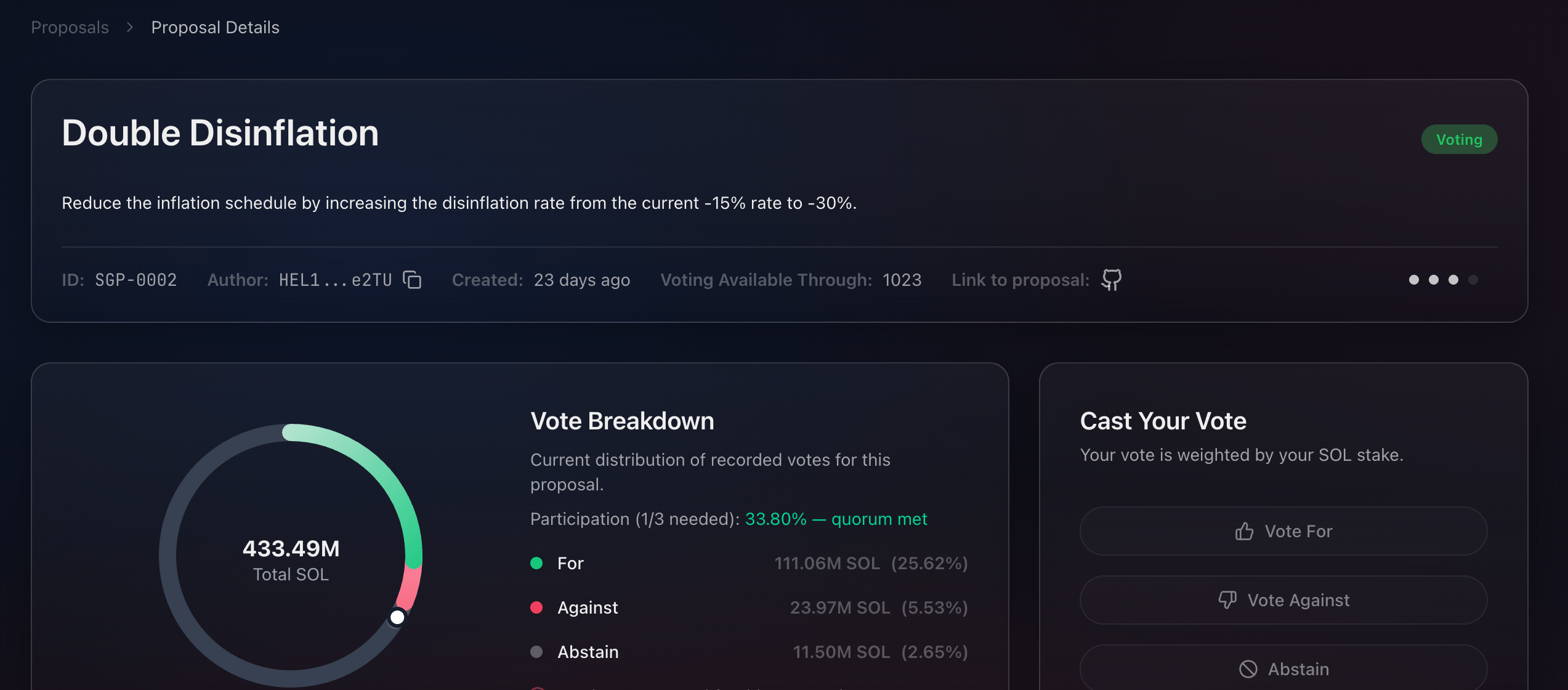
Current voting distribution for SIMD-553 as of August 27. Source: Solana Governance

Staking Yield Could Fall to 2.25%

Under SIMD-550, Solana will reach its final inflation rate of 1.5% around the first half of 2029 instead of approximately 2032. The projected nominal staking yield is expected to fall to about 4.34% in the first year, 3% in the second year, and 2.25% in the third year.

Proposal SIMD-553 will simultaneously increase the volume of $SOL burned. At the current level of activity, the daily burn volume could increase from approximately 600–800 $SOL to 7,500–9,000 $SOL. This is still below the current inflation rate but substantially changes the supply trajectory.

"We believe inflation should be tied to economic performance and growth to help offset declining staking yields," Mena wrote.

Validator economics remain a concern. Depending on the final fee structure, voting costs could rise significantly, while lower inflation will reduce rewards. According to SIMD-550 estimates, two validators could become unprofitable in the first year, with the number rising to around 30 by the third year.

Lower Yields May Push Capital into Solana DeFi

These proposals also aim to change the distribution of $SOL capital.

Currently, about 67.9% of $SOL is staked, almost double Ethereum's rate of approximately 34.1%. Lower passive yields may prompt holders to redirect capital into lending, trading, and other decentralized finance (DeFi) applications.

This could be significant if activity growth leads to an increase in transaction fees, MEV, and other revenues sufficient to offset the decline in inflation rewards.

Mena argues that the supply-reduction signal could also support $SOL's investment appeal. Following Ethereum's EIP-1559 burn mechanism and Cosmos's inflation reduction in 2023, short-term price surges occurred, though broader market conditions played the primary role.

For $SOL holders, the picture is becoming clearer: lower yield today in exchange for less dilution tomorrow. Whether this becomes a growth driver will depend on whether network usage grows fast enough to make such a trade-off worthwhile.

end-content

Trending Cryptos

Related Questions

QWhat are the two proposals driving potential changes to Solana's monetary model, and what is the core aim of each?

AThe two proposals are SIMD-550 and SIMD-553. SIMD-550 aims to double Solana's annual disinflation rate from 15% to 30%. SIMD-553 introduces an additional token burn mechanism tied to requested computational units. Together, their core aim is to shift Solana towards a tighter monetary model, potentially creating a supply deficit and reducing inflation-driven staking rewards.

QAccording to the article, how low could the projected nominal staking yield for Solana fall in the third year under the proposed changes?

AAccording to the projections in the article, the nominal staking yield for Solana could fall to approximately 2.25% in the third year under the proposed changes outlined in SIMD-550.

QHow much could the daily token burn volume increase under proposal SIMD-553 based on current network activity levels?

AUnder proposal SIMD-553, based on current activity levels, the daily token burn volume could increase from approximately 600–800 SOL to 7,500–9,000 SOL.

QWhat potential impact on validator economics is highlighted as a concern regarding these proposals?

AThe article highlights that validator economics are a concern. A reduction in inflation will decrease staking rewards, while voting costs could increase significantly depending on the final fee structure. Estimates from SIMD-550 suggest that two validators could become unprofitable in the first year, with that number potentially rising to around 30 by the third year.

QHow might the proposed reduction in staking yields change the allocation of SOL capital within the Solana ecosystem?

AThe reduction in passive staking yields might push SOL holders to reallocate their capital into Solana's DeFi ecosystem, such as lending, trading, and other applications. This could potentially boost on-chain activity and related fee revenues, which might help offset the lower inflation-based rewards.

Related Reads

Trading

Spot

Hot Articles

Discussions

Welcome to the HTX Community. Here, you can stay informed about the latest platform developments and gain access to professional market insights. Users' opinions on the price of SOL (SOL) are presented below.

活动图片