2026 Altcoin Season Guide: Is It Time to Welcome the Altcoin Season?

marsbitPublished on 2026-07-19Last updated on 2026-07-19

Abstract

The Altcoin Season Guide for 2026 examines the phenomenon where alternative cryptocurrencies outperform Bitcoin. Defined by the Altseason Index, an altcoin season occurs when over 75% of the top 50 altcoins beat Bitcoin's returns over a rolling 90-day period, typically lasting 2-6 months. This cycle differs due to the "ETF wall," where institutional capital in Bitcoin ETFs may limit immediate flows into altcoins. A genuine season requires Bitcoin's dominance to fall below 50-55%, coupled with strength in key pairs like ETH/BTC. Historical patterns show capital rotation through distinct phases: accumulation, early narrative-driven breakouts (e.g., AI, RWA, DePIN), and a peak phase marked by high volatility and retail frenzy. Successful strategies involve portfolio diversification, sector rotation, and strict risk management. The next major altcoin season is anticipated 18-30 months post the 2024 Bitcoin halving, potentially in 2026-2027, driven by macroeconomic conditions, institutional adoption, and strong narratives in emerging sectors. Preparation involves building a watchlist of projects with solid fundamentals and active ecosystems.

Written by: Maciej Zerelik

Compiled by: AididiaoJP, Foresight News

The altcoin season kicks off when alternative cryptocurrencies start outperforming Bitcoin. However, accurately pinpointing its exact start is not easy. This guide will provide a detailed explanation of the cyclical patterns of altcoin seasons, the impact of the ETF Wall, narrative-driven sector rotations, and potential cross-chain strategies for 2026.

Understanding Altcoin Season

Definition of Altcoin Season

Many newcomers wonder, what exactly is an altcoin season, and why does it attract so much attention from crypto investors.

Altcoin season refers to a phase where at least 75% of the top 50 cryptocurrencies outperform Bitcoin over a rolling 90-day period. Analysts use this benchmark to gauge whether capital is flowing from BTC into other digital assets.

This concept became widely known during the 2017-2018 bull market. At that time, countless investors shifted Bitcoin profits into Ethereum and other smaller tokens, resulting in many altcoins delivering returns far exceeding BTC within months.

Historically, a complete altcoin season typically lasts 2 to 6 months, though the rhythm varies each cycle.

"Outperform" means that an altcoin has a higher return than Bitcoin over the same period. For example, if Bitcoin rises 25% over 90 days, and Solana rises 80%, then Solana has significantly outperformed BTC. When most leading cryptocurrencies exhibit similar performance, the market is usually considered to be in an altcoin season.

Bitcoin vs. Altcoin Dynamics: The ETF Wall

Bitcoin Dominance represents Bitcoin's share of the total cryptocurrency market capitalization. When this indicator begins to decline, investors often interpret it as a signal that capital is flowing into altcoins.

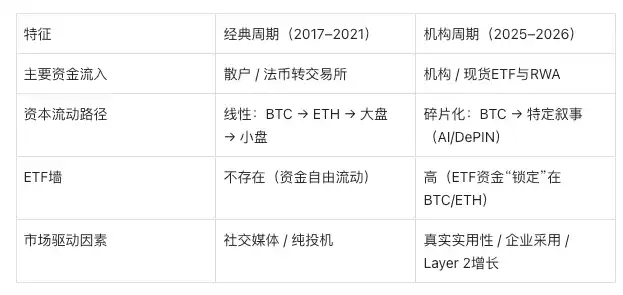
However, this market cycle is different from previous ones due to the existence of the so-called "ETF Wall."

Spot Bitcoin ETFs launched by asset managers like BlackRock and Fidelity have attracted tens of billions of dollars from institutional investors. These investors typically only gain Bitcoin exposure through regulated financial products, effectively locking this portion of capital within the BTC ecosystem.

In the 2017 bull market, retail capital could flow more freely into thousands of altcoins. In 2026, for a broad altcoin season to occur, it may require Bitcoin profit-taking alongside a new wave of retail and on-chain liquidity injection before capital can diffuse into the broader market.

Comparison between classic cycles (2017–2021) and institutional cycles (2025–2026):
How to Identify Altcoin Season

Identifying an altcoin season early can make a huge difference, as entering after the biggest gains often carries higher risks and less upside potential.

Altcoin Season Index and New 2026 Indicators

The Altcoin Season Index is one of the most popular tools for tracking market rotation. Developed by Blockchaincenter, it measures the performance of major cryptocurrencies against Bitcoin over the past 90 days on a scale of 0-100.

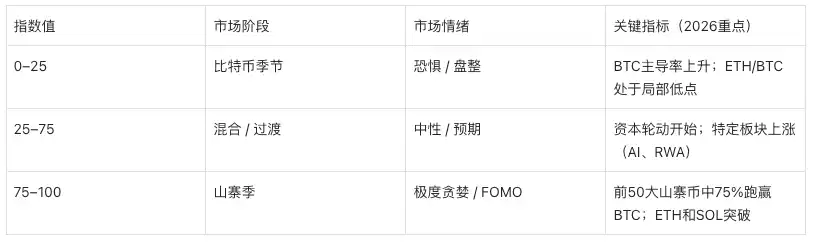
An index below 25 indicates Bitcoin season, 25-75 indicates a mixed market, and when the index rises above 75, the market is usually considered to be in an altcoin season, as most leading altcoins are outperforming BTC.
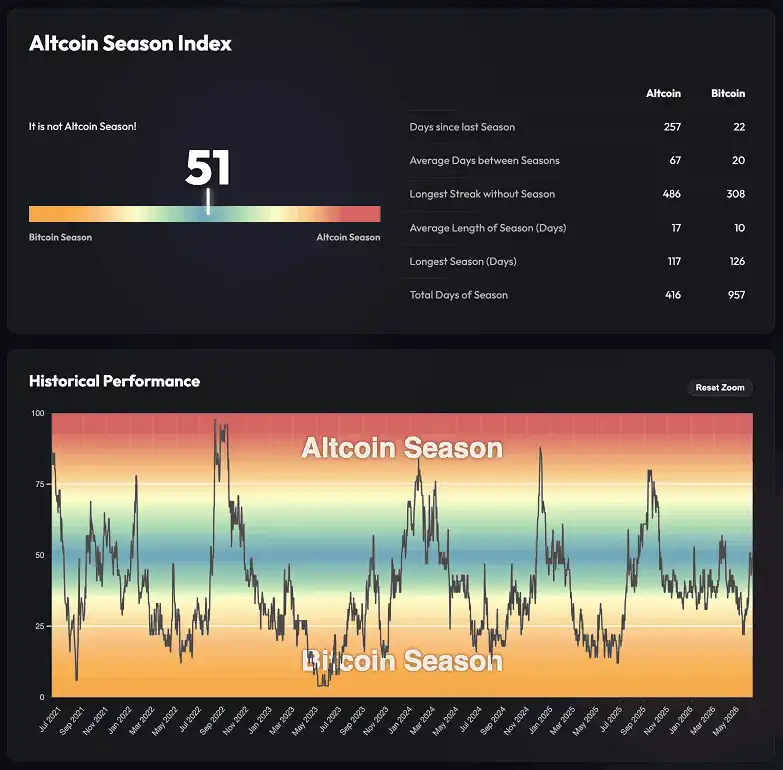
(Chart: Altcoin Season Index, BlockchainCenter, June 10, 2026)

However, the 2026 market requires additional confirmation. Many analysts now also observe the ETH/BTC and SOL/BTC trading pairs. If Ethereum and Solana fail to strengthen against Bitcoin, even if the index exceeds 75, it might only be short-term speculation rather than a sustainable rotation. Strong performance in benchmark pairs often confirms that capital has flowed from Bitcoin into the broader ecosystem.

Table of index values corresponding to market phases:
Key Metrics and Indicators

No single metric can perfectly predict the market. Experienced investors combine multiple signals to judge whether a new rotation is genuinely starting.

One of the strongest indicators is Bitcoin Dominance. When it retreats from above 50% to 40% or lower, it typically means capital is moving away from BTC into altcoins. Simultaneously, the total altcoin market cap growth rate should significantly outpace Bitcoin's, ideally by 2-3 times.

Trading activity also provides important clues. A week-over-week increase in altcoin/BTC trading volume exceeding 50% often indicates growing investor interest. Social media engagement and Google Trends can corroborate this, especially when search terms like "best altcoins" or "altcoin season" grow 30-50% within a few weeks.

When multiple indicators align, the probability of a genuine altcoin season is much higher than relying on the Altcoin Season Index alone.

Historical Altcoin Bull Run Patterns

Each major altcoin rally leaves valuable lessons, helping investors identify recurring trends and avoid emotional decisions in future cycles.

2017-2018 and 2020-2021 Bull Markets

Although both cycles produced astonishing returns, the driving forces behind them were entirely different.

The 2017-2018 altcoin season was driven by the ICO frenzy. Hundreds of new blockchain projects raised funds directly from retail investors, with speculation often outweighing fundamentals. As Bitcoin hit new highs and slowed down, capital quickly shifted to smaller tokens, with many coins surging hundreds of percent within months.

The 2020-2021 cycle followed a different path. Market focus shifted to DeFi protocols, NFT platforms, Layer 1 blockchains, and later, meme coins. Meanwhile, institutional investors entered the crypto space through companies, funds, and regulated products, bringing in capital far exceeding previous levels.

Retail investors still played a significant role in the NFT and meme coin mania, but institutional participation made the market larger and more mature. This shift also changed the way capital rotated, making the leadership role of Ethereum and key sectors more important than broad speculation. Therefore, future altcoin seasons may become increasingly selective rather than lifting all projects simultaneously.

Phases of an Altcoin Season: From BTC to Narrative-Driven

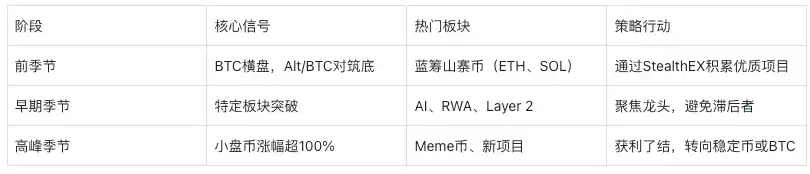
Modern altcoin cycles are no longer about all tokens rising in sync. Capital now rotates among different narratives, rewarding those sectors with the strongest adoption and momentum. Understanding these phases helps investors see where money is flowing, rather than chasing projects that have already peaked.

Phase comparison table:
Pre-Season (Accumulation Phase)

The accumulation phase typically begins when Bitcoin is range-bound or corrects by 10-20%. During this time, many altcoins may fall another 20-40% from their local highs, leading to disappearing retail interest.

Trading volume remains low, social media activity declines, and discussions are filled with negative sentiment. Behind the scenes, experienced investors are gradually accumulating fundamentally strong projects at discounted prices.

This phase often ends when Bitcoin stabilizes, Ethereum starts outperforming BTC, and trading volume slowly recovers. For long-term investors, this is the best time to research projects, build watchlists, and establish positions before widespread market attention returns.

Early Season: Narrative-Led Breakouts

Many investors ask, when does the altcoin season start? In today's market, the answer is often linked to narratives rather than market cap.

Not all top-ten cryptocurrencies will rise simultaneously; capital first flows into the most talked-about sectors. AI agents, Real-World Assets (RWA), and DePIN projects have recently become typical examples of this trend.

The traditional strategy of buying the largest altcoins simply because they are in the top ten is much less effective. Early winners are increasingly those projects with clear use cases, growing ecosystems, and the ability to attract fresh liquidity.

Peak Season (Maximum Activity)

When mid- and small-cap coins achieve 100-500% gains within weeks, does that mean we are in the common altcoin season? In this phase, optimism reaches extremes, and the Fear & Greed Index often exceeds 80.

Retail investors aggressively buy every dip, while experienced traders begin gradually reducing positions and locking in profits. New token launches surge, leverage amplifies, and social media is flooded with unrealistic price predictions.

These conditions are often warning signs rather than buying opportunities. Rising volatility, excessive leverage, and parabolic moves typically indicate the market is approaching exhaustion. Historically, this peak phase lasts 2 to 6 weeks, followed by significant corrections or broader market rotations.

Trading Strategies for Altcoin Season

Successful altcoin investing depends on a clear plan. A structured strategy helps investors manage risk, protect profits, and avoid emotional decisions during extreme volatility.

Portfolio Allocation and Sector Rotation

A balanced portfolio should match your risk tolerance and market environment. Conservative investors allocate more capital to Bitcoin, Ethereum, and stablecoins, while aggressive traders increase exposure to high-growth sectors during strong trends.

Sector rotation is equally important. Capital rarely stays in one narrative for the entire cycle. For example, profits taken from AI-related projects may later rotate into RWA, DePIN, gaming, or other emerging sectors. Following liquidity rather than chasing past winners often yields better long-term results.

Risk Management and Stop-Loss Discipline

Even the strongest altcoin seasons eventually end, so risk management is one of the most crucial parts of any strategy.

Many experienced investors limit single positions to 5-10% of their portfolio to minimize the impact of any one trade failing. Diversifying across 8-12 carefully selected projects further reduces overall risk while maintaining exposure to multiple narratives.

Keeping a portion of the portfolio in stablecoins also provides flexibility. A stablecoin reserve allows you to buy quality assets during pullbacks and protect profits when the market overheats. Combined with preset stop-losses and profit targets, this disciplined approach often leads to more consistent outcomes than trying to maximize gains on every trade.

Altcoin Season vs. Bitcoin Season

Understanding the transition between Bitcoin season and altcoin season helps investors identify market rotations and adjust strategies before capital shifts.

Key Differences and Rotation Signals

The difference between altcoin season and Bitcoin season lies in capital flow. During Bitcoin season, BTC dominance typically rises above 50-60%, showing investor preference for the market's largest, most mature asset. Simultaneously, many altcoins underperform or decline against BTC even if their USD price is stable.

Altcoin season is the opposite story. Bitcoin dominance tends to fall back to 40% or lower, and Ethereum and other major cryptocurrencies begin to attract more liquidity. This rotation eventually spreads to mid-cap and small-cap projects, creating the cycle's strongest gains.

Investor profiles also change. Bitcoin season attracts more conservative investors and institutions seeking lower volatility and long-term exposure. Altcoin season brings more speculative capital, with traders accepting higher risk in pursuit of significantly higher returns.

Historically, Bitcoin dominant phases can last for months, while intense altcoin seasons may only last 2-6 weeks before momentum fades. Therefore, watching BTC dominance is critical. If dominance begins rising again, stablecoin inflows increase, and leading altcoins start weakening against Bitcoin, these are often early signals that capital is flowing back to BTC or defensive positions, signaling the altcoin season is about to end.

Expert Predictions and Future Outlook for Altcoin Season

While all predictions involve uncertainty, understanding altcoin season forecasts and their key catalysts can help investors build smarter long-term strategies.

When Will the Next Altcoin Season Start

Many investors ask when the altcoin season will start, but no indicator can give an exact date. Successful prediction relies on a combination of macroeconomic conditions, Bitcoin market cycles, and capital rotation.

Historically, the strongest altcoin rallies have occurred 18 to 30 months after a Bitcoin market bottom, often following a halving event. Given the most recent Bitcoin halving occurred in April 2024, many analysts believe 2026-2027 could still offer favorable conditions if liquidity continues to improve.

Macroeconomic factors will play a significant role. Lower interest rates, global liquidity expansion, and stronger investor risk appetite may encourage capital flow into high-risk digital assets. Institutional adoption will also support the market, though much investment remains concentrated in Bitcoin ETFs rather than altcoins.

Technological progress will likely shape the next cycle alongside macroeconomics. Narratives like AI infrastructure, real-world asset tokenization, DePIN, next-gen DeFi, and blockchain gaming may become the primary destinations for fresh capital. Investors should not expect all cryptocurrencies to rise in unison but should focus on sectors attracting real users, active developer engagement, and institutional attention.

When Will the 2026 Altcoin Season Start

The official confirmation of a 2026 altcoin season has not yet begun, as Bitcoin currently represents about 56-60% of the total market cap. Analysts predict that a sustained shift to altcoins will only occur when Bitcoin dominance falls below 50-55% and the Altcoin Season Index reaches the 75 threshold.

How to Prepare for the Next Altcoin Season

Preparing during calm market periods often creates better opportunities than reacting after prices have already skyrocketed. A solid plan allows you to act confidently when momentum returns.

Building a Watchlist

The best watchlists focus on quality over quantity. Before adding a project, investors should confirm it has a real product, active users, an experienced and public development team, reasonable valuation, and a strong community supporting long-term growth.

A practical research checklist should include: token utility, ecosystem activity, developer updates, partnerships, liquidity, tokenomics, and competitive advantages. Regularly reviewing these factors makes it easier to distinguish lasting projects from short-term hype.

Frequently Asked Questions

What is the current Altcoin Season Index value?

You can view the Altcoin Season Index in real-time on Blockchaincenter. A score of 0-25 indicates Bitcoin season, 25-75 indicates a mixed market, and 75-100 suggests an altcoin season. Although the index updates daily, checking weekly often provides clearer signals and avoids overtrading due to short-term noise.

When is the altcoin season coming?

Many investors ask when the altcoin season is coming, but there is no fixed date. Historically, major altcoin rallies have often occurred 12-18 months after a Bitcoin halving. While the most recent halving was in April 2024, market conditions, Bitcoin dominance, liquidity, and ETH/BTC strength are more important than the calendar.

If Bitcoin crashes, can an altcoin season still happen?

No. A broad altcoin season requires Bitcoin to remain stable or rise moderately. When Bitcoin drops more than 20% in a short period, capital typically leaves the entire crypto market rather than rotating into altcoins. Historically, significant altcoin rallies have occurred during Bitcoin consolidation or moderate uptrends, with only a few exceptions during minor BTC pullbacks.

When will altcoins surge?

The answer to when altcoins will surge usually depends on market rotation. Altcoins tend to accelerate after Bitcoin dominance peaks above 50-55% and begins to decline, while the ETH/BTC ratio strengthens. A 15-30% rise in ETH/BTC often heralds a broader rally, with capital gradually flowing from Ethereum to large-cap, then mid-cap, and finally small-cap altcoins.


Trending Cryptos

Related Questions

QWhat is the key metric used by analysts to define an 'alt season', and what does it measure?

AThe key metric used to define an 'alt season' is the Altseason Index, which measures the percentage of the top 50 cryptocurrencies that have outperformed Bitcoin over a rolling 90-day period. An index value above 75 typically indicates an alt season is underway, signaling a capital rotation from BTC into other digital assets.

QWhat is the 'ETF wall' mentioned in the article, and how does it differ from previous market cycles?

AThe 'ETF wall' refers to the massive capital inflows into spot Bitcoin ETFs from institutional investors via firms like BlackRock and Fidelity. Unlike the 2017 cycle where retail capital flowed freely into altcoins, a significant portion of institutional capital in the current cycle is locked into regulated BTC products. This creates a structural difference, potentially making a broad alt season reliant on bitcoin profit-taking and a new wave of retail or on-chain liquidity to spread to the wider market.

QAccording to the article, what additional confirmation is needed in 2026 beyond the Altseason Index to signal a sustainable alt season?

AIn 2026, analysts look for additional confirmation beyond the Altseason Index reaching above 75. Specifically, they monitor the strength of key trading pairs like ETH/BTC and SOL/BTC. If major cryptocurrencies like Ethereum and Solana are not strengthening against Bitcoin, a high index score might indicate short-term speculation rather than a sustained, broad-based capital rotation.

QWhat are the typical stages of a modern altcoin cycle as described in the guide, and what characterizes the 'Early Season'?

AThe typical stages of a modern altcoin cycle are: Accumulation Phase (Pre-Season), Early Season, and Peak Season (Maximum Activity). The 'Early Season' is characterized by narrative-led breakouts, where capital flows first into the most compelling thematic sectors (like AI agents, RWA, or DePIN projects) rather than all top altcoins rising simultaneously. Winners are increasingly projects with clear use cases and growing ecosystems.

QUnder what market condition is a broad alt season unlikely to occur, and why?

AA broad alt season is unlikely to occur if Bitcoin experiences a sharp crash. Historically, when Bitcoin drops more than 20% in a short period, capital tends to exit the entire crypto market rather than rotate into altcoins. Significant altcoin rallies usually happen during periods of Bitcoin consolidation or moderate uptrends, with only minor exceptions during slight BTC pullbacks.

Related Reads

Should Developers Build on Corporate Chains Like Base and Robinhood? Five Key Risks to Consider

Should developers build on enterprise chains like Base and Robinhood? While offering enticing initial benefits like user access, these chains pose significant risks due to the inherent conflict of interest when the operator controls both the platform and a leading on-chain application. The primary lure is the promise of traffic and user distribution (e.g., through a parent company's app). However, five key risks emerge: 1. **Direct Competition**: The platform can use its exclusive data and positioning to launch competing products against third-party developers, mirroring cases like Amazon and Microsoft. 2. **Wallet Multi-Chain Reality**: Associated wallets (like Coinbase Wallet) must support multiple chains to remain competitive, diluting the promised exclusive traffic advantage for the enterprise chain. 3. **Exclusion by Platform Rivals**: Competing platforms (e.g., Coinbase vs. Robinhood) have no incentive to promote applications built on each other's chains, limiting growth avenues. 4. **Profit Squeeze**: The party controlling the end-user interface holds superior bargaining power and can capture a disproportionate share of value, squeezing developer profits. 5. **Unfulfilled Promises**: Promised traffic support can fail to materialize due to shifting platform priorities or strategic changes. In contrast, neutral blockchains like Ethereum and Solana avoid these platform risks. To mitigate risks on enterprise chains, developers should consider strategies like securing substantial onboarding grants, obtaining formal commitments (though these have weak historical enforceability), or, most effectively, pursuing a multi-chain deployment strategy while building independent user acquisition channels. Enterprise chains may be useful for initial cold-start user acquisition, but the core goal should be cultivating an independent user base rather than long-term dependence.

Foresight News10m ago

Should Developers Build on Corporate Chains Like Base and Robinhood? Five Key Risks to Consider

Foresight News10m ago

Crypto Watch This Week: Uniswap Fee Switch Vote Starts Today, CLARITY Act Could Face Senate Vote This Week

**Weekly Crypto Watch: Key Events & Catalysts** This week’s crypto focus is on pivotal governance votes, potential regulatory progress, and major protocol upgrades. **Uniswap** takes center stage with two crucial on-chain proposals going to vote from July 19-26. The first aims to activate protocol fees for Uniswap V2/V3 on the new Robinhood Chain and direct them to a UNI token burn mechanism. The second seeks to activate V4 fees across seven major chains, including Ethereum and Base. Robinhood Chain has already seen over $60B in Uniswap volume since its launch 18 days ago. The proposals build on last year's UNIfication plan, which transformed UNI into a fee-generating asset. On the **U.S. regulatory front**, the **CLARITY Act** could face a Senate floor vote this week. While some lawmakers are optimistic, the bill faces hurdles, needing at least 60 votes to overcome a filibuster. Prediction market Polymarket currently gives it only a 34% chance of being signed into law this year. Other notable catalysts include: * **Morpho's** fixed-rate lending protocol, **Morpho Midnight**, is set for its public launch, starting with a single market (cbBTC/USDC) on Base. * **Derive** (formerly Lyra) is preparing for its largest-ever upgrade, **V3**, which will reportedly introduce 0DTE options and a more retail-friendly UX. * **Pendle** will hold a community call on July 22 to share its roadmap, with a focus on expanding its RWA (Real World Assets) capabilities. * An undisclosed privacy-focused application for **Polymarket**, built on **Starknet**, is reportedly launching on July 20.

marsbit1h ago

Crypto Watch This Week: Uniswap Fee Switch Vote Starts Today, CLARITY Act Could Face Senate Vote This Week

marsbit1h ago

Citi's Interpretation: Upgrading China, Downgrading South Korea, Is the Emerging Markets Rally Beginning to Broaden?

In its latest emerging markets strategy report, Citi has upgraded China to overweight from neutral, while downgrading South Korea to neutral from overweight. It maintains an overweight rating for China-Taiwan markets. The report sets MSCI EM index targets of 1870 by end-2026 and 2050 by mid-2027, implying further upside of approximately 12% and over 20% respectively from current levels. Citi's move reflects a search for "broadening" opportunities beyond the concentrated rally in AI hardware and tech, which has driven EM gains year-to-date, led by South Korea and China-Taiwan markets. The upgrade for China is based on factors including light investor positioning, potential benefits from lower oil prices, and relative attractiveness in a recovering global growth cycle. While maintaining a strong long-term view on South Korea, Citi notes its recent outperformance and elevated volatility prompted a tactical downgrade. The report highlights that EM earnings revisions remain narrow, with the IT sector contributing about 85% of 2026 EPS estimate upgrades. For a sustained rally, Citi argues that market gains need to broaden to other sectors and regions. China, South Africa, and Mexico rank highly as potential "broadening candidates" based on factors like sensitivity to a weaker dollar, lower bond yields, and oil prices. Key uncertainties include the sustainability of AI capital expenditure returns, geopolitical risks, and Federal Reserve policy. Citi's stance is cautiously optimistic, suggesting the rally has room to broaden rather than signaling a confirmed broad-based EM bull market. The path to higher index targets depends on whether non-tech earnings revisions improve and if capital rotates from concentrated winners into a wider set of markets.

marsbit1h ago

Citi's Interpretation: Upgrading China, Downgrading South Korea, Is the Emerging Markets Rally Beginning to Broaden?

marsbit1h ago

Trading

Spot

Hot Articles

What is SONIC

Sonic: Pioneering the Future of Gaming in Web3 Introduction to Sonic In the ever-evolving landscape of Web3, the gaming industry stands out as one of the most dynamic and promising sectors. At the forefront of this revolution is Sonic, a project designed to amplify the gaming ecosystem on the Solana blockchain. Leveraging cutting-edge technology, Sonic aims to deliver an unparalleled gaming experience by efficiently processing millions of requests per second, ensuring that players enjoy seamless gameplay while maintaining low transaction costs. This article delves into the intricate details of Sonic, exploring its creators, funding sources, operational mechanics, and the timeline of significant events that have shaped its journey. What is Sonic? Sonic is an innovative layer-2 network that operates atop the Solana blockchain, specifically tailored to enhance the existing Solana gaming ecosystem. It accomplishes this through a customised, VM-agnostic game engine paired with a HyperGrid interpreter, facilitating sovereign game economies that roll up back to the Solana platform. The primary goals of Sonic include: Enhanced Gaming Experiences: Sonic is committed to offering lightning-fast on-chain gameplay, allowing players and developers to engage with games at previously unattainable speeds. Atomic Interoperability: This feature enables transactions to be executed within Sonic without the need to redeploy Solana programmes and accounts. This makes the process more efficient and directly benefits from Solana Layer1 services and liquidity. Seamless Deployment: Sonic allows developers to write for Ethereum Virtual Machine (EVM) based systems and execute them on Solana’s SVM infrastructure. This interoperability is crucial for attracting a broader range of dApps and decentralised applications to the platform. Support for Developers: By offering native composable gaming primitives and extensible data types - dining within the Entity-Component-System (ECS) framework - game creators can craft intricate business logic with ease. Overall, Sonic's unique approach not only caters to players but also provides an accessible and low-cost environment for developers to innovate and thrive. Creator of Sonic The information regarding the creator of Sonic is somewhat ambiguous. However, it is known that Sonic's SVM is owned by the company Mirror World. The absence of detailed information about the individuals behind Sonic reflects a common trend in several Web3 projects, where collective efforts and partnerships often overshadow individual contributions. Investors of Sonic Sonic has garnered considerable attention and support from various investors within the crypto and gaming sectors. Notably, the project raised an impressive $12 million during its Series A funding round. The round was led by BITKRAFT Ventures, with other notable investors including Galaxy, Okx Ventures, Interactive, Big Brain Holdings, and Mirana. This financial backing signifies the confidence that investment foundations have in Sonic’s potential to revolutionise the Web3 gaming landscape, further validating its innovative approaches and technologies. How Does Sonic Work? Sonic utilises the HyperGrid framework, a sophisticated parallel processing mechanism that enhances its scalability and customisability. Here are the core features that set Sonic apart: Lightning Speed at Low Costs: Sonic offers one of the fastest on-chain gaming experiences compared to other Layer-1 solutions, powered by the scalability of Solana’s virtual machine (SVM). Atomic Interoperability: Sonic enables transaction execution without redeployment of Solana programmes and accounts, effectively streamlining the interaction between users and the blockchain. EVM Compatibility: Developers can effortlessly migrate decentralised applications from EVM chains to the Solana environment using Sonic’s HyperGrid interpreter, increasing the accessibility and integration of various dApps. Ecosystem Support for Developers: By exposing native composable gaming primitives, Sonic facilitates a sandbox-like environment where developers can experiment and implement business logic, greatly enhancing the overall development experience. Monetisation Infrastructure: Sonic natively supports growth and monetisation efforts, providing frameworks for traffic generation, payments, and settlements, thereby ensuring that gaming projects are not only viable but also sustainable financially. Timeline of Sonic The evolution of Sonic has been marked by several key milestones. Below is a brief timeline highlighting critical events in the project's history: 2022: The Sonic cryptocurrency was officially launched, marking the beginning of its journey in the Web3 gaming arena. 2024: June: Sonic SVM successfully raised $12 million in a Series A funding round. This investment allowed Sonic to further develop its platform and expand its offerings. August: The launch of the Sonic Odyssey testnet provided users with the first opportunity to engage with the platform, offering interactive activities such as collecting rings—a nod to gaming nostalgia. October: SonicX, an innovative crypto game integrated with Solana, made its debut on TikTok, capturing the attention of over 120,000 users within a short span. This integration illustrated Sonic’s commitment to reaching a broader, global audience and showcased the potential of blockchain gaming. Key Points Sonic SVM is a revolutionary layer-2 network on Solana explicitly designed to enhance the GameFi landscape, demonstrating great potential for future development. HyperGrid Framework empowers Sonic by introducing horizontal scaling capabilities, ensuring that the network can handle the demands of Web3 gaming. Integration with Social Platforms: The successful launch of SonicX on TikTok displays Sonic’s strategy to leverage social media platforms to engage users, exponentially increasing the exposure and reach of its projects. Investment Confidence: The substantial funding from BITKRAFT Ventures, among others, emphasizes the robust backing Sonic has, paving the way for its ambitious future. In conclusion, Sonic encapsulates the essence of Web3 gaming innovation, striking a balance between cutting-edge technology, developer-centric tools, and community engagement. As the project continues to evolve, it is poised to redefine the gaming landscape, making it a notable entity for gamers and developers alike. As Sonic moves forward, it will undoubtedly attract greater interest and participation, solidifying its place within the broader narrative of blockchain gaming.

1.9k Total ViewsPublished 2024.04.04Updated 2024.12.03

What is SONIC

What is $S$

Understanding SPERO: A Comprehensive Overview Introduction to SPERO As the landscape of innovation continues to evolve, the emergence of web3 technologies and cryptocurrency projects plays a pivotal role in shaping the digital future. One project that has garnered attention in this dynamic field is SPERO, denoted as SPERO,$$s$. This article aims to gather and present detailed information about SPERO, to help enthusiasts and investors understand its foundations, objectives, and innovations within the web3 and crypto domains. What is SPERO,$$s$? SPERO,$$s$ is a unique project within the crypto space that seeks to leverage the principles of decentralisation and blockchain technology to create an ecosystem that promotes engagement, utility, and financial inclusion. The project is tailored to facilitate peer-to-peer interactions in new ways, providing users with innovative financial solutions and services. At its core, SPERO,$$s$ aims to empower individuals by providing tools and platforms that enhance user experience in the cryptocurrency space. This includes enabling more flexible transaction methods, fostering community-driven initiatives, and creating pathways for financial opportunities through decentralised applications (dApps). The underlying vision of SPERO,$$s$ revolves around inclusiveness, aiming to bridge gaps within traditional finance while harnessing the benefits of blockchain technology. Who is the Creator of SPERO,$$s$? The identity of the creator of SPERO,$$s$ remains somewhat obscure, as there are limited publicly available resources providing detailed background information on its founder(s). This lack of transparency can stem from the project's commitment to decentralisation—an ethos that many web3 projects share, prioritising collective contributions over individual recognition. By centring discussions around the community and its collective goals, SPERO,$$s$ embodies the essence of empowerment without singling out specific individuals. As such, understanding the ethos and mission of SPERO remains more important than identifying a singular creator. Who are the Investors of SPERO,$$s$? SPERO,$$s$ is supported by a diverse array of investors ranging from venture capitalists to angel investors dedicated to fostering innovation in the crypto sector. The focus of these investors generally aligns with SPERO's mission—prioritising projects that promise societal technological advancement, financial inclusivity, and decentralised governance. These investor foundations are typically interested in projects that not only offer innovative products but also contribute positively to the blockchain community and its ecosystems. The backing from these investors reinforces SPERO,$$s$ as a noteworthy contender in the rapidly evolving domain of crypto projects. How Does SPERO,$$s$ Work? SPERO,$$s$ employs a multi-faceted framework that distinguishes it from conventional cryptocurrency projects. Here are some of the key features that underline its uniqueness and innovation: Decentralised Governance: SPERO,$$s$ integrates decentralised governance models, empowering users to participate actively in decision-making processes regarding the project’s future. This approach fosters a sense of ownership and accountability among community members. Token Utility: SPERO,$$s$ utilises its own cryptocurrency token, designed to serve various functions within the ecosystem. These tokens enable transactions, rewards, and the facilitation of services offered on the platform, enhancing overall engagement and utility. Layered Architecture: The technical architecture of SPERO,$$s$ supports modularity and scalability, allowing for seamless integration of additional features and applications as the project evolves. This adaptability is paramount for sustaining relevance in the ever-changing crypto landscape. Community Engagement: The project emphasises community-driven initiatives, employing mechanisms that incentivise collaboration and feedback. By nurturing a strong community, SPERO,$$s$ can better address user needs and adapt to market trends. Focus on Inclusion: By offering low transaction fees and user-friendly interfaces, SPERO,$$s$ aims to attract a diverse user base, including individuals who may not previously have engaged in the crypto space. This commitment to inclusion aligns with its overarching mission of empowerment through accessibility. Timeline of SPERO,$$s$ Understanding a project's history provides crucial insights into its development trajectory and milestones. Below is a suggested timeline mapping significant events in the evolution of SPERO,$$s$: Conceptualisation and Ideation Phase: The initial ideas forming the basis of SPERO,$$s$ were conceived, aligning closely with the principles of decentralisation and community focus within the blockchain industry. Launch of Project Whitepaper: Following the conceptual phase, a comprehensive whitepaper detailing the vision, goals, and technological infrastructure of SPERO,$$s$ was released to garner community interest and feedback. Community Building and Early Engagements: Active outreach efforts were made to build a community of early adopters and potential investors, facilitating discussions around the project’s goals and garnering support. Token Generation Event: SPERO,$$s$ conducted a token generation event (TGE) to distribute its native tokens to early supporters and establish initial liquidity within the ecosystem. Launch of Initial dApp: The first decentralised application (dApp) associated with SPERO,$$s$ went live, allowing users to engage with the platform's core functionalities. Ongoing Development and Partnerships: Continuous updates and enhancements to the project's offerings, including strategic partnerships with other players in the blockchain space, have shaped SPERO,$$s$ into a competitive and evolving player in the crypto market. Conclusion SPERO,$$s$ stands as a testament to the potential of web3 and cryptocurrency to revolutionise financial systems and empower individuals. With a commitment to decentralised governance, community engagement, and innovatively designed functionalities, it paves the way toward a more inclusive financial landscape. As with any investment in the rapidly evolving crypto space, potential investors and users are encouraged to research thoroughly and engage thoughtfully with the ongoing developments within SPERO,$$s$. The project showcases the innovative spirit of the crypto industry, inviting further exploration into its myriad possibilities. While the journey of SPERO,$$s$ is still unfolding, its foundational principles may indeed influence the future of how we interact with technology, finance, and each other in interconnected digital ecosystems.

152 Total ViewsPublished 2024.12.17Updated 2024.12.17

What is $S$

What is AGENT S

Agent S: The Future of Autonomous Interaction in Web3 Introduction In the ever-evolving landscape of Web3 and cryptocurrency, innovations are constantly redefining how individuals interact with digital platforms. One such pioneering project, Agent S, promises to revolutionise human-computer interaction through its open agentic framework. By paving the way for autonomous interactions, Agent S aims to simplify complex tasks, offering transformative applications in artificial intelligence (AI). This detailed exploration will delve into the project's intricacies, its unique features, and the implications for the cryptocurrency domain. What is Agent S? Agent S stands as a groundbreaking open agentic framework, specifically designed to tackle three fundamental challenges in the automation of computer tasks: Acquiring Domain-Specific Knowledge: The framework intelligently learns from various external knowledge sources and internal experiences. This dual approach empowers it to build a rich repository of domain-specific knowledge, enhancing its performance in task execution. Planning Over Long Task Horizons: Agent S employs experience-augmented hierarchical planning, a strategic approach that facilitates efficient breakdown and execution of intricate tasks. This feature significantly enhances its ability to manage multiple subtasks efficiently and effectively. Handling Dynamic, Non-Uniform Interfaces: The project introduces the Agent-Computer Interface (ACI), an innovative solution that enhances the interaction between agents and users. Utilizing Multimodal Large Language Models (MLLMs), Agent S can navigate and manipulate diverse graphical user interfaces seamlessly. Through these pioneering features, Agent S provides a robust framework that addresses the complexities involved in automating human interaction with machines, setting the stage for myriad applications in AI and beyond. Who is the Creator of Agent S? While the concept of Agent S is fundamentally innovative, specific information about its creator remains elusive. The creator is currently unknown, which highlights either the nascent stage of the project or the strategic choice to keep founding members under wraps. Regardless of anonymity, the focus remains on the framework's capabilities and potential. Who are the Investors of Agent S? As Agent S is relatively new in the cryptographic ecosystem, detailed information regarding its investors and financial backers is not explicitly documented. The lack of publicly available insights into the investment foundations or organisations supporting the project raises questions about its funding structure and development roadmap. Understanding the backing is crucial for gauging the project's sustainability and potential market impact. How Does Agent S Work? At the core of Agent S lies cutting-edge technology that enables it to function effectively in diverse settings. Its operational model is built around several key features: Human-like Computer Interaction: The framework offers advanced AI planning, striving to make interactions with computers more intuitive. By mimicking human behaviour in tasks execution, it promises to elevate user experiences. Narrative Memory: Employed to leverage high-level experiences, Agent S utilises narrative memory to keep track of task histories, thereby enhancing its decision-making processes. Episodic Memory: This feature provides users with step-by-step guidance, allowing the framework to offer contextual support as tasks unfold. Support for OpenACI: With the ability to run locally, Agent S allows users to maintain control over their interactions and workflows, aligning with the decentralised ethos of Web3. Easy Integration with External APIs: Its versatility and compatibility with various AI platforms ensure that Agent S can fit seamlessly into existing technological ecosystems, making it an appealing choice for developers and organisations. These functionalities collectively contribute to Agent S's unique position within the crypto space, as it automates complex, multi-step tasks with minimal human intervention. As the project evolves, its potential applications in Web3 could redefine how digital interactions unfold. Timeline of Agent S The development and milestones of Agent S can be encapsulated in a timeline that highlights its significant events: September 27, 2024: The concept of Agent S was launched in a comprehensive research paper titled “An Open Agentic Framework that Uses Computers Like a Human,” showcasing the groundwork for the project. October 10, 2024: The research paper was made publicly available on arXiv, offering an in-depth exploration of the framework and its performance evaluation based on the OSWorld benchmark. October 12, 2024: A video presentation was released, providing a visual insight into the capabilities and features of Agent S, further engaging potential users and investors. These markers in the timeline not only illustrate the progress of Agent S but also indicate its commitment to transparency and community engagement. Key Points About Agent S As the Agent S framework continues to evolve, several key attributes stand out, underscoring its innovative nature and potential: Innovative Framework: Designed to provide an intuitive use of computers akin to human interaction, Agent S brings a novel approach to task automation. Autonomous Interaction: The ability to interact autonomously with computers through GUI signifies a leap towards more intelligent and efficient computing solutions. Complex Task Automation: With its robust methodology, it can automate complex, multi-step tasks, making processes faster and less error-prone. Continuous Improvement: The learning mechanisms enable Agent S to improve from past experiences, continually enhancing its performance and efficacy. Versatility: Its adaptability across different operating environments like OSWorld and WindowsAgentArena ensures that it can serve a broad range of applications. As Agent S positions itself in the Web3 and crypto landscape, its potential to enhance interaction capabilities and automate processes signifies a significant advancement in AI technologies. Through its innovative framework, Agent S exemplifies the future of digital interactions, promising a more seamless and efficient experience for users across various industries. Conclusion Agent S represents a bold leap forward in the marriage of AI and Web3, with the capacity to redefine how we interact with technology. While still in its early stages, the possibilities for its application are vast and compelling. Through its comprehensive framework addressing critical challenges, Agent S aims to bring autonomous interactions to the forefront of the digital experience. As we move deeper into the realms of cryptocurrency and decentralisation, projects like Agent S will undoubtedly play a crucial role in shaping the future of technology and human-computer collaboration.

817 Total ViewsPublished 2025.01.14Updated 2025.01.14

What is AGENT S

Discussions

Welcome to the HTX Community. Here, you can stay informed about the latest platform developments and gain access to professional market insights. Users' opinions on the price of S (S) are presented below.

活动图片