Investors are starting to reposition ahead of the upcoming CLARITY Act.
Case in point: Circle [CRCL] dropped 20.11% on the 24th of March after news that stablecoin balances wouldn’t earn yields.
This effectively reduces the incentive to hold USDC, sparking broader market uncertainty, especially since stablecoins are central to connecting TradFi and DeFi.
That said, major L1s didn’t really react.
Ethereum [ETH], for instance, was up 1.5% intraday as of this writing, nearing $2.2k resistance. Still, as the network behind 50%+ of the stablecoin market, any policy shifts could ripple through Ethereum’s ecosystem, raising the question: What happens if the CLARITY Act caps stablecoin yields?
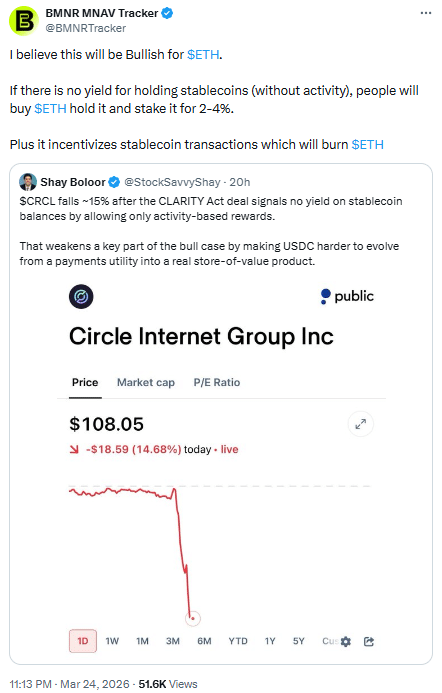
Notably, the market is reading this as bullish for ETH.
Analysts note that if holding stablecoins like USDC no longer earns yield, essentially removing the “interest” on idle cash, then staking ETH becomes a more attractive way to earn passive income.
As a result, more ETH could flow into staking, increasing network activity and making the overall setup positive for Ethereum.
On top of that, since stablecoins are used for transactions, traders are likely to move them more instead of just holding. This is where Ethereum’s edge as the largest stablecoin network really shows.
More transactions drive up gas fees, and EIP-1559 burns more ETH, adding another positive layer to the network.
Overall, the market’s reaction shows ETH’s technical resilience. In fact, investors plan to stake about $6 billion ETH in Ethereum’s pipeline over the next 50 days.
So the big question now: If the bullish thesis plays out, could this be just the start of Ethereum’s staking queue?
Sharplink demonstrates the potential of ongoing Ethereum staking
Sharplink provides a real-world example of why Ethereum staking isn’t slowing down anytime soon.
On X, the ETH staking pool shared that it has already generated 15,996 ETH ($34 million) in cumulative staking rewards. This shows that staking activity continues non-stop, even as the market moves and prices fluctuate.
The result? ETH remains locked, steadily generating rewards for participants.
Moreover, the timing of the post is clearly strategic. With investors adjusting around the CLARITY Act, it highlights the growing potential of Ethereum staking.
The point is made even stronger by Ethereum’s nearly $164 billion stablecoin pool, showing just how much capital could flow into staking.
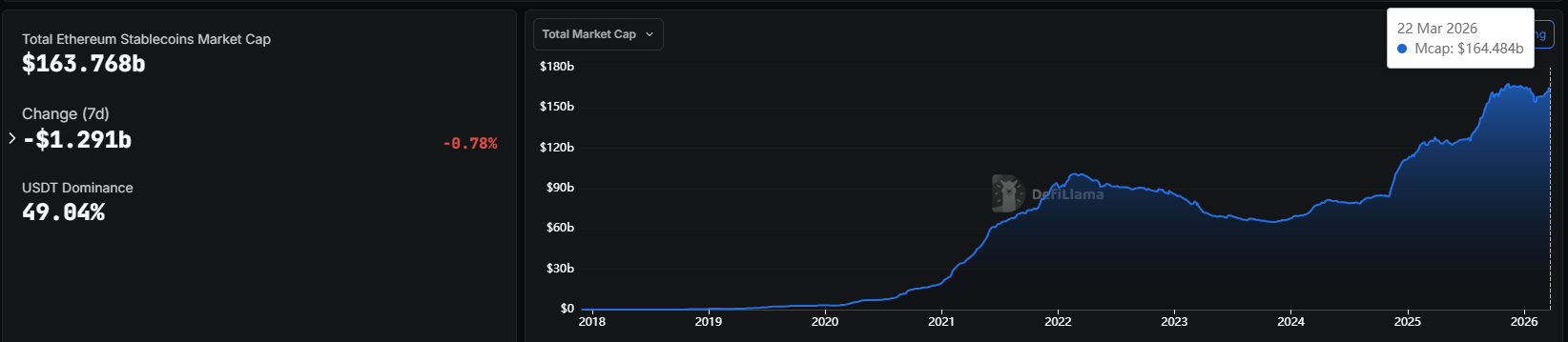
At the same time, only about 3.46 million ETH ($7.4 billion) is available on exchanges. If even a small portion of stablecoins moves into ETH or staked ETH for better yields, which is likely after the CLARITY Act changes, exchanges could run out of ETH fast.
This sets up a third bullish case for Ethereum.
Taken together, all of these point to a clear trend: Capped stablecoin yields could push more capital into ETH staking, locking up supply and boosting network activity. With the growing staking queue, rewards from Sharplink, and Ethereum’s huge stablecoin pool, the setup looks strong. If the bullish thesis plays out, this could mark the start of a new era for Ethereum staking.
Final Summary
- Capped stablecoin yields could drive more ETH into staking, locking up supply, boosting network activity, and increasing rewards for participants.
- Ethereum’s large stablecoin pool, ongoing staking rewards, and $6 billion staking queue make the network well-positioned for continued growth.