Bitcoin Halving Overrated? This 3.5-Year Cycle Dictates Price: Analyst

BitcoinistPublished on 2023-11-13Last updated on 2023-11-13

Abstract

In an analysis that could shift the narrative around the Bitcoin value proposition, crypto analyst TechDev has presented evidence suggesting...

In an analysis that could shift the narrative around the Bitcoin value proposition, crypto analyst TechDev has presented evidence suggesting that liquidity cycles, rather than the much-discussed Bitcoin halvings, are the primary catalyst for bull runs. Using a set of charts, TechDev offers a new perspective on Bitcoin’s price dynamics.
Is Bitcoin Halving Overrated?
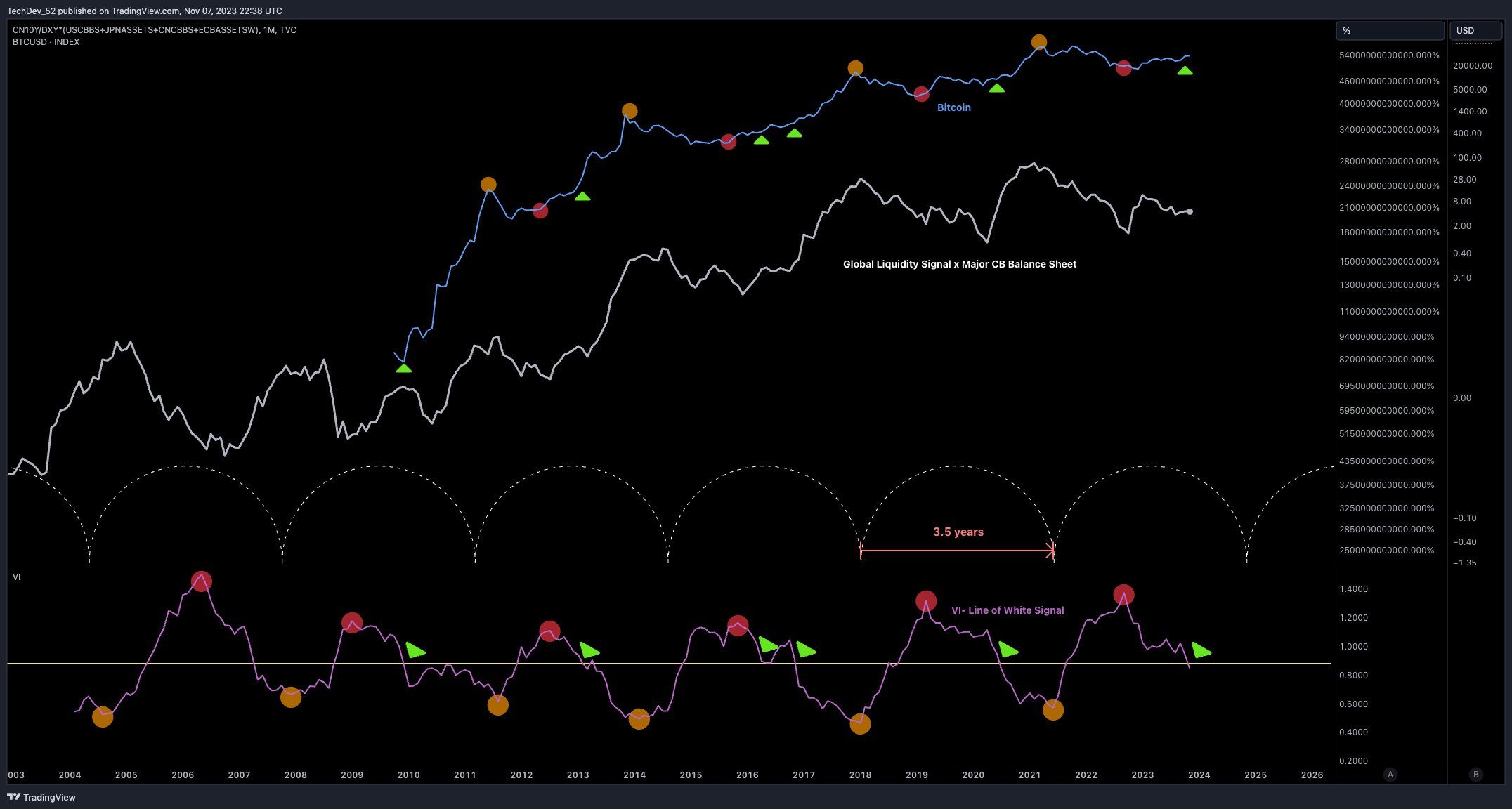
In a recent post on X, TechDev asserts, “Still waiting on the halving? The ~3.5 year liquidity cycle has been running before Bitcoin existed.” The chart provided by TechDev illustrates a juxtaposition of Bitcoin’s price movements with a liquidity signal derived from major central bank balance sheets.
Bitcoin 3.5 year liquidity cycle

3.5 year liquidity cycle | Source: X @TechDev_52 The striking feature in this chart is the series of sinusoidal lines that seem to predict pivot points in Bitcoin’s price trajectory. These pivot points, marked by colored dots, align closely with the inflections in the central banks’ aggregated balance sheet, suggesting a correlation between global liquidity and Bitcoin price movements.
It is worth noting that each liquidity cycle has a length of around 3.5 years, which is slightly shorter than the Bitcoin halving cycle, which takes place around every 4 years. Remarkably, the Vortex Indicator (VI), a technical indicator that is designed to identify the start of a new trend or the continuation of an existing trend, also aligns with this trend.
This correlation seems to hint at a broader economic tapestry at play, with the chart showing an intriguing synchronization with the expansion and contraction of major central bank balance sheets, denoted as the global liquidity signal.
Next Bitcoin Cycle High In 4-11 Months?
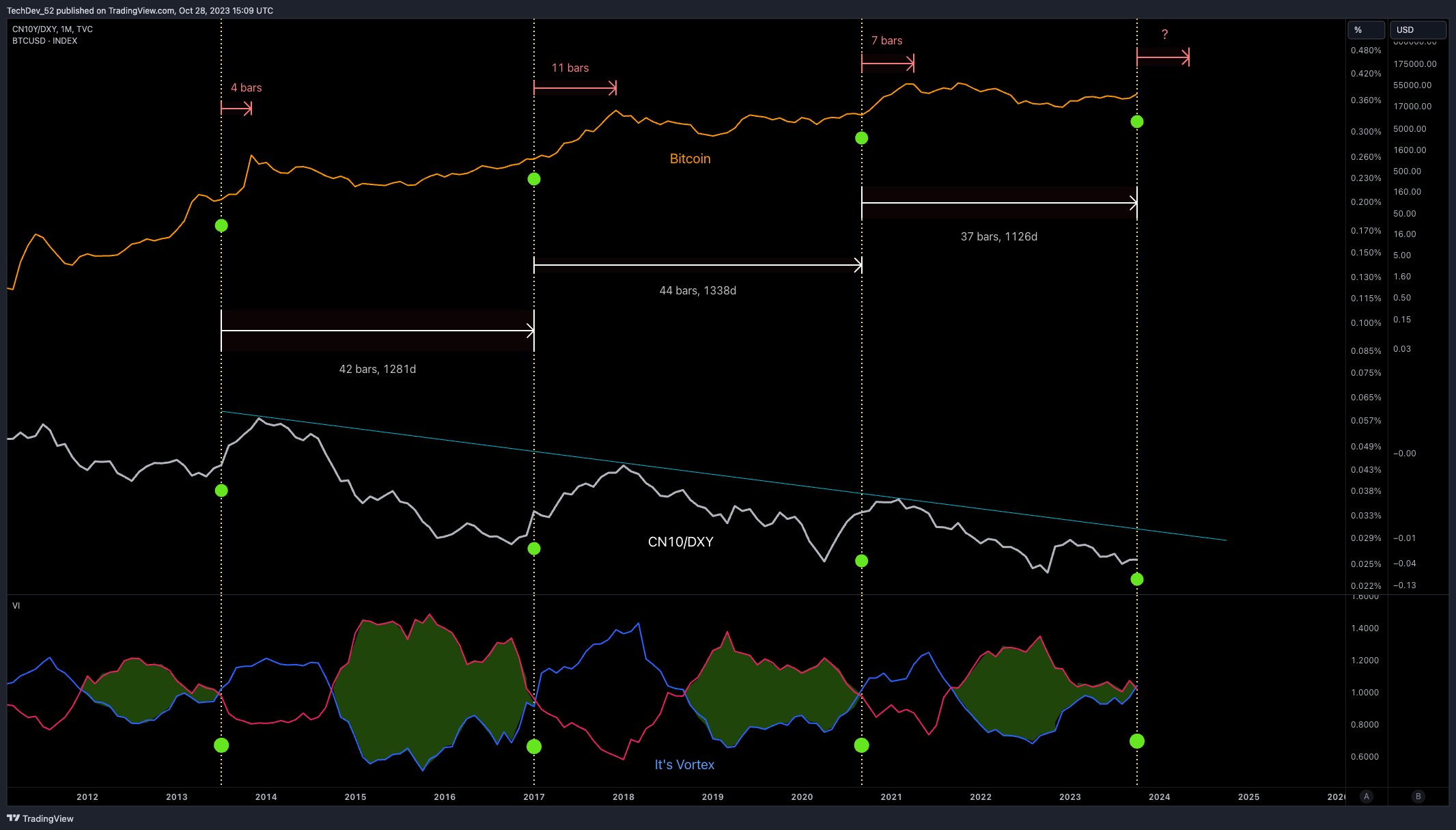
The second chart by Tech Dev further reinforces this relationship. It overlays the VI with the CN10Y/DXY. The VI here underscores the trend direction and strength, with turning points that coincide with the other indicators and Bitcoin’s price movements.
Bitcoin vs. global liquidity

BTC vs. global liquidity | Source: X @TechDev_52 The yellow arrows (dotted lines) show when the positive vortex (blue line) crosses the negative vortex (red line), marking the start of a strong upward price move. Currently, another cross can be observed. During the last cycles, it took 4, 11, and 7 months after the signal for the BTC price to reach its cycle high.
The chart also points to the trend shifts in the CN10Y/DXY High-Yield Spread, which align with the VI and signal key moments in Bitcoin’s price trajectory. Notably, these moments do not align with halving events. TechDev claims that the liquidity cycles are the real drivers behind BTC’s explosive moves.
The previous liquidity cycle ran from December 2017 to mid-2021 and lasted 42 months. The cycle before that lasted from mid-2013 to the end of 2017 and was 44 months long. Currently, the liquidity cycle has been running for 37 months.
Elaborating on this, TechDev explains, “Doesn’t look like it’s ever been the halving. Clever if Satoshi tried to line it up though. It’s a liquidity cycle world. Bitcoin lives in it.” Following the question of an X user if the BTC price will top around February to March next year, he added, “Indeed possible. Would be fitting to top around the halving.”
Kristoph Jeffers, a partner at Three Jay Partners, echoed TechDev’s sentiments, acknowledging the visual effectiveness of these charts in understanding the market dynamics. Jeffers remarked, “Been talking about this for a while, and this is a great visualization of the dynamics at play. While the Bitcoin issuance rate is important, the liquidity cycle is the true driving force.”
In addition, the analyst has received a lot of encouragement from the BTC community and the technical analyst camp. Gern van Lagen commented, “Great one.” Bitcoin advocate Dr. Jeff Ross answered, “Great chart.”
Mike Alfred stated, “If I hear ‘I’m waiting for the halving’ one more damn time, I’m going to die laughing. Such an asinine approach but a lot of kids on this website are repeating it over and over like it’s gospel.”
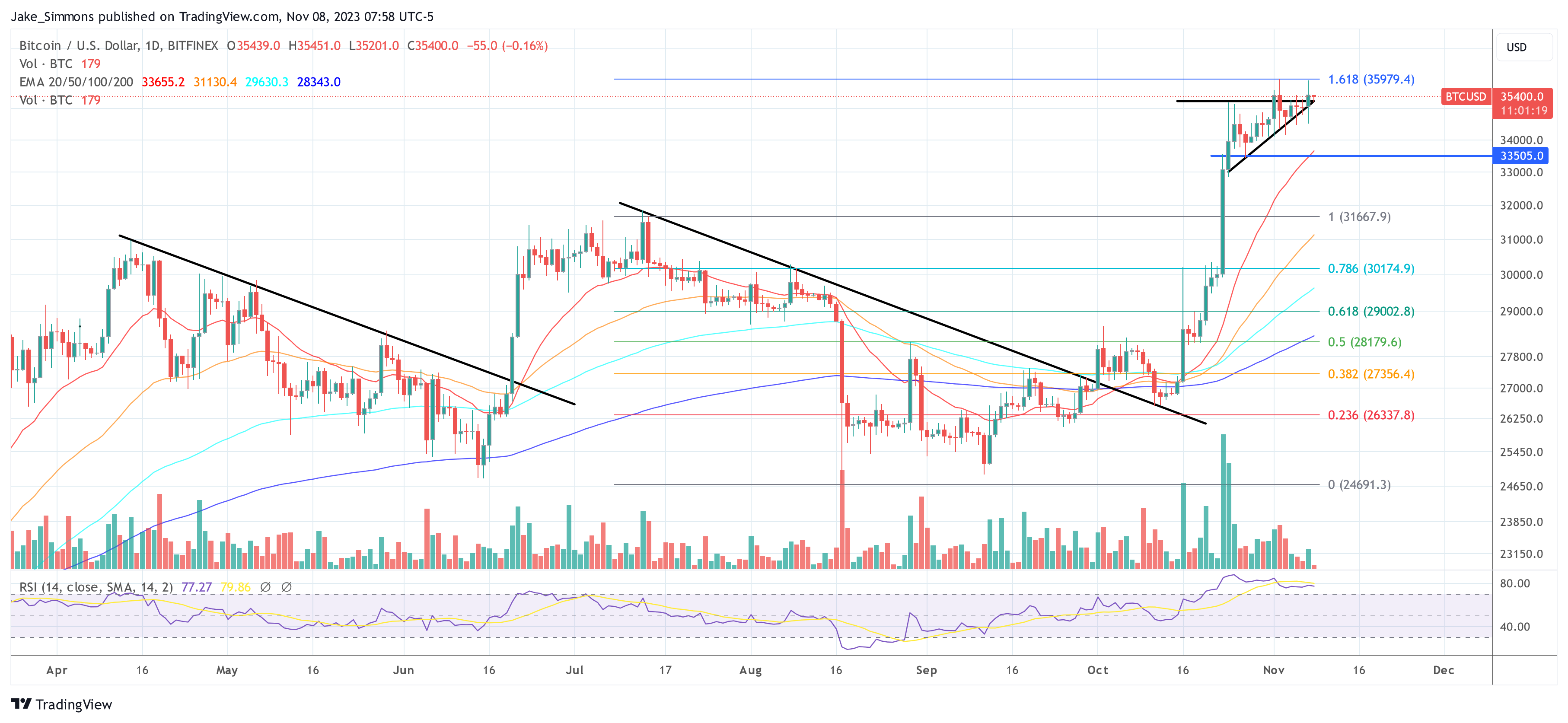
At press time, BTC traded at $35,400.
Bitcoin price

BTC bull pennant, 1-day chart | Source: BTCUSD on TradingView.com Featured image from XT, chart from TradingView.com


Trending Cryptos

Related Reads

Aave Founder Dismisses Reports Of Payward’s ‘70% Discount’ Stake Purchase

Aave founder Stani Kulechov has dismissed reports claiming that Kraken's parent company, Payward, was negotiating to purchase a 15% stake in Aave Group at a steep 70% discount. The reported deal proposed a $71 million investment at a $385 million valuation, which was framed as a significant discount compared to AAVE's fully diluted token valuation. Kulechov rejected this narrative, stating AAVE would not be sold at such a discount, and highlighted Aave's protocol revenue. The article clarifies the distinction between different entities within the Aave ecosystem—Aave Group, Aave Labs, Aave DAO, and AAVE token holders—noting that an equity discussion in a related company does not equate to selling the protocol or transferring DAO control. It underscores the sensitivity of major DeFi protocols to strategic investment rumors and the importance of accurate terminology to avoid misleading readers. While strategic discussions are common in the crypto sector, Kulechov specifically denied the discounted sale framing. The situation highlights that future developments should be monitored via official Aave channels, and market reactions may depend on whether token holders view the denial as value-supportive or focus on potential future distributions. The key takeaway is the founder's rejection of the 70% discount story, while leaving room for strategic partnerships under different terms.

bitcoinist4h ago

Aave Founder Dismisses Reports Of Payward’s ‘70% Discount’ Stake Purchase

bitcoinist4h ago

Trading

Spot

Hot Articles

What is $BITCOIN

DIGITAL GOLD ($BITCOIN): A Comprehensive Analysis Introduction to DIGITAL GOLD ($BITCOIN) DIGITAL GOLD ($BITCOIN) is a blockchain-based project operating on the Solana network, which aims to combine the characteristics of traditional precious metals with the innovation of decentralized technologies. While it shares a name with Bitcoin, often referred to as “digital gold” due to its perception as a store of value, DIGITAL GOLD is a separate token designed to create a unique ecosystem within the Web3 landscape. Its goal is to position itself as a viable alternative digital asset, although specifics regarding its applications and functionalities are still developing. What is DIGITAL GOLD ($BITCOIN)? DIGITAL GOLD ($BITCOIN) is a cryptocurrency token explicitly designed for use on the Solana blockchain. In contrast to Bitcoin, which provides a widely recognized value storage role, this token appears to focus on broader applications and characteristics. Notable aspects include: Blockchain Infrastructure: The token is built on the Solana blockchain, known for its capacity to handle high-speed and low-cost transactions. Supply Dynamics: DIGITAL GOLD has a maximum supply capped at 100 quadrillion tokens (100P $BITCOIN), although details regarding its circulating supply are currently undisclosed. Utility: While precise functionalities are not explicitly outlined, there are indications that the token could be utilized for various applications, potentially involving decentralized applications (dApps) or asset tokenization strategies. Who is the Creator of DIGITAL GOLD ($BITCOIN)? At present, the identity of the creators and development team behind DIGITAL GOLD ($BITCOIN) remains unknown. This situation is typical among many innovative projects within the blockchain space, particularly those aligning with decentralized finance and meme coin phenomena. While such anonymity may foster a community-driven culture, it intensifies concerns about governance and accountability. Who are the Investors of DIGITAL GOLD ($BITCOIN)? The available information indicates that DIGITAL GOLD ($BITCOIN) does not have any known institutional backers or prominent venture capital investments. The project seems to operate on a peer-to-peer model focused on community support and adoption rather than traditional funding routes. Its activity and liquidity are primarily situated on decentralized exchanges (DEXs), such as PumpSwap, rather than established centralized trading platforms, further highlighting its grassroots approach. How DIGITAL GOLD ($BITCOIN) Works The operational mechanics of DIGITAL GOLD ($BITCOIN) can be elaborated on based on its blockchain design and network attributes: Consensus Mechanism: By leveraging Solana’s unique proof-of-history (PoH) combined with a proof-of-stake (PoS) model, the project ensures efficient transaction validation contributing to the network's high performance. Tokenomics: While specific deflationary mechanisms have not been extensively detailed, the vast maximum token supply implies that it may cater to microtransactions or niche use cases that are still to be defined. Interoperability: There exists the potential for integration with Solana’s broader ecosystem, including various decentralized finance (DeFi) platforms. However, the details regarding specific integrations remain unspecified. Timeline of Key Events Here is a timeline that highlights significant milestones concerning DIGITAL GOLD ($BITCOIN): 2023: The initial deployment of the token occurs on the Solana blockchain, marked by its contract address. 2024: DIGITAL GOLD gains visibility as it becomes available for trading on decentralized exchanges like PumpSwap, allowing users to trade it against SOL. 2025: The project witnesses sporadic trading activity and potential interest in community-led engagements, although no noteworthy partnerships or technical advancements have been documented as of yet. Critical Analysis Strengths Scalability: The underlying Solana infrastructure supports high transaction volumes, which could enhance the utility of $BITCOIN in various transaction scenarios. Accessibility: The potential low trading price per token could attract retail investors, facilitating wider participation due to fractional ownership opportunities. Risks Lack of Transparency: The absence of publicly known backers, developers, or an audit process may yield skepticism regarding the project's sustainability and trustworthiness. Market Volatility: The trading activity is heavily reliant on speculative behavior, which can result in significant price volatility and uncertainty for investors. Conclusion DIGITAL GOLD ($BITCOIN) emerges as an intriguing yet ambiguous project within the rapidly evolving Solana ecosystem. While it attempts to leverage the “digital gold” narrative, its departure from Bitcoin's established role as a store of value underscores the need for a clearer differentiation of its intended utility and governance structure. Future acceptance and adoption will likely depend on addressing the current opacity and defining its operational and economic strategies more explicitly. Note: This report encompasses synthesised information available as of October 2023, and developments may have transpired beyond the research period.

467 Total ViewsPublished 2025.05.13Updated 2025.05.13

What is $BITCOIN

Discussions

Welcome to the HTX Community. Here, you can stay informed about the latest platform developments and gain access to professional market insights. Users' opinions on the price of BTC (BTC) are presented below.

活动图片