Crypto Turmoil: How The US Banking Collapse Dented Institutional Trading

BitcoinistPublished on 2023-10-23Last updated on 2023-10-24

Abstract

March witnessed a series of bank failures that have had ramifications for institutional crypto trading, putting a damper on what...

March witnessed a series of bank failures that have had ramifications for institutional crypto trading, putting a damper on what was once considered a bustling market space.
According to the latest insights from the blockchain intelligence platform Chainalysis, concerning North America, the fallout from these bank closures has been far-reaching, impacting the pace and volume of large-scale crypto transactions. 
A Dip In Institutional Crypto Activity
Chainalysis’s recent report highlights the drop in “institutional” cryptocurrency transaction volume – transactions valued at more than $10 million. Starting in April 2023, the volume of these transactions plunged sharply, particularly in the North American region.
Interestingly, this downturn was specific to institutional transactions, as professional and retail trading volumes reportedly “remained constant.”
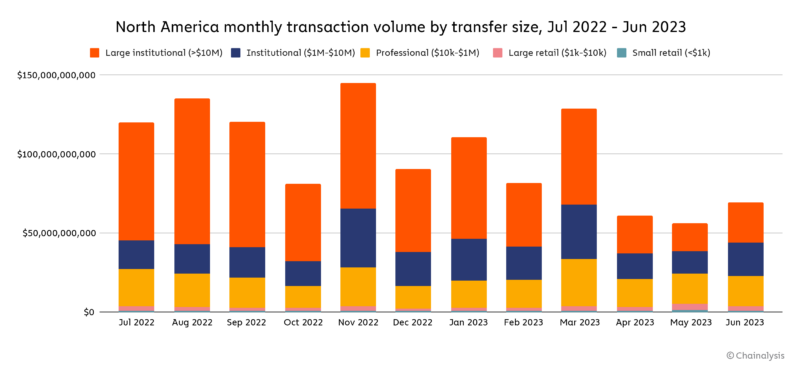
Crypto transaction volume transfer wise from July 2022 to June 2023.

Transaction volume transfer-wise from July 2022 to June 2023. | Source: Chainalysis The report points directly to the banking crisis in March, which led to several major US bank shutdowns, including the “Silicon Valley Bank and the crypto-friendly banks Signature and Silvergate” as factors that resulted in this drop.
In addition, the failure of troubled digital currency exchanges and lending desks, such as FTX and Alameda Research, in the preceding November further exacerbated the decline, according to the Chainalysis report.
The Exodus Of Stablecoins From North America
Furthermore, in the Chainlalysis report, one of the notable aftermaths of the banking crisis has been the dwindling dominance of stablecoins in North America. Stablecoins, primarily USD-pegged tokens, accounting for roughly 90% of global activity, began to lose ground in North America from February 2023 onwards.
Within a short span from February to June, the percentage of digital currency volume in the region attributable to stablecoins declined from 70.3% to 48.8%.
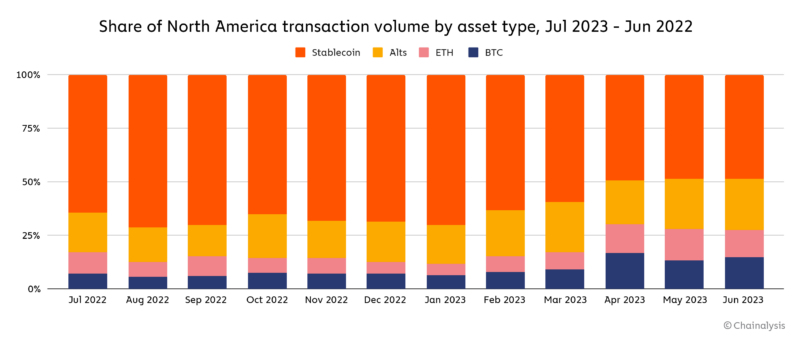
North America crypto transaction volume by asset type from June 2022 to July 2023.

North America crypto transaction volume by asset type from June 2022 to July 2023. | Source: Chainalysis Chainalysis’s research further underscores that since the spring of 2023, there has been a noticeable shift of stablecoin inflows from US -US-licensed crypto services to their non-U.S. counterparts.
Related Reading: Nigeria’s Crypto Adoption Continues To Surge Amid Economic Challenges: Report
This shift denotes a broader migration pattern, with businesses and traders seeking financial shores beyond US jurisdictions. The report noted:
Since [the] spring of 2023, the majority of stablecoin inflows to the 50 biggest crypto services have shifted from US licensed-services to non-U.S. licensed services, undoing a shift in the opposite direction that occurred over the course of late 2022 and early 2023.
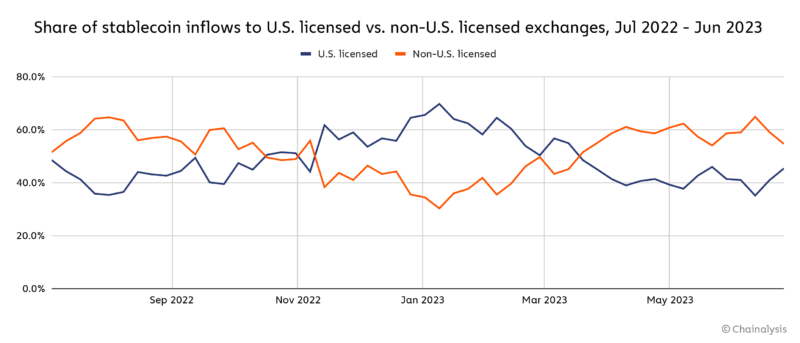
Stablecoin inflows in U.S. licensed-services compared to in non-U.S. licensed services.

Stablecoin inflows in US-licensed services compared to non-US-licensed services. | Source: Chainalysis Chainalysis further disclosed that non-U.S. licensed platforms received 54.6% of stablecoin inflows among the top 50 services as of June.

The global crypto market cap value on TradingView

The global crypto market cap value on the 1-day chart. Source: Crypto TOTAL Market Cap on TradingView.com Featured image from iStock, Chart from TradingView


Trending Cryptos

Related Reads

STRC Must Re-Anchor for a BTC Bull Market to Happen

Title: STRC's Depegging Threatens MicroStrategy's Bitcoin-Buying Machine, and Thus the BTC Bull Run Summary: The sustained depegging of MicroStrategy's priority share STRC (trading ~25% below its $100 target) is severely disrupting the company's core business model and poses a major risk to Bitcoin (BTC) price support. STRC was MicroStrategy's most efficient and low-cost funding tool, designed to allow continuous capital raises near its $100 par value to fuel relentless BTC accumulation. Its depegging has effectively blocked this primary funding channel. The situation creates a severe cash flow crisis. STRC and other priority shares now obligate MicroStrategy to pay approximately $1.7 billion in annual cash dividends, while the company's cash reserves are only about $1.4 billion — insufficient to cover one year of payments. To raise cash, MicroStrategy is increasingly resorting to issuing common stock (MSTR) through ATM offerings. However, recent raises show most proceeds (around 90% in one week) are now used to bolster cash reserves rather than buy Bitcoin. This dilutes the key metric of Bitcoin per MSTR share, eroding the fundamental value proposition for equity investors. The company faces grim alternatives: issuing high-cost debt or selling its massive Bitcoin holdings. The latter, though hinted at, would likely trigger significant negative market reactions. Conclusion: As BTC's largest corporate holder and a major marginal buyer, MicroStrategy's funding woes mean reduced, and potentially reversing, institutional buy-side pressure. The company has shifted from being a guaranteed source of BTC demand to a significant overhang on the market. The article argues that without STRC re-anchoring to restore its funding engine, a sustained BTC bull market is in jeopardy.

marsbit16m ago

STRC Must Re-Anchor for a BTC Bull Market to Happen

marsbit16m ago

No Bull Market for BTC Without STRC Re-pegging

Summary: The sustained de-pegging of MicroStrategy's (MSTR) Strategy Preferred Shares (STRC) poses a severe threat to Bitcoin (BTC) and could prevent a bull market. STRC, designed to trade near a $100 target, has plunged to around $75, effectively shutting down MicroStrategy's cheapest and most efficient funding channel. This channel was critical for its "raise funds, buy BTC" business model. More critically, MicroStrategy now faces a massive cash outflow from these preferred shares. With approximately $10.49 billion of STRC outstanding at an 11.5% dividend yield, the annual cash obligation exceeds $1.2 billion. Combined with other preferred shares, the total annual payout nears $1.7 billion, depleting its current ~$1.4 billion cash reserve within a year. To address this, MicroStrategy is increasingly relying on common stock (MSTR) offerings via its ATM program. However, recent sales show most raised capital is now used to bolster cash reserves rather than buy more Bitcoin. This dilutes the key metric of BTC per share for common stockholders, eroding the foundation of its premium valuation. If STRC cannot re-peg, this costly dilution may continue. Worse, if cash pressure intensifies, selling Bitcoin becomes a real risk. As the largest corporate BTC holder (~847,363 BTC), any significant sales could crash the market. Thus, MicroStrategy is transforming from BTC's most reliable institutional buyer into a major potential seller, casting a significant shadow over Bitcoin's price prospects.

Odaily星球日报17m ago

No Bull Market for BTC Without STRC Re-pegging

Odaily星球日报17m ago

Tornado Cash Suffers Another Governance Attack: A Fake Proposal Targets $23 Million Community Treasury

On June 25, 2026, a deceptive governance proposal (#67) appeared in the Tornado Cash DAO, masquerading as an upgrade to implement fee adjustments and token burns. Security researchers, including Sergey Shemyakov and Pascal Caversaccio, quickly identified it as malicious. The proposal's unverified code contained a hidden function designed to stealthily replace the protocol's legitimate governance address (0x5efda50f22d34F262c29268506C5Fa42cB56A1Ce) with an attacker-controlled address (0x5efda50f22d34f272c7077689d6abc42f15e285f). If passed, this would have granted the attacker control over the DAO's treasury, containing approximately $23 million in TORN tokens, and the ability to drain all relayers. The attacker's wallet (0xd4eca8c9242b9f9faa3cf19a78defc21dc97a925) was funded via the privacy protocol Railgun four days prior, obscuring the source. The community response was swift, with the proposal receiving 27,163 TORN votes against (100%) and 0 for, far below the 100,000 TORN quorum required for validity. It is set to expire on June 30. This incident marks the second major governance attack on Tornado Cash, following a May 2023 exploit that stole $2.17 million. It highlights persistent vulnerabilities in DAO structures where power derives from token ownership. The article advises users to follow security researchers, vote against unverified proposals, and delegate voting power. For developers, implementing timelocks—a delay between proposal approval and execution—is presented as a critical security measure to allow for community review and intervention.

Foresight News37m ago

Tornado Cash Suffers Another Governance Attack: A Fake Proposal Targets $23 Million Community Treasury

Foresight News37m ago

Trading

Spot
Futures

Hot Articles

Discussions

Welcome to the HTX Community. Here, you can stay informed about the latest platform developments and gain access to professional market insights. Users' opinions on the price of ETH (ETH) are presented below.

活动图片