This Week in Coins: Bitcoin and Ethereum Hold Stable Amid Frantic News Cycle

DecryptPublished on 2023-10-08Last updated on 2023-10-08

Abstract

Ethereum and XRP both saw depreciation despite many positive developments.

It was a week full of headlines in crypto, but they weren't being made by market stalwarts Bitcoin and Ethereum. Their stable values suggest cryptocurrencies are less reactive to the current news cycle than they were during its heady 2021 bull run and subsequent 2022 crash.

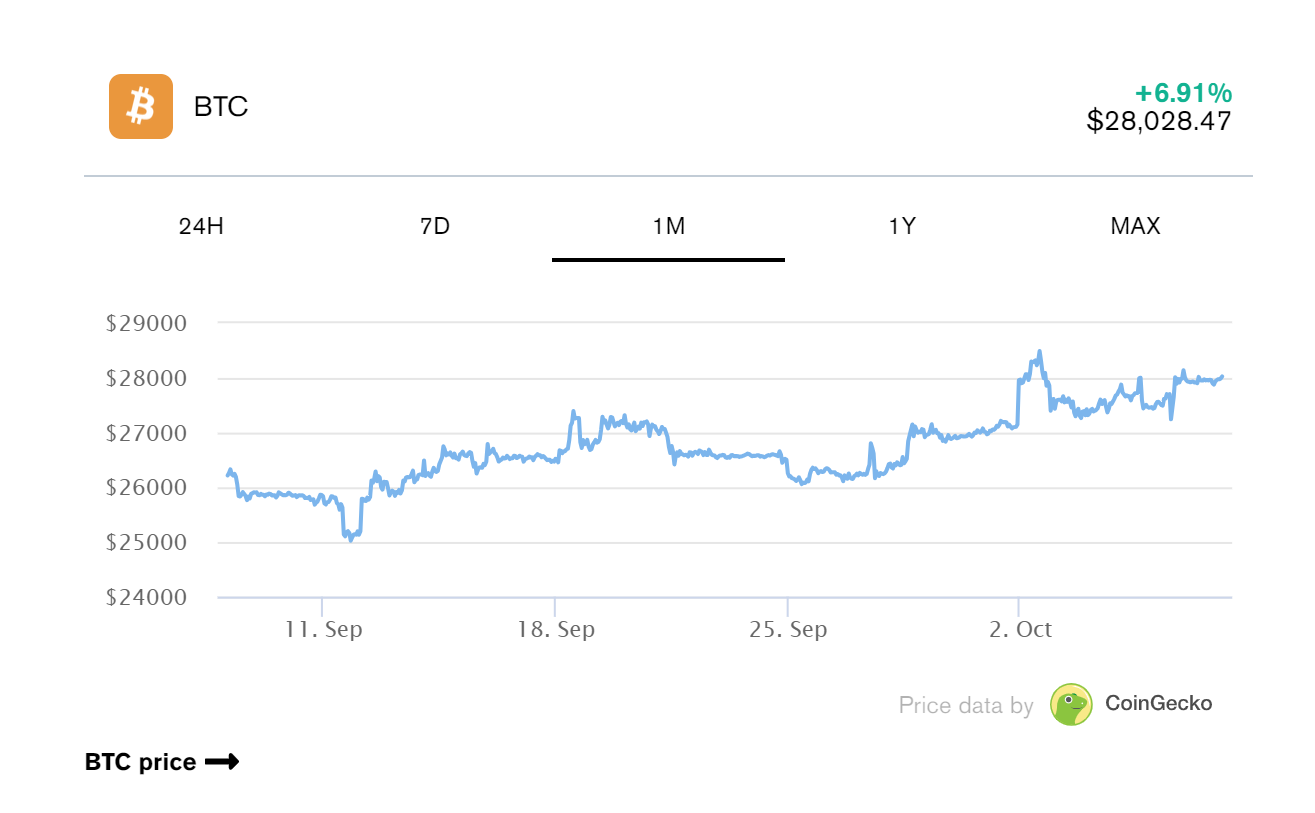
Market leader Bitcoin (BTC) grew a modest 2.7% over the seven days and now changes hands at $27,952. It briefly hit a two-month high on Sunday night when it crossed the $28,000 threshold.

The closest contender Ethereum (ETH) had a comparably harder week and lost 2.1% to trade at $1,636 at the time of writing. Its weak performance comes despite several positive announcements, including a UBS asset tokenization trial supported by the Monetary Authority of Singapore (MAS) and the launch of nine Ethereum Futures ETFs in the U.S. on Monday.

Grayscale announced on Monday that it hopes to convert its Ethereum trust into a spot ETF. The crypto asset manager’s application stems from its courtroom victory back in August when it won an appeal against the Securities and Exchange Commission after the latter rejected its application to convert its Bitcoin trust into a spot ETF.

The SEC also lost an appeal in its lawsuit against XRP progenitor Ripple this week. The SEC had hoped in vain that Judge Torres would reconsider her ruling that selling XRP to retail consumers doesn’t constitute a breach of American securities laws.

Ripple also secured a Major Payments Institution license from the MAS this week. However, the good news gains were reversed by the weekend. XRP fell 1.6% over the last seven days to hit $0.5224 by the weekend.

Only two cryptocurrencies posted any notable price movements, rallying around 15% this week: Avalanche (AVAX), which currently trades for $10.39, and Solana (SOL), which is currently worth $23.31.

On Monday, the Solana network's total value locked (TVL) hit a new 2023 high of $338.82 million.

The week began with Coinbase secured a Major Payment Institution (MPI) license from MAS. This development follows the In-Principle Approval (IPA) Coinbase received last year, part of a drive by the exchange to expand globally due to the uncertain regulatory climate on the company’s U.S. home turf.

On Tuesday, Helen Boyd, Head of Capital Markets at the independent regulatory watchdog the Financial Conduct Authority (FCA), announced that the British Treasury hopes to launch a Digital Securities Sandbox (DSS) by the end of the first quarter of next year.

A sandbox is a controlled test environment for those looking to bring innovative products to the market. The FCA already has a similar engagement via its Regulatory Sandbox where companies with viable products can begin pitching them to a closed circle of early customers, but the DSS has “a new rule set that would allow it to do new things with digital securities.”

On Thursday, Hong Kong’s police force and Securities and Futures Commission (SFC) launched a joint task force to monitor illegal activities on crypto exchanges following the suspension of trading on the JPEX exchange. The JPEX incident is one of the largest cases of financial fraud in Hong Kong history. involving at least 2,305 victims of the incident, who collectively have been defrauded of HK$1.43 billion ($182.9 million).

A report published this week by blockchain data platform Chainalysis shows that recent inflows to Hong Kong have rivaled that of mainland China over the past year, despite hosting only 0.5% of the latter’s population.

Finally this week, both Starbucks and the Museum of Modern Art launched NFTs.
Trending Cryptos

Related Reads

How 5G Will Be Launched in Russia: The Digital Ministry's Proposal and the Roadmap to 2035

Russia's Ministry of Digital Development has proposed a plan for launching 5G networks. It allows the "Big Four" mobile operators (Beeline, Megafon, MTS, T2) to deploy 5G on existing 4G/LTE base stations and frequencies, and will allocate them the new 4.63–4.99 GHz band. A key element is "technological neutrality," permitting the use of foreign equipment until September 2026. The new 4.63–4.99 GHz band is intended for more advanced services and industrial applications. However, a phased transition to Russian-made base stations will begin in 2027, with a target of at least 50% domestic equipment by 2030. The rollout timeline aims for 5G in cities with over 1 million people by the end of 2027, expanding to 84 cities by 2035. Initial "5G Ready" service, operating over existing infrastructure, will offer minimal speed improvements. Significant speed gains (4-10x over LTE) will require the new band and corresponding equipment. The plan addresses long-standing regulatory delays, including the military's hold on the global standard 3.4–3.8 GHz band. This forced Russia to adopt the 4.63–4.99 GHz range, overlapping with a Chinese band, making Chinese equipment a potential transitional solution. The success of the rollout will depend on equipment supply and the pace of production localization, while a challenge lies in smartphone compatibility with this non-standard frequency band.

cryptonews.ru1h ago

How 5G Will Be Launched in Russia: The Digital Ministry's Proposal and the Roadmap to 2035

cryptonews.ru1h ago

The Federal Reserve Bank of Dallas Announces a Colossal $700 Billion Allocation! How Will This Affect Bitcoin?

The Federal Reserve Bank of Dallas warns that the growing adoption of tokenized deposits in the banking sector could pose unforeseen risks to the financial system. Tokenized deposits, which transfer traditional bank deposits to blockchain infrastructure, offer features like instant settlement and programmable payments. While issued by regulated banks and maintaining deposit characteristics, they could enable customers to move funds between banks much faster in search of higher yields. This would significantly weaken banks' liquidity management and lending capacity. The Fed's analysis estimates that an increase in deposit interest rate sensitivity by 10% could reduce the interest rate risk banks can bear by approximately $700 billion over ten years. Similarly, a 10% shortening of the average deposit maturity could reduce the banking system's capacity to convert deposits into loans by about $580 billion. This acceleration of deposit movement could force banks to rely on more expensive wholesale funding, increasing borrowing costs for consumers and businesses and potentially making traditional banks resemble non-bank financial institutions. While the report does not directly address Bitcoin, the described shifts could have long-term implications. Firstly, the tokenization of deposits by banks could promote institutional adoption of blockchain-based financial infrastructure, indirectly legitimizing digital asset classes like Bitcoin. Secondly, faster-moving deposits and resulting higher funding costs could increase the price of liquidity in the financial system. This could create near-term headwinds for risk assets, including Bitcoin, due to tighter financial conditions and potential selling pressure. The report concludes that widespread adoption of this technology could impact many areas, from payment systems to monetary policy transmission mechanisms.

cryptonews.ru1h ago

The Federal Reserve Bank of Dallas Announces a Colossal $700 Billion Allocation! How Will This Affect Bitcoin?

cryptonews.ru1h ago

Trading

Spot

Hot Articles

What is $BITCOIN

DIGITAL GOLD ($BITCOIN): A Comprehensive Analysis Introduction to DIGITAL GOLD ($BITCOIN) DIGITAL GOLD ($BITCOIN) is a blockchain-based project operating on the Solana network, which aims to combine the characteristics of traditional precious metals with the innovation of decentralized technologies. While it shares a name with Bitcoin, often referred to as “digital gold” due to its perception as a store of value, DIGITAL GOLD is a separate token designed to create a unique ecosystem within the Web3 landscape. Its goal is to position itself as a viable alternative digital asset, although specifics regarding its applications and functionalities are still developing. What is DIGITAL GOLD ($BITCOIN)? DIGITAL GOLD ($BITCOIN) is a cryptocurrency token explicitly designed for use on the Solana blockchain. In contrast to Bitcoin, which provides a widely recognized value storage role, this token appears to focus on broader applications and characteristics. Notable aspects include: Blockchain Infrastructure: The token is built on the Solana blockchain, known for its capacity to handle high-speed and low-cost transactions. Supply Dynamics: DIGITAL GOLD has a maximum supply capped at 100 quadrillion tokens (100P $BITCOIN), although details regarding its circulating supply are currently undisclosed. Utility: While precise functionalities are not explicitly outlined, there are indications that the token could be utilized for various applications, potentially involving decentralized applications (dApps) or asset tokenization strategies. Who is the Creator of DIGITAL GOLD ($BITCOIN)? At present, the identity of the creators and development team behind DIGITAL GOLD ($BITCOIN) remains unknown. This situation is typical among many innovative projects within the blockchain space, particularly those aligning with decentralized finance and meme coin phenomena. While such anonymity may foster a community-driven culture, it intensifies concerns about governance and accountability. Who are the Investors of DIGITAL GOLD ($BITCOIN)? The available information indicates that DIGITAL GOLD ($BITCOIN) does not have any known institutional backers or prominent venture capital investments. The project seems to operate on a peer-to-peer model focused on community support and adoption rather than traditional funding routes. Its activity and liquidity are primarily situated on decentralized exchanges (DEXs), such as PumpSwap, rather than established centralized trading platforms, further highlighting its grassroots approach. How DIGITAL GOLD ($BITCOIN) Works The operational mechanics of DIGITAL GOLD ($BITCOIN) can be elaborated on based on its blockchain design and network attributes: Consensus Mechanism: By leveraging Solana’s unique proof-of-history (PoH) combined with a proof-of-stake (PoS) model, the project ensures efficient transaction validation contributing to the network's high performance. Tokenomics: While specific deflationary mechanisms have not been extensively detailed, the vast maximum token supply implies that it may cater to microtransactions or niche use cases that are still to be defined. Interoperability: There exists the potential for integration with Solana’s broader ecosystem, including various decentralized finance (DeFi) platforms. However, the details regarding specific integrations remain unspecified. Timeline of Key Events Here is a timeline that highlights significant milestones concerning DIGITAL GOLD ($BITCOIN): 2023: The initial deployment of the token occurs on the Solana blockchain, marked by its contract address. 2024: DIGITAL GOLD gains visibility as it becomes available for trading on decentralized exchanges like PumpSwap, allowing users to trade it against SOL. 2025: The project witnesses sporadic trading activity and potential interest in community-led engagements, although no noteworthy partnerships or technical advancements have been documented as of yet. Critical Analysis Strengths Scalability: The underlying Solana infrastructure supports high transaction volumes, which could enhance the utility of $BITCOIN in various transaction scenarios. Accessibility: The potential low trading price per token could attract retail investors, facilitating wider participation due to fractional ownership opportunities. Risks Lack of Transparency: The absence of publicly known backers, developers, or an audit process may yield skepticism regarding the project's sustainability and trustworthiness. Market Volatility: The trading activity is heavily reliant on speculative behavior, which can result in significant price volatility and uncertainty for investors. Conclusion DIGITAL GOLD ($BITCOIN) emerges as an intriguing yet ambiguous project within the rapidly evolving Solana ecosystem. While it attempts to leverage the “digital gold” narrative, its departure from Bitcoin's established role as a store of value underscores the need for a clearer differentiation of its intended utility and governance structure. Future acceptance and adoption will likely depend on addressing the current opacity and defining its operational and economic strategies more explicitly. Note: This report encompasses synthesised information available as of October 2023, and developments may have transpired beyond the research period.

2.3k Total ViewsPublished 2025.05.13Updated 2025.05.13

What is $BITCOIN

Discussions

Welcome to the HTX Community. Here, you can stay informed about the latest platform developments and gain access to professional market insights. Users' opinions on the price of BTC (BTC) are presented below.

活动图片