Number Of Ethereum Addresses Losing Money Just Reached A New All-Time High

newsbtcPublished on 2023-09-25Last updated on 2023-09-26

Abstract

Ethereum holders have been subject to uncertainty over the last few months as bulls and bears have struggled for control. With the bears winning at a much higher rate than...

Ethereum holders have been subject to uncertainty over the last few months as bulls and bears have struggled for control. With the bears winning at a much higher rate than the bulls, Ethereum holders have found their holdings have continued to lose value. This time around, the plunge has sent the number of investors losing money to a new all-time high.
Number Of Ethereum Addresses In Loss At ATH
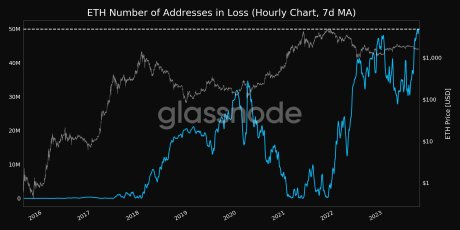
On-chain data tracker Glassnode Alerts on X (formerly Twitter) has revealed a shocking development regarding Ethereum addresses. According to the tracker, the number of addresses seeing losses on a 7-day moving average (MA) has jumped to its highest level ever.
This metric takes note of the price at which the ETH coins being held on addresses were last moved. Then it is compared to the current price of the altcoin to figure out if the addresses are seeing gains or losses. The metric had been rapidly climbing in 2023 due to the bear market, culminating in a new all-time high.
According to Glassnode’s report, the total number of addresses in loss is now sitting at 49,939,211.006, rising from its previous all-time high of 49,921,736.464 that was reached on September 15. If the price of ETH continues to drop, then this figure will likely hit another all-time high soon.
Ethereum addresses


Number of addresses in loss hit new all-time high  Source: Glassnode
Other ETH Metrics Flashing Bearish
Ethereum’s open interest in perpetual futures contracts had also taken a hit with the price struggles. It dropped to a one-month low $445,789,354, just weeks after hitting a previous one-month low of $450,965,900 on September 13.
Accumulation also seems to be dropping among mid-sized investors in the meantime. Glassnode also reports that the number of addresses holding at least 10 ETH had plunged to a 3-month low of 347,825. This suggests that these investors may be offloading their holdings to prevent more losses.
Small investors are also not left out of this trend. Another metric that tracks the number of Ethereum addresses holding at least 0.1 ETH also showed a decline in recent months. This has led to a 5-month low for the metric, with only 5,120,950 addresses holding 0.1+ ETH.
These declines come as no surprise as the ETH price had lost support above $1,600. With the bears dragging the price below $1,600, the losses for holders had climbed rapidly as the altcoin’s price fell to two-week lows.
Founder Vitalik Buterin had also made transactions carrying a significant amount of ETH toward centralized exchanges. This has sparked speculations that the founder is selling, which in turn could influence investors to sell as well.

Ethereum price chart from Tradingview.com (ETH addresses in loss)


ETH bears take control of price | Source: ETHUSD on Tradingview.com
Featured image from Blockchair, chart from Tradingview.com


Trending Cryptos

Related Reads

Veterans of the 'Little Smart' Era Return, This Time Leading a Robot Company in a Sprint to an IPO

UTStarcom Veteran Returns: Robot Maker Rushes for IPO On August 24, UDI Robot passed the listing hearing for the Hong Kong Stock Exchange main board. Known for its delivery robots in hotels and KTVs, the company was founded in 2013 by Lu Ying, former CEO of the once-dominant "PHS" phone maker UTStarcom, and other ex-colleagues. UDI has five main product series, including indoor delivery, outdoor delivery, and cleaning robots. Significantly, its business model is shifting from hardware sales to recurring service revenue. In 2025, AI vision model solutions contributed 37.5% of its total revenue of ~318 million RMB, while robot product sales accounted for 42.5%. However, its overall business remains unprofitable, with a cumulative net loss of 5.44 billion RMB from 2023 to Q1 2026. A key challenge is low hardware毛利率 (gross margin for robot products was 8.3% in 2025). Despite losses common in the robotics sector, UDI's deficit is narrowing. It has raised ~989 million RMB over 13 pre-IPO rounds from investors including Alibaba (Ele.me, Yunfeng Capital), Legend Capital, SenseTime, and hotel chains like Huazhu. The founding team, largely from UTStarcom, collectively controls 33.40% of the company. UDI ranks as China's third-largest commercial service robotics company with an 8.9% market share in 2025. Its IPO, sought via Hong Kong's special tech chapter 18C, aims to fund R&D, expansion, and working capital, marking a comeback attempt for the "PHS" veterans in a new technological era.

marsbit5m ago

Veterans of the 'Little Smart' Era Return, This Time Leading a Robot Company in a Sprint to an IPO

marsbit5m ago

Zuck refuses to give up, secretly develops one of his own called 'Hatch', but the model uses Claude...

Meta, led by Mark Zuckerberg, is developing a new AI agent platform called "Hatch" after its reported unsuccessful attempt to acquire Manus. Described as a "consumer version of OpenClaw," Hatch aims to automate tasks across various digital services. The platform is trained on simulated versions of services like DoorDash, Etsy, Reddit, Yelp, and Outlook, and is deeply integrated with Meta's own ecosystem, including Instagram, Facebook, and WhatsApp. Its goal is to enable end-to-end task completion, such as identifying a product in a social media post, comparing prices, and facilitating purchases. During development, Hatch is reportedly relying on Anthropic's Claude model. However, Meta plans to transition to its proprietary model, Muse Spark, for the official launch, with a newer model named Watermelon expected in October. This phased migration highlights potential technical challenges, as switching core models can affect performance and user experience. Priced at up to $199.99 per month, Hatch targets consumers willing to pay for significant time savings. Its key advantage is default distribution within Meta's vast suite of apps, potentially giving it access to rich user context. However, it faces major hurdles in real-world reliability, needing to handle complex, dynamic web environments, authentication changes, and anti-bot measures that differ from its controlled training simulations. The move represents Meta's strategic push to monetize AI directly beyond its core advertising business.

marsbit6m ago

Zuck refuses to give up, secretly develops one of his own called 'Hatch', but the model uses Claude...

marsbit6m ago

IOSG: U.S. Bonds, AI, and Inflation Can't All Be Had. Which Side Should BTC Bet On?

**Title: IOSG: Can't Have It All – Treasury Bonds, AI, and Inflation. Where Should BTC Bet?** **Core Thesis:** Washington is likely to prioritize stabilizing the Treasury market and sustaining the AI investment cycle, accepting higher inflation for longer as the trade-off. This creates sustained tailwinds for both gold and Bitcoin by injecting liquidity and shifting duration risk away from private balance sheets. **Key Issue:** The critical macro price is no longer the Fed funds rate, but the yield investors demand to hold long-term US Treasuries. Recent surges in 10-year and 30-year yields stem from a combination of persistent inflation risks, heavy fiscal supply, thinning demand for duration, and new competition for capital from massive AI infrastructure investments. **The Trilemma:** The US faces a difficult choice between controlling inflation, maintaining Treasury market stability, and fostering the AI growth cycle. Political pressure suggests inflation control is the most likely sacrifice. **Treasury's Response:** Measures by Treasury Secretary Besant focus on defending the bond market: supporting the Yen to prevent forced Japanese Treasury sales, increasing long-end liquidity via repos (effectively shortening government debt maturity), and a potential shift toward more short-term bill issuance. This could generate significant liquidity, reigniting "currency debasement" trades. **Gold's Role:** Gold's ~90% surge since mid-2024 is not just an inflation hedge but a bet on monetary debasement as a politically viable path out of the debt cycle, driven by declining dollar trust. **Bitcoin's Positioning:** Bitcoin has historically failed to correlate with gold during "debasement" rallies. However, its recent strong performance alongside Treasury's liquidity actions suggests the market may be treating it as a "stealth QE" trade—a scenario where crypto assets typically thrive amid expanding global liquidity. For BTC to firmly join the "debasement hedge" category, this correlation needs to persist. **Conclusion & Risks:** The framework suggests that preserving market stability and the AI cycle will likely mean shorter debt maturity,常态化 liquidity backstops, and tolerance for higher inflation—favorable for gold and BTC. This outlook would be undermined if inflation falls toward 2%, a credible fiscal path emerges, AI becomes self-funding, or private demand absorbs debt without higher term premiums. The key question is which corner of the trilemma breaks first; accelerated "duration transfer" by the Treasury would mean a longer tailwind for Bitcoin.

marsbit21m ago

IOSG: U.S. Bonds, AI, and Inflation Can't All Be Had. Which Side Should BTC Bet On?

marsbit21m ago

How 5G Will Be Launched in Russia: The Digital Ministry's Proposal and the Roadmap to 2035

Russia's Ministry of Digital Development has proposed a plan for launching 5G networks. It allows the "Big Four" mobile operators (Beeline, Megafon, MTS, T2) to deploy 5G on existing 4G/LTE base stations and frequencies, and will allocate them the new 4.63–4.99 GHz band. A key element is "technological neutrality," permitting the use of foreign equipment until September 2026. The new 4.63–4.99 GHz band is intended for more advanced services and industrial applications. However, a phased transition to Russian-made base stations will begin in 2027, with a target of at least 50% domestic equipment by 2030. The rollout timeline aims for 5G in cities with over 1 million people by the end of 2027, expanding to 84 cities by 2035. Initial "5G Ready" service, operating over existing infrastructure, will offer minimal speed improvements. Significant speed gains (4-10x over LTE) will require the new band and corresponding equipment. The plan addresses long-standing regulatory delays, including the military's hold on the global standard 3.4–3.8 GHz band. This forced Russia to adopt the 4.63–4.99 GHz range, overlapping with a Chinese band, making Chinese equipment a potential transitional solution. The success of the rollout will depend on equipment supply and the pace of production localization, while a challenge lies in smartphone compatibility with this non-standard frequency band.

cryptonews.ru3h ago

How 5G Will Be Launched in Russia: The Digital Ministry's Proposal and the Roadmap to 2035

cryptonews.ru3h ago

The Federal Reserve Bank of Dallas Announces a Colossal $700 Billion Allocation! How Will This Affect Bitcoin?

The Federal Reserve Bank of Dallas warns that the growing adoption of tokenized deposits in the banking sector could pose unforeseen risks to the financial system. Tokenized deposits, which transfer traditional bank deposits to blockchain infrastructure, offer features like instant settlement and programmable payments. While issued by regulated banks and maintaining deposit characteristics, they could enable customers to move funds between banks much faster in search of higher yields. This would significantly weaken banks' liquidity management and lending capacity. The Fed's analysis estimates that an increase in deposit interest rate sensitivity by 10% could reduce the interest rate risk banks can bear by approximately $700 billion over ten years. Similarly, a 10% shortening of the average deposit maturity could reduce the banking system's capacity to convert deposits into loans by about $580 billion. This acceleration of deposit movement could force banks to rely on more expensive wholesale funding, increasing borrowing costs for consumers and businesses and potentially making traditional banks resemble non-bank financial institutions. While the report does not directly address Bitcoin, the described shifts could have long-term implications. Firstly, the tokenization of deposits by banks could promote institutional adoption of blockchain-based financial infrastructure, indirectly legitimizing digital asset classes like Bitcoin. Secondly, faster-moving deposits and resulting higher funding costs could increase the price of liquidity in the financial system. This could create near-term headwinds for risk assets, including Bitcoin, due to tighter financial conditions and potential selling pressure. The report concludes that widespread adoption of this technology could impact many areas, from payment systems to monetary policy transmission mechanisms.

cryptonews.ru3h ago

The Federal Reserve Bank of Dallas Announces a Colossal $700 Billion Allocation! How Will This Affect Bitcoin?

cryptonews.ru3h ago

Trading

Spot

Hot Articles

Discussions

Welcome to the HTX Community. Here, you can stay informed about the latest platform developments and gain access to professional market insights. Users' opinions on the price of ETH (ETH) are presented below.

活动图片