愚人节,周杰伦的 NFT 是如何被黑客盗走的?

成都链安Published on 2022-04-02Last updated on 2022-04-02

Abstract

2022年4月1日愚人节周杰伦在Instagram上发文称持有的BAYC#3738 NFT已被盗了!

2022年4月1日愚人节周杰伦在Instagram上发文称持有的BAYC#3738 NFT已被盗了!

纳尼??尽然敢盗华语天王的数字藏品?当大家都以为是一场玩笑的时候黑客已经将周杰伦的NFT转走并卖出
愚人节黑客是如何盯上周杰伦的NFT的?又是如何转走的?虽然流程很简单但这份NFT防盗提示或许很适合杰伦
周杰伦的NFT如何被转走?
据了解,该 NFT 在今年1月由黄立成赠送。
在成都链安技术团队的查看之后,发现周杰伦将0x71de2开头的钱包地址在11点左右签名了授权(approve)交易,将NFT的权限授予了0xe34f0开头的攻击者钱包,可能这时候杰伦还没意识到自己的NFT,已经处于风险之中。
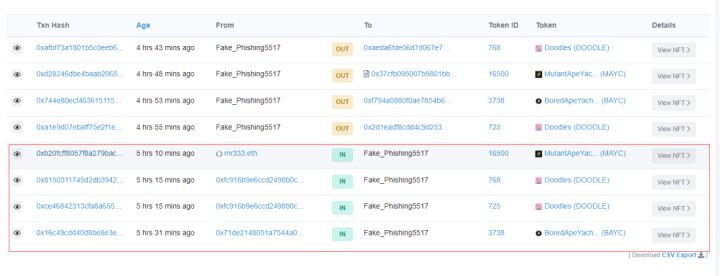
仅仅过去几分钟,攻击者就在11:07将无聊猿 BAYC #3738 NFT转移到自己的钱包地址中。

但是,黑客似乎盯上了这位华语流行天王,接着将周杰伦持有的1枚MAYC和两枚Doodles同样盗走。
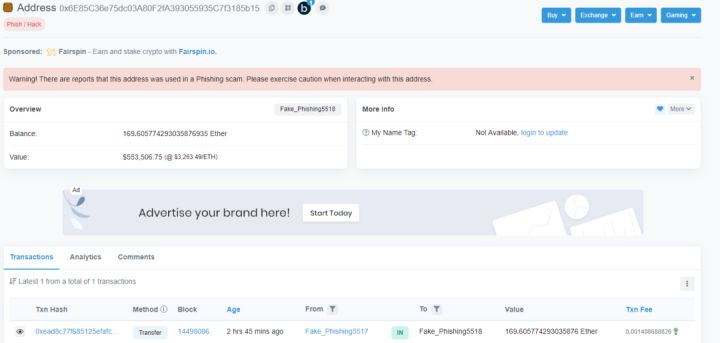
攻击者得手后,在LooksRare和OpenSea上将盗取的NFT卖掉,获得约169.6 ETH。

目前资金停留在 0x6E85C开头的这个地址上,就这样,周杰伦的NFT被黑客获利。
小编想说,杰伦哥,盗了就盗了,快准备新专辑吧。
NFT的风险都有哪些?
在此前的几篇文章里,我们已指出,目前NFT的风险可大致分为两类:
一是NFT本身的授权问题(NFT持有者可授权其它地址作为代理人),可能因NFT持有者的误操作,导致NFT权限被劫持(主要是钓鱼网站、钱包层面的不安全接口调用);
二是NFT参与DEFI系统后引入的外部风险,如:NFT质押挖矿合约本身所带来的安全风险,这部分与常规DEFI风险基本一致。

除此之外,我们还需要防范各类诈骗手段:
比如骗子会通过 Discord 私信你诈骗网站链接,或者是发送假的交易链接,诱导你去点击。除此之外,骗子会通过各种手段诱导用户将私钥或助记词发送给自己,因此一定要保护好自己的私钥和助记词。
这些防骗指南你需要知道
除了警惕NFT炒作之外,还需要防范各类NFT骗局套路,最近一年与NFT有关的诈骗数量和范围也呈现出现爆炸性增长,大家还需要多加防范。
注意真假网站的甄别
一定要注意假网站,特别是钓鱼网站。不要轻易授权!不要轻易授权!不要轻易授权
不要泄露私钥或助记词
保护好自己的私钥与助记词,不要泄露。一旦泄露,你的数字资产很可能就已处于风险之中。
及时取消钱包授权
如果你已经在诈骗网站授权钱包,可以及时前往以下两个地址检查钱包授权情况并及时取消:
https://etherscan.io/tokenapprovalchecker
https://revoke.cash/

Trending Cryptos

Related Reads

Lei Jun Earns 7 Billion in One Day from CXMT's IPO? Xiaomi Executive Responds

On July 28th, Changxin Technology's stock price on the Sci-Tech Innovation Board experienced minor fluctuations. The company had made a historic market debut the previous day, becoming the first A-share stock to record a single-day trading volume exceeding 1 trillion yuan. This led to significant paper gains for its strategic investors. Among them, Xiaomi's wholly-owned subsidiary was allocated 18.24 million shares with an initial investment of approximately 158 million yuan. Reports estimated a paper profit of 717 million yuan for Xiaomi founder Lei Jun based on his shareholding structure. However, a Xiaomi executive clarified that this was a corporate investment and should not be conflated with personal wealth. Other major beneficiaries included Alibaba and Nio. Alibaba, an early investor, held nearly a 5% stake through two entities, with an estimated paper gain exceeding 160 billion yuan. Nio, participating in the strategic placement, also saw substantial paper returns. Additionally, state-owned banks and insurance institutions that invested in Changxin recorded potential gains in the hundreds of billions. Conversely, companies like Country Garden reportedly missed out on nearly 50 billion yuan in potential gains after divesting their stakes before the IPO due to liquidity pressures. The article notes that these are paper profits based on the listing price, as the allocated shares are subject to lock-up periods, and final realized gains will depend on future stock performance. An employee from Changxin Technology commented that ordinary staff remain focused on their salaries and benefits rather than the market hype.

marsbit8m ago

Lei Jun Earns 7 Billion in One Day from CXMT's IPO? Xiaomi Executive Responds

marsbit8m ago

Selling Tokens or Selling Outcomes: Several Paradoxes of the AI Business Model

"The Token vs. Outcome Sale: Key Paradoxes in the AI Business Model By mid-2026, the AI industry shows rapid growth in revenue and token usage, yet the underlying business models differ significantly. This article analyzes four structural paradoxes defining the current landscape, all pointing to the commoditization of intelligence and the concentration of profits in few segments. **The Cost Paradox: Cheaper Tokens, Heavier Bills** Despite a >95% price drop for equivalent AI capability since 2023, total spending has skyrocketed due to the Jevons Paradox: lower prices expand usage into previously uneconomical tasks. Furthermore, the shift to autonomous agents operating 24/7 multiplies consumption. However, efficiency gains often remain unrealized due to unchanged organizational workflows (the Solow Paradox). The focus is shifting from optimizing token price to optimizing the task itself. **The Hierarchy Paradox: The App is King vs. The App is Dead** While conventional wisdom holds that value accrues at the application layer, the AI stack is inverted. Infrastructure (chips) captures ~70% of industry revenue and ~80% of gross profit, while application-layer margins are thin (0-30%). Fast-evolving base models threaten "thin" apps. Sustainable applications are those that embed intelligence into specific contexts, possessing private data, workflows, or delivery capabilities that become more valuable as the base model improves. **The Responsibility Paradox: Profit Follows Accountability** Growth rates alone don't guarantee profit. A key differentiator is a company's willingness and ability to take responsibility for specific outcomes. Selling by the token competes for IT budgets; selling by the outcome (e.g., a resolved support ticket) taps into larger human labor budgets. Low-responsibility, high-volume tasks (e.g., generic客服) face commoditization. High-stakes, regulated domains (e.g., law, healthcare) where vendors assume heavier liability for results command higher margins, as seen with companies like Harvey in legal tech. **The Open-Source Paradox: Open Wins Traffic, Closed Wins Revenue** Open-source models dominate in usage share and developer adoption, often being 5-20x cheaper. However, closed-source models still capture the majority of enterprise spending (~89%). Enterprises pay a premium for closed-source reliability, support, compliance, and accountability. The total cost of ownership (TCO) is converging as closed-source prices fall faster than open-source builds trust, leading to hybrid deployments. Profit is migrating from the model layer itself to upstream (compute) and downstream (orchestration, data, services)."

marsbit9m ago

Selling Tokens or Selling Outcomes: Several Paradoxes of the AI Business Model

marsbit9m ago

Ethereum's 2030 Blueprint: 200x Speed Increase, Quantum-Resistance, and Native Privacy

Ethereum's 2030 Roadmap: 200x Speed, Quantum-Resistant, Native Privacy Ethereum, now in its 11th year, is guided by the "Lean Ethereum" vision, a unified development blueprint aiming to streamline the network. This plan, outlined in the evolving "Strawmap" document, targets five core goals for 2030. **1. Fast L1:** Ethereum aims for near-instant finality and faster block times. By using Zero-Knowledge (ZK) proofs to aggregate validator votes, final confirmation could drop from ~15 minutes to seconds. Block times are slated to decrease from 12 seconds to 6 seconds (2027-28) and eventually 4 seconds (2029-30). The minimum staking requirement may also lower to 1 ETH, enhancing decentralization. **2. 1 Billion Gas L1:** To break the scalability-decentralization trade-off, L1 ZK-EVM will replace redundant transaction execution with ZK proofs. This allows nodes (even on phones) to verify blocks without re-running computations, paving the way to increase L1 throughput ~200x to 1 billion gas per second. **3. Trillion-Gas L2:** Ethereum will become a high-capacity settlement layer for Layer 2 networks (L2s). Planned upgrades, like PeerDAS and subsequent optimizations, target 1 GB per second of data bandwidth for L2s (Blobs), enabling a massive ecosystem of high-throughput rollups for specialized use cases. **4. Quantum-Resistant L1:** To counter future quantum computing threats, Ethereum plans to migrate its cryptographic signatures (ECDSA, BLS) to quantum-resistant, hash-based schemes. This multi-upgrade transition is targeted for completion by 2029, securing the network in the post-quantum era. **5. Privacy-Native L1:** For the first time, native transaction privacy is an official goal. Using ZK proofs, transactions could hide sender, receiver, and amount while proving compliance with rules. This infrastructure is tentatively planned, though details remain fluid and subject to regulatory landscapes. Driven by a broader ecosystem beyond the core Foundation, this ambitious roadmap seeks to make Ethereum faster, more scalable, quantum-secure, and private, while preserving its core tenets of neutrality and trustlessness. All plans remain subject to ongoing research, audits, and community consensus.

marsbit22m ago

Ethereum's 2030 Blueprint: 200x Speed Increase, Quantum-Resistance, and Native Privacy

marsbit22m ago

Trading

Spot

Hot Articles

How to Buy NFT

Welcome to HTX.com! We've made purchasing AINFT (NFT) simple and convenient. Follow our step-by-step guide to embark on your crypto journey.Step 1: Create Your HTX AccountUse your email or phone number to sign up for a free account on HTX. Experience a hassle-free registration journey and unlock all features.Get My AccountStep 2: Go to Buy Crypto and Choose Your Payment MethodCredit/Debit Card: Use your Visa or Mastercard to buy AINFT (NFT) instantly.Balance: Use funds from your HTX account balance to trade seamlessly.Third Parties: We've added popular payment methods such as Google Pay and Apple Pay to enhance convenience.P2P: Trade directly with other users on HTX.Over-the-Counter (OTC): We offer tailor-made services and competitive exchange rates for traders.Step 3: Store Your AINFT (NFT)After purchasing your AINFT (NFT), store it in your HTX account. Alternatively, you can send it elsewhere via blockchain transfer or use it to trade other cryptocurrencies.Step 4: Trade AINFT (NFT)Easily trade AINFT (NFT) on HTX's spot market. Simply access your account, select your trading pair, execute your trades, and monitor in real-time. We offer a user-friendly experience for both beginners and seasoned traders.

7.6k Total ViewsPublished 2024.03.29Updated 2026.06.02

How to Buy NFT

What is Altura NFT?

Altura: Providing One-Stop NFT Solutions for Game Developers

56.2k Total ViewsPublished 2024.06.12Updated 2024.06.12

What is Altura NFT?

What is AINFT

EternaFi Agents and $AINFT: A Comprehensive Analysis of AI-Powered NFT Infrastructure in the Web3 Ecosystem The intersection of artificial intelligence (AI) and blockchain technology is rapidly evolving, establishing innovative platforms that redefine ownership models and economic participation. EternaFi Agents, along with its native token $AINFT, exemplifies a groundbreaking approach to the tokenization of AI infrastructures through the means of non-fungible tokens (NFTs). Launched in July 2025 by the development team at Nova Club, EternaFi merges the advancements of AI with the decentralized financial mechanisms of blockchain, presenting a unique investment opportunity for participants within the web3 ecosystem. This article aims to provide an in-depth assessment of EternaFi Agents, covering its core components, functionality, and significance within the crypto landscape. Introduction and Project Overview EternaFi Agents stands as a salient example of how blockchain technology can democratize access to advanced AI capabilities. The project endeavors to reshape the paradigm of AI ownership by diversifying economic participation, making sophisticated AI systems accessible to a larger pool of stakeholders. At its core, the project tokenizes a proprietary large language model (LLM) developed by Nova Club, allowing NFT holders to gain fractional exposure to the model's economic performance. By utilizing NFTs representing stakes in the LLM, EternaFi Agents fosters a model wherein stakeholders not only participate in AI service consumption but also enjoy sharing in the economic rewards generated by the platform. This transformative approach enables the development of sustainable revenue models for AI services, all the while promoting broad community engagement and facilitating transparent governance. What is EternaFi Agents? EternaFi Agents represents an AI-NFT infrastructure project that aims to blend the capabilities of AI with blockchain technology in a coherent ecosystem. The essential feature of this project is the creation of NFTs that serve as financial instruments, representing fractions of ownership in Nova Club's proprietary AI infrastructure. Each NFT symbolizes direct exposure to the economic performance of the underlying AI system, providing a lucrative opportunity for investors. The project operates on the Base blockchain, known for its scalability and efficiency, thus ensuring manageable transaction costs while facilitating a seamless operational experience. One of the notable features includes a revenue-sharing mechanism, wherein NFT holders can receive portions of subscription income generated by the AI services provided on the platform. This innovative approach establishes a connection between the success of the AI services and the economic dividends distributed among the holders, thus ensuring an alignment of interests across the community. Who is the Creator of EternaFi Agents? The creative force behind EternaFi Agents is Nova Club, a development team based in Singapore proficient in the amalgamation of AI and blockchain technology. Their prior experience in AI development and cryptocurrency analysis gives credence to the project, contributing a breadth of expertise to the creation of EternaFi Agents. Nova Club’s mission centers on democratizing access to cutting-edge AI technologies while building sustainable economic models that benefit users alongside developers. Their commitment to transparency, community governance, and innovation is reflected in the design and implementation of the EternaFi platform, aiming to establish a unique ecosystem that fosters positive engagement and long-term value creation. Who are the Investors of EternaFi Agents? The specific details concerning investors or investment organizations backing EternaFi Agents are not publicly available. However, EternaFi has adopted an inclusive approach to funding its development through the sale of NFTs to the public, allowing a wide array of participants to invest in the ecosystem. The project’s architecture ensures that core infrastructure is funded responsibly while allowing community members to partake in the ownership and economic returns generated from the AI services. This model emphasizes community engagement by aligning the interests of investors and project developers, creating a collaborative environment where long-term participation is incentivized. How Does EternaFi Agents Work? EternaFi Agents operates through a multifaceted ecosystem where NFTs serve as a primary means of ownership representation within the project. Each NFT holder is entitled to a share of the monthly subscription income produced by the underlying AI-powered platform, thereby positioning NFT ownership as a lucrative investment vehicle. Revenue Generation Mechanism The primary source of revenue generation for the EternaFi platform stems from subscription fees related to the AI services provided. Users can access various tiered services, ranging from basic market analysis tools to comprehensive AI-assisted trading solutions. These services are monetized and form the basis for the revenue-sharing framework, which distributes profits to NFT holders through automated smart contracts. An innovative feature of the EternaFi ecosystem is the revenue-sharing mechanism that operates transparently, ensuring that rewards are allocated based on verifiable metrics from the AI platform's operations. This creates a direct link between the performance of AI services and the returns available to community investors, establishing a sustainable economic model. Staking and Vesting Mechanisms Participants within EternaFi can engage in staking their NFTs to unlock additional economic benefits. The vesting schedule is designed to promote long-term commitment among participants, rewarding those who exhibit ongoing support for the project. This ensures a robust alignment of interests and fosters a sense of community engagement essential for achieving the project's long-term goals. Transparent Governance EternaFi Agents embraces decentralized governance, allowing NFT holders to play an active role in decision-making regarding the platform's development and future directions. The governing structure includes community voting mechanisms, providing NFT holders with the opportunity to influence significant decisions and contributing to a collaborative approach to project growth. Timeline of EternaFi Agents The development trajectory of EternaFi Agents showcases a systematic approach toward building a sustainable AI infrastructure while meeting the needs of community participants. Below is a timeline of important milestones in the project’s history: July 2025: Launch of EternaFi Agents, including the public sale of NFTs and deployment of the $AINFT token on the Base blockchain. Q4 2025: Establishment of market infrastructure including liquidity pools and launch of staking dashboards for NFT holders. 2026: Initiation of community engagement programs, expanding AI capabilities, and integration with cross-chain technologies. Q4 2026: Implementation of the dividend distribution system, allowing NFT holders to reap economic benefits from their investments. These milestones signify the focus on establishing a functional and participative ecosystem while ensuring continuous evolution to meet market demands. Technological Infrastructure and Blockchain Integration EternaFi Agents is anchored in an advanced technological framework combining AI systems with blockchain capabilities. Operating on the Base blockchain, the project leverages the advantages of scalability and low transaction costs. The underlying smart contract architecture governs the NFT ownership, revenue sharing, and community management features, ensuring efficiency and transparency. AI System Development The proprietary large language model underpinning EternaFi Agents has been independently developed and designed to cater to revenue-generating applications without reliance on proprietary external frameworks. This endeavor reflects a commitment to creating a versatile and adaptable AI infrastructure capable of delivering meaningful services to users, thus generating economic value for investors. Security Measures The robustness of EternaFi’s security infrastructure is paramount. Regular audits and stringent security measures ensure the integrity of the AI systems and blockchain mechanisms, safeguarding against potential vulnerabilities while fostering confidence among participants. Conclusion EternaFi Agents signifies a landmark innovation within the realm of artificial intelligence and blockchain technology, opening avenues for community ownership and economic participation in advanced AI capabilities. The project’s comprehensive strategy to tokenize AI infrastructure via NFTs establishes a precedent for future decentralized ecosystems. By harmonizing technical sophistication with user-centric economic models, EternaFi not only fosters engagement but also generates a sustainable revenue-sharing framework for community participants. The significance of EternaFi extends well beyond its operational success as it exemplifies how blockchain can democratize cutting-edge AI technologies, paving the way for future ventures in this intersectional space. The evolution of EternaFi Agents may herald a new era of AI development characterized by participant-driven governance, sustainable economic models, and transparent verification, ultimately contributing to the broader democratization of AI and technology accessibility across industries.

4.9k Total ViewsPublished 2025.08.14Updated 2025.08.14

What is AINFT

Discussions

Welcome to the HTX Community. Here, you can stay informed about the latest platform developments and gain access to professional market insights. Users' opinions on the price of NFT (NFT) are presented below.

活动图片