How ARB Shifts the Future of Airdrops

BanklessPublished on 2023-04-01Last updated on 2023-04-01

Abstract

Dear Bankless Nation, The Arbitrum $ARB launch was a big moment for crypto and Ethereum, but it was also a huge milestone for airdrops. The question now is how, in the wake of ARB, projects shift their thinking around token incentives for early adopters. Today, we dig into the future of airdrops. - Bankless team

Airdrops remain the go-to model for rewarding communities and decentralizing protocol ownership. However, gone are the days of Uniswap-style retroactive airdrops.

No longer will a simple transaction or LP position qualify you for a drop! Even the most basic airdrops are now designed with tiered criteria and sybil resistance in mind.

While Arbitrum has certainly proved to be 2023’s hottest airdrop (to date), the airdrop left something to be desired, from both the technical performance and token distribution perspectives. Today, we’ll dissect some pitfalls of the ARB airdrop and explore how other prominent protocols have iterated on airdrops past to align communities, attract liquidity and minimize disruptions.

ARB Autopsy

On March 23, over 1.16B ARB were airdropped to 625k unique wallets, with distributions ranging from 625 to 10,250 tokens per address. Much of the claiming activity was front-loaded, with 52% of allocations claimed within the first four hours.

Arbitrum saw extremely elevated levels of on-chain activity during ARB launch day, setting an all-time daily record of 2.7M transactions from 612k active addresses, outperforming Ethereum by 145% and 32%, respectively.

While Arbitrum’s tech is currently some of the best in the game, offering increased throughput and call data compression with Nitro, the limits of blockchain technology were evident over the hours that followed the ARB drop.

Arbitrum’s Web2 infrastructure also failed to handle the load. Frontends for the recommended claim portal, arbitrum.foundation, and blockchain explorer, Arbiscan, were down in the hours following ARB’s release. A cohort of Arbitrum users and airdrop claimers voiced frustrations on Crypto Twitter.

Iterating and Improving

Retroactive airdrops and simplistic criteria are so 2022. Today’s hottest protocols recognize the potency of airdrops and are designing novel distribution strategies to best capitalize on their potential.

Airdrops are undeniably the single largest “expense” many protocols will ever incur, so how do they maximize value?

🎯 Targeted Distribution

Any airdrop’s primary goal should be to fairly reward a variety of on-chain activities, aiming to distribute tokens to those least likely to sell and most likely to participate in governance. Targeted distribution criteria is key in accomplishing this pursuit!

Protocols have begun increasingly rewarding numerous categories of on-chain interactions, outside of basic usage.

Optimism chose to allocate OP tokens to DAO voters, multisig signers, and Gitcoin L1 donors, aligning HODLers with the chain’s Retroactive Public Goods Funding efforts from day one.

Sudoswap carved out SUDO allocations specifically for holders of project team-designed “0xmon” NFTs, providing extra rewards for those who have already displayed a financial commitment to the Sudoswap universe.

While Arbitrum provided allocations for DAOs to spend at their discretion, the rollup missed out on the opportunity to directly reward good citizen behaviors in the ecosystem and seemingly neglected “Enter the Odyssey” NFT holders.

While not intended to completely replace transaction value and use-based criteria, additional categories can be used to reward desirable behavior. For example, Arbitrum could have included governance participation among its list of qualifying actions.

And despite partnering with Nansen to weed out sybil attackers, clear vulnerabilities in Arbitrum’s sybil detection are evident. An analysis performed by X-explore found approximately 4k sybil communities, controlling 150k addresses eligible to claim 253M tokens (21% of ARB user allocation), were included in the ARB drop.

Three prominent sybil communities alone claimed over 4.2M ARB.

While not a bulletproof solution, niching down criteria and rewarding diverse actions more characteristic of human on-chain behavior can help to limit the number of tokens distributed to sybil farmers. Additional criteria and multipliers serve to curate airdrop distribution and provide tokens to addresses that have displayed commitments to the ecosystem beyond financial value.

💨 Push v. Pull

Creating a smooth claim process should be a focus for protocols looking to build goodwill with their communities.

Pull-style airdrops, which require recipients to claim the drop, appear attractive for many projects. Gas fees are avoided and funneling claiming activity through a team-run frontend presents protocols the opportunity to dissuade sellers by promoting governance, as seen in Arbitrum’s claiming process.

However, given the present limits of blockchain technology, network-wide pull airdrops can create on-chain pandemonium, hampering chains’ abilities to process transactions and providing difficult claim experiences.

Optimism’s Airdrop 2 took a push approach, gaslessly distributing 55M OP to over 330k unique addresses seamlessly, without causing broader network disruptions. While pull drops are viable for protocols attempting to bootstrap governance participation for large initial airdrops, recurring network airdrops to a large number of wallets are best pushed.

👯 Attracting Users

What crypto application doesn’t like attracting more TVL? Airdrops provide a convenient format to do just this. NFT marketplace Blur innovated on the retroactive airdrop model and opted to proactively announce airdrop qualification criteria to attract usage.

Since launch, the platform has publicly marketed its intention to airdrop tokens to various user categories and much of the NFT marketplace’s initial adoption came from users attempting to maximize their airdrop eligibility. Currently, Blur processes 72% of weekly NFT trading volume, in part a result of the preannounced Season 2 airdrop.
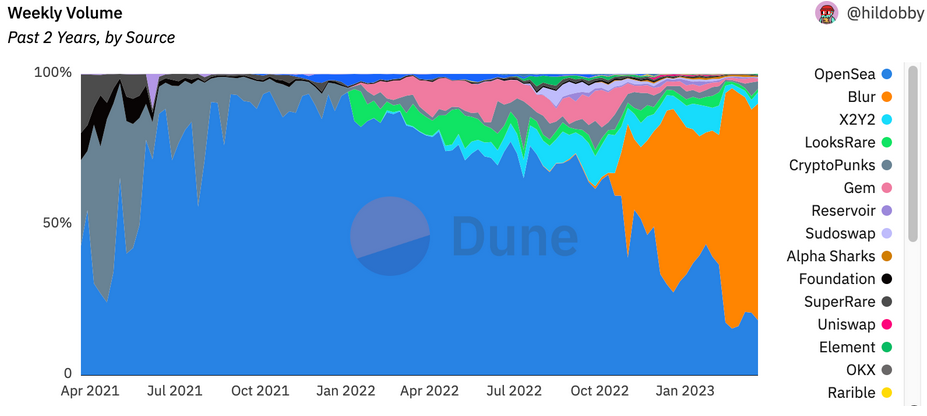
Despite the demonstrated success of Blur’s tactics, Arbitrum stuck to a token distribution based solely on past activity, missing out on an opportunity to attract additional users and TVL to the chain.

Dominance in the NFT trading scene may fade as incentives eventually dry up, however the preannounced airdrops have helped Blur locate a foothold in the competition against behemoths like OpenSea.

Tokens can also be viewed as direct-to-consumer marketing spend via retroactive allocations. While these allocations do not need to be large, granting tokens to users of competitive protocols can help to establish a relationship and provide an opportunity for capture of new liquidity and users. Both Optimism and Sturdy Finance rank among protocols utilizing this approach, with each allocating a portion of their tokens to users of competitive protocols.

Learning From Our Mistakes

Airdrop best practices are far from settled territory: protocols are continuously updating distribution methods -- attempting to optimize eligibility, attract liquidity, and create frictionless user experiences.

The metas are constantly shifting, but it's clear that Arbitrum's latest airdrop was not the final form and that other projects have seemed to be innovating the humble airdrop further. Arbitrum's token launch was a big moment for the industry, it will also be a moment that plenty of project founders analyze endlessly as they aim to boost the gains from their own eventual token distribution efforts.

Trending Cryptos

Related Reads

Comprehensive Analysis of the AI Inference Market: How Can Crypto Projects Break Through?

"AI Inference Market: A Strategic Overview and Crypto's Path to Disruption" The AI inference market, where trained models generate responses to user prompts, is now the primary economic driver, surpassing model training in value. This market is fragmented: hyperscalers (AWS, Google, Microsoft) dominate enterprise reliability; specialized providers (Together, Fireworks) optimize performance; and routing platforms like OpenRouter act as critical bottlenecks, dynamically allocating requests based on cost, latency, and privacy. Crypto AI networks are not competing directly on reliability but are carving out distinct niches: permissionless access, lower-cost supply, privacy, verifiable computation, and agent-native payments. Key projects include Chutes (decentralized inference platform), Akash & io.net (GPU marketplaces), Targon (confidential computing), Darkbloom & Venice (private, consumer-focused inference), and NuNet (orchestration for distributed workloads). The core differentiator is that traditional providers sell trust and enterprise workflows, while crypto networks offer new incentive loops, censorship resistance, and programmable access to resources like compute. For crypto projects to succeed, key metrics are paid token volume (not just usage), sustainable GPU provider revenue, integration into routers like OpenRouter, robust verification against fraud, and genuine privacy guarantees. Ultimately, market control will belong to entities that route, verify, and settle demand—not just those supplying raw compute. The inference market is evolving to resemble a financial system, with tokens as units of account, and crypto's unique value propositions position it to capture emerging segments in this expanding landscape.

Foresight News13m ago

Comprehensive Analysis of the AI Inference Market: How Can Crypto Projects Break Through?

Foresight News13m ago

The War Without a Unified Name: The Domestic Tech Giants' World Model Landscape

The article outlines the diverse and fragmented landscape of "World Models" in China's tech industry, where major players are pursuing similar goals under different names like world foundational models, physical AI, or integrated within autonomous driving and embodied intelligence systems. The core aim is to enable AI to create an internal, dynamic environment for simulation, reasoning, and learning, reducing reliance on infinite real-world data. This "data engine" allows for unlimited generation, experimentation, and iteration. The report categorizes the approaches of different companies: * **Internet Giants:** Alibaba is developing models for linguistic, virtual, and physical worlds (Qwen-AgentWorld, HappyOyster, Qwen-RobotWorld). Tencent's HY-World focuses on 3D, game, and social scenarios. ByteDance leverages its vast video data for a potential "digital twin" model. Huawei integrates its model into industrial applications like smart cars and robotics without separately branding it. Baidu embeds world model capabilities within its Apollo autonomous driving and Ernie systems. * **Automakers:** Companies like NIO, Li Auto, XPeng, and Geely are using world models as virtual "driving schools" and "testing grounds." They generate complex scenarios (e.g., rain, snow) to train and validate autonomous driving systems in simulation, aiming for more capable and safer AI drivers. * **Autonomous Driving Suppliers:** Firms such as Momenta, Horizon Robotics, Haomo.ai, and DeepRoute.ai are building the underlying "world engines." They focus on large-scale video generation for simulation, reinforcement learning, and enhancing end-to-end autonomous driving models, often integrating these capabilities into commercial products. While startups bring focus and innovation, they face challenges like limited data, compute resources, and deployment channels. Large companies possess these advantages and are rapidly transitioning world models from research projects into core business infrastructure powering products in vehicles, games, and industry. The conclusion is that world models represent an evolution and convergence of existing AI fields into crucial industrial infrastructure, moving the competition from simply building a model to effectively deploying it to understand and interact with the physical world.

marsbit30m ago

The War Without a Unified Name: The Domestic Tech Giants' World Model Landscape

marsbit30m ago

Trading

Spot
Futures

Hot Articles

How to Buy NFT

Welcome to HTX.com! We've made purchasing AINFT (NFT) simple and convenient. Follow our step-by-step guide to embark on your crypto journey.Step 1: Create Your HTX AccountUse your email or phone number to sign up for a free account on HTX. Experience a hassle-free registration journey and unlock all features.Get My AccountStep 2: Go to Buy Crypto and Choose Your Payment MethodCredit/Debit Card: Use your Visa or Mastercard to buy AINFT (NFT) instantly.Balance: Use funds from your HTX account balance to trade seamlessly.Third Parties: We've added popular payment methods such as Google Pay and Apple Pay to enhance convenience.P2P: Trade directly with other users on HTX.Over-the-Counter (OTC): We offer tailor-made services and competitive exchange rates for traders.Step 3: Store Your AINFT (NFT)After purchasing your AINFT (NFT), store it in your HTX account. Alternatively, you can send it elsewhere via blockchain transfer or use it to trade other cryptocurrencies.Step 4: Trade AINFT (NFT)Easily trade AINFT (NFT) on HTX's spot market. Simply access your account, select your trading pair, execute your trades, and monitor in real-time. We offer a user-friendly experience for both beginners and seasoned traders.

7.2k Total ViewsPublished 2024.03.29Updated 2026.06.02

How to Buy NFT

What is Altura NFT?

Altura: Providing One-Stop NFT Solutions for Game Developers

56.0k Total ViewsPublished 2024.06.12Updated 2024.06.12

What is Altura NFT?

What is AINFT

EternaFi Agents and $AINFT: A Comprehensive Analysis of AI-Powered NFT Infrastructure in the Web3 Ecosystem The intersection of artificial intelligence (AI) and blockchain technology is rapidly evolving, establishing innovative platforms that redefine ownership models and economic participation. EternaFi Agents, along with its native token $AINFT, exemplifies a groundbreaking approach to the tokenization of AI infrastructures through the means of non-fungible tokens (NFTs). Launched in July 2025 by the development team at Nova Club, EternaFi merges the advancements of AI with the decentralized financial mechanisms of blockchain, presenting a unique investment opportunity for participants within the web3 ecosystem. This article aims to provide an in-depth assessment of EternaFi Agents, covering its core components, functionality, and significance within the crypto landscape. Introduction and Project Overview EternaFi Agents stands as a salient example of how blockchain technology can democratize access to advanced AI capabilities. The project endeavors to reshape the paradigm of AI ownership by diversifying economic participation, making sophisticated AI systems accessible to a larger pool of stakeholders. At its core, the project tokenizes a proprietary large language model (LLM) developed by Nova Club, allowing NFT holders to gain fractional exposure to the model's economic performance. By utilizing NFTs representing stakes in the LLM, EternaFi Agents fosters a model wherein stakeholders not only participate in AI service consumption but also enjoy sharing in the economic rewards generated by the platform. This transformative approach enables the development of sustainable revenue models for AI services, all the while promoting broad community engagement and facilitating transparent governance. What is EternaFi Agents? EternaFi Agents represents an AI-NFT infrastructure project that aims to blend the capabilities of AI with blockchain technology in a coherent ecosystem. The essential feature of this project is the creation of NFTs that serve as financial instruments, representing fractions of ownership in Nova Club's proprietary AI infrastructure. Each NFT symbolizes direct exposure to the economic performance of the underlying AI system, providing a lucrative opportunity for investors. The project operates on the Base blockchain, known for its scalability and efficiency, thus ensuring manageable transaction costs while facilitating a seamless operational experience. One of the notable features includes a revenue-sharing mechanism, wherein NFT holders can receive portions of subscription income generated by the AI services provided on the platform. This innovative approach establishes a connection between the success of the AI services and the economic dividends distributed among the holders, thus ensuring an alignment of interests across the community. Who is the Creator of EternaFi Agents? The creative force behind EternaFi Agents is Nova Club, a development team based in Singapore proficient in the amalgamation of AI and blockchain technology. Their prior experience in AI development and cryptocurrency analysis gives credence to the project, contributing a breadth of expertise to the creation of EternaFi Agents. Nova Club’s mission centers on democratizing access to cutting-edge AI technologies while building sustainable economic models that benefit users alongside developers. Their commitment to transparency, community governance, and innovation is reflected in the design and implementation of the EternaFi platform, aiming to establish a unique ecosystem that fosters positive engagement and long-term value creation. Who are the Investors of EternaFi Agents? The specific details concerning investors or investment organizations backing EternaFi Agents are not publicly available. However, EternaFi has adopted an inclusive approach to funding its development through the sale of NFTs to the public, allowing a wide array of participants to invest in the ecosystem. The project’s architecture ensures that core infrastructure is funded responsibly while allowing community members to partake in the ownership and economic returns generated from the AI services. This model emphasizes community engagement by aligning the interests of investors and project developers, creating a collaborative environment where long-term participation is incentivized. How Does EternaFi Agents Work? EternaFi Agents operates through a multifaceted ecosystem where NFTs serve as a primary means of ownership representation within the project. Each NFT holder is entitled to a share of the monthly subscription income produced by the underlying AI-powered platform, thereby positioning NFT ownership as a lucrative investment vehicle. Revenue Generation Mechanism The primary source of revenue generation for the EternaFi platform stems from subscription fees related to the AI services provided. Users can access various tiered services, ranging from basic market analysis tools to comprehensive AI-assisted trading solutions. These services are monetized and form the basis for the revenue-sharing framework, which distributes profits to NFT holders through automated smart contracts. An innovative feature of the EternaFi ecosystem is the revenue-sharing mechanism that operates transparently, ensuring that rewards are allocated based on verifiable metrics from the AI platform's operations. This creates a direct link between the performance of AI services and the returns available to community investors, establishing a sustainable economic model. Staking and Vesting Mechanisms Participants within EternaFi can engage in staking their NFTs to unlock additional economic benefits. The vesting schedule is designed to promote long-term commitment among participants, rewarding those who exhibit ongoing support for the project. This ensures a robust alignment of interests and fosters a sense of community engagement essential for achieving the project's long-term goals. Transparent Governance EternaFi Agents embraces decentralized governance, allowing NFT holders to play an active role in decision-making regarding the platform's development and future directions. The governing structure includes community voting mechanisms, providing NFT holders with the opportunity to influence significant decisions and contributing to a collaborative approach to project growth. Timeline of EternaFi Agents The development trajectory of EternaFi Agents showcases a systematic approach toward building a sustainable AI infrastructure while meeting the needs of community participants. Below is a timeline of important milestones in the project’s history: July 2025: Launch of EternaFi Agents, including the public sale of NFTs and deployment of the $AINFT token on the Base blockchain. Q4 2025: Establishment of market infrastructure including liquidity pools and launch of staking dashboards for NFT holders. 2026: Initiation of community engagement programs, expanding AI capabilities, and integration with cross-chain technologies. Q4 2026: Implementation of the dividend distribution system, allowing NFT holders to reap economic benefits from their investments. These milestones signify the focus on establishing a functional and participative ecosystem while ensuring continuous evolution to meet market demands. Technological Infrastructure and Blockchain Integration EternaFi Agents is anchored in an advanced technological framework combining AI systems with blockchain capabilities. Operating on the Base blockchain, the project leverages the advantages of scalability and low transaction costs. The underlying smart contract architecture governs the NFT ownership, revenue sharing, and community management features, ensuring efficiency and transparency. AI System Development The proprietary large language model underpinning EternaFi Agents has been independently developed and designed to cater to revenue-generating applications without reliance on proprietary external frameworks. This endeavor reflects a commitment to creating a versatile and adaptable AI infrastructure capable of delivering meaningful services to users, thus generating economic value for investors. Security Measures The robustness of EternaFi’s security infrastructure is paramount. Regular audits and stringent security measures ensure the integrity of the AI systems and blockchain mechanisms, safeguarding against potential vulnerabilities while fostering confidence among participants. Conclusion EternaFi Agents signifies a landmark innovation within the realm of artificial intelligence and blockchain technology, opening avenues for community ownership and economic participation in advanced AI capabilities. The project’s comprehensive strategy to tokenize AI infrastructure via NFTs establishes a precedent for future decentralized ecosystems. By harmonizing technical sophistication with user-centric economic models, EternaFi not only fosters engagement but also generates a sustainable revenue-sharing framework for community participants. The significance of EternaFi extends well beyond its operational success as it exemplifies how blockchain can democratize cutting-edge AI technologies, paving the way for future ventures in this intersectional space. The evolution of EternaFi Agents may herald a new era of AI development characterized by participant-driven governance, sustainable economic models, and transparent verification, ultimately contributing to the broader democratization of AI and technology accessibility across industries.

4.1k Total ViewsPublished 2025.08.14Updated 2025.08.14

What is AINFT

Discussions

Welcome to the HTX Community. Here, you can stay informed about the latest platform developments and gain access to professional market insights. Users' opinions on the price of NFT (NFT) are presented below.

活动图片