Possible Timelines For Bitcoin To Hit $100k: Why CEOs See Bullish Signs

newsbtcPublished on 2022-04-01Last updated on 2022-04-01

Abstract

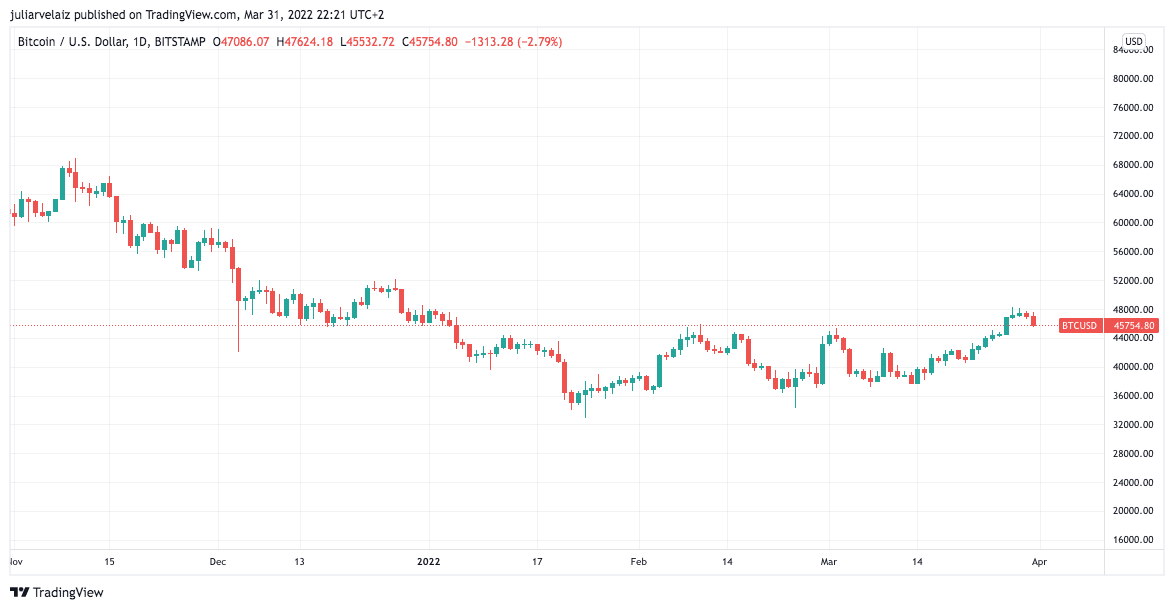
After bitcoin broke above the $45k resistance level reaching the $48k mark, it has retested the $45k level. Some analysts still expect a rise to above $50k, others have abandoned...

After bitcoin broke above the $45k resistance level reaching the $48k mark, it has retested the $45k level. Some analysts still expect a rise to above $50k, others have abandoned their bullish approach. Meanwhile, leading CEOs from Pantera Capital and Skybridge Capital remain positive that the coin will reach the $100k mark in a period of one to two years.
bitcoin

Bitcoin trading at $45,754 in the daily chart | BTCUSD on TradingView.com Pantera Capital CEO Is ‘Wildly Bullish’
In an interview with Yahoo Finance, the CEO of Pantera Capital Dan Morehead commented on Bitcoin’s price action so far in the year. Morehead noted that within the history of Bitcoin cycles, it’s had six previous bear markets that average about 60%, and 2022’s has been 50%.
In his opinion, the bitcoin cycles will begin to moderate thanks to large institutional engagement, and “a 50% bear market is probably all you’re going to get going forward.”
I think we’re either at the lows or very close to it.”
Morehead said he is “wildly bullish right now” because he believes that Bitcoin and the asset classes will decouple, noting that the high correlation that usually happens during periods of stress –similar to 2022’s turmoil– eventually breaks, usually after a 72-days average. “I think stocks and bonds may keep going down potentially for years, whereas blockchain assets can go up.“
Morehead accepted that Pantera Capital failed to predict how fear over the Fed’s rates rising would affect the crypto market, but believes that “in this case, the markets have it wrong, and blockchain will decouple from the other asset classes.”
If you think about it, with rates rising, that is mathematically negative for bonds. It also has a negative impact for anything else with discounted cash flows like equities or real estate, but blockchain’s totally independent of rates.”
In his forecast, Morehead expects that six months from now bitcoin will be back to the typical 2.5X yearly growth that it’s been doing for 11 years. If so, then in a year Bitcoin could be worth about $100,000 per coin.
Scaramucci Sees a $500k Bitcoin
Similarly, in an interview with CNBC, the CEO of Skybridge Capital Anthony Scaramucchi predicted again that “Bitcoin will hit $100k in the next two years” based on adoption growth.
Scaramucchi quotes Glassnode claiming that “there’s probably 245 million wallets out there or accounts related to Bitcoin,” while in October-November of 2020 there were about 85 million wallets. The CEO believes the growing adoption turns into people being more confident in the coin.
“Somebody like Cathie Wood would say to you, a billion wallets, Bitcoin could easily trade to $500,000 a coin.”
While Scaramucchi’s predictions from 2021 were not spot on, he accepts that he failed to anticipate the Russo-Ukrainian war and the elongation of COVID, but he sees no reason for Bitcoin not to hit the $100K mark within two years “given the way it’s scaling globally” and its many use cases.
A Bullish Pattern
Meanwhile, analyst Yuriy Bishko believes that BTC follows a Wyckoff re-accumulation pattern. The Wyckoff market cycle theory is used to predict the market’s direction, and it supports the idea that prices move in a cyclical pattern of four phases: accumulation, markup, distribution, and markdown.
These phases can reflect the investors’ behavior, thus possibly predicting future price movement.
Within the Markup phase price action moves in a long uptrend, and the re-accumulation phase is a sideways range that interrupts Markup with small consolidation patterns. After re-accumulation, prices start to move higher, but the support zone needs to hold strongly. Note the example shared by a pseudonym analyst:

Like so, Bishko believes that Bitcoin is following this same pattern, currently entering Phase D. If true and the price continues to replicate the movements, it could retest an ATH.
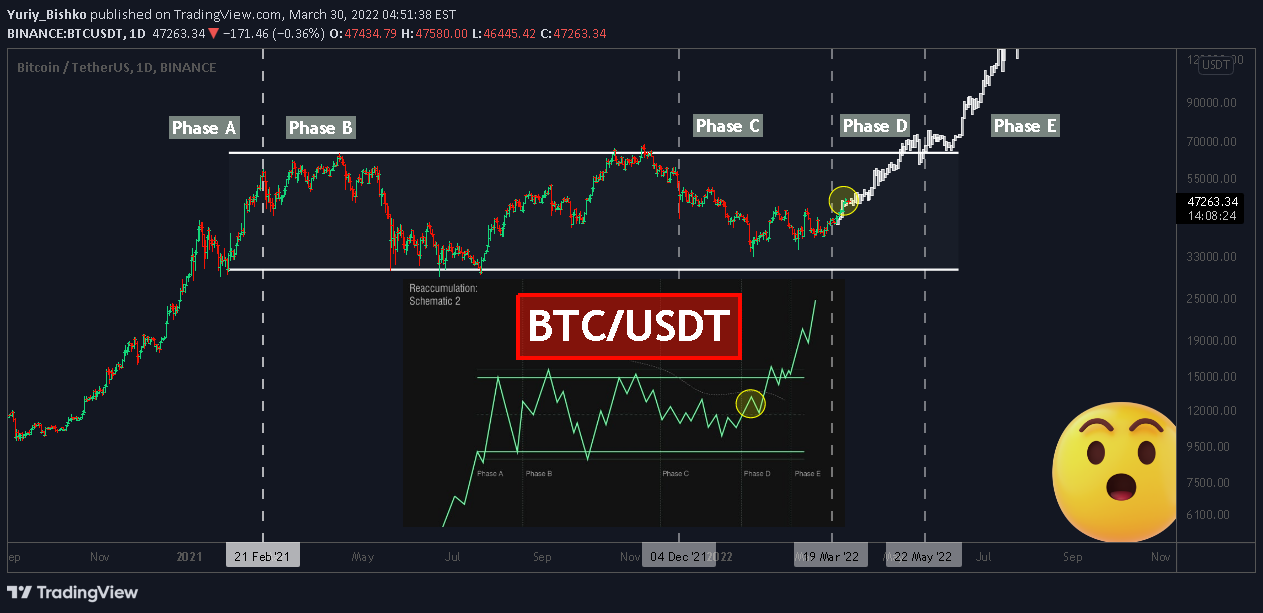
“Globally, Bitcoin is in a larger consolidation channel with a range of $30-67K. This consolidation is not a bear market until the price creates lower lows. Right now we see on the chart higher highs (HH) and higher lows (HL) on the higher timeframes(1d,1w).”


Related Reads

Podcast Notes: Hyperliquid Has Become the Top Interest Point for Traditional Hedge Funds

Empire Podcast hosts Jason Yanowitz and Santiago Santos discuss the surging institutional interest in Hyperliquid, a decentralized perpetual exchange, marking the highest level of engagement from traditional hedge fund managers since Paul Tudor Jones endorsed Bitcoin in 2020. The primary driver is the demand for weekend trading of commodities like oil, especially during geopolitical tensions such as the Iran conflict, as Hyperliquid provides the only active price discovery venue when traditional markets are closed. Trade XYZ, a front-end on Hyperliquid, has seen significant growth, with weekend oil price predictions having a median error of only 50 basis points. Santos predicts commodity trading volume on Hyperliquid will surpass Bitcoin within the year and that its market cap could rise from $25 billion to $100 billion. Other key points include Kraken raising $200 million at a reduced valuation of $13.3 billion, and the SEC clarifying that self-custodied DeFi frontends like MetaMask are not subject to broker-dealer rules, resolving a major regulatory uncertainty. The hosts also note the strong correlation between crypto and macro markets, with the S&P 500 posting one of its best 10-day rallies since 1950. They highlight MicroStrategy's continued Bitcoin acquisitions and the potential of real-world asset (RWA) tokenization as a key trend. The discussion concludes with skepticism towards many L2 projects, predicting a wave of protocols truly going to zero as capital concentrates in proven assets like Bitcoin and Hyperliquid.

marsbit3h ago

Podcast Notes: Hyperliquid Has Become the Top Interest Point for Traditional Hedge Funds

marsbit3h ago

a16z: The Next Frontier of AI, The Triple Flywheel of Robotics, Autonomous Science, and Brain-Computer Interfaces

a16z presents a comprehensive investment thesis for the next frontier of AI: Physical AI, centered on a synergistic flywheel of robotics, autonomous science, and novel human-computer interfaces (HCIs) like brain-computers. While the current AI paradigm scales on language and code, the most disruptive future capabilities will emerge from three adjacent fields leveraging five core technical primitives: 1) learned representations of physical dynamics (via models like VLA, WAM, and native embodied models), 2) embodied action architectures (e.g., dual-system designs, diffusion-based motion generation, and RL fine-tuning like RECAP), 3) simulation and synthetic data as scaling infrastructure, 4) expanded sensory channels (touch, neural signals, silent speech, olfaction), and 5) closed-loop agent systems for long-horizon tasks. These primitives converge to power three key domains: * **Robotics:** The literal embodiment of AI, requiring all primitives for real-world physical interaction and manipulation. * **Autonomous Science:** Self-driving labs that conduct hypothesis-experiment-analysis loops, generating structured, causally-grounded data to improve physical AI models. * **Novel HCIs:** Devices (AR glasses, EMG wearables, BCIs) that expand human-AI bandwidth and act as massive data-collection networks for real-world human experience. These domains form a mutually reinforcing flywheel: Robotics enable autonomous labs, which in turn generate valuable data for robotics and materials science. New interfaces provide rich human-physical interaction data to train better robots and scientists. Together, they represent a new scaling axis for AI, moving beyond the digital realm to interact with and learn from physical reality, promising significant emergent capabilities and value.

marsbit4h ago

a16z: The Next Frontier of AI, The Triple Flywheel of Robotics, Autonomous Science, and Brain-Computer Interfaces

marsbit4h ago

Conversation with Bitwise Advisor: From K-Shaped Economy to AI Taking Jobs, How Can Bitcoin Save the Younger Generation?

Jeff Park, a macro strategist and advisor at Bitwise, argues that the traditional financial system is broken, particularly for young generations. He describes a "K-shaped economy" where asset inflation enriches the wealthy while leaving others behind, with unaffordable housing as a key symptom. Park explains that real estate is often a depreciating asset due to maintenance costs and taxes, yet it remains unattainable for many young people due to distorted demand from global capital flows. He proposes Bitcoin as a superior store of value—scarce, portable, and free from maintenance costs or excessive taxation. By diverting capital away from real estate, Bitcoin could help lower housing prices and increase accessibility. Park also discusses the decline of traditional "smart investing" (e.g., value stocks) and the rise of "ideological investing" in non-correlated assets like crypto, luxury goods, and collectibles. On AI, Park warns it could trigger extreme social inequality by eliminating jobs while boosting corporate profits. He believes this will push younger generations toward Bitcoin, not only as a hedge but also as a symbol of decentralization and data sovereignty—offering an alternative to centralized AI systems that use personal data without fair compensation. He advises a diversified portfolio with Bitcoin as a core holding to hedge against currency devaluation and systemic risk.

marsbit5h ago

Conversation with Bitwise Advisor: From K-Shaped Economy to AI Taking Jobs, How Can Bitcoin Save the Younger Generation?

marsbit5h ago

Trading

Spot
Futures

Hot Articles

What is $BITCOIN

DIGITAL GOLD ($BITCOIN): A Comprehensive Analysis Introduction to DIGITAL GOLD ($BITCOIN) DIGITAL GOLD ($BITCOIN) is a blockchain-based project operating on the Solana network, which aims to combine the characteristics of traditional precious metals with the innovation of decentralized technologies. While it shares a name with Bitcoin, often referred to as “digital gold” due to its perception as a store of value, DIGITAL GOLD is a separate token designed to create a unique ecosystem within the Web3 landscape. Its goal is to position itself as a viable alternative digital asset, although specifics regarding its applications and functionalities are still developing. What is DIGITAL GOLD ($BITCOIN)? DIGITAL GOLD ($BITCOIN) is a cryptocurrency token explicitly designed for use on the Solana blockchain. In contrast to Bitcoin, which provides a widely recognized value storage role, this token appears to focus on broader applications and characteristics. Notable aspects include: Blockchain Infrastructure: The token is built on the Solana blockchain, known for its capacity to handle high-speed and low-cost transactions. Supply Dynamics: DIGITAL GOLD has a maximum supply capped at 100 quadrillion tokens (100P $BITCOIN), although details regarding its circulating supply are currently undisclosed. Utility: While precise functionalities are not explicitly outlined, there are indications that the token could be utilized for various applications, potentially involving decentralized applications (dApps) or asset tokenization strategies. Who is the Creator of DIGITAL GOLD ($BITCOIN)? At present, the identity of the creators and development team behind DIGITAL GOLD ($BITCOIN) remains unknown. This situation is typical among many innovative projects within the blockchain space, particularly those aligning with decentralized finance and meme coin phenomena. While such anonymity may foster a community-driven culture, it intensifies concerns about governance and accountability. Who are the Investors of DIGITAL GOLD ($BITCOIN)? The available information indicates that DIGITAL GOLD ($BITCOIN) does not have any known institutional backers or prominent venture capital investments. The project seems to operate on a peer-to-peer model focused on community support and adoption rather than traditional funding routes. Its activity and liquidity are primarily situated on decentralized exchanges (DEXs), such as PumpSwap, rather than established centralized trading platforms, further highlighting its grassroots approach. How DIGITAL GOLD ($BITCOIN) Works The operational mechanics of DIGITAL GOLD ($BITCOIN) can be elaborated on based on its blockchain design and network attributes: Consensus Mechanism: By leveraging Solana’s unique proof-of-history (PoH) combined with a proof-of-stake (PoS) model, the project ensures efficient transaction validation contributing to the network's high performance. Tokenomics: While specific deflationary mechanisms have not been extensively detailed, the vast maximum token supply implies that it may cater to microtransactions or niche use cases that are still to be defined. Interoperability: There exists the potential for integration with Solana’s broader ecosystem, including various decentralized finance (DeFi) platforms. However, the details regarding specific integrations remain unspecified. Timeline of Key Events Here is a timeline that highlights significant milestones concerning DIGITAL GOLD ($BITCOIN): 2023: The initial deployment of the token occurs on the Solana blockchain, marked by its contract address. 2024: DIGITAL GOLD gains visibility as it becomes available for trading on decentralized exchanges like PumpSwap, allowing users to trade it against SOL. 2025: The project witnesses sporadic trading activity and potential interest in community-led engagements, although no noteworthy partnerships or technical advancements have been documented as of yet. Critical Analysis Strengths Scalability: The underlying Solana infrastructure supports high transaction volumes, which could enhance the utility of $BITCOIN in various transaction scenarios. Accessibility: The potential low trading price per token could attract retail investors, facilitating wider participation due to fractional ownership opportunities. Risks Lack of Transparency: The absence of publicly known backers, developers, or an audit process may yield skepticism regarding the project's sustainability and trustworthiness. Market Volatility: The trading activity is heavily reliant on speculative behavior, which can result in significant price volatility and uncertainty for investors. Conclusion DIGITAL GOLD ($BITCOIN) emerges as an intriguing yet ambiguous project within the rapidly evolving Solana ecosystem. While it attempts to leverage the “digital gold” narrative, its departure from Bitcoin's established role as a store of value underscores the need for a clearer differentiation of its intended utility and governance structure. Future acceptance and adoption will likely depend on addressing the current opacity and defining its operational and economic strategies more explicitly. Note: This report encompasses synthesised information available as of October 2023, and developments may have transpired beyond the research period.

363 Total ViewsPublished 2025.05.13Updated 2025.05.13

What is $BITCOIN

Discussions

Welcome to the HTX Community. Here, you can stay informed about the latest platform developments and gain access to professional market insights. Users' opinions on the price of BTC (BTC) are presented below.

活动图片