Silicon Valley Moguls Gather for 'Werewolf' Reality Show, Billionaires Engage in Power Gameplay

marsbitPublished on 2026-06-08Last updated on 2026-06-08

Abstract

Silicon Valley elites, including OpenAI's Sam Altman, Anduril's Palmer Luckey, and Signal's Moxie Marlinspike, gathered not for a tech discussion, but to film a reality show playing "Mafia" (the US version of Werewolf). The show, titled *MAFIA*, is produced by the legendary venture capital firm Founders Fund. Held at the historic Tosca Cafe in San Francisco, the game revealed participants' real-time decision-making and personalities under pressure. Altman applied analytical logic, Luckey's playful style made him an early target, and Marlinspike skillfully shifted the group's thinking. The session quickly devolved into a battle of intuition and accusation after Figma's Dylan Field was eliminated first. More than just entertainment, the show is seen as a public experiment and a rebellion against standard VC narratives. It demonstrates how Silicon Valley's new elite leverages "infotainment" to build influence. As traditional media wanes, figures like Founders Fund are taking control of content creation, understanding that narrative control and public performance are becoming crucial capital in the internet age. The strategic thinking, persuasive communication, and rapid decision-making displayed in the game mirror the very skills that drive their real-world success.

By: Ye Zhen

If you were to imagine a closed-door gathering of Silicon Valley's top power players, you would most likely think of artificial intelligence, the chip war, robotics, defense technology, or the next generation of the internet.

After all, the people seated in the room include OpenAI founder Sam Altman, defense tech unicorn Anduril founder Palmer Luckey, Figma founder Dylan Field, Signal founder Moxie Marlinspike, and a group of investors directing the flow of hundreds of billions of dollars in capital.

But a recent gathering in San Francisco was nothing like that.

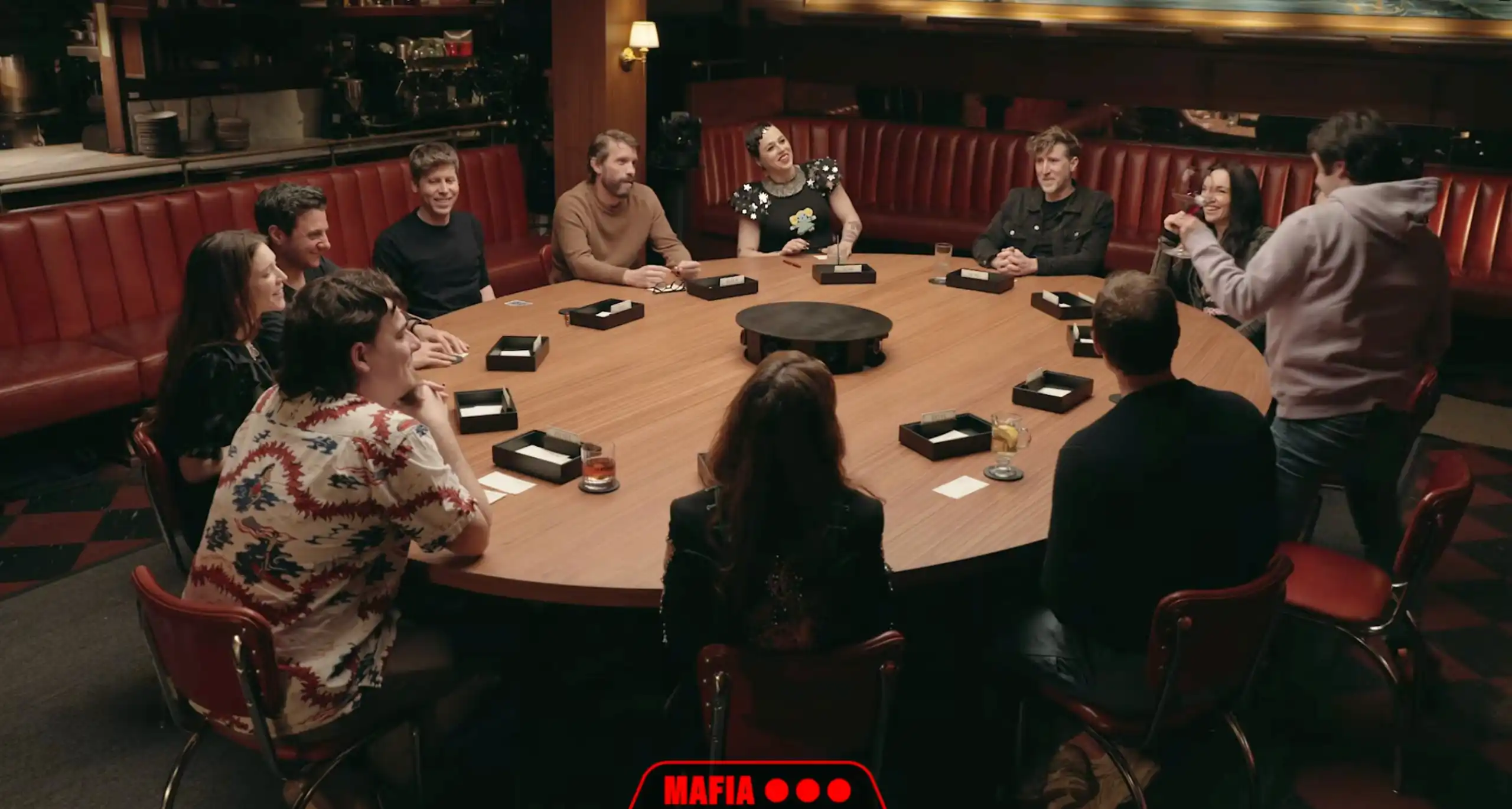
No one discussed AI models, nor did anyone talk about funding rounds and valuations. Instead, this group of Silicon Valley's smartest and most powerful people sat around a circular table and seriously started playing a game of Werewolf.

To be precise, the American version of Werewolf—Mafia.

What's even more interesting is that this was not a private gathering among friends, but a formally filmed and publicly broadcast reality show.

The show is simply called "MAFIA," and the producer is one of Silicon Valley's most legendary and controversial venture capital firms: Founders Fund.
Founders Fund might not be as well-known as Sequoia or Hillhouse, but if you mention the companies it has invested in, its weight becomes immediately apparent: Facebook, SpaceX, Palantir, Stripe, Airbnb, Anduril, and OpenAI have all appeared in its investment portfolio.

This investment firm, founded by Peter Thiel and other members of the "PayPal Mafia," has participated in almost all of Silicon Valley's most important technological waves over the past two decades. And now, it's doing something that seems completely unrelated to investing—making a variety show.

Of course, simply understanding "MAFIA" as a tech circle reality show might underestimate Founders Fund's true intentions.

It resembles more of a public experiment packaged as entertainment.

Why Are These Billionaires Obsessed with Werewolf?

The opening of the show is surreal.

The location is the legendary Tosca Cafe in San Francisco, a place that holds the iconic group photo of the "PayPal Mafia."
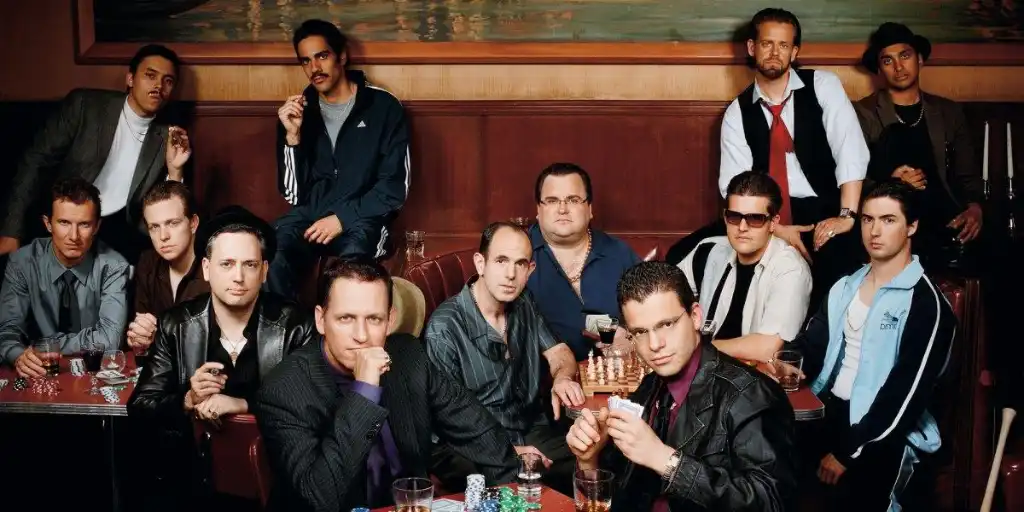
(The iconic "PayPal Mafia" group photo refers to a famous team photo in Silicon Valley's tech history, taken during a gathering of PayPal's early core members. It has been repeatedly referenced to symbolize the enormous influence this group had on the subsequent Silicon Valley entrepreneurial ecosystem.)

And this time, seated around the table is the new generation of Silicon Valley's power core:

  • Sam Altman (OpenAI Founder & CEO)
  • Palmer Luckey (Anduril Industries Founder)
  • Dylan Field (Figma Co-founder & CEO)
  • Moxie Marlinspike (Signal Co-founder)
  • Bryan Johnson ("Don't Die" Project Founder)
  • Trae Stephens (Founders Fund Partner)
  • Ryan Petersen (Flexport Founder & CEO)

If you simply added up the market value and influence of these individuals' companies, this table could almost be seen as a miniature "global tech economy."

But the first thing they did was: close their eyes, commit a murder, and vote.

In the view of Founders Fund's Head of Marketing, Mike Solana, this seemingly absurd arrangement is actually a deliberate rebellion against the traditional VC content format.

Over the past decade-plus, the most common narrative style in the tech world has been founders telling standardized life stories on podcasts: loving programming, failing at a startup, changing the world.

After hearing enough, everyone started to sound similar.

But Werewolf is different.

It doesn't give you time to prepare, nor does it allow you to package your narrative.

You must judge others' intentions in an extremely short time and make decisions under conditions of severe information asymmetry. The behavioral patterns revealed under this kind of pressure are often closer to true personality than any interview.

Thus, this game essentially becomes a "personality development experiment."

Sam Altman dissects everyone's speech logic like he's analyzing an AI model; Palmer Luckey continues his characteristic banter, becoming a target within minutes of the game starting due to his excessive activity; and Signal founder Moxie Marlinspike delivers the most brilliant moment of the entire show—with just one sentence, he successfully changes everyone's frame of thinking.

Silicon Valley Moguls at the Card Table

The game spiraled out of control from the first night.

After Figma founder Dylan Field was executed by the mafia in the first round, the situation quickly plunged into an information vacuum, forcing everyone to rely on intuition and experience for deduction.

AI policy expert Ryan Beiermeister took the lead, questioning Trae Stephens and Bryan Johnson for overreacting upon hearing the news of the death, while biohacker Josie Zayner defended Bryan by saying he "watches too many Korean dramas."

Just as everyone was talking over each other, Sam Altman spoke up. Relying on extremely calm defense and analytical skills, he began analyzing others' statements and defenses.

When Signal founder Moxie confidently accused biohacker Josie Zayner of being in the mafia, Altman sensed something off:

"It's interesting that Moxie, as an experienced player, would take such a big risk to accuse a newbie... This highly certain way of speaking feels very 'mafia.' Moxie, I think you are the most like mafia."

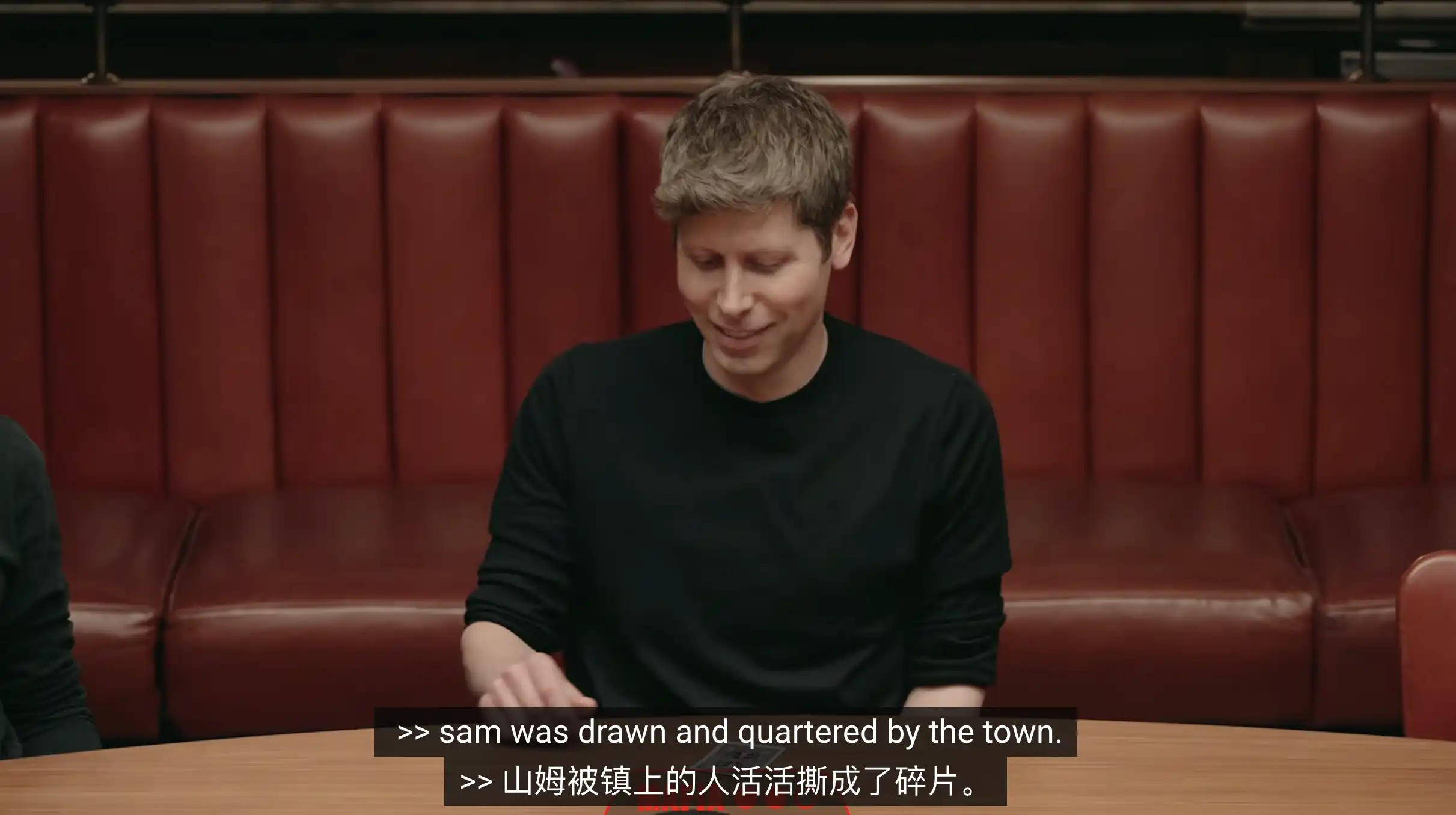
However, this open-play strategy instantly made him a target. In the third night's vote, Altman was regretfully eliminated.

When the host announced he had been "drawn and quartered" by the townspeople, the room erupted in laughter. Someone even added, "At least this proves he's not a super-intelligent AI."
The Silicon Valley "New Wealth Password" in the Age of Infotainment

After the "MAFIA" reality show premiered on YouTube and X, it quickly drew attention within the tech circle, with the first episode easily surpassing ten thousand views in a short time.

Against the backdrop of traditional media's gradual decline and the cancellation of some talk shows, Silicon Valley's VC giants are ostentatiously taking up the baton of content creation. From a16z's heavy investment in its media matrix earlier, to OpenAI's recent acquisition of the tech talk show TBPN, to Founders Fund now personally producing entertainment variety shows, the underlying business logic is highly consistent.

In modern society, reshaped by social media, the path to power and influence is increasingly paved with "Infotainment."

Whether it's Bryan Johnson gaining traffic by showcasing bizarre anti-aging routines online, or Elon Musk bolstering his business empire through his personal influencer network, Silicon Valley's new generation of elites understand better than anyone—in the internet age, controlling traffic, crafting narratives, and even performing skillfully in public are becoming the most crucial forms of business capital.

Although the venture capital moguls were playing a game at this long table, the precise defense, logical deconstruction, highly persuasive eloquence, and decisive actions they demonstrated in the face of insufficient information are precisely the underlying genes that have made them successful in the real business world.


Related Questions

QWhat is the name of the reality TV show featuring Silicon Valley elites playing a version of 'Mafia' (Werewolf) and who produced it?

AThe reality TV show is called 'MAFIA', and it was produced by the venture capital firm Founders Fund.

QAccording to the article, what is the deeper purpose behind the 'MAFIA' show, beyond just being a reality program?

AThe article suggests the show is a 'public experiment packaged as entertainment,' designed to reveal the true personalities of the participants under pressure, acting as a 'personality development experiment' rather than just a game.

QWho are some of the notable Silicon Valley figures mentioned as participants in the 'MAFIA' game?

ANotable participants include Sam Altman (OpenAI), Palmer Luckey (Anduril), Dylan Field (Figma), Moxie Marlinspike (Signal), Bryan Johnson ('Don't Die' project), Trae Stephens (Founders Fund), and Ryan Petersen (Flexport).

QHow did Sam Altman's gameplay style lead to his elimination from the 'MAFIA' game, as described in the article?

ASam Altman used a very analytical, open strategy, calmly dissecting others' arguments. He directly accused Moxie Marlinspike of being Mafia. This 'playing with open cards' made him a target, leading to his elimination by vote in the third round.

QWhat broader trend in Silicon Valley does the article connect the production of shows like 'MAFIA' to?

AThe article connects it to the trend of Silicon Valley elites and VC firms heavily investing in content creation and 'infotainment' to control narratives, generate influence, and attract attention, which is seen as a new form of commercial capital in the internet age.

Related Reads

The Compounding Crisis in an Era of High Valuations: Is the US Stock Market Facing a New 'Lost Decade'?

This article analyzes the long-term structural risks in US equity markets, challenging the assumption that "time in the market" always ensures positive returns. Drawing on 155 years of historical data, it identifies three prolonged periods—1929-1954, 1966-1982, and 2000-2013—where real buy-and-hold returns were near zero or negative. Collectively, these "lost decades" represent roughly 35% of market history since 1871 and cause not just delayed wealth accumulation but permanent damage to compound growth paths due to the mathematics of recovering from significant drawdowns. Crucially, the authors argue that current conditions mirror historical precursors to such phases. Multiple valuation indicators, including the CAPE ratio (near its 99th percentile), the Buffett Indicator, and Tobin's Q, signal extreme overvaluation, historically associated with lower future 10-year real returns (averaging 3.6%). The paper debunks the common objection to tactical management—fear of missing the "best days" in the market—by showing that the vast majority of these top-performing days occur during bear markets and crises, often adjacent to the worst days. Therefore, avoiding major drawdowns inherently means missing these volatile surges. A key framework proposed involves monitoring market breadth (advance/decline data), which tends to deteriorate before major indices peak, providing an early warning signal. Combined with high valuations, breadth analysis offers a more robust risk-assessment tool. The conclusion for investors and advisors is not a forecast of an inevitable downturn, but a call to move from complacency to preparedness. The empirical evidence suggests that the conditions preceding lost decades are identifiable. A disciplined, adaptive strategy focused on valuation and breadth signals, rather than precise timing, can help protect long-term compounding from permanent impairment.

marsbit7m ago

The Compounding Crisis in an Era of High Valuations: Is the US Stock Market Facing a New 'Lost Decade'?

marsbit7m ago

Farewell to Traditional Bull and Bear Markets, Deciphering the Logic of Today's Bubble Rotation

"Farewell to Traditional Bulls and Bears: Understanding Today's Market Logic of Bubble Rotation" The article draws a parallel between modern financial markets and a meteorological chain of thunderstorms, contrasting it with the past's slower-moving, more predictable 'layered cloud' systems of long bull/bear cycles and gradual sector rotations. The author argues that today's market has undergone a permanent structural shift, creating an environment where discrete, intense thematic bubbles (e.g., AI, GLP-1 drugs, crypto, robotics, quantum tech) sequentially form, swell, and burst. These 'storm cells' are triggered when capital fleeing a dying bubble acts like a meteorological 'cold air wedge,' forcing the warm, moist capital of latent interest in a new sector to rapidly rise and condense into the next speculative frenzy. This new 'convective' market regime is driven by eight fundamental changes: 1. Democratization of speculation via zero-commission trading, gamified apps, and heavy retail participation in instruments like 0DTE options. 2. Permanent, price-insensitive buying pressure from defined-contribution retirement plans (e.g., 401(k)s). 3. Passive investing creating inelastic market participants that amplify momentum, especially into mega-cap stocks. 4. The dominance of multi-strategy funds and high-frequency trading (HFT), weakening price discovery and creating fragile microstructure prone to synchronized sell-offs. 5. Artificially suppressed volatility that eventually erupts in violent spikes. 6. A transformed market index heavily weighted toward long-duration, narrative-driven tech companies instead of stable, cyclical industrials. 7. The total elimination of information delay, accelerating fear-of-missing-out (FOMO) and herd behavior. 8. A persistently loose fiscal and monetary policy environment. These structural shifts are deemed irreversible. The article outlines the common lifecycle of these thematic bubbles: latency, catalyzing event, narrative formation, peak divergence, and rupture—with outflowing capital seeding the next bubble. In this environment, two investor archetypes can thrive: deep domain experts who understand underlying technologies and business models, and disciplined trend-followers. The author concludes that while emotionally challenging, recognizing this new "climate" is crucial. The key is to elevate one's perspective above the immediate storm to see the cyclical chain of bubbles, avoiding being swept away by the emotions of any single thematic frenzy.

Foresight News26m ago

Farewell to Traditional Bull and Bear Markets, Deciphering the Logic of Today's Bubble Rotation

Foresight News26m ago

Michael Saylor's Latest Article: Bitcoin Must Find Balance Between Uniqueness and Universal Value

Michael Saylor outlines four key Bitcoin ideologies shaping its future: * **Bitcoin Maximalists** see Bitcoin as the dominant digital monetary network and a breakthrough in economic empowerment, emphasizing its superior property rights and role as a sound money solution. * **Bitcoin Capitalists** focus on integration, believing Bitcoin must embed into the global economy—through institutions, capital markets, and financial products—to reach its full potential as digital capital. * **Bitcoin Technologists** advocate for continuous protocol improvements in scalability, privacy, and security to adapt to evolving needs and threats, while acknowledging the high bar for change. * **Bitcoin Fundamentalists** guard Bitcoin's core principles of self-custody, decentralization, and censorship resistance, warning against dilution from institutions or risky modifications. Saylor argues that a healthy Bitcoin ecosystem requires a balance of these perspectives. Bitcoin's path forward involves disciplined expansion: preserving its immutable core (Fundamentalist insight), recognizing its dominant status (Maximalist view), integrating with the global economy (Capitalist drive), and enabling careful innovation, primarily in higher layers (Technologist role). The challenge is to maintain Bitcoin's unique properties while making it useful for the world, ensuring it remains Bitcoin as it grows.

Foresight News58m ago

Michael Saylor's Latest Article: Bitcoin Must Find Balance Between Uniqueness and Universal Value

Foresight News58m ago

Trading

Spot
Futures

Hot Articles

Discussions

Welcome to the HTX Community. Here, you can stay informed about the latest platform developments and gain access to professional market insights. Users' opinions on the price of S (S) are presented below.

活动图片