Cardano Founder Hoskinson Says He’s ‘Taking A Break’: Here’s What Happened

bitcoinistPublished on 2026-06-04Last updated on 2026-06-04

Abstract

Cardano founder Charles Hoskinson announced he is "taking a break" on X, following a tense livestream where he expressed frustration over his limited power within Cardano's decentralized governance system. This comes amid growing ecosystem pressures, highlighted by the shutdown of the key analytics platform TapTools due to senior departures and rising costs. Hoskinson argued that Cardano's governance, designed to shift control to the community, now leaves him with no unilateral authority over the treasury, protocol upgrades, or brand infrastructure. He noted he is often blamed for ADA's price and ecosystem issues despite having no direct control. This dynamic was recently seen when a Cardano Foundation funding proposal for a 2026 summit was rejected by the community vote. The situation underscores a central tension for Cardano: its governance can reject major spending but may struggle to act swiftly to support critical infrastructure during a downturn. Hoskinson's break reflects the personal strain of this decentralized model, where founder influence is intentionally limited.

Charles Hoskinson, the founder of Cardano and CEO of Input Output, abruptly told followers on X that he is “taking a break,” following a tense livestream on June 2 in which he questioned what power he actually has to stop project failures and funding disputes inside Cardano’s decentralized governance system.

The post was brief: “I’m taking a break. TTYL.” Hoskinson gave no explicit explanation. But the timing points to a broader frustration that has been building around Cardano’s ecosystem funding, the shutdown of TapTools, and the practical consequences of Voltaire-era governance moving authority away from founding entities and toward on-chain decision-making.

TapTools Shutdown Puts Cardano Governance Under Pressure

TapTools, one of the most visible analytics and data platforms in the Cardano ecosystem, said it would wind down operations after nearly four years, citing a series of senior departures and rising operating costs. According to the platform, both co-founders, its chief operating officer and chief technology officer had already left earlier this year. A backend developer who stepped into the CTO role later also departed, leaving the company without technical capacity it said could not be replaced quickly enough to keep the platform running responsibly.

The shutdown clearly hit a nerve. In his livestream, Hoskinson warned that the second half of the year could bring further stress across Cardano DeFi.

“So this year is going to be very hard. The second half of the year for Cardano, we’re probably going to see more dApps in DeFi die and a consolidation happen. I’m not exactly sure what my role or place is to resolve this.”

His core argument was not that Cardano lacked resources, but that the network’s governance and funding architecture no longer gives him unilateral control over those resources. Hoskinson said he is often blamed for ADA’s market performance and ecosystem setbacks, while having no direct command over the treasury, protocol upgrades or brand infrastructure.

“You know, I keep getting criticized relentlessly online. People every single day post on my Twitter feed the price of ADA and blame me for it collapsing. And I’d really like to know, I just like to understand what my agency is here.”

Hoskinson Says He Lacks Control

The comments reflect a deeper tension in Cardano’s current phase. Cardano’s governance system was designed to shift control from founding entities to ADA holders, delegated representatives and other governance bodies. That structure gives the community more formal authority over treasury withdrawals and protocol decisions, but it also makes emergency coordination more difficult when key ecosystem companies are under pressure.

The same governance dynamic was visible days earlier when the Cardano Foundation canceled Cardano Summit 2026 in Singapore after its treasury funding proposal failed to reach the required two-thirds approval threshold. A revised request for roughly 7.8 million ADA received majority support but still fell short, while a smaller EMURGO proposal for a Cardano presence at TOKEN2049 Singapore was approved.

For Hoskinson, TapTools appears to have become a case study in the limits of founder influence after decentralization. He said the resources intended to grow and govern the ecosystem were assigned to separate entities, not to him personally.

“I don’t have any special powers with Cardano. I don’t have any governance keys. I don’t have any ability to even initiate a hard fork, much less a protocol parameter change. I don’t have access to the treasury. I don’t even own the trademark for the name Cardano.”

He continued: “All of the funding that was given for growing the ecosystem and governing the ecosystem was given to separate entities. And at the all-time high, it was billions of dollars. It was not given to me.”

The episode leaves Cardano facing an uncomfortable test. Its governance system is now powerful enough to reject major spending requests, including those from core ecosystem institutions. The harder question is whether it can also move quickly enough to preserve critical infrastructure during a market downturn without recreating the centralized dependency it was designed to remove.

At press time, ADA traded at $0.1886.
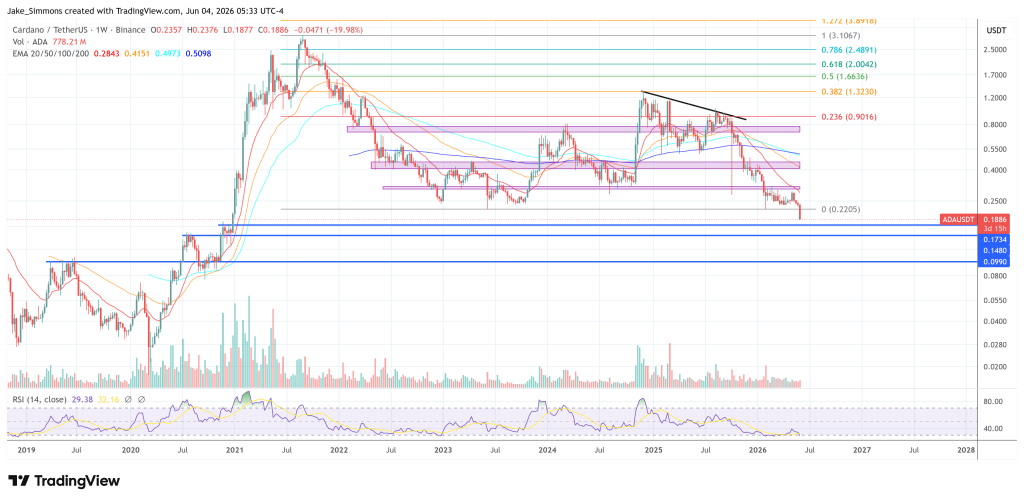
ADA drops below key support, 1-day chart | Source: ADAUSDT on TradingView.com

Related Questions

QWhy did Charles Hoskinson announce he is taking a break?

ACharles Hoskinson announced he is taking a break after a tense livestream where he expressed frustration over his limited power to intervene in project failures and funding disputes within Cardano's decentralized governance system.

QWhat recent event contributed to the pressure on Cardano's governance?

AThe recent shutdown of TapTools, a major analytics and data platform in the Cardano ecosystem, contributed significantly to the pressure. It highlighted challenges in ecosystem funding and the practical difficulties of decentralized governance during market stress.

QAccording to Hoskinson, what does he lack control over in the Cardano ecosystem?

AHoskinson stated he lacks unilateral control over key aspects of Cardano. He has no governance keys, cannot initiate hard forks or protocol changes, has no access to the treasury, and does not own the Cardano trademark. Funding for ecosystem growth was allocated to separate entities, not to him personally.

QWhat was the outcome of the Cardano Foundation's proposal for Cardano Summit 2026?

AThe Cardano Foundation's treasury funding proposal for Cardano Summit 2026 in Singapore failed to reach the required two-thirds approval threshold. A revised request for about 7.8 million ADA received majority support but still fell short, leading to the event's cancellation.

QWhat broader challenge for Cardano does the TapTools shutdown and funding disputes illustrate?

AThese events illustrate the broader challenge of whether Cardano's decentralized governance system, while effective at preventing centralized control, can act quickly and decisively enough to preserve critical ecosystem infrastructure and respond to emergencies during a market downturn.

Related Reads

BIT Research: ETF Purchases Have Slowed, Strategy (MicroStrategy) Has Slowed, What Else Can Drive Bitcoin's Rise?

Market Refocus on Inflation and Rate Expectations Weighs on Bitcoin Currently, the market is in a phase of macro-repricing dominated by inflation and interest rate expectations. Bitcoin, which previously benefited from easy liquidity and low inflation, is seeing its core bullish drivers weaken. These drivers were market expectations for interest rate cuts and strong inflows from Bitcoin ETFs and institutions like MicroStrategy (referred to as "Strategy" in the text). The logic has shifted. Recent high inflation data (e.g., CPI hitting 3.8% in a May 2026 report) has caused the market to sharply reduce its rate cut expectations for 2025 and even price in potential hikes. This is a key constraint for Bitcoin, as it lacks cash flows and is highly sensitive to rate expectations. Concurrently, institutional capital flows have slowed significantly. Following the hot CPI data, Bitcoin ETFs saw accelerated outflows, with around $4.3 billion leaving over a period. MicroStrategy's ability to keep adding substantial Bitcoin to its balance sheet is also diminishing. Together, ETF and MicroStrategy holdings total roughly $110 billion, but their momentum as growth engines is cooling. In summary, Bitcoin's current pressure stems not from its own fundamentals but from a changing macro environment. As long as inflation stays elevated, Bitcoin is likely to remain in a consolidating phase. However, historically, inflation eventually peaks. Once it recedes and rate cut expectations rebuild, institutional capital could return, potentially fueling a new and more robust recovery phase for Bitcoin.

marsbit7m ago

BIT Research: ETF Purchases Have Slowed, Strategy (MicroStrategy) Has Slowed, What Else Can Drive Bitcoin's Rise?

marsbit7m ago

Earning 1000 Trillion in Half a Year, 'Pocketing' 20 Million per Capita: This Round of Wealth Creation in the Korean Stock Market is Unprecedented in Scale

The South Korean stock market is experiencing an unprecedented wealth surge in 2026, with household equity and fund asset values soaring by over 1,000 trillion KRW (~$730bn) year-to-date. This translates to an average per capita wealth increase of roughly 20 million KRW, fueled by a historic 109% rally in the KOSPI index. The boom is driven by three converging forces: an AI-driven semiconductor supercycle boosting giants like Samsung and SK Hynix; the government's "Value-Up" market reforms addressing long-standing corporate governance issues; and aggressive real estate regulations that have locked capital within financial markets, preventing profits from flowing back into property. This has triggered a wealth effect, boosting high-end consumption significantly. However, the gains are highly concentrated. The two semiconductor behemoths account for over half the index's value, but retail investors own relatively low stakes in them, systematically missing the biggest rallies. Wealth and consumption benefits are skewed towards luxury goods and imported cars, bypassing mainstream retail. Further risks stem from excessive leverage, with high trading volume in leveraged ETFs, and a market sentiment heavily reliant on the AI sector's fortunes and speculative rumors. While this cycle marks a potential shift from real estate to equities as a primary wealth generator for Koreans, its sustainability, amid structural imbalances and leverage, remains a critical test.

marsbit12m ago

Earning 1000 Trillion in Half a Year, 'Pocketing' 20 Million per Capita: This Round of Wealth Creation in the Korean Stock Market is Unprecedented in Scale

marsbit12m ago

imToken's 10th Anniversary Unveils Strategic Direction for the Next Decade: Evolving from a Trusted Main Wallet to a Personal Digital Hub

On its tenth anniversary, decentralized wallet imToken announced its strategic vision for the next decade: evolving from a "trusted main wallet" into a "personal control interface." This new direction aims to help users manage not only digital assets but also identity, permissions, and AI agent actions in an increasingly open and intelligent internet. imToken outlined that while the past decade focused on Store, Send, and Stake—securing assets, enabling transfers, and facilitating network participation—the future introduces a fourth core proposition: Sign. This expanded concept goes beyond transaction signing to encompass expressing intent, granting permissions, setting rules, delegating actions, and revoking authorizations. As AI agents gain autonomy, imToken emphasizes the need for clear, verifiable, and revocable user control over their actions. CEO Ben He stated that imToken's mission is shifting from enabling ownership of digital assets to ensuring user sovereignty over their entire digital world in the AI era. The company's core principle has been upgraded from "Digital Assets, Under Your Control" to "Your Digital World, Under Your Control." Future development will focus on three areas: upholding self-custody principles, extending security from transactions to authorizations and automated actions, and building product capabilities for managing permissions, delegations, policies, and revocations. imToken views the wallet's role as expanding into a trusted control interface for human-AI collaboration, where managing keys, signatures, and permissions forms the infrastructure for personal digital sovereignty. Founded in 2016, imToken serves millions of users across 150+ countries, providing non-custodial wallet services supporting over 50 blockchain networks.

marsbit16m ago

imToken's 10th Anniversary Unveils Strategic Direction for the Next Decade: Evolving from a Trusted Main Wallet to a Personal Digital Hub

marsbit16m ago

Trading

Spot
Futures

Hot Articles

Discussions

Welcome to the HTX Community. Here, you can stay informed about the latest platform developments and gain access to professional market insights. Users' opinions on the price of ADA (ADA) are presented below.

活动图片