Bitcoin Price Could Resume Its Downward Trend As Realized Profit Climbs To 2022 Level

bitcoinistPublished on 2026-05-17Last updated on 2026-05-17

Abstract

Bitcoin's price may be poised for a downturn, according to on-chain analysis. Despite recent signs of recovery, a key metric—the Realized Profit/Loss Margin—has reached 17%. Crypto analyst Ali Martinez highlights that this level, last seen in March 2022, previously signaled a local market top before a downtrend resumed. The indicator suggests average Bitcoin investors are sitting on significant profits and may start selling to lock in gains. Currently trading around $78,070, Bitcoin faces a critical test at the $78,000 support level. A break below could trigger further downside, aligning with the historical warning from the overheated profit margins.

Based on its performance over the past month, the Bitcoin price seems to be fighting its way out of the bear market. However, the overall market structure has yet to completely shift from a downward to a positive trend. In fact, a recent on-chain analysis suggests that the premier cryptocurrency might have recently formed a local top, with a downtrend resumption potentially on the cards.

Why The BTC Market Might Be Overheating

In a new post on the X platform, crypto analyst Ali Martinez revealed that the Bitcoin price is overheating and is at an increased risk of a return to the downside. This postulation is based on the Realized Profit/Loss Margin, which measures the actual return on a closed position in the cryptocurrency market.

This on-chain indicator helps evaluate general investor sentiment, offering insight into whether the market is heating up or cooling off. Typically, a high profit margin could signal an impending price top, while a negative value is often correlated with panic sell-offs and the formation of a market bottom.

According to CryptoQuant data highlighted by Martinez, the average Bitcoin trader’s realized profit margin has reached 17%, which could be seen as a warning signal. The analyst noted that, for the first time since October 2025, the average Bitcoin investor is sitting on significant returns and could be looking to lock in those gains.
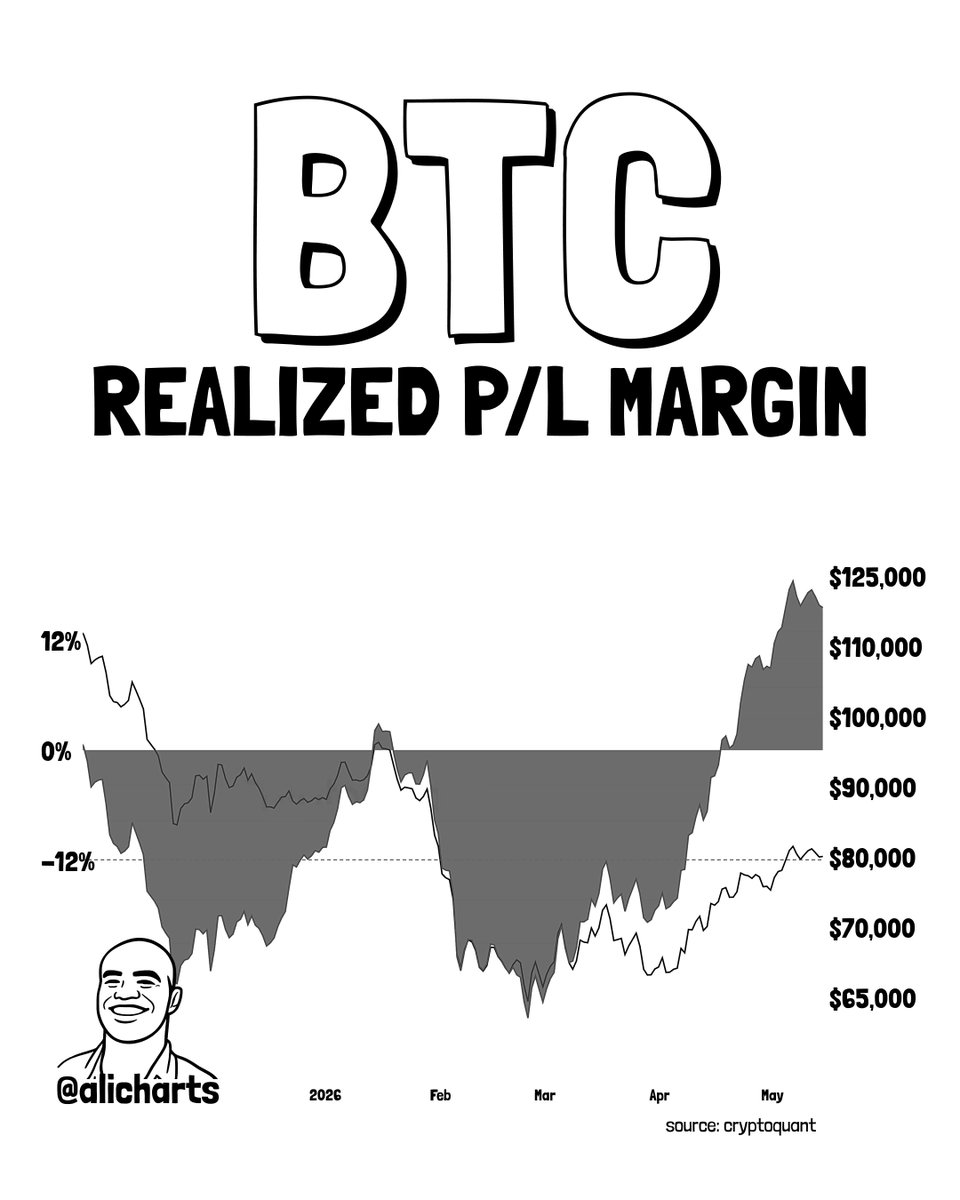
Source: @alicharts on X

From a historical perspective, this profit margin level doesn’t look like good news for the Bitcoin price, as it has coincided with a market top in the past. More specifically, Martinez noted that the last time this metric reached 17% was in March 2022, when the flagship cryptocurrency was testing the 200-day moving average resistance.

The analyst explained:

That specific alignment signaled the exact moment the local top was in before the downtrend resumed in earnest.

Hence, if history is anything to go by, the current confluence of on-chain signals suggests that the Bitcoin price might have reached a local top and may be on its way down.

Bitcoin Price Overview

All in all, the $78,000 mark might be one to watch, as the price level has proven to be a good support cushion in recent weeks and falling beneath it could open the door to further downside movement. As of this writing, the price of BTC stands at around $78,070, reflecting no significant movement in the past 24 hours. According to data from CoinGecko, the flagship cryptocurrency is down by more than 3% on the weekly timeframe.

The price of BTC on the daily timeframe | Source: BTCUSDT charrt on TradingView


Related Questions

QAccording to the article, what on-chain indicator suggests the Bitcoin market might be overheating and why?

AThe Realized Profit/Loss Margin indicator suggests the Bitcoin market might be overheating. CryptoQuant data shows the average Bitcoin trader's realized profit margin has reached 17%, which is a level that has historically signaled an impending price top.

QWhat historical event does the analyst Ali Martinez compare the current 17% profit margin to, and what was the outcome then?

AAnalyst Ali Martinez compares the current 17% profit margin to March 2022, when Bitcoin was testing the 200-day moving average resistance. That specific alignment signaled the exact moment the local top was in before the downtrend resumed.

QWhat key price level for Bitcoin does the article identify as an important support to watch?

AThe article identifies the $78,000 mark as an important support level to watch. Falling beneath it could open the door to further downside movement for Bitcoin's price.

QWhat is the current Bitcoin price and its weekly performance as mentioned in the article?

AAs mentioned in the article, the current Bitcoin price stands at around $78,070. According to CoinGecko data, it is down by more than 3% on the weekly timeframe.

QWhat does the Realized Profit/Loss Margin measure, and what do its high and negative values typically indicate?

AThe Realized Profit/Loss Margin measures the actual return on a closed position in the cryptocurrency market. Typically, a high profit margin could signal an impending price top, while a negative value is often correlated with panic sell-offs and the formation of a market bottom.

Related Reads

This Chip Sector Is on Fire

The global AI chip market is undergoing a significant paradigm shift, with ASICs (Application-Specific Integrated Circuits) emerging from a niche to a mainstream force, challenging the long-held dominance of GPUs in AI training. This "golden era" for ASICs is primarily driven by the industry's pivot from training to inference, where the cost and energy efficiency advantages of custom chips become critical for scaling to billions of users. Key signals include Google's TPU capturing 78% of its AI server shipments in Q1 2026, OpenAI's plans for a massive custom ASIC cluster with Broadcom, and cloud providers (CSPs) increasingly favoring in-house or custom designs for supply chain control and cost efficiency. Market forecasts are bullish: AI ASIC revenue is projected to hit $300 billion by 2027, with a 34% CAGR, potentially reaching a 45% share of the AI chip market. The competitive landscape is expanding beyond traditional leaders Broadcom and Marvell. MediaTek is aggressively targeting the data center ASIC market, projecting over $10 billion in 2026 revenue, while Qualcomm, leveraging its AlphaWave acquisition, is launching customized inference chips. These mobile chip giants are leveraging their SoC design expertise for a cloud-side transition. In China, companies like VeriSilicon and ASR Microelectronics are capitalizing on this trend as pivotal "enablers," providing full-stack ASIC design services and experiencing explosive order growth, particularly for cloud-side AI projects. However, challenges remain: high development costs, software ecosystem gaps compared to NVIDIA's CUDA, dependency on advanced packaging capacity (like TSMC's CoWoS), and the fundamental trade-off between customization and flexibility. The future is not a simple replacement of GPUs by ASICs but a more specialized coexistence. The consensus points toward "GPUs for training, ASICs for inference," or hybrid clusters. Ultimately, the rise of ASICs represents a democratization of computing power, shifting definition authority from a single chip giant to a broader ecosystem of cloud providers and end-users, offering the industry more choice in the silicon that powers AI.

marsbit1h ago

This Chip Sector Is on Fire

marsbit1h ago

Trading

Spot
Futures

Hot Articles

What is $BITCOIN

DIGITAL GOLD ($BITCOIN): A Comprehensive Analysis Introduction to DIGITAL GOLD ($BITCOIN) DIGITAL GOLD ($BITCOIN) is a blockchain-based project operating on the Solana network, which aims to combine the characteristics of traditional precious metals with the innovation of decentralized technologies. While it shares a name with Bitcoin, often referred to as “digital gold” due to its perception as a store of value, DIGITAL GOLD is a separate token designed to create a unique ecosystem within the Web3 landscape. Its goal is to position itself as a viable alternative digital asset, although specifics regarding its applications and functionalities are still developing. What is DIGITAL GOLD ($BITCOIN)? DIGITAL GOLD ($BITCOIN) is a cryptocurrency token explicitly designed for use on the Solana blockchain. In contrast to Bitcoin, which provides a widely recognized value storage role, this token appears to focus on broader applications and characteristics. Notable aspects include: Blockchain Infrastructure: The token is built on the Solana blockchain, known for its capacity to handle high-speed and low-cost transactions. Supply Dynamics: DIGITAL GOLD has a maximum supply capped at 100 quadrillion tokens (100P $BITCOIN), although details regarding its circulating supply are currently undisclosed. Utility: While precise functionalities are not explicitly outlined, there are indications that the token could be utilized for various applications, potentially involving decentralized applications (dApps) or asset tokenization strategies. Who is the Creator of DIGITAL GOLD ($BITCOIN)? At present, the identity of the creators and development team behind DIGITAL GOLD ($BITCOIN) remains unknown. This situation is typical among many innovative projects within the blockchain space, particularly those aligning with decentralized finance and meme coin phenomena. While such anonymity may foster a community-driven culture, it intensifies concerns about governance and accountability. Who are the Investors of DIGITAL GOLD ($BITCOIN)? The available information indicates that DIGITAL GOLD ($BITCOIN) does not have any known institutional backers or prominent venture capital investments. The project seems to operate on a peer-to-peer model focused on community support and adoption rather than traditional funding routes. Its activity and liquidity are primarily situated on decentralized exchanges (DEXs), such as PumpSwap, rather than established centralized trading platforms, further highlighting its grassroots approach. How DIGITAL GOLD ($BITCOIN) Works The operational mechanics of DIGITAL GOLD ($BITCOIN) can be elaborated on based on its blockchain design and network attributes: Consensus Mechanism: By leveraging Solana’s unique proof-of-history (PoH) combined with a proof-of-stake (PoS) model, the project ensures efficient transaction validation contributing to the network's high performance. Tokenomics: While specific deflationary mechanisms have not been extensively detailed, the vast maximum token supply implies that it may cater to microtransactions or niche use cases that are still to be defined. Interoperability: There exists the potential for integration with Solana’s broader ecosystem, including various decentralized finance (DeFi) platforms. However, the details regarding specific integrations remain unspecified. Timeline of Key Events Here is a timeline that highlights significant milestones concerning DIGITAL GOLD ($BITCOIN): 2023: The initial deployment of the token occurs on the Solana blockchain, marked by its contract address. 2024: DIGITAL GOLD gains visibility as it becomes available for trading on decentralized exchanges like PumpSwap, allowing users to trade it against SOL. 2025: The project witnesses sporadic trading activity and potential interest in community-led engagements, although no noteworthy partnerships or technical advancements have been documented as of yet. Critical Analysis Strengths Scalability: The underlying Solana infrastructure supports high transaction volumes, which could enhance the utility of $BITCOIN in various transaction scenarios. Accessibility: The potential low trading price per token could attract retail investors, facilitating wider participation due to fractional ownership opportunities. Risks Lack of Transparency: The absence of publicly known backers, developers, or an audit process may yield skepticism regarding the project's sustainability and trustworthiness. Market Volatility: The trading activity is heavily reliant on speculative behavior, which can result in significant price volatility and uncertainty for investors. Conclusion DIGITAL GOLD ($BITCOIN) emerges as an intriguing yet ambiguous project within the rapidly evolving Solana ecosystem. While it attempts to leverage the “digital gold” narrative, its departure from Bitcoin's established role as a store of value underscores the need for a clearer differentiation of its intended utility and governance structure. Future acceptance and adoption will likely depend on addressing the current opacity and defining its operational and economic strategies more explicitly. Note: This report encompasses synthesised information available as of October 2023, and developments may have transpired beyond the research period.

363 Total ViewsPublished 2025.05.13Updated 2025.05.13

What is $BITCOIN

Discussions

Welcome to the HTX Community. Here, you can stay informed about the latest platform developments and gain access to professional market insights. Users' opinions on the price of BTC (BTC) are presented below.

活动图片