Arizona lawmaker proposes barring taxes on crypto and blockchain

cointelegraphPublished on 2025-12-22Last updated on 2025-12-22

Abstract

Arizona State Senator Wendy Rogers has introduced two bills and a resolution to change how digital assets are taxed in the state. The proposals include exempting virtual currency from taxation (SB 1044), preventing local governments from taxing or fining blockchain node operators (SB 1045), and amending the state constitution to exclude digital assets from property tax (SCR 1003). While the node bill may pass through the legislature, the tax exemption and constitutional change would require voter approval in the 2026 general election. Arizona is among a small group of states, including New Hampshire and Texas, with laws establishing digital asset reserve policies. The move follows broader U.S. state-level efforts to create supportive regulatory frameworks for cryptocurrency.

Arizona state Senator Wendy Rogers has proposed two bills and a resolution in an effort to change the state’s laws on taxing digital assets.

In legislation prefiled with the Arizona Senate on Friday, Rogers proposed amending state statues to exempt virtual currency from taxation (SB 1044), barring counties, cities and towns from taxing or fining entities running blockchain nodes (SB 1045), and amending the state constitution’s definition of property taxes to clarify rules on digital assets (SCR 1003).

The blockchain node bill may move through the state legislature, but the crypto tax bill and resolution would require a vote by Arizona voters during the next general election, in November 2026.

SCR 1003 would amend Arizona’s constitution to specifically exclude virtual currency from property tax, while SB 1044 would add similar language to the state’s statutes. SB 1045 would prohibit cities, towns and counties in the state from imposing “a tax or fee on a person that runs a node on blockchain technology.”
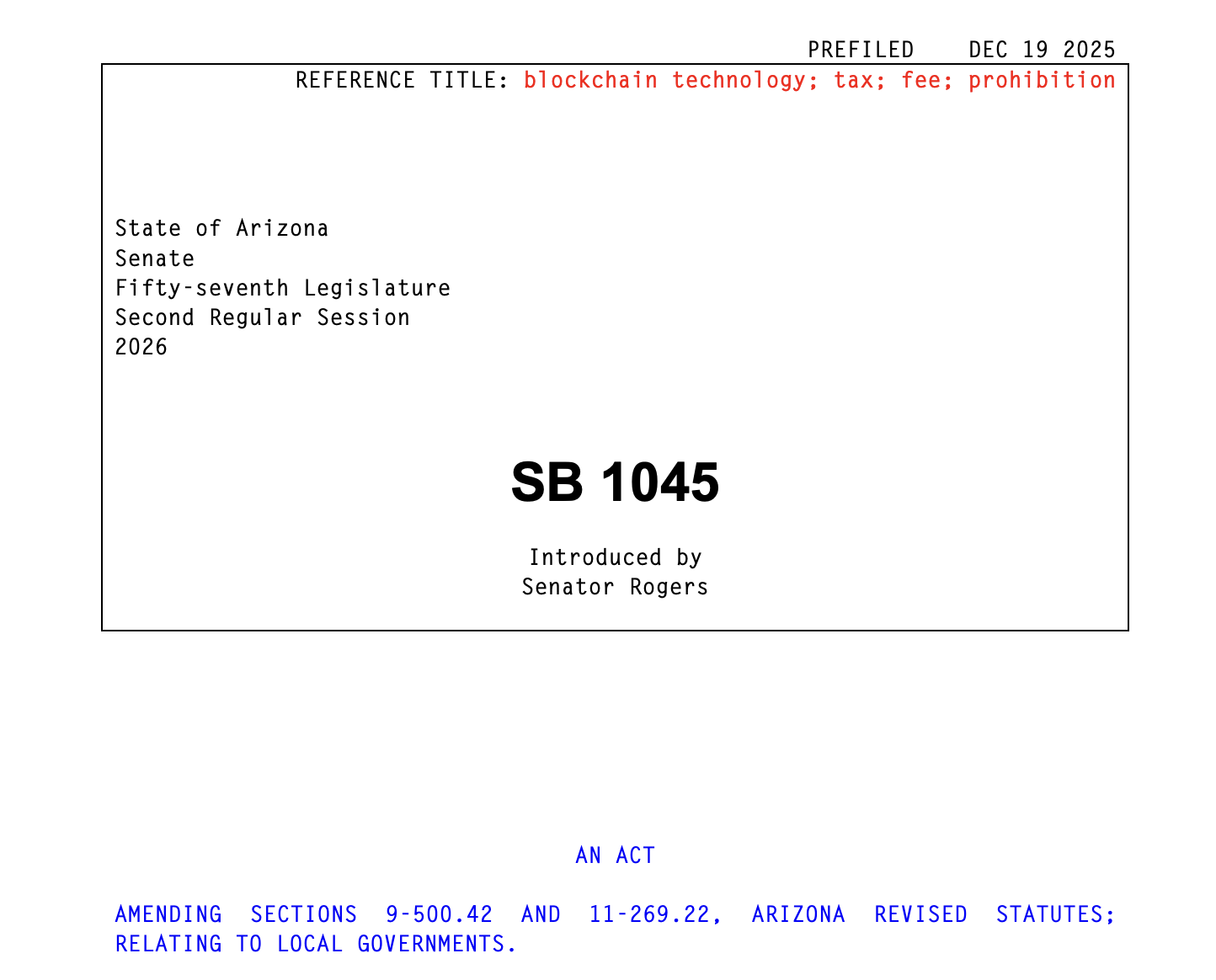
Bill barring cities or towns from taxing blockchain node activity: Source: Arizona legislature

Arizona is one of the few US states that has a law on the books allowing the government to claim ownership of digital assets that have been abandoned for at least three years. The law was part of efforts by crypto advocates to establish a digital asset reserve in Arizona, but there are other proposals to give the state more authority to invest in cryptocurrencies like Bitcoin (BTC).

Related: New Hampshire governor signs crypto reserve bill into law

Rogers was one of the co-sponsors of a Bitcoin reserve bill vetoed by Arizona Governor Katie Hobbs in May. The senator condemned the move and said she would refile the bill during the next session. Cointelegraph reached out to Rogers for comment but had not received a response at the time of publication.

US states adopt crypto reserve bills, different digital asset policies

Arizona remains one of the few US states with a law establishing a digital asset reserve, along with New Hampshire and Texas. Although some lawmakers in other states have been attempting to gather support for similar bills, there are also many suggesting a different approach to digital asset taxation.

For example, Ohio’s House of Representatives passed a bill that could exempt crypto transactions under $200 from the state’s capital gain taxes. The legislation does not appear to have advanced since June.

New York Assemblymember Phil Steck proposed adding a 0.2% excise tax on “digital asset transactions, including the sale or transfer of digital assets” for the state’s residents. The bill was referred to the ways and means committee and did not appear to have advanced since August.

At the federal level, Wyoming Senator Cynthia Lummis submitted a draft bill in July proposing a de minimis exemption for digital asset transactions and capital gains of $300 or less. Lummis announced on Friday that she would retire from the US Senate in January 2027.

Magazine: When privacy and AML laws conflict: Crypto projects’ impossible choice

Related Questions

QWhat are the three legislative actions proposed by Arizona state Senator Wendy Rogers regarding digital assets?

ASenator Wendy Rogers proposed two bills and one resolution: SB 1044 to exempt virtual currency from taxation, SB 1045 to bar counties, cities, and towns from taxing or fining blockchain node operators, and SCR 1003 to amend the state's constitution to clarify property tax rules for digital assets.

QWhich of Senator Rogers' proposals would require a vote by Arizona voters in the 2026 general election?

AThe crypto tax bill (SB 1044) and the resolution to amend the state constitution (SCR 1003) would require a vote by Arizona voters in the November 2026 general election.

QWhat does SB 1045 specifically prohibit local governments in Arizona from doing?

ASB 1045 prohibits cities, towns, and counties in Arizona from imposing a tax or fee on any person running a node on blockchain technology.

QWhich other US states have laws establishing a digital asset reserve, similar to Arizona?

ANew Hampshire and Texas are the other US states that have laws establishing a digital asset reserve, similar to Arizona.

QWhat federal-level proposal did Wyoming Senator Cynthia Lummis make regarding digital asset transactions in July?

AIn July, Wyoming Senator Cynthia Lummis submitted a draft bill proposing a de minimis exemption for digital asset transactions and capital gains of $300 or less at the federal level.

Related Reads

The Hunter Becomes the Hunted: The Most Profitable MEV Bot Gets Hacked

A well-known and highly profitable Ethereum MEV Bot, Jaredfromsubway.eth, suffered a sophisticated on-chain attack this Saturday, losing over $7.5 million. Analysis by Blockaid and others reveals this was not a conventional phishing or smart contract exploit, but a targeted "counter-MEV honeypot attack." The attacker meticulously laid a trap over several weeks, deploying 66 fake token contracts and liquidity pools disguised as major assets like WETH and USDC. These pools created the illusion of arbitrage opportunities. The MEV Bot's automated system detected these signals, executed trades, and in the process, granted approval permissions to attacker-controlled contracts. These approvals were not revoked, creating a persistent vulnerability. The attacker then exploited this in a single transaction, draining the bot's ETH, USDC, and USDT holdings. Jaredfromsubway.eth is notorious as one of Ethereum's most active and profitable MEV Bots, primarily known for executing "sandwich attacks" to profit from transaction slippage. Estimates suggest it has earned tens of millions in MEV revenue. The incident highlights escalating crypto security threats, demonstrating that even top-tier automated "predators" are vulnerable to novel, logic-based attacks designed to exploit their own operational rules. Following the hack, an unverified X account impersonating Jaredfromsubway.eth emerged, falsely offering a bounty for the return of funds, prompting developer warnings for users to stay vigilant.

marsbit1h ago

The Hunter Becomes the Hunted: The Most Profitable MEV Bot Gets Hacked

marsbit1h ago

The Reality of Payments in Latin America Is Not What You Think

The payment landscape in Latin America is undergoing a fundamental shift, driven by on-the-ground realities that challenge common perceptions. Based on over 500 hours of field research across the region, key insights emerge. Firstly, QR code payments, like Brazil's Pix, are becoming the dominant payment method in most emerging markets, overtaking cards. However, these domestic instant payment systems lack international interoperability, creating a significant gap for cross-border users. Secondly, the narrative around crypto cards is often misunderstood; their primary volume comes from high-net-worth professionals using them for salary conversions (e.g., USDT to local currency via Pix), not retail micro-payments. Competition in payments is shifting from customer acquisition to controlling the settlement layer, leading fintechs to acquire banking licenses for efficiency. Thirdly, treating "Latin America" as a single market is a mistake. Countries like Argentina, Brazil, and Mexico have distinct economic realities, user segments, and regulatory approaches. Brazil alone has at least five distinct user segments with different financial flows. Overlooked markets like Guatemala, Honduras, and El Salvador (the "forgotten five") offer high remittance volumes with lower competitive density. Finally, regulation in Latin America is often ahead of the US, with clearer frameworks for digital assets and a pragmatic approach from regulators focused on safety rather than obstruction. The margin on stablecoin forex is rapidly compressing toward zero, meaning future winners will be those building value-added services on top of the infrastructure, not just the cheapest exchange.

marsbit1h ago

The Reality of Payments in Latin America Is Not What You Think

marsbit1h ago

Making Music in a Bear Market: The Survival Experiment of a Bitcoin Band

"Orange Pill Jam: A Bitcoin Band's Survival in the Bear Market" Orange Pill Jam is a musical group exploring themes of financial sovereignty and privacy, born from the Bitcoin community. Formed after singer Mermaid performed her song "Dollar Apocalypse" at a 2022 conference, the band creates music intended for both Bitcoin enthusiasts and general audiences. Their creative process involves Mermaid writing lyrics and melodies, which producer/multi-instrumentalist Michi then shapes with a precise, rhythm-focused approach, often demanding numerous retakes to achieve his unique standard of timing. Their songs, like "Cypherpunks' Manifesto" and "Fire of Freedom," tackle concepts of digital privacy, the pitfalls of "free" services, and personal sovereignty, influenced by experiences in places like El Salvador. Despite operating in a crypto bear market with a Copyleft model (offering music for free sharing/remixing and accepting optional Bitcoin donations), they face practical challenges. Their growth is slow on platforms like YouTube and Spotify, which aren't optimized for their niche content. The band also navigates the rise of AI-generated music. While acknowledging AI's efficiency for certain tasks, they believe human creativity occupies a unique space that algorithms cannot replicate—the ability to create new genres and capture intangible rhythmic feeling. For Orange Pill Jam, the core argument for both Bitcoin in a downturn and human artistry in the AI age lies in this irreplaceable, intentional, and imperfectly human creative process. Their project persists as an anti-algorithm experiment, valuing the unquantifiable impact of music over scalable metrics.

marsbit1h ago

Making Music in a Bear Market: The Survival Experiment of a Bitcoin Band

marsbit1h ago

Trading

Spot
Futures
活动图片