Not AI, Not War: What the US Stock Market Should Worry About Is Japan?

marsbitPublié le 2026-07-24Dernière mise à jour le 2026-07-24

Résumé

Global markets may be underestimating a systemic risk from Japan. As the yen hits multi-decade lows and domestic asset appeal rises, the world's largest pension fund, the Government Pension Investment Fund (GPIF), faces policy pressure to repatriate substantial assets. Such a shift could pressure U.S. stocks, bonds, and the dollar. GPIF manages roughly $1.8 trillion, with about half invested overseas. Even a modest reallocation to Japan could boost yen demand and Japanese government bond buying, potentially raising U.S. yields and weakening the dollar. Unwinding of yen carry trades could further pressure risk assets. This potential move is driven by improving fundamentals in Japan: rising inflation, economic recovery, and narrowing yield gaps with the U.S. The yen's depreciation to levels not seen since 1986 also enhances domestic investment appeal. While markets currently price in limited risk, key indicators like the dollar-yen cross-currency basis swap are showing subtle shifts. A surge in hedging demand for yen appreciation could tighten liquidity and impact U.S. equities. Conversely, GPIF repatriation could benefit Japanese equities, which trade at a discount to U.S. markets and are driven by corporate governance reforms. However, persistent yen weakness remains a major hurdle for foreign investors' returns.

Author: Zhao Ying

The global market is underestimating a potential systemic risk—Japan. As the yen falls to multi-decade lows and the appeal of domestic Japanese assets rises, the world's largest pension fund is facing policy pressure to repatriate its massive asset holdings back to Japan on a large scale. Once this process begins, the US stock market, bond market, and the US dollar may come under simultaneous pressure.

Recently, Japanese Prime Minister Takaichi Sanae stated that the government will promote the Government Pension Investment Fund (GPIF) and other national pension funds to increase their investment in domestic Japanese financial assets. Finance Minister Katayama Satsuki previously gave a similar signal. Although the GPIF has not announced any formal asset allocation adjustments, the market has already begun to assess its potential impact: if the fund repatriates its overseas holdings back to Japan, US Treasury yields may rise, the US dollar may weaken, and risk assets may come under pressure.

Currently, the market's pricing of the aforementioned risk remains relatively calm, but some technical indicators are already showing subtle changes, and investors should not be complacent.

The $1.8 Trillion Variable

The GPIF manages approximately $1.8 trillion, with domestic and foreign assets each accounting for about half, of which its overseas holdings total about $930 billion. In recent years, the fund's holdings of Japanese government bonds have decreased from about $770 billion to about $515 billion, while its holdings of foreign bonds have increased from about $128 billion to about $470 billion.

This structural change means that even a small-scale asset reallocation could trigger significant waves in the global market. According to a MarketWatch report, analyst Michael Kramer pointed out that if the GPIF repatriates some of its overseas assets back to Japan, it will directly boost demand for the yen and introduce a massive buying wave into the Japanese government bond market—a positive for Japan, but for the US, it implies higher interest rates and a weaker dollar.

At the same time, any large-scale unwinding of yen carry trades (i.e., borrowing low-interest yen, converting to US dollars, and investing in US assets) would further pressure the performance of risk assets.

Yen and JGBs: The Appeal of Domestic Assets Is Rising

Driving the potential GPIF reallocation is a substantial improvement in the fundamentals of Japanese domestic assets. With Japan's inflation recovering and economic growth resuming, the appeal of domestic investment opportunities has significantly increased. In February, the yield spread between US and Japanese two-year government bonds narrowed to its lowest level since early 2022.

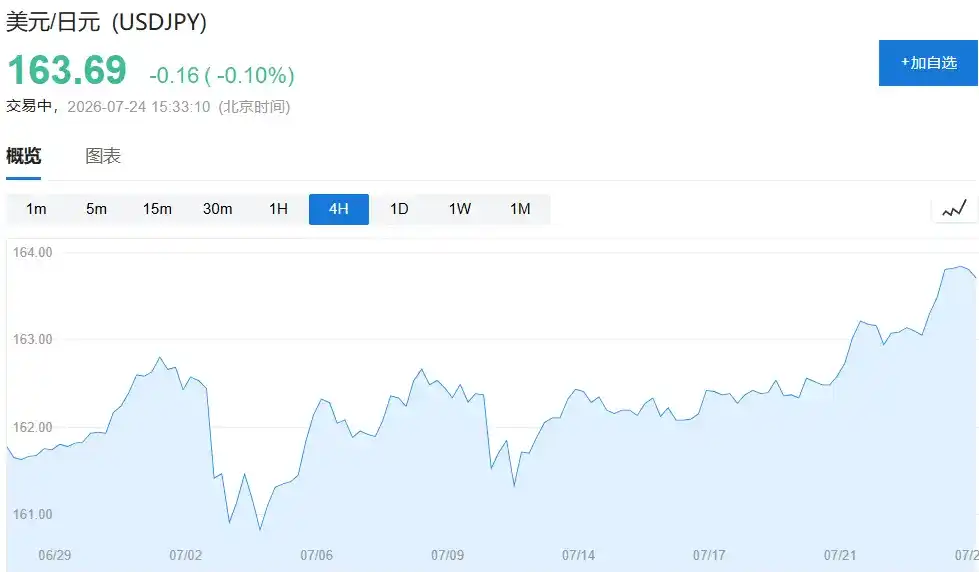
At the same time, the yen has continued to weaken, with USD/JPY breaking above 163, reaching its highest level since 1986. From a technical analysis perspective, if the exchange rate rises further, the next resistance level is around 176. According to a report by the Financial Times, Fredrik Repton of Neuberger Berman believes that if GPIF allocates more funds to domestic assets, this could be a "very elegant solution" to Japan's macroeconomic problems, but other domestic financial institutions would also need to follow suit, and "this process will take a long time."
Japan's 10-year government bond yield recently touched 2.7%, the first time in 30 years. Deutsche Bank analyst Mallika Sachdeva pointed out in a recent report that the focus of Japanese authorities' policy may be shifting from exchange rate management to yield management, and if this shift materializes, it will put further pressure on the yen.

Market Not Yet Pricing It In, But Signals Are Emerging

Currently, the global market's reaction to the risk of Japanese capital repatriation remains relatively restrained. The five-year USD/JPY cross-currency basis swap recently stood at about minus 30 basis points, the narrowest level since this data series began in 2021, indicating that the market's hedging demand for a stronger yen has not yet risen significantly.

However, this indicator itself is a key signal for observing whether capital flows are beginning to shift. Historical data shows that the S&P 500 index and the cross-currency basis swap have moved in sync during multiple periods—whenever hedging demand rises sharply, the US stock market often declines as liquidity tightens accordingly. Once market expectations for yen appreciation heat up, the demand for USD hedging will climb accordingly, and the liquidity tightening effect will become more pronounced.

Japanese Stocks: The Other Side of the Risk

It is worth noting that while the potential asset reallocation by GPIF may bring pressure to US markets, it also provides a new narrative logic for Japanese stocks. The Japanese stock market is benefiting from drivers that are distinctly different from those in the US market: the concentration of the technology sector in the Topix index is much lower than in the S&P 500, its exposure to artificial intelligence is relatively limited, and its valuation still trades at a discount of more than 20% compared to the S&P 500.

Corporate governance reform is a core catalyst for Japanese stocks. Dan Rasmussen of Verdad Advisers points out that there are still about 1,000 companies in Japan whose stock prices are below book value, and among the cheapest quintile of companies, cross-shareholdings still account for about 40% of their market capitalization. As cross-shareholdings are gradually unwound, a large amount of historically accumulated profits is expected to be released, having a materially positive impact on corporate earnings.

However, for foreign investors, the persistently weakening yen is the biggest obstacle—over the past two years, yen depreciation has significantly eroded the real returns of foreign capital in the Japanese stock market. How to handle currency hedging, and whether the hedging cost is bearable, remain core issues facing global investors.


Cryptos en tendance

Questions liées

QWhat is the main systemic risk that global markets are currently underestimating according to the article?

AThe article states that global markets are underestimating the potential systemic risk posed by Japan. Specifically, the risk arises from the possibility that Japan's Government Pension Investment Fund (GPIF) and other national pension funds might reallocate a significant portion of their foreign assets back to domestic Japanese investments.

QWhat would be the likely impact on the US if GPIF repatriates a portion of its foreign assets back to Japan?

AIf GPIF repatriates part of its foreign assets, it would likely lead to higher U.S. Treasury yields, a weaker U.S. dollar, and pressure on U.S. risk assets like stocks. This is due to reduced demand for U.S. bonds and dollars, alongside potential unwinding of yen carry trades.

QWhat is the current approximate size of GPIF's foreign asset holdings?

AGPIF's foreign asset holdings amount to approximately $930 billion, which is about half of its total assets under management of roughly $1.8 trillion.

QWhat is one of the key fundamental improvements in Japan that makes domestic assets more attractive, according to the article?

AOne key improvement is the recovery in Japanese inflation and economic growth, which enhances the attractiveness of domestic investment opportunities. This is evidenced by the narrowing yield gap between U.S. and Japanese two-year government bonds.

QWhat is a major catalyst for the Japanese stock market mentioned in the article, distinct from U.S. market drivers?

AA major catalyst for the Japanese stock market is corporate governance reform. This includes the unwinding of cross-shareholdings, which could release historically accumulated profits and substantially boost corporate earnings, unlike the U.S. market which is more driven by technology and AI concentration.

Lectures associées

Les investisseurs commencent à « changer de table de jeu »

Alors que le marché des capitaux privés en Chine connaît un regain de fièvre, en particulier dans les technologies de pointe comme l'IA, un mouvement notable se dessine : des investisseurs quittent les fonds de capital-risque pour rejoindre des entreprises en pleine croissance. Ce n'est plus un choix par défaut, mais une transition active et stratégique. La dynamique du marché est intense : les levées de fonds s'accélèrent, les valorisations montent en flèche et la concurrence pour les projets vedettes est féroce. Face à cette frénésie, certaines entreprises technologiques leaders, confrontées à des besoins de financement rapides et complexes, recherchent activement des talents maîtrisant les rouages du capital-investissement. Elles proposent des postes attrayants (directeur financier, vice-président, voire cofondateur) pour attirer ces profils. Pour les investisseurs, ce mouvement représente une "changement de table". Motivés par des opportunités de carrière concrètes, une rémunération attractive et la perspective de contribuer directement à la croissance opérationnelle d'une entreprise, ils voient dans ce virage un échappatoire à l'hyperconcurrence entre fonds, aux incertitudes croissantes sur les sorties (introductions en bourse) et à un environnement réglementaire en mutation. Ainsi, une convergence d'intérêts s'opère : les entreprises gagnent en expertise capitalistique pour soutenir leur expansion, tandis que les investisseurs trouvent un nouveau terrain d'application pour leurs compétences. Bien que l'adaptation au monde opérationnel de l'entreprise présente ses défis, cette tendance élargit significativement les horizons de carrière dans l'écosystème de l'investissement.

marsbitIl y a 1 h

Les investisseurs commencent à « changer de table de jeu »

marsbitIl y a 1 h

Trading

Spot

Articles tendance

Comment acheter WAR

Bienvenue sur HTX.com ! Nous vous permettons d'acheter WAR (WAR) de manière simple et pratique. Suivez notre guide étape par étape pour commencer votre parcours crypto.Étape 1 : Création de votre compte HTXUtilisez votre adresse e-mail ou votre numéro de téléphone pour ouvrir un compte sur HTX gratuitement. L'inscription se fait en toute simplicité et débloque toutes les fonctionnalités.Créer mon compteÉtape 2 : Choix du mode de paiement (rubrique Acheter des cryptosCarte de crédit/débit : utilisez votre carte Visa ou Mastercard pour acheter instantanément WAR (WAR).Solde :utilisez les fonds du solde de votre compte HTX pour trader en toute simplicité.Prestataire tiers :pour accroître la commodité d'utilisation, nous avons ajouté des modes de paiement populaires tels que Google Pay et Apple Pay.P2P :tradez directement avec d'autres utilisateurs sur HTX.OTC (de gré à gré) : nous offrons des services personnalisés et des taux de change compétitifs aux traders.Étape 3 : stockage de vos WAR (WAR)Après avoir acheté vos WAR (WAR), stockez-les sur votre compte HTX. Vous pouvez également les envoyer ailleurs via un transfert sur la blockchain ou les utiliser pour trader d'autres cryptos.Étape 4 : tradez des WAR (WAR)Tradez facilement WAR (WAR) sur le marché Spot de HTX. Il vous suffit d'accéder à votre compte, de sélectionner la paire de trading, d'exécuter vos trades et de les suivre en temps réel. Nous offrons une expérience conviviale aux débutants comme aux traders chevronnés.

643 vues totalesPublié le 2024.12.11Mis à jour le 2026.06.02

Comment acheter WAR

Discussions

Bienvenue dans la Communauté HTX. Ici, vous pouvez vous tenir informé(e) des derniers développements de la plateforme et accéder à des analyses de marché professionnelles. Les opinions des utilisateurs sur le prix de WAR (WAR) sont présentées ci-dessous.

活动图片