By Market Cap Observation
Entering July, global tech stocks suddenly weakened. Korea's leading memory chip manufacturers faced concentrated selling first, which quickly spread to markets like the US and Japan. Subsequently, A-share tech sectors came under pressure, with the STAR 50 and ChiNext indices declining successively.
However, under external shocks, A-shares have not lost their support. The underlying logic of prosperity for the tech industry has not reversed, and long-term funds and market stabilizing forces have begun to step in. Meanwhile, consumption, cyclical, and financial sectors are also accumulating momentum for repair.
This round of adjustment is both a release of risk and a test of the true resilience of A-shares.
01 Tech Adjustment and Resilience
From April to the end of June this year, A-share tech sectors experienced a remarkable rally. This rise was anchored by two major logics. The first was reflecting high earnings growth. In the first half of the year, net profit growth for core tech tracks like optical modules, chip manufacturing, packaging & testing, and optical fiber & cable mostly exceeded 50%.
National Bureau of Statistics data corroborates this — in the first five months, profits in the computer, communication, and other electronic equipment manufacturing industry increased by 103.9% year-on-year, contributing 43% to the growth of industrial profits.
The second was the spillover effect from the surge in overseas tech stocks. Particularly, the rise and fall rhythms of A-share tech and Korean tech stocks were highly synchronized.
But the tone changed abruptly since July, with A-share tech stocks adjusting continuously. The core reason was not a deterioration in their own fundamentals, but rather the transmission of external risks such as deleveraging in the Korean stock market.
However, the market resilience of A-share tech and Korean tech is not on the same level. A-shares do not have the foundation for a systemic decline. The most core difference lies in their vastly different tech sector structures.
Samsung Electronics and SK Hynix account for about 50% of the total market capitalization of the KOSPI index. Moreover, about 60% of the total market's leveraged funds are betting on these two stocks. Thus, the entire Korean stock market is deeply tied to the memory chip super cycle narrative. Any withdrawal of leveraged funds or any flaw in earnings growth expectations could trigger violent selling.
In contrast, A-share tech encompasses numerous sectors like computers, communications, electronics, etc. Even narrowed down to the semiconductor sector, the industrial chain covers multiple segments like materials, equipment, design, manufacturing, and packaging & testing.
More importantly, A-share tech follows a dual narrative logic. One anchors to the global tech giants' supply chain — "Yizhongtian" is bound to chain leaders like NVIDIA, trading on the massive global AI capital expenditure. The other anchors to domestic substitution, where leading companies like Hygon Information, SMIC, and Cambricon target domestic computing infrastructure.
One internal, one external — this provides greater risk resistance than Korea's single narrative centered on the memory super cycle.
At the same time, the fundamental earnings logic for core areas of the tech sector has not been disproven.
For example, in the optical module sector, Suzhou Everbright's H1 net profit attributable to shareholders reached 7-8 billion yuan, nearly doubling again on a high base of 235% growth in the same period last year. In the optical fiber & cable sector, Yangtze Optical Fibre and Cable's net profit attributable to shareholders reached 2.4-3 billion yuan, up 711% to 914% year-on-year.
Thus, this round of A-share tech decline is directly related to the transmission of external risks, and the risk has been released to a considerable extent. Notably, Citi issued a report on July 20 downgrading Korean equities and upgrading Chinese equities, also indicating significant differences in the resilience of the two markets.
In fact, after continuous adjustments, A-share tech stocks staged a recovery on July 21 — the STAR 50 surged 10.7%, and the ChiNext Index jumped 7%.
02 The "National Team" Sets the Tone
Facing market volatility, the "National Team" (state-backed institutions) decisively stepped in again to support the market.
Specifically, China Reform Holdings announced that its subsidiary, Guoxin Investment, has invested over 50 billion yuan into the market. China Chengtong and its platforms have cumulatively purchased nearly 10 billion yuan and stated they will continue to use their own funds, stock buybacks, and special relending facilities to increase holdings of state-owned central enterprise and tech company stocks and ETFs.
At the listed company level, central SOEs like Aluminum Corporation of China and CRRC announced buybacks. A new wave of buyback tides also started among securities firms like Huaan Securities and Guolian Minsheng.
On the institutional level, quantitative private equity firms with tens of billions under management like Lingjun Investment and Square Sum announced self-purchases. Insurers like Ping An, China Pacific Insurance, PICC, New China Life Insurance, and China Life successively voiced support for the capital market, stating they will continue to increase their equity allocation ratio.
Among them, China Life Asset Management recently made active allocations, with net purchases of A-share and on/off-exchange fund market equity assets exceeding 10 billion yuan in a single day.
The "National Team" taking the lead, followed by other market participants, can easily form a powerful upward force. Especially, the heavyweight move by the "National Team" holds very positive significance for the market, mainly reflected in three aspects.
First, genuine capital injections through share purchases help alleviate part of the market's liquidity pressure through concrete actions.
Second, guiding market expectations is more crucial. The "National Team" holds strong influence in A-shares. Acting counter-cyclically at this time sends a signal of a potential bottoming phase, providing a strong example for a market dominated by institutions.
Currently, major funds like active equity public funds, passive ETFs, insurance capital, northbound, and QFII hold over 3 trillion yuan each, with a combined scale exceeding 15 trillion yuan, accounting for about 40% of free-float market capitalization. Compared to the 2015 market and earlier periods dominated by retail investors, these institutional investors pay more attention to market pricing factors like macro policies, fundamentals, and monetary liquidity.
Generally speaking, "National Team" intervention is seen as counter-cyclical adjustment for the stock market, often having a quasi-stabilization fund effect. The movements of these large funds tend to have a stronger exemplary effect on institutional investors (with less emotionalism), making it easier to drive long-term funds like social security, insurance capital, and SOE buybacks to resonate.
Third, historical experience shows that the market is often at a stage bottom after the "National Team" enters.
Since 2008, in multiple counter-cyclical interventions by the "National Team", although short-term trends varied, looking at longer cycles, the win rate of following the National Team's rhythm hasn't been poor. Particularly after the interventions on September 24, 2024, and April 7, 2025, the market stabilized quickly and embarked on sustained trending rallies.
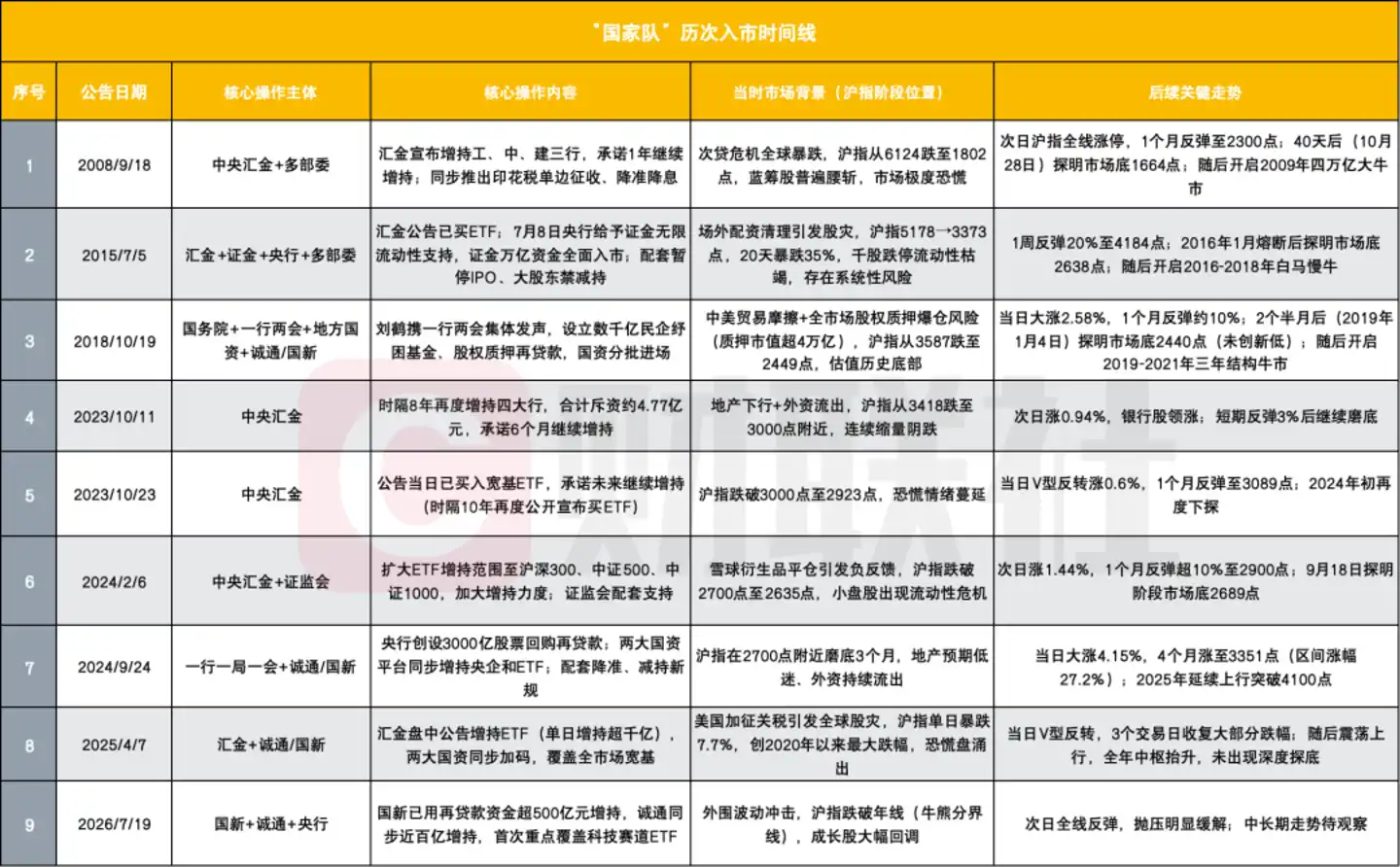
▲Source: Cailian Press
Notably, another innovative tool has been added to the policy toolkit for stabilizing the capital market — the Special Relending Facility for Stock Buybacks and Shareholding Increases (established in September 2024, first phase 300 billion yuan), integrating capital market stability into the macro-policy regulatory framework.
This facility, combined with the 500 billion yuan swap line quota, brings the total available pool to 800 billion yuan. Currently, the actual utilization rate is not high; collectively, hundreds of billions of yuan in backup funds remain available.
Therefore, this intervention is not simple market-propping, but a clear signal of policy intent.
03 Three Lines Supporting the Market: Where Does the Confidence Come From?
Beyond the capital logic, A-shares have sufficient resilience, and intrinsic upward momentum is not lacking.
Strategically categorized, A-shares can be divided into four core types: finance, consumption, cyclical, and tech. Their combined force determines the market's direction. Not just tech, but consumption, cyclical, and financial lines all possess strong intrinsic recovery momentum.
First, consumption. From a macro perspective, the CPI has stabilized above 1% for five consecutive months, whereas it fluctuated between -0.8% and 0.8% for nearly three years prior. Continuous price increases for consumer goods indicate marginal improvement in the profit predicament of consumer stocks. For consumer stocks that have fallen for five years, with valuations at absolute lows over the past decade, this could be a beam of light illuminating the darkness.
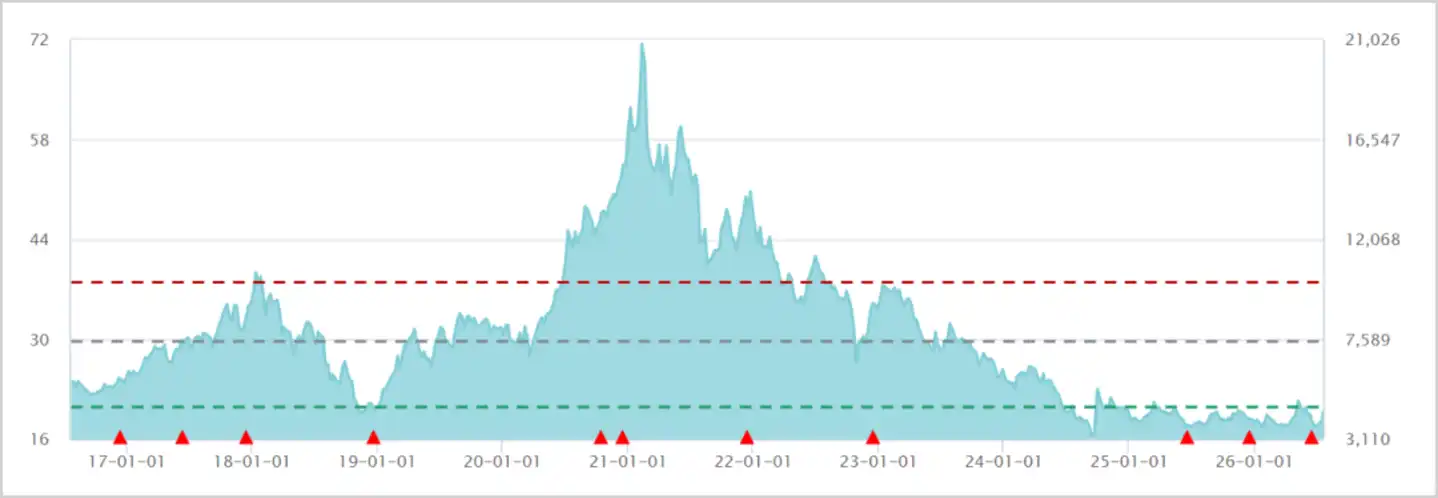
▲CSI Liquor Index PE Chart, Source: Wind
From a corporate perspective, Kweichow Moutai, as a bellwether for the baijiu and even the entire food & beverage sector, has raised prices twice consecutively this year, with a cumulative increase exceeding 10%. This action indicates that after years of continuous inventory destocking, channel inventories have largely normalized. The deep adjustment in baijiu may be nearing its end, with signs of recovery emerging.
In the first half of this year, retail sales of tobacco and alcohol performed strongly, reaching a cumulative 354.7 billion yuan, up 13.2% year-on-year. This also supports the view that the most difficult period for baijiu consumption may be over.
Next, look at cyclical sectors led by aluminum, which may be facing a triple resonance.
First, high earnings momentum. In the first five months, non-ferrous metal profits grew 117% year-on-year, even faster than tech sectors like computing. Looking at specific companies, Yunnan Aluminium and Tianshan Aluminium saw net profit attributable to shareholders grow 171%–182% and 101.5% year-on-year, respectively.
Second, there may still be price increase expectations in the second half of the year. On one hand, the global aluminum market remains in tight balance — demand continues to grow at 3%-5% overall driven by new energy vehicles, power, and "aluminum for copper" substitution in home appliances. On the supply side, China firmly maintains the 45-million-ton capacity ceiling. Against this backdrop, global aluminum inventories continue to decline, with LME aluminum stocks hitting multi-year lows.
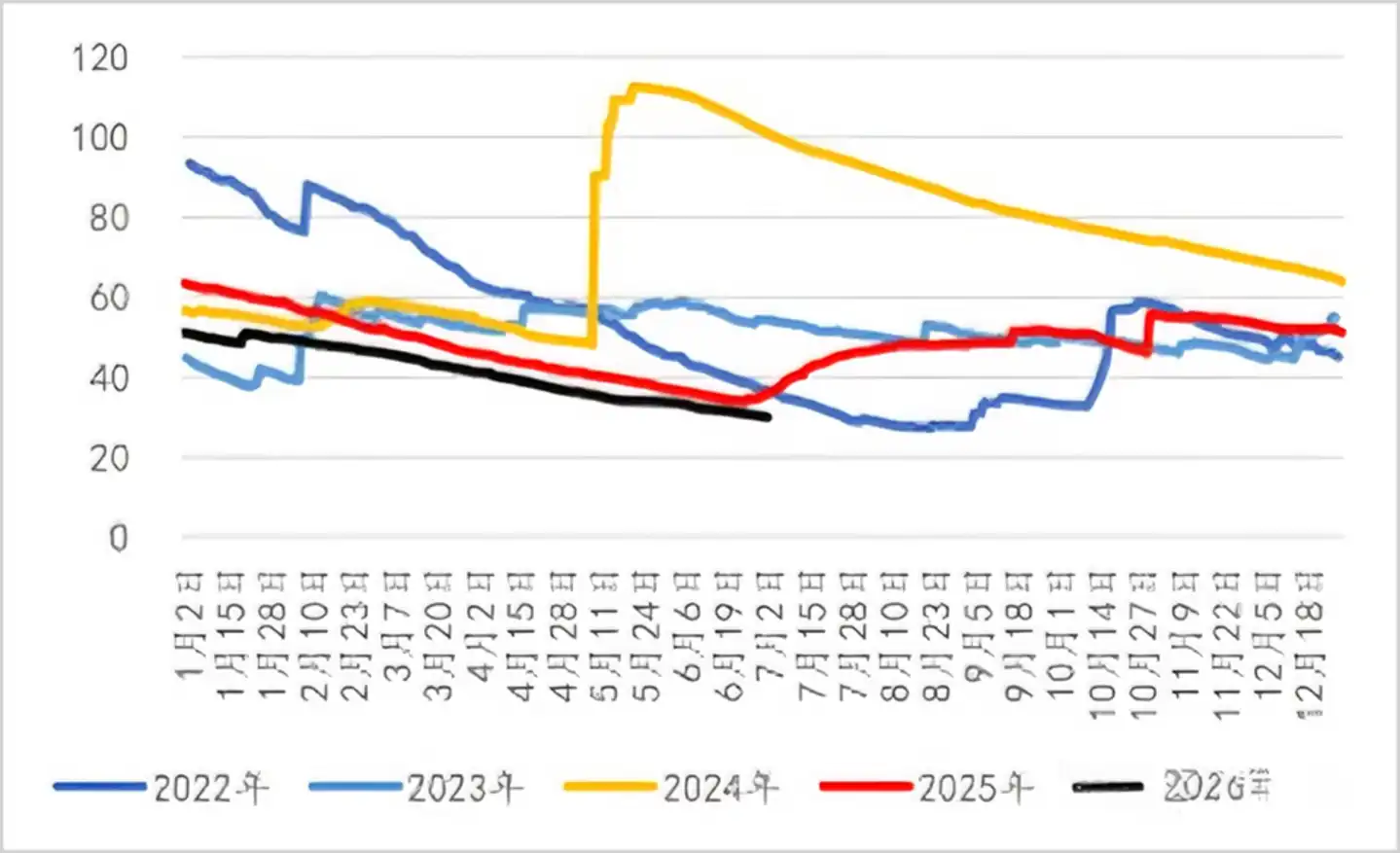
▲LME Total Aluminum Inventory Chart, Source: Wind
On the other hand, there is significant uncertainty regarding the previously aggressive expectations for Fed rate hikes. For example, June's non-farm payroll and CPI data both came in below expectations, suggesting the pace of hikes may be delayed.
Third, since the end of January, aluminum companies have generally experienced maximum drawdowns of around 40% or more. Currently, the forward PE (2026E) for leading companies like Aluminum Corporation of China, Yunnan Aluminium, and Tianshan Aluminium is only 6-7 times. High earnings momentum, coupled with price increase expectations and low valuations, naturally provides recovery momentum for the future.
In fact, besides aluminum, metals like gold, silver, copper, and lithium share similar underlying logics.
Finally, look at the financial sector. Banks, as typical dividend assets, have stable fundamentals and relatively high dividend yields. Meanwhile, securities firms and insurers, benefiting from capital market activity, generally see high earnings growth, yet their valuations remain at multi-year lows.
Certainly, the rapid development of China's tech industry, especially continuous technological breakthroughs in the semiconductor, AI, and other industrial chains, achieving domestic substitution across multiple fields and expanding exports to capture overseas market share, leads to continuously improving earnings fundamentals and solid long-term value. Coupled with the intrinsic recovery momentum of the three major lines — consumption, cyclical, and financial assets, A-shares possess a fairly strong foundation for resilience.
Overall, this round of tech adjustment stems from external risk transmission, not a collapse in the growth cycle. The "National Team" decisively intervened to stabilize the bottom line of expectations. As the intrinsic momentum of consumption, cyclical, and financial sectors gradually takes over, the market may not be far from regaining stability.



















