What’s next as GENIUS Act misses first major rulemaking deadline?

ambcryptoPublié le 2026-07-18Dernière mise à jour le 2026-07-18

Résumé

The GENIUS Act, the U.S. stablecoin framework passed in July 2027, has missed its first major rulemaking deadline. Regulators, including the Federal Reserve, were required to finalize rules by July 18, 2027, but none of the 10 related proposals have been officially completed. Six are past the comment period, while four remain open. Federal Reserve Chairman Kevin Warsh indicated final rules could be issued imminently. The banking industry has expressed concerns about the legislation creating an uneven playing field. Despite the regulatory delay, the stablecoin market has responded positively, with total supply growing from $250 billion to over $300 billion since the law's passage, and firms like Fidelity launching new offerings. Senator Bill Hagerty, a co-sponsor, hailed the act as a "watershed moment" for U.S. leadership in digital assets.

The U.S. stablecoin framework, the GENIUS Act, has hit the initial deadline of the 18th of July. Passed into law on the 18th of July 2027, the framework set multiple milestones for its progressive enactment.

For the first year after passage, regulators, including the Federal Reserve and the OCC, were mandated to finalize rulemakings for the GENIUS Act by the 18th of July, 2027.

In 18 months, or by January 2027, the framework should begin taking effect after the regulators publish final rules.

Finally, the transition period will end after three years, by mid-2028. After this, there will be no firm allowed to offer or handle stablecoins in the U.S. without GENIUS Act compliance.

Why are the final rules delayed?

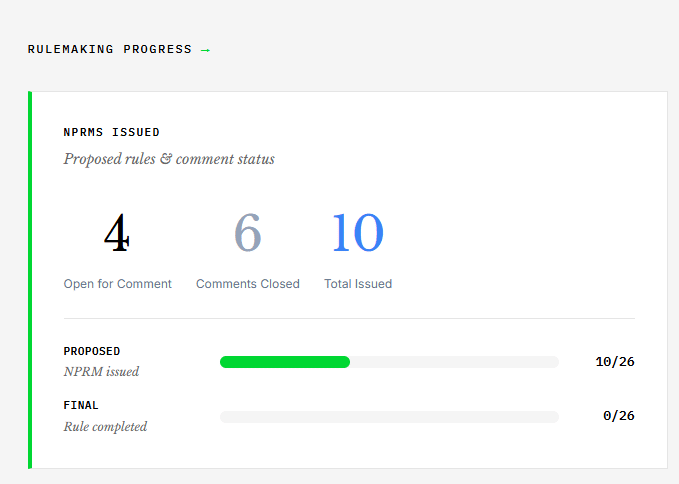
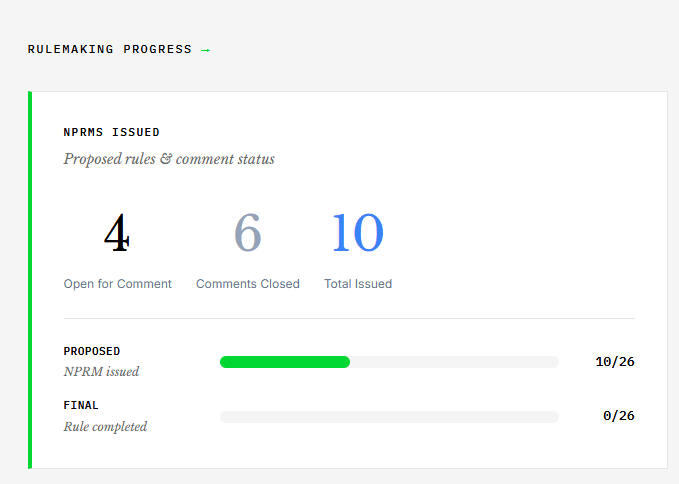
Six regulators have issued 10 rulemaking proposals related to the law. But none of the proposals have been officially completed, at least as of writing. Only six of the proposals have closed their comment period, meaning the regulators could issue final rulings for them.
Source: Paradigm

Still, four other proposals, including Bank Secrecy Act and sanction compliance for FDIC-supervised stablecoin issuers, are still open for comment.

In other words, despite hitting the rulemaking deadline, the GENIUS Act was still far from finalizing key rules.

What’s next for the GENIUS Act?

However, it’s worth noting that in a recent Congress hearing, Kevin Warsh, the chairman of the Federal Reserve, said that the final rules could be issued soon.

We’re racing to put that out (GENIUS Act final rules) by this deadline, this Saturday.

For the banking industry, which has opposed the legislation due to the stablecoin yield loophole, it called for a review of the proposed rules to avoid.

Uneven playing field or opportunities for regulatory arbitrage, unintended policy consequences, or unworkable or incongruous requirements.

How has the stablecoin market responded?

The GENIUS Act is the first formal stablecoins framework in the U.S that aims to advance innovation and protect consumers. To achieve this, it has reserve requirements and anti-money laundering provisions.

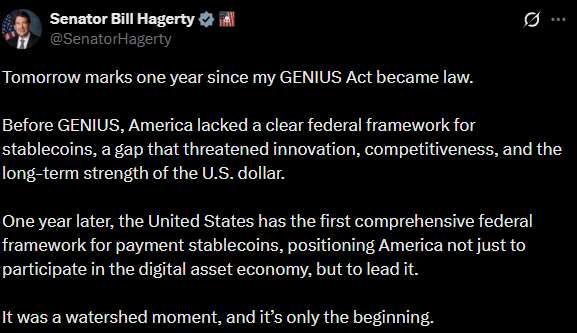
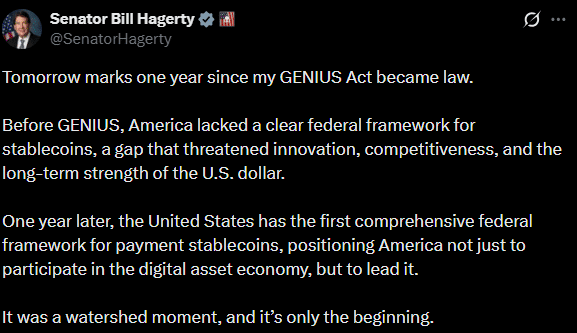
Commenting on the legislation, Senator Bill Hagerty, who co-sponsored it, said,

The United States has the first comprehensive federal framework for payment stablecoins, positioning America not just to participate in the digital asset economy, but to lead it. It was a watershed moment, and it’s only the beginning.
Source: X

Since the law, the stablecoin market supply surged from $250B to over $300B. Even several firms like Fidelity have begun their stablecoin offerings.

Additionally, some crypto platforms like Phantom recorded a 20% increase in stablecoin balance from $2.33B to $2.82B since the GENIUS Act was passed.

It remains to be seen how the growth will accelerate when regulators publish final rules as the legislation enters its second year.


Final SummaryThe

  • GENIUS Act has entered its second year, but final rules will likely stretch beyond the rulemaking deadline
  • Stablecoin market supply increased by over $50B after legislation became law, with Sen. Hagerty calling ‘watershed moment’


Cryptos en tendance

Questions liées

QWhat is the first major rulemaking deadline that the GENIUS Act has missed, and who was responsible for meeting it?

AThe first major rulemaking deadline was July 18, 2027. Regulators, including the Federal Reserve and the OCC, were mandated to finalize rules for the GENIUS Act by this date, but none of the proposals have been officially completed.

QAccording to the article, what are two key reasons why the final rules for the GENIUS Act have been delayed?

ATwo reasons for the delay are: 1) Only six out of ten rulemaking proposals have closed their comment period, meaning regulators could only potentially issue final rules for those. 2) Four proposals, including those on Bank Secrecy Act and sanction compliance for FDIC-supervised issuers, are still open for comment.

QWhat specific market impact has the passage of the GENIUS Act had on the stablecoin sector?

ASince the GENIUS Act became law, the stablecoin market supply has surged from $250 billion to over $300 billion, an increase of over $50 billion. Firms like Fidelity have launched stablecoin offerings, and platforms like Phantom saw a 20% increase in stablecoin balances.

QWhat did Federal Reserve Chairman Kevin Warsh recently indicate about the timing of the final rules for the GENIUS Act?

AIn a recent Congress hearing, Federal Reserve Chairman Kevin Warsh said that the final rules could be issued soon, stating, "We're racing to put that out (GENIUS Act final rules) by this deadline, this Saturday."

QWhat is the banking industry's primary concern regarding the GENIUS Act, as mentioned in the article?

AThe banking industry opposes the legislation due to the stablecoin yield loophole. They have called for a review of the proposed rules to avoid an uneven playing field, opportunities for regulatory arbitrage, unintended policy consequences, or unworkable requirements.

Lectures associées

Les investisseurs commencent à « changer de table de jeu »

Alors que le marché des capitaux privés en Chine connaît un regain de fièvre, en particulier dans les technologies de pointe comme l'IA, un mouvement notable se dessine : des investisseurs quittent les fonds de capital-risque pour rejoindre des entreprises en pleine croissance. Ce n'est plus un choix par défaut, mais une transition active et stratégique. La dynamique du marché est intense : les levées de fonds s'accélèrent, les valorisations montent en flèche et la concurrence pour les projets vedettes est féroce. Face à cette frénésie, certaines entreprises technologiques leaders, confrontées à des besoins de financement rapides et complexes, recherchent activement des talents maîtrisant les rouages du capital-investissement. Elles proposent des postes attrayants (directeur financier, vice-président, voire cofondateur) pour attirer ces profils. Pour les investisseurs, ce mouvement représente une "changement de table". Motivés par des opportunités de carrière concrètes, une rémunération attractive et la perspective de contribuer directement à la croissance opérationnelle d'une entreprise, ils voient dans ce virage un échappatoire à l'hyperconcurrence entre fonds, aux incertitudes croissantes sur les sorties (introductions en bourse) et à un environnement réglementaire en mutation. Ainsi, une convergence d'intérêts s'opère : les entreprises gagnent en expertise capitalistique pour soutenir leur expansion, tandis que les investisseurs trouvent un nouveau terrain d'application pour leurs compétences. Bien que l'adaptation au monde opérationnel de l'entreprise présente ses défis, cette tendance élargit significativement les horizons de carrière dans l'écosystème de l'investissement.

marsbitIl y a 1 h

Les investisseurs commencent à « changer de table de jeu »

marsbitIl y a 1 h

Trading

Spot

Articles tendance

Comment acheter GENIUS

Bienvenue sur HTX.com ! Nous vous permettons d'acheter Genius (GENIUS) de manière simple et pratique. Suivez notre guide étape par étape pour commencer votre parcours crypto.Étape 1 : Création de votre compte HTXUtilisez votre adresse e-mail ou votre numéro de téléphone pour ouvrir un compte sur HTX gratuitement. L'inscription se fait en toute simplicité et débloque toutes les fonctionnalités.Créer mon compteÉtape 2 : Choix du mode de paiement (rubrique Acheter des cryptosCarte de crédit/débit : utilisez votre carte Visa ou Mastercard pour acheter instantanément Genius (GENIUS).Solde :utilisez les fonds du solde de votre compte HTX pour trader en toute simplicité.Prestataire tiers :pour accroître la commodité d'utilisation, nous avons ajouté des modes de paiement populaires tels que Google Pay et Apple Pay.P2P :tradez directement avec d'autres utilisateurs sur HTX.OTC (de gré à gré) : nous offrons des services personnalisés et des taux de change compétitifs aux traders.Étape 3 : stockage de vos Genius (GENIUS)Après avoir acheté vos Genius (GENIUS), stockez-les sur votre compte HTX. Vous pouvez également les envoyer ailleurs via un transfert sur la blockchain ou les utiliser pour trader d'autres cryptos.Étape 4 : tradez des Genius (GENIUS)Tradez facilement Genius (GENIUS) sur le marché Spot de HTX. Il vous suffit d'accéder à votre compte, de sélectionner la paire de trading, d'exécuter vos trades et de les suivre en temps réel. Nous offrons une expérience conviviale aux débutants comme aux traders chevronnés.

783 vues totalesPublié le 2026.04.29Mis à jour le 2026.06.02

Comment acheter GENIUS

Discussions

Bienvenue dans la Communauté HTX. Ici, vous pouvez vous tenir informé(e) des derniers développements de la plateforme et accéder à des analyses de marché professionnelles. Les opinions des utilisateurs sur le prix de GENIUS (GENIUS) sont présentées ci-dessous.

活动图片