Crypto market’s weekly winners and losers – MYX, PEPE, UNI, HYPE

ambcryptoPublished on 2026-01-04Last updated on 2026-01-04

Abstract

Crypto markets opened 2026 with broad-based gains, as the CoinMarketCap Top 20 Index rose nearly 5%. Bitcoin and Ethereum posted gains of nearly 5% and 7%, respectively. Weekly winners included MYX Finance (MYX), which surged 77% ahead of its upcoming V2 upgrade, showing strong buying pressure. World Liberty Financial (WLFI) climbed roughly 22%, breaking out of a tight range. Pepe (PEPE) led memecoins with over 70% gains, backed by sustained volume. Other notable gainers included Toncoin (up ~12%), Canton (up 28%), and Dogecoin (up 22%). Weekly losers included Uniswap (UNI), which slipped after failing to hold above $6 amid selling pressure. Hyperliquid (HYPE) fell toward $25 due to profit-taking and repeated rejections at resistance. Monero (XMR) pulled back to $420 after a rejection at $450. Tokenized assets like Tether Gold and PAX Gold both fell nearly 5%, indicating reduced hedging demand. The market showed renewed momentum but selective leadership, with advice to avoid chasing rallies and conduct due diligence.

New year, new market?

The crypto community stepped into 2026 with just enough green to make us all happy. Many top 100 coins closed the week on a high, with CoinMarketCap’s top 20 index up by nearly 5%.

Crowd favorites Bitcoin [BTC] and Ethereum [ETH] posted gains of nearly 5% and 7%.

Source: CoinMarketCap

What about the rest? Settle in with your drink of choice, and here’s a recap of how the market moved this week.

Weekly winners

MYX Finance [MYX] – Huge surge ahead of developments

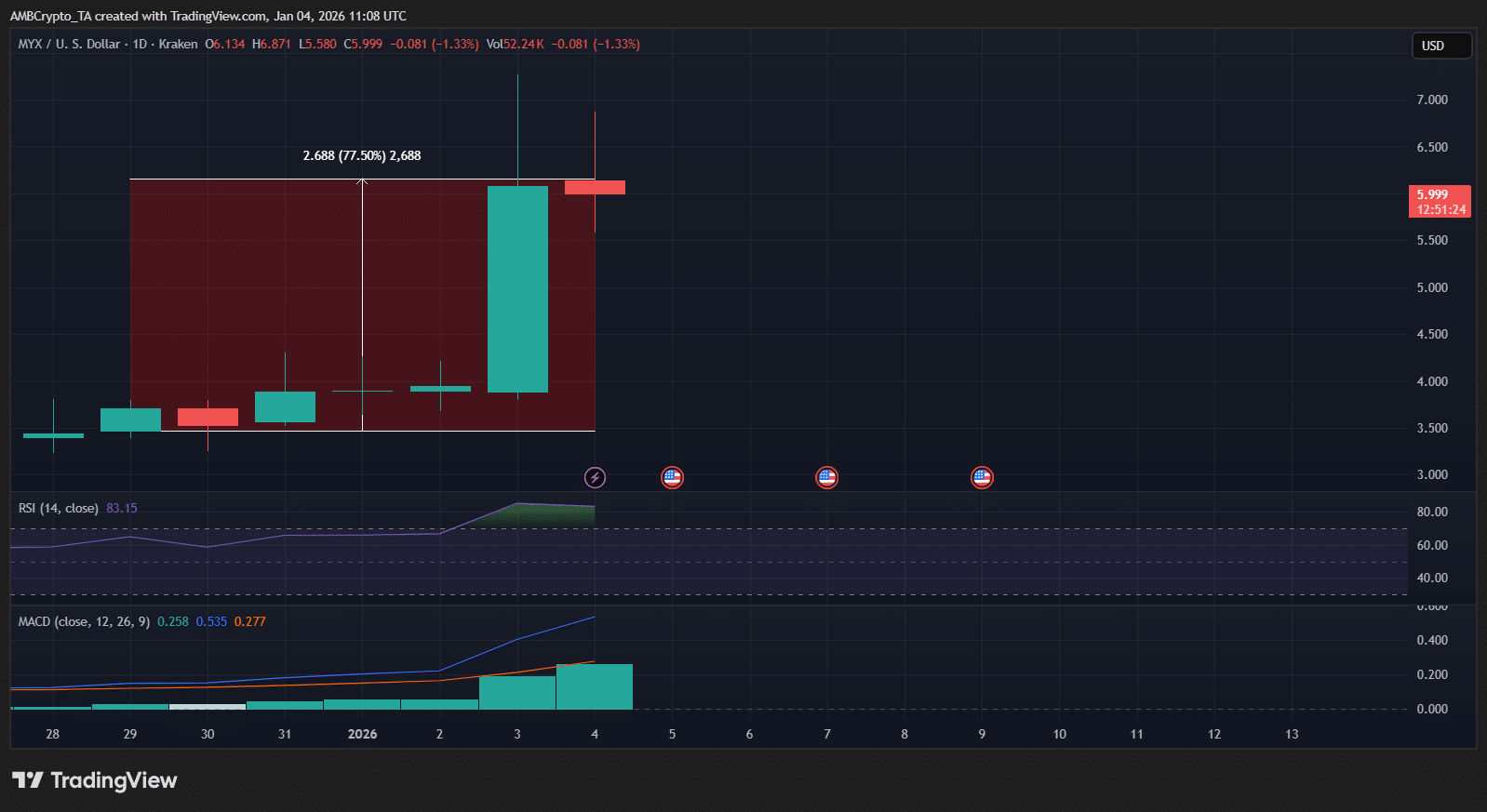
MYX Finance [MYX] has had a standout week, surging 77% at press time with attention on its upcoming V2 upgrade. Price went from the mid-$3 range to above $6 in a matter of days, with a strong candle early in the week.

Source: TradingView

RSI indicated heavy buying pressure, and MACD accelerated too; there’s a quick change in trend strength. While price pulled back from its intraday highs, the move so far looks caused by anticipation.

For now, it looks like traders are preparing ahead of the upgrade rather than reacting after it.

World Liberty Financial [WLFI] – In the momentum trade

World Liberty Financial [WLFI] posted strong gains coming into the new year! The token climbed roughly 22% over the period, breaking out of a tight range that had capped price action through late December.

RSI showed rising momentum, and OBV turned higher after weeks of decline. There’s a lot of fresh buying activity.

WLFI has cooled just slightly near recent highs. There seems to be more speculative interest than anything else, but only time (and announcements) will tell.

Pepe [PEPE] – Leading the memecoin pack!

Pepe [PEPE] has been a clear standout among memecoins this week. At the time of writing, it is the best-performing meme token on the market, posting gains of over 70%. The next closest contender, Bonk [BONK], was far behind with a 46% rise.

There’s been a clean breakout from consolidation, followed by strong follow-through. The RSI showed an aggressive pace, while OBV proved more sustained buying interest.

Unlike other short-lived pumps, Pepe’s move has been backed by rising volume across multiple sessions. This keeps it firmly ahead of the memecoin field.

Other notable winners

Beyond the week’s top performers, a few names also stood out. Toncoin [TON] rose around 12% over the week, moving higher alongside Telegram’s launch of its self-custodial wallet in the United States.

Canton [CC] gained 28% this week, extending a multi-week rally that began after its partnership with DTCC came into focus.

Dogecoin [DOGE] also joined the move, climbing 22% as interest across large-cap and memecoin names picked up again.

Weekly losers

Uniswap [UNI] – Fading pace

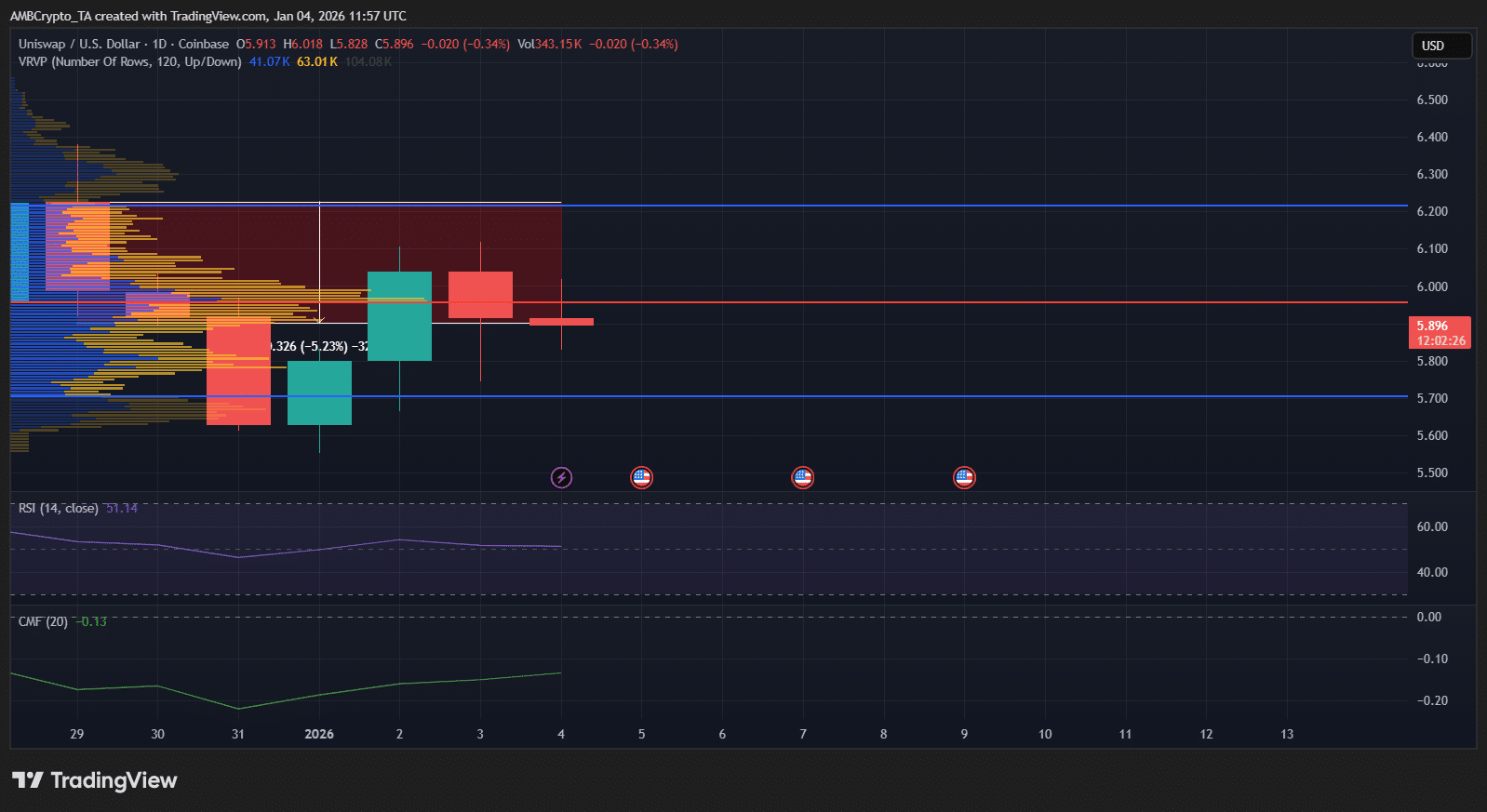
Uniswap [UNI] struggled this week, slipping back after failing to hold above the $6 level.

Price got rejected near a high-volume zone, with sellers stepping in quickly after the brief push higher. RSI was just above 50, so pace has cooled.

Source: TradingView

Meanwhile, CMF was negative, so capital was slowly leaking out. Price was trading near short-term support around $5.8, where buyers previously showed up.

Unless UNI can reclaim $6 with stronger volume, the move is highly likely to be a pause under resistance.

Hyperliquid [HYPE] – Moving against the market

While much of the top 20 finished the week in the green, Hyperliquid [HYPE] moved the other way. Price slipped back toward the $25 zone after failing to hold above recent highs.

There were repeated rejections near resistance, with each bounce getting sold into quickly.

RSI showed a weak pace. Importantly, the pullback comes after a prior run-up, so profit-taking is starting to dominate. At press time, HYPE was absorbing gains, even with risk appetite being strong everywhere else.

Monero [XMR] – Cooling post-rejection

Monero’s [XMR] price was rejected near the $450 zone, causing a pullback toward $420 before buyers stepped back in. There was aggressive selling, but demand hadn’t disappeared.

The MACD remained in bearish territory, but selling pressure was clearly easing. CMF nudged back above zero, so there were mild capital inflows after the dip.

XMR is consolidating after a failed breakout, with the market still seemingly undecided on the next move.

Other notable losers

Losses this week weren’t limited to high-beta tokens. Tokenized assets Tether Gold [XAUt] and PAX Gold [PAXG] both slipped nearly 5%, so demand for defensive, commodity-linked exposure rotated elsewhere.

There’s less interest in hedging, even during uncertainty. Meanwhile, Dash [DASH] fell 3%, continuing its slow grind lower.

Conclusion

As the year unfolds, excitement will come and go faster than most New Year’s resolutions. Keep your head firmly on your shoulders, don’t chase every green candle, and DYOR before jumping in.

Here’s wishing you a calm portfolio, good timing, and a happy New Year!


Final Thoughts

  • Crypto opened 2026 with broad-based gains, as the CoinMarketCap Top 20 Index rose nearly 5%.
  • Rallies in MYX, PEPE, and WLFI show momentum is back, but leadership remains selective.
Next: SPX rallies 16% amid fresh capital inflow – Can bulls keep control?
Share
  • Share
  • Tweet

Trending Cryptos

Related Questions

QWhich cryptocurrency was the top weekly performer and what was the main reason for its surge?

AMYX Finance (MYX) was the top weekly performer, surging 77% due to anticipation of its upcoming V2 upgrade.

QAmong memecoins, which token significantly outperformed its closest competitor this week?

APepe (PEPE) was the best-performing memecoin with a 70% gain, far outperforming its closest competitor Bonk (BONK), which rose 46%.

QWhat was the primary technical reason for Uniswap's (UNI) price decline this week?

AUniswap (UNI) declined after failing to hold above the $6 resistance level, with sellers stepping in quickly after a brief push higher and the Chaikin Money Flow (CMF) turning negative.

QWhich two tokenized gold assets were notable losers this week, and what does their decline suggest about market sentiment?

ATether Gold (XAUt) and PAX Gold (PAXG) both declined nearly 5%, indicating reduced demand for defensive, commodity-linked assets and less interest in hedging during uncertainty.

QWhat was the overall performance of the crypto market at the start of 2026 according to the CoinMarketCap index?

AThe crypto market opened 2026 with broad-based gains, as the CoinMarketCap Top 20 Index rose nearly 5% for the week.

Related Reads

Vitalik's Algorithmic Stablecoin Vision: Interpreting the Mechanism and Challenges from an Options Perspective

Vitalik Buterin's recent algorithmic stablecoin proposal envisions using an option-like mechanism to create a stablecoin without the liquidation risks inherent in traditional collateralized debt position (CDP) models. The design splits one unit of ETH into two components: a 'stable' leg (P) that maintains value up to a certain strike price, and an 'upside' leg (N) that captures any appreciation above that price. Together, they always sum to one ETH, eliminating the need for debt or liquidation mechanisms. From an options perspective, the stable leg essentially functions as a synthetic, covered call position. However, significant challenges exist. For the stable asset to maintain its peg, it must continuously roll deep in-the-money call options, leading to potential rollover slippage, predictable trading paths vulnerable to front-running, and liquidity issues. Crucially, the system's scalability depends on a constant demand for the upside leg—a form of leveraged ETH long position without funding rates or liquidation risk. It's unclear if such persistent, specific demand will materialize from speculators or market makers who have simpler alternatives like perpetual swaps. The author, drawing from experience with Rysk, argues that DeFi options have struggled as standalone trading products due to complexity and fragmented liquidity. Their potential lies instead as foundational infrastructure underpinning more complex financial primitives like stablecoins, structured yields, or index products—transforming from a direct product into a core pricing and risk distribution engine for the next generation of on-chain finance.

marsbit1h ago

Vitalik's Algorithmic Stablecoin Vision: Interpreting the Mechanism and Challenges from an Options Perspective

marsbit1h ago

GPT-5.6 Countdown: Abandon the Illusion of a Single API, Computational Iteration Can't Outpace a Single Page of Compliance

In mid-June, three seemingly independent industry events—the compliance-driven throttling of Fable 5, the open-sourcing of GLM-5.2, and the leaked release timeline for GPT-5.6—are pushing the global AI industry toward a watershed moment. These shifts signal a fundamental restructuring of the industry's underlying logic. First, **"usability" has substantially overtaken "advanced capabilities"** as the primary weight, pushing the global large language model (LLM) supply chain into a "dual-track" phase of controlled closed-source and local open-source coexistence. Second, **the competitive moats of closed-source giants are shifting**. Their technical focus is moving from "language intelligence" toward "spatial intelligence (world models)"—a domain heavily reliant on computing power. Third, faced with常态化 transnational compliance risks, **a "model-agnostic" decoupled design has become a survival necessity for application-layer developers to maintain business continuity.** The article details how Anthropic's Fable 5, despite its advanced engineering feats, was restricted for non-U.S. citizens within 72 hours of launch, highlighting how geopolitical compliance can instantly limit even the most advanced models. In response, the open-source camp, exemplified by Zhipu AI's MIT-licensed GLM-5.2, is gaining market share by offering stable performance improvements and significant cost advantages (up to 70% savings for enterprises), while achieving full adaptation with domestic semiconductor platforms. Meanwhile, closed-source leaders like OpenAI are pivoting. The anticipated GPT-5.6 reportedly shifts focus from language to spatial intelligence and world models, aiming to rebuild a generational gap in areas like 3D understanding, simulation, and industrial design that demand immense compute. The core conclusion is that the LLM supply chain's logic has changed. Enterprises must now evaluate infrastructure based on a composite of technical performance and policy compliance. For developers, complete reliance on a single closed-source API poses unacceptable risk. Implementing a truly model-agnostic architecture—enabling swift switches to compliant, locally deployable open-source alternatives—is no longer just good practice but a fundamental baseline for business continuity.

marsbit3h ago

GPT-5.6 Countdown: Abandon the Illusion of a Single API, Computational Iteration Can't Outpace a Single Page of Compliance

marsbit3h ago

Is the 'Token Subsidy War' Among AI Giants Almost Over?

The article discusses the ongoing "token subsidy war" among AI giants like OpenAI and Anthropic, questioning whether it's nearing its end. It reveals that current AI subscription prices are heavily subsidized, with some plans offering tokens at up to 70 times the actual cost to attract and retain heavy users, especially developers and enterprises. This strategy mirrors past internet-era subsidy battles, but with a key difference: AI tokens lack "lock-in" effects. Unlike ride-hailing or food delivery apps, users can easily switch between AI providers as APIs become standardized, making it difficult for companies to raise prices post-subsidy. The piece highlights a structural asymmetry in the competition. Giants like Google, with massive advertising revenue, can afford to subsidize tokens indefinitely, akin to using "tokens as a weapon." In contrast, venture-backed companies like OpenAI and Anthropic face pressure to become profitable, especially as they approach IPO. The article cites Google Ventures founder Bill Maris, who suggests Google could slash token prices by 80%, putting immense pressure on competitors. Two potential endgames are presented: the "internet service" model (subsidize, monopolize, then raise prices) and the "utility" model (tokens become a standardized, low-margin commodity like electricity). Given the low switching costs, the latter seems more likely. The competition may not have a single winner but could instead accelerate AI's evolution into a foundational, infrastructure-level technology, akin to a public utility. For now, users continue to benefit from heavily subsidized token costs.

marsbit4h ago

Is the 'Token Subsidy War' Among AI Giants Almost Over?

marsbit4h ago

Trading

Spot
Futures

Hot Articles

Discussions

Welcome to the HTX Community. Here, you can stay informed about the latest platform developments and gain access to professional market insights. Users' opinions on the price of S (S) are presented below.

活动图片