Breaking Through the $4,200 Resistance Level! Gold "Reset" Complete, Possibly Ushering in the Best Window for Gains in Months

Published on 2026-08-06Last updated on 2026-08-06

Abstract

Gold has achieved its most critical technical breakthrough in months. The price has broken through the descending trend line and held above $4,200, with multiple positive factors converging: technicals, a weakening U.S. dollar, continuous gold purchases by the People's Bank of China, and CTA net short positions. Analysis suggests that if key price levels can be sustained, it could trigger short covering and follow-through buying from programmatic funds, propelling gold into a new round of upward momentum.

The gold market has completed its most noteworthy technical breakout in months. After a prolonged period of digestion following its early-year highs, technicals, positioning structure, and macro drivers are beginning to align, providing support for a new round of upside in the gold price.

The gold price recently broke through the downtrend line established from the all-time high, registering the strongest bullish candlestick in weeks and touching the 50-day moving average for the first time in months. On Wednesday, spot gold broke above $4,200 per ounce, gaining 3.2% on the day to $4,206.33 per ounce.
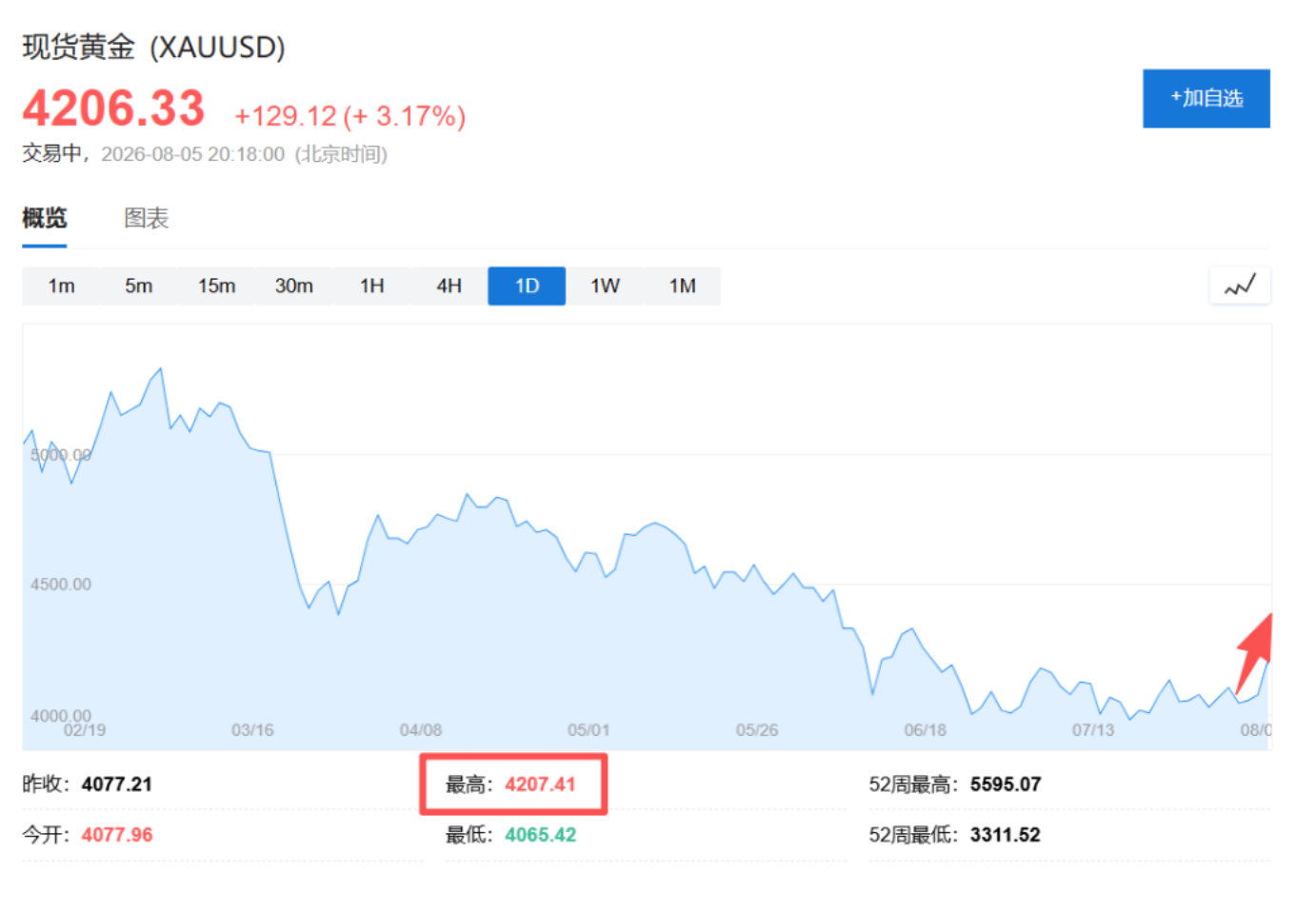
Market analysis firm The Market Ear pointed out that if the gold price can also close and stabilize above $4,200, it could trigger a larger-scale short squeeze.

Meanwhile, a weakening US dollar, sustained gold purchases by the Chinese central bank, speculative long positioning at historically low levels, and Commodity Trading Advisors (CTAs) still holding net short positions are multiple factors combining to significantly improve the risk-reward profile for gold at present.

Technical Breakthrough: Downtrend Line Broken, 50-Day MA Becomes Key Hurdle

The gold price is breaking through the downtrend line formed from the all-time high earlier this year, one of the most significant technical developments in months.

According to analysis by The Market Ear, the gold price recently registered its strongest bullish candlestick in weeks and tested the 50-day moving average for the first time. Closing, especially firmly above $4,200, could trigger a more substantial short squeeze.

From a market context, the speculative froth from early in the year has largely been cleared, but structural buying has not dissipated. After months of consolidation, technical and fundamental drivers are gradually aligning.

Weakening Dollar: Gold Price and Currency Divergence Offer Catch-up Potential

Gold is responding to the latest round of US dollar weakness. The Market Ear, citing LSEG Workspace data, noted that the last time the US Dollar Index (DXY) was at its current level, the gold price was about $200 higher.

This divergence implies that if the dollar remains weak, there is considerable catch-up potential for gold. The current gap between the exchange rate and the gold price provides an additional fundamental support logic for bulls.

Chinese Demand: Central Bank Purchases Continue, Structural Support from Physical Demand Unchanged

Demand signals from China remain robust.

According to Goldman Sachs analysis, the significant increase in UK gold exports to China largely reflects the Chinese central bank's sustained gold purchases, while the surge in private imports further confirms the structural demand for physical gold. This trend shows no signs of loosening, even amid recent macro headwinds.

However, speculative positioning on the Shanghai Futures Exchange (SHFE) has not yet followed, currently only about 1% above its lows, indicating that speculative forces in the Chinese market remain dormant. Once a gold price breakout is confirmed, this latent buying could become an additional upside catalyst.

Positioning Structure: Speculative Longs Still Low, CTA Net Shorts Await Reversal

The current positioning structure provides significant asymmetry for gold price upside.

The Market Ear, citing Goldman Sachs data, pointed out that although speculative long positioning has recovered somewhat since May, overall positioning levels remain relatively low by historical standards. There is ample room to trigger chasing by these positions if the gold price breaks higher.

More notably, CTAs currently still hold a net short position in gold. If the breakout trend continues, passive buying from systematic strategies will provide additional elasticity to the upside move.

Options Market: Volatility Retreats, Cost-Effectiveness of Bullish Positions Becomes Prominent

The Gold Volatility Index (GVZ) has retreated significantly since the panic-driven rise earlier this year, with recent price consolidation further compressing implied volatility.

The Market Ear notes that gold typically exhibits upward volatility skew—sharp rallies are often accompanied by a synchronous rise in implied volatility. Although the GVZ is not at an absolute bargain level currently, it still offers a relatively low-cost way to position for a bullish breakout. For investors looking to express a bullish view through options, the current time window holds some appeal.


Related Reads

Tiger Research: What Will the Crypto World Look Like in 2036?

Tiger Research envisions the crypto world of 2036 through four narrative vignettes. In a fictional nation with a hyperinflating currency, the local "Bucks" are nearly obsolete. Citizens and eventually the government itself—for taxes, bonds, and salaries—adopt dollar-pegged stablecoins like USDT and USDC, marking a fundamental shift in monetary sovereignty. In Singapore, a young trader named Lia operates in a borderless, 24/7 market. She trades tokenized versions of everything from NVIDIA stock to Korean real estate indices on decentralized platforms, representing a generation for whom constant, global asset exposure is the norm. An infrastructure engineer, Do-hyun, reflects on the consolidation of blockchain networks. The hundreds of independent chains and Layer 2 solutions that boomed in the 2020s, fueled by incentives, have largely collapsed under their own weight. By 2036, only a few major, efficient infrastructures remain, having absorbed liquidity and users. Finally, media entrepreneur Jae-hoon witnesses the end of the traditional web advertising model. With AI agents generating over half of web traffic by 2029, banner ads become irrelevant. The industry pivots to a new machine-to-machine economy, using protocols like the x402 standard to charge AI models micropayments for direct data access, creating a more reliable revenue stream than human eyeballs ever did. The article paints a picture of 2036 defined by stablecoin adoption as sound money, perpetual global trading of all assets, consolidation into few dominant blockchain infrastructures, and the restructuring of digital commerce around AI agents.

marsbit20m ago

Tiger Research: What Will the Crypto World Look Like in 2036?

marsbit20m ago

IOSG: How Can Blockchains Keep Secrets? Three Answers to On-Chain Privacy

**Title: IOSG: How Does Blockchain Keep Secrets? Three Answers to On-Chain Privacy** **Summary:** Public blockchains expose every transaction. To protect sensitive data like institutional balances or trade sizes, three main approaches have emerged: 1. **Native Privacy Networks:** Projects like Zcash (with optional privacy) and Monero (with mandatory privacy) build secrecy directly into their own blockchains. However, they exist as isolated "islands," limiting interaction with mainstream DeFi applications. Canton, a permissioned network, offers privacy by restricting data sharing only to transaction participants, which appealed to JPMorgan for its deposit token. 2. **Privacy as an Add-On Layer:** This approach adds privacy to existing chains like Ethereum. Tornado Cash was an early "mixer" but was sanctioned. Railgun provides private balances and payments via zero-knowledge proofs on Ethereum. Zama uses Fully Homomorphic Encryption (FHE) to encrypt balances and amounts on-chain, enabling confidential DeFi activities like private yield vaults and over-the-counter trading while keeping transaction graphs public. 3. **The Core Trade-off:** All solutions sacrifice some privacy for functionality. Truly private chains (Zcash, Monero) lack smart contract versatility. Add-on layers (Zama, Railgun) reveal some metadata to enable computation. "Perfect" privacy that hides everything while allowing full functionality remains elusive. **Market Reality:** Demand is validated, with institutions moving trades off-screen to avoid slippage. However, the sector's revenue (est. $6-7M/year across all protocols) is minuscule compared to the ~$25B market cap of privacy assets. Protocols like Zama charge minimal, usage-based fees, while others like Railgun take a small percentage. The key gap is a sustainable pricing model. The conclusion is bullish on the underlying demand but suggests value will accrue to the applications (trading venues, wallets) that successfully monetize privacy, not necessarily the foundational privacy layers themselves.

marsbit24m ago

IOSG: How Can Blockchains Keep Secrets? Three Answers to On-Chain Privacy

marsbit24m ago

SanDisk Reports Record Earnings, Why Did It Still Plunge 8% After Hours?

SanDisk Reports Record Earnings, Yet Stock Plunges 8% After-Hours Despite announcing record-breaking Q4 and full-year fiscal 2026 results, SanDisk's stock fell sharply. Key figures were stellar: Q4 revenue surged 372% YoY to $8.97B, beating estimates, with adjusted EPS skyrocketing to $39.25. Full-year revenue hit $20.25B, with a dramatic swing from a $1.64B loss in FY2025 to an $11.43B GAAP profit, highlighting a powerful recovery driven by the NAND cycle and AI demand. The market's negative reaction stemmed from future guidance failing to meet elevated expectations. SanDisk's Q1 FY2027 revenue guidance of $10.3B-$10.8B (midpoint $10.55B) fell short of the $11.16B consensus, creating a roughly 5.5% gap. Investors are concerned not with past performance but with whether growth can accelerate further. Business segment analysis revealed a strategic shift. Data Center revenue was the standout, soaring nearly 13x YoY to $2.98B and becoming a key growth pillar at 33% of revenue. The larger Edge Computing segment also grew robustly by 392%. However, Consumer revenue declined 5% YoY, reflecting weak traditional electronics demand. Management highlighted strategic moves, including securing five new or expanded long-term supply agreements under its "New Business Model," aiming to lock in over half of FY2027 supply to smooth cyclical volatility. A new $14B stock buyback authorization signaled confidence but couldn't offset short-term guidance disappointment. The core issue is that the market is trading on the "acceleration of growth." While SanDisk's fundamentals remain strong—with record revenue and an 84.6% adjusted gross margin—the stellar performance was already priced in. The guidance, while still indicating high growth (~359% YoY), did not show further acceleration, causing a "sell the news" reaction as expectations had outpaced reality.

Odaily星球日报31m ago

SanDisk Reports Record Earnings, Why Did It Still Plunge 8% After Hours?

Odaily星球日报31m ago

Trading

Spot
活动图片