
Quick Facts:
- ➡️ Polymarket is suing Massachusetts to establish that prediction markets are federally regulated derivatives, not state-regulated gambling.
- ➡️ The lawsuit represents a critical test for the crypto industry’s ability to operate under federal oversight rather than fragmented state laws.
- ➡️ SUBBD Token leverages similar decentralized principles to disrupt the $85B creator economy, offering AI tools and lower fees than Web2 competitors.
- ➡️ The conflict highlights a broader market trend toward platforms that offer user sovereignty and resistance to centralized censorship.
The battle for decentralized information markets just hit a breaking point.
Polymarket, the world’s largest prediction platform, has officially filed a lawsuit against the Commonwealth of Massachusetts. This legal maneuver serves as a sharp counter-offensive to the Cease and Desist order issued by the state’s Attorney General, who accused the platform of running an unlicensed gambling operation.
Polymarket’s argument hangs on a single hook: federal preemption. The company contends its markets are financial derivatives under the jurisdiction of the Commodity Futures Trading Commission (CFTC), not games of chance subject to state-level gambling laws.
That distinction isn’t just legalese, it’s survival. If prediction markets are classified merely as gambling, they face a fractured nightmare of 50 different state regulators. If they’re derivatives? They face a single federal framework.
This lawsuit follows the precedent set by Kalshi, a regulated competitor that recently scored a massive win against the CFTC, emboldening platforms to challenge regulatory overreach.
But this isn’t just about election betting or sports outcomes. The conflict highlights the friction between decentralized protocols and legacy frameworks that struggle to categorize Web3 innovation. The market’s reaction? Telling.
Rather than fleeing, liquidity in decentralized sectors has deepened. Investors are hunting for sovereignty and utility outside the reach of arbitrary restrictions.
While prediction markets fight for the right to trade truth, SUBBD Token ($SUBBD) is using this sentiment to disrupt the $85 billion creator economy. As users look for platforms that guarantee ownership and freedom from censorship, SUBBD is capitalizing on the shift toward decentralized monetization.
Explore the SUBBD Token ecosystem.
Disrupting The $85B Content Economy With AI And Web3
While the Polymarket case highlights the struggle for permissionless trading, the content creation industry faces a parallel crisis: centralization.
Right now, Web2 giants strangle the landscape, extracting up to 70% of creator earnings through fees and maintaining absolute authority over who can monetize. Sound familiar?
This centralized control creates a fragile ecosystem where influencers face arbitrary bans, demonetization, and payment processor restrictions. SUBBD Token has emerged to fix these inefficiencies by merging Web3 financial sovereignty with advanced AI tooling.
The project’s architecture is built to return value to the user (a concept foreign to most legacy platforms). By utilizing the Ethereum blockchain, SUBBD eliminates the intermediaries that typically siphon revenue, offering a transparent payment infrastructure that supports creators, fans, and even AI-driven influencers.
The platform integrates proprietary AI models directly into the ecosystem, offering features like AI Personal Assistants for automated interactions and AI Voice Cloning. Why does that matter? It lets creators scale their output without the burnout associated with traditional streaming.
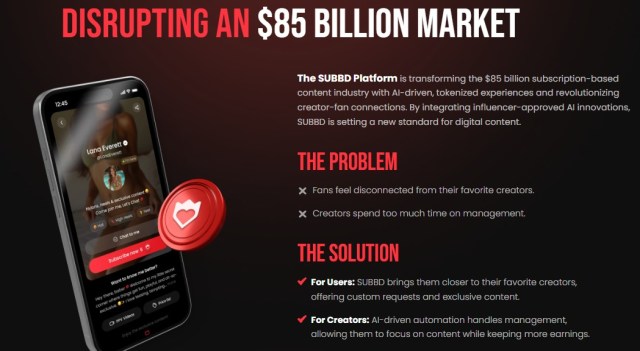
From a market perspective, the utility here goes beyond simple tokenization. The platform introduces governance mechanisms that allow token holders to vote on feature rollouts and creator curation, fostering a community-owned ecosystem rather than a corporate dictatorship.
For investors watching the regulatory squeeze on platforms like Polymarket, SUBBD represents a tangible application of decentralized tech, solving a clear operational problem rather than relying on purely speculative trading. The integration of ‘HoneyHive’ membership tiers and token-gated exclusive content further aligns the token’s velocity with platform growth.
Read more about $SUBBD here.
SUBBD Presale Momentum Signals Demand For Decentralized Monetization
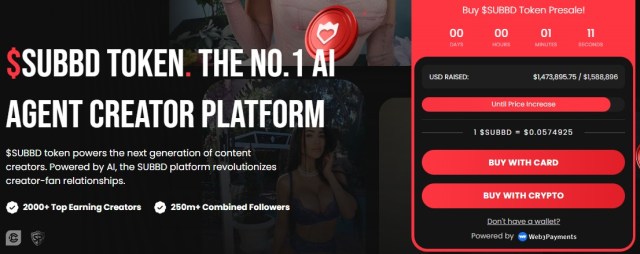
You can see the hunger for utility-driven crypto assets in the project’s early numbers. According to official presale data, SUBBD Token has already raised $1.47M, indicating strong capital inflows despite the broader market’s regulatory uncertainty.
The token’s current price of $0.057495 offers a vital entry point for investors looking to capitalize on the intersection of AI and the creator economy before the platform fully launches.
Financial incentives play a major role in this early accumulation phase. The protocol offers a robust staking mechanism, providing a fixed 20% APY for the first year to users who lock their tokens. This strategy is designed to reduce circulating supply volatility during the project’s initial expansion phase.
Plus, stakers unlock platform-specific benefits, including exclusive livestreams, daily behind-the-scenes drops, and XP multipliers that enhance their standing within the ecosystem.
Smart money seems to be betting on the convergence of two high-growth narratives: the explosion of AI tools and the necessity of censorship-resistant payments. While the Polymarket lawsuit dominates the headlines regarding regulatory jurisdiction, projects like SUBBD Token are building the infrastructure that renders traditional gatekeepers obsolete.
By offering a solution that combines lower fees, AI utility, and staking yields, the project positions itself as a hedge against the centralization risks currently plaguing both the prediction and content markets.
Buy your $SUBBD tokens here.
This article is for informational purposes only and doesn’t constitute financial advice. Cryptocurrencies are volatile assets; always conduct your own research before investing. The regulatory landscape is evolving and may impact project viability.

Related Posts

Binance Dominates Trump’s USD1 Supply as Bitcoin Hyper Breaks Records

Cathie Wood’s Ark Invest Buys More Bullish Assets Just Days After Last Purchase, While LiquidChain Turns Heads

Bitcoin Hyper Could Conquer 2026 if Bitcoin Regains Lost Ground

Tether Pushes for $1 Despite Market Crash, While Maxi Doge Reaches New Heights

Ethereum Holds Strong Above $2K, While $LIQUID Starts Turning Heads: Price Analysis & Outlook








