OpenAI Official Plugin Strongly Integrated into Claude Code

marsbit發佈於 2026-03-31更新於 2026-03-31

文章摘要

OpenAI has officially released the "codex-plugin-cc" on GitHub, enabling developers to integrate OpenAI’s Codex model capabilities directly into Anthropic’s command-line development tool, Claude Code. This cross-platform integration breaks down ecosystem barriers between major AI tools, allowing developers to leverage the strengths of both models without switching environments. With simple configuration, Claude Code becomes a versatile programming assistant combining the advantages of both companies. Key features include: - Standard code review via the `/codex:review` command, providing expert improvement recommendations and double-checking for logic errors. - Adversarial review using `/codex:adversarial-review`, which challenges design decisions to identify potential performance bottlenecks or security risks. - Task delegation through `/codex:rescue`, allowing complex debugging or repair tasks to be handed off to a Codex sub-agent for collaborative problem-solving. This integration enhances code quality and development efficiency through multi-model collaboration.

Recently, the AI developer community welcomed a major update: OpenAI officially released an open-source project named codex-plugin-cc on GitHub. This plugin allows developers to directly utilize the capabilities of OpenAI's Codex model within the command-line development tool Claude Code, introduced by Anthropic.

This "cross-brand" integration breaks down the ecosystem barriers that previously existed between major AI model tools, enabling developers to leverage the technical strengths of both industry giants without switching environments. With simple command configurations, Claude Code instantly transforms into an all-in-one programming assistant that combines the best of both.
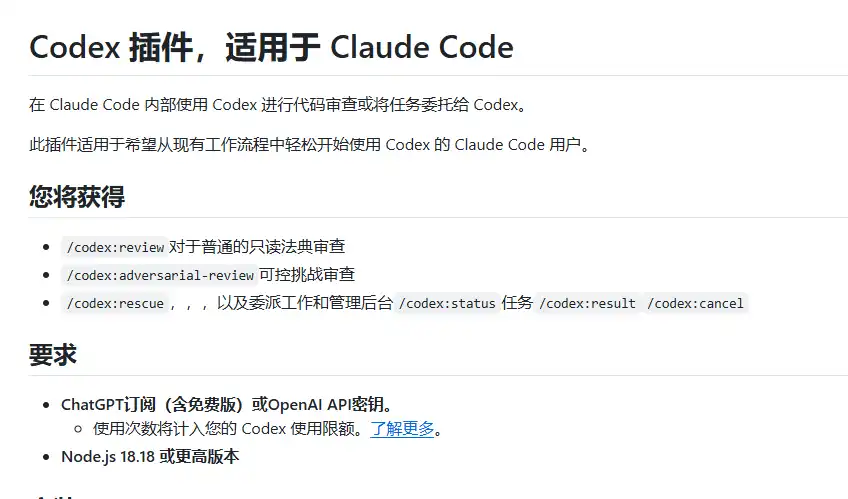
Empowered by this plugin, users can initiate a standard read-only code review using the /codex:review command to receive professional improvement suggestions from Codex. This dual verification mechanism effectively catches logical vulnerabilities that a single model might miss, adding a "double insurance" for code quality.

More uniquely, its "adversarial review" feature allows developers to use /codex:adversarial-review to actively request Codex to challenge existing design decisions. This mode is specifically designed to stress-test the rationality of system architecture, uncovering potential performance bottlenecks or security risks from a "fault-finding" perspective.

Additionally, the plugin introduces a task delegation mechanism, enabling users to transfer complex debugging or repair tasks to a Codex sub-agent via /codex:rescue. This collaborative model achieves automatic task distribution, allowing the primary model and auxiliary models to each focus on their respective areas of expertise.

github:https://github.com/openai/codex-plugin-cc

相關問答

QWhat is the name of the official OpenAI plugin that integrates with Claude Code?

AThe plugin is called codex-plugin-cc.

QWhat is the primary function of the /codex:review command in the new plugin?

AThe /codex:review command is used to initiate a standard read-only code review to get professional improvement suggestions from the Codex model.

QWhat unique feature does the /codex:adversarial-review command provide?

AThe /codex:adversarial-review command enables an 'adversarial review' function, which actively challenges existing design decisions to stress-test the system architecture and uncover potential performance bottlenecks or security risks.

QHow does the /codex:rescue command facilitate task management?

AThe /codex:rescue command allows users to delegate complex debugging or repair tasks to a Codex sub-agent, enabling a collaborative model where the main and auxiliary models work in their respective areas of expertise.

QWhere was the codex-plugin-cc project officially released?

AThe project was officially released by OpenAI on GitHub.

你可能也喜歡

俄罗斯议员呼吁“避免使用Telegram代币”,正值杜罗夫面临指控之际

俄罗斯国家杜马信息政策委员会副主席安德烈·斯温佐夫建议民众停止购买加密货币Gram,并呼吁在俄罗斯通信监管局和联邦安全局(FSB)就“通过Telegram渠道进行金融交易”发表官方评论前保持谨慎。他重申了俄当局对Telegram创始人帕维尔·杜罗夫提出的要求:在俄罗斯设立办事处、将用户数据存储于该国境内以及与“特殊服务部门合作”。 斯温佐夫的声明是在俄方指控杜罗夫协助恐怖主义活动后作出的。联邦安全局称,Telegram未能删除被乌克兰特工部门、恐怖及极端组织用于策划破坏、恐怖活动、大规模谋杀及网络诈骗的“众多频道、聊天群组和机器人”,并称这些行为导致了包括妇女儿童在内的大量人员伤亡及数十亿美元的物质损失。 俄罗斯调查委员会进一步说明,针对杜罗夫的刑事案件与拥有超过1300万用户的交友聊天机器人“Divechik/Leo”有关,FSB指控乌克兰特工利用该机器人伪装成女性招募俄罗斯年轻人。目前被法国当局拘押的杜罗夫于二月底表示,俄当局已以其协助恐怖主义为由对其提起刑事诉讼。 今年六月,杜罗夫宣布将其2019年创立的加密项目Gram恢复原名,并由Telegram全面接管。在对杜罗夫的指控公布后,Gram价格短暂下跌,7月29日从1.45美元跌至日内低点1.38美元,随后24小时内回升至约1.42美元。但其价格仍远低于5月8日超过2.70美元的峰值,年内跌幅达14%。

cryptonews.ru1 小時前

俄罗斯议员呼吁“避免使用Telegram代币”,正值杜罗夫面临指控之际

cryptonews.ru1 小時前

交易

現貨
活动图片