Hoskinson Blasts Ripple CEO Garlinghouse In Fresh Public Rant

bitcoinist發佈於 2026-01-19更新於 2026-01-19

文章摘要

Cardano founder Charles Hoskinson criticized Ripple CEO Brad Garlinghouse in a video on January 18, 2026, for supporting the US Clarity Act, which Hoskinson argues would expand the SEC's authority and harm the crypto industry. He claimed the bill, with 137 amendments, would treat all new projects as securities by default, forcing them to seek regulatory relief. Hoskinson called this worse than the current regulatory uncertainty, accusing Garlinghouse and others of compromising too easily. He warned that passing a flawed bill would make meaningful change nearly impossible, citing the long-standing Securities Exchange Act of 1933. Hoskinson also expressed concerns about the industry moving toward custodial wallets, KYC, and reversible transactions, which he believes betray crypto's original revolutionary ethos. At the time of reporting, XRP was trading at $1.95.

Cardano founder Charles Hoskinson took aim at Ripple CEO Brad Garlinghouse in a January 18, 2026 video, criticizing what he framed as an industry push to accept the US Clarity Act on terms that would expand the Securities and Exchange Commission’s authority over new projects.

Speaking on Jan 18, Hoskinson used a wide-ranging monologue on market fatigue, industry morale, and the mission behind Cardano and Midnight to zero in on a regulatory flashpoint: a bill he described as swollen by “137 amendments” and tilted toward the SEC. In his telling, the proposal would force crypto projects to “go beg and plead” for relief, with “all new projects” treated as securities by default.

Why Hoskinson Blasted Ripple CEO Garlinghouse

Hoskinson argued that the outcome would be a strategic own-goal, worse, in his view, than the policy uncertainty the industry has been trying to escape. “How is that any better than what Scary Gary [Gensler] gave us under Biden?” he said, referring to the SEC’s enforcement action against the crypto industry under former US President Joe Biden, before extending the critique to lobbying and political dealmaking more broadly.

Hoskinson’s sharpest remarks came when he cited unnamed industry figures he suggested are urging compromise, then called out Garlinghouse directly. “Still got people like Brad [Garlinghouse] saying well it’s not perfect but we just got to get something,” he said. “You know, it’s better than no clarity. Hand it to the same people who sued us. Hand it to the same people who put us out of business, who subpoenaed us, who put us in jail. That’s better. That’s what we fought for.”

He then framed the decision as effectively irreversible once legislated, invoking the long life of US securities law to argue that a flawed framework would calcify. “And tell me, how do we change it? Like we changed the Securities Exchange Act of 1933,” Hoskinson said. “93 years later, have we been able to change it? No. You pass it, you own it forever. Sorry, Brad. It’s not better than chaos. Take the chaos and fight for what’s right. Fight for integrity.”

While the Garlinghouse jab was the most explicit, Hoskinson placed it inside a larger narrative: that crypto’s purpose is being reduced to a lobbying-driven contest for acceptable market access rather than an attempt to redesign how value and identity are handled online.

He argued that the industry is at risk of normalizing a world of “custodial wallet” defaults, pervasive KYC, and reversible transactions, outcomes he associated with legacy power structures rather than the original “revolution” ethos.

“I didn’t sign up to hand the revolution to 15 banks,” he said, describing a future where transactions can be “frozen at a whim.” Hoskinson linked those concerns to a broader critique of technological surveillance and what he called the loss of individual “agency,” suggesting the industry’s incentive structure is pulling leaders toward comfort and access rather than confrontation.

The remarks landed amid a separate thread in his talk: a rebuke of what he called “toxic learned hopelessness” in crypto discourse. Hoskinson said he had stopped using X/Twitter, still broadcasting, but not reading or engaging—arguing that constant outrage and demands for instant announcements distort how long negotiations and product development actually work.

At press time, XRP traded at $1.95.
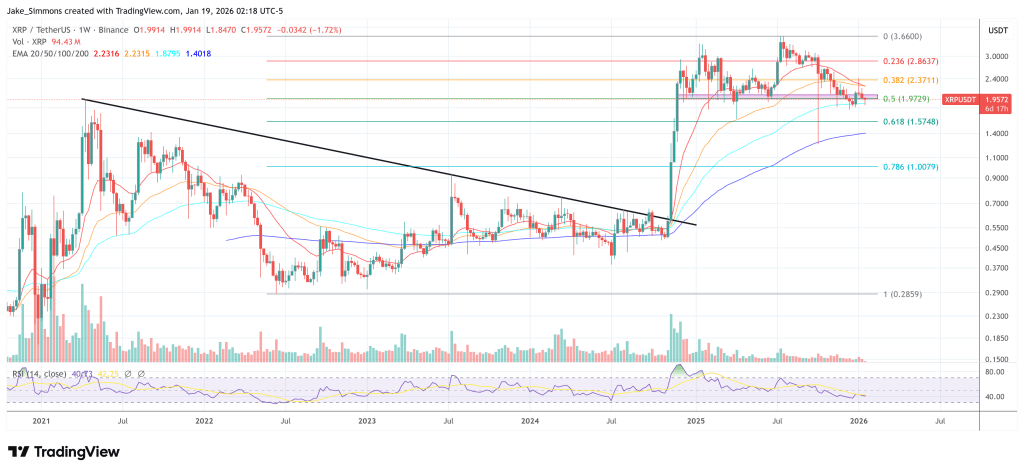
XRP falls into the red support zone again, 1-week chart | Source: XRPUSDT on TradingView.com

相關問答

QWhat was the main criticism Charles Hoskinson directed at Brad Garlinghouse in his January 18, 2026 video?

AHoskinson criticized Garlinghouse for advocating to accept the US Clarity Act despite its flaws, arguing that compromising with a bill that expands SEC authority and treats all new projects as securities by default is worse than regulatory chaos.

QAccording to Hoskinson, what negative outcomes would the proposed regulatory framework lead to for the crypto industry?

AHoskinson argued it would force crypto projects to beg for relief, treat all new projects as securities by default, normalize custodial wallets, pervasive KYC, and reversible transactions, ultimately handing control to traditional banks and allowing transactions to be frozen at a whim.

QWhy does Hoskinson believe that passing a flawed regulatory framework would be effectively irreversible?

AHe invoked the long life of US securities law, specifically referencing the Securities Exchange Act of 1933 which hasn't been changed in over 93 years, arguing that once such a framework is passed, the industry would be stuck with it forever.

QBeyond criticizing Garlinghouse, what broader concern did Hoskinson express about the crypto industry's direction?

AHe expressed concern that the industry's purpose is being reduced to a lobbying-driven contest for acceptable market access rather than a revolution to redesign how value and identity are handled online, and that leaders are being pulled toward comfort and access rather than confrontation.

QWhat did Hoskinson say about his own engagement with social media platform X/Twitter?

AHoskinson stated that he had stopped using X/Twitter in terms of reading or engaging with content, though he still broadcasts, due to what he called 'toxic learned hopelessness' and the distortion that constant outrage and demands for instant announcements create.

你可能也喜歡

SharpLink CEO:如何理解以太坊开发者刚刚突破 100 万?

作者Joseph Chalom从亚洲之行中感受到以太坊生态的活力与建设者的雄心。他指出,Electric Capital数据显示以太坊历史开发者总数已突破100万,其中约23.2万人在过去一年保持活跃,这是加密领域最大的技术人才库。 Chalom认为,加密领域的核心问题并非哪条链最快,而是顶尖建设者选择在哪里长期建设。以太坊的显著优势源于十年积累的制度、文化、经济和生态结构,使其成为可编程金融和互联网原生资本形成的默认操作系统。 这百万建设者正致力于解决行业最难的问题:核心协议的可扩展性、隐私、抗量子能力及智能体系统。例如,2026年预计进行的Glamsterdam升级将在不破坏核心原则下提升性能;同步可组合性技术让众多Rollup能像一条链般运作;以太坊在抗量子准备上也处于明显领先地位。 以太坊的深层护城河在于开发者聚集产生的复利效应,以及由此强化的可组合性、共享标准(如EVM和Solidity)和信任。其可信中立性(由超90万验证者保障)、模块化架构(如Base、Arbitrum等Rollup)以及吸引顶尖研究人员的文化,共同巩固了其作为大型机构首选互联网原生金融协调层的地位。Chalom坚信,以太坊的生态系统优势及其汇聚的人才,将持续推动下一代金融基础设施的变革。

marsbit12 分鐘前

SharpLink CEO:如何理解以太坊开发者刚刚突破 100 万?

marsbit12 分鐘前

SharpLink CEO:如何理解以太坊开发者刚刚突破 100 万?

SharpLink CEO分享了其对以太坊开发者总数突破100万的见解。根据Electric Capital数据,以太坊历史开发者总数已达1,012,824人,其中约23.2万人在过去一年保持活跃,构成了加密领域最庞大的技术人才库。 作者认为,加密领域的核心竞争并非单纯追求速度与低费用,而是顶尖建设者的选择。以太坊凭借十年积累的制度、文化、经济与生态结构,形成了难以复制的综合优势,已成为可编程金融和互联网原生资本的默认操作系统。 这百万开发者正致力于攻克行业最前沿的挑战:通过预计2026年的Glamsterdam升级提升核心协议可扩展性;通过同步可组合性技术让众多Rollup如一条链般协同工作;以及积极布局抗量子能力,以太坊基金会已成立专门团队推进,目标是2029年前完成迁移。 更深层的护城河在于网络效应:以太坊的可组合性让应用像乐高积木一样互操作,EVM和Solidity技能在数百个网络中通用,形成了“更多开发者→更多工具与流动性→更多应用”的飞轮。此外,由超90万验证者保障的可信中立性、模块化扩展架构以及顶尖的研究与文化氛围,共同巩固了其作为大型机构首选信任层的地位。 作者在访问亚洲以太坊社区后强调,以太坊的竞争优势在于汇聚了改变未来金融的建设者,其生态不仅是链上活跃,更在成为互联网原生金融的长期协调层。

链捕手16 分鐘前

SharpLink CEO:如何理解以太坊开发者刚刚突破 100 万?

链捕手16 分鐘前

从身份协议到AI入口,World的野心有多大?

近期,加密市场中的WLD成为焦点,其价格持续上涨,市值突破30亿美元。这一热度源于World项目正式进入“The Simple Plan”第三阶段,其发展逻辑正从早期的代币激励转向实用驱动。World的核心目标是构建全球“人格证明”网络,通过扫描虹膜的World ID解决互联网中验证真实人类身份的关键问题。随着生成式AI爆发,区分真人与AI变得日益紧迫。 World的落地场景正在拓宽,覆盖企业端、个人端及AI Agent端。企业方面,与Zoom等公司合作应对深度伪造;个人层面,瞄准社交与票务等场景的真人验证需求;AI Agent端则推出AgentKit,旨在建立人与AI间的可信授权框架,为未来AI经济奠定信任基础。 市场上涨背后是对“真人身份”稀缺价值的重估。在AI内容成本趋近零的未来,真人身份与行为可能成为稀缺资源。World的运营策略也更聚焦,资源集中于高价值城市以构建网络效应,同时下一代Orb设备将实现自助化以降低扩张成本。 宏观来看,World可能推动加密叙事从金融扩展到身份基础设施,身份或成为可组合资产。它也有望成为AI Agent经济的关键入口,解决Agent归属、可信与验证问题。World ID 4.0引入的费用机制开启了协议的收入来源,使其商业模式更趋清晰。 总之,WLD的上涨反映了市场对World在AI时代定位的认可——其野心是成为验证人类身份的关键入口。随着AI与人的界限模糊,掌握人格证明网络可能意味着掌握下一代互联网的重要枢纽。

marsbit1 小時前

从身份协议到AI入口,World的野心有多大?

marsbit1 小時前

交易

現貨
合約
活动图片