Hong Kong is reportedly exploring new rules that would allow insurance companies to invest in cryptocurrencies and the infrastructure sector as part of its efforts to become a leading hub for digital assets and support broader economic development.
Hong Kong Eyes Crypto Investments For Insurers
On Monday, Bloomberg reported that the Hong Kong Insurance Authority has proposed a set of new rules that could channel insurance capital into digital assets, including cryptocurrencies and stablecoins.
Hong Kong financial authorities have been actively working to develop a comprehensive framework that supports the expansion of the digital assets industry, part of its strategy to become a leading crypto hub in the world.
According to the December 4 presentation reviewed by Bloomberg, the insurance regulator would impose a 100% risk charge on crypto assets, requiring insurers to hold reserves equal to the value of their crypto investments.
Meanwhile, stablecoin investments would be approached differently under the new proposal, with risk charges based on the fiat currency the Hong Kong-regulated token is pegged to.
The Insurance Authority proposal, which could still change in the coming months, will reportedly be open for public consultation from February through April 2026, followed by legislative submissions.
The regulator told Bloomberg that it initiated the review of the risk-based capital regime this year with the main goal of supporting the insurance industry and broader economic development.
Notably, the insurance authority website states that there were 158 authorized insurers in Hong Kong as of June 2025. Moreover, the total gross premiums of the Hong Kong insurance industry were HK$635 billion, worth approximately $82 billion, in 2024.
“We are at the stage of gauging industry feedback and will also put the proposals for public consultation in due course,” a spokesperson for the regulator told the news media outlet.
The proposed insurer framework also addresses new infrastructure rules as the city seeks new growth. The regulator is reportedly planning capital incentives for investments in Hong Kong or on the mainland, as well as for projects listed or issued in the financial hub.
HK’s Stablecoin Landscape
As Bloomberg noted, the Hong Kong Monetary Authority (HKMA) is expected to grant the first batch of stablecoin issuer licenses at the start of 2026. However, some industry players believe that the regulator’s timeline could be delayed.
As reported by Bitcoinist, the People’s Bank of China (PBOC) and other top financial regulators recently affirmed that stablecoins do not qualify as legal tender in the mainland, as they don’t meet regulatory requirements and risk of being used for illegal activities.
Following the pronouncement, multiple analysts suggested that the PBOC’s recent declarations not only sank hopes that Beijing might have softened its stance on cryptocurrencies but also would affect Hong Kong’s efforts to become a hub for the stablecoin industry.
Earlier this year, the HKMA enacted the Stablecoins Ordinance, which directs any individual or entity seeking to issue a fiat-referenced stablecoin (FRS) in Hong Kong, or any Hong Kong Dollar-pegged token, to obtain a license from the regulator.
Multiple companies have applied for the license, with more than 30 applications filed this year, according to local news outlets. The list of applicants includes logistics technology firm Reitar Logtech and the overseas arm of Chinese mainland financial technology giant Ant Group.
According to the founding director of the Law, Innovation, Technology and Entrepreneurship Lab at the University of Hong Kong’s Faculty of Law, Brian Tang, Beijing’s stance means that applicants for Hong Kong’s stablecoin licenses would need to reconsider if the application submitted to the HKMA touches mainland China issuers and users.
A spokesperson stated that the HKMA was reviewing the applications and aimed to begin with a reduced number of licenses. However, they noted that even if Hong Kong proceeds with the original approval schedule, projects that involve the yuan or mainland Chinese institutions would likely be delayed.
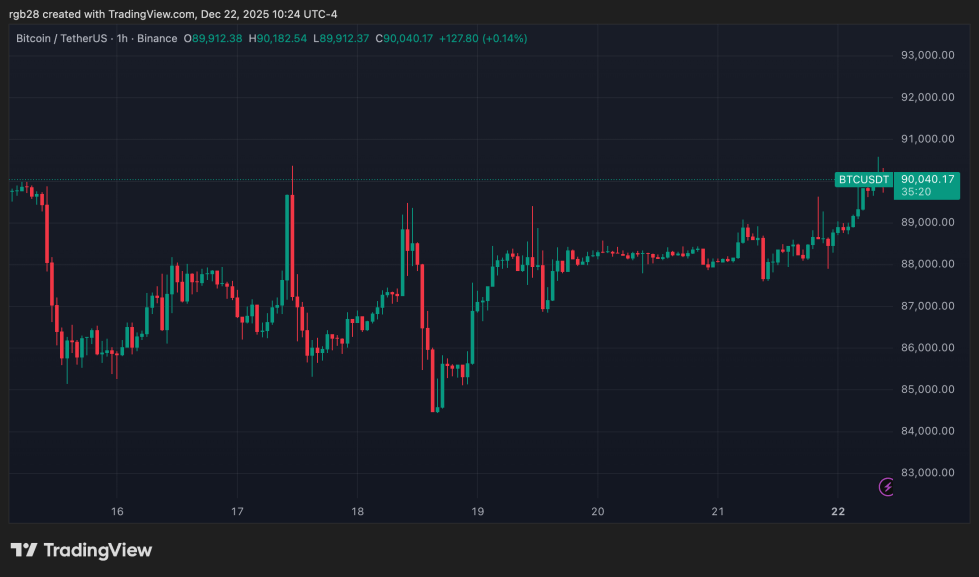
Bitcoin (BTC) trades at $90,040 in the one-week chart. Source: BTCUSDT on TradingView







