Gold Reaches Two-Month High, Exceeding $4,400, Amid Continued Accumulation of Reserves by China

cryptonews.ru發佈於 2026-08-11更新於 2026-08-11

文章摘要

Gold prices soared to over $4,400, hitting a two-month high, driven primarily by a weak U.S. jobs report and sustained gold accumulation by China. The July employment data, showing a loss of 23,000 jobs against expectations of an 80,000 gain, shifted market expectations away from near-term Federal Reserve rate hikes. This pushed Treasury yields down, boosting gold's appeal as a non-yielding asset. Technically, gold broke above its 100-day moving average, attracting new buyers. China provided further support, with the People's Bank of China extending its gold-buying streak to 21 months by adding roughly 20 tons in July. This consistent central bank demand, valued for gold's sovereignty from other governments, has underpinned prices. Geopolitical tensions in the Middle East, particularly involving the U.S. and Iran near the Strait of Hormuz, added a safe-haven bid. Analysts like Peter Schiff noted gold breaking its recent negative correlation with oil, suggesting both could rise together on inflation fears amid economic weakening. The rally's sustainability hinges on upcoming U.S. inflation data. A softer CPI could fuel further gains toward $4,500, while hotter data could reverse the rally by strengthening the dollar and yields.

The price of gold rose to approximately $4,434–$4,435 before sellers finally entered the game. By 1:00 PM Eastern Time (EDT) on Tuesday, August 11, the spot price of gold was $4,382.43, putting the market in wait-and-see mode for a breakout.

Disappointing Jobs Report Overturns Fed Expectations

The spark was the U.S. July jobs report. The economy lost 23,000 jobs, while economists had expected about 80,000 new jobs, and significant downward revisions made the previous months' figures substantially weaker.

This labor market miss quickly shifted expectations regarding Federal Reserve policy. Traders scaled back bets on another near-term rate hike, which led to a decline in Treasury yields and gave gold fresh arguments against interest-bearing assets.

Holding gold does not generate income, so rising yields are one of the most reliable factors pressuring the gold price. When yields fall, this disadvantage becomes less significant, and capital has fewer reasons to stay in bonds and cash.
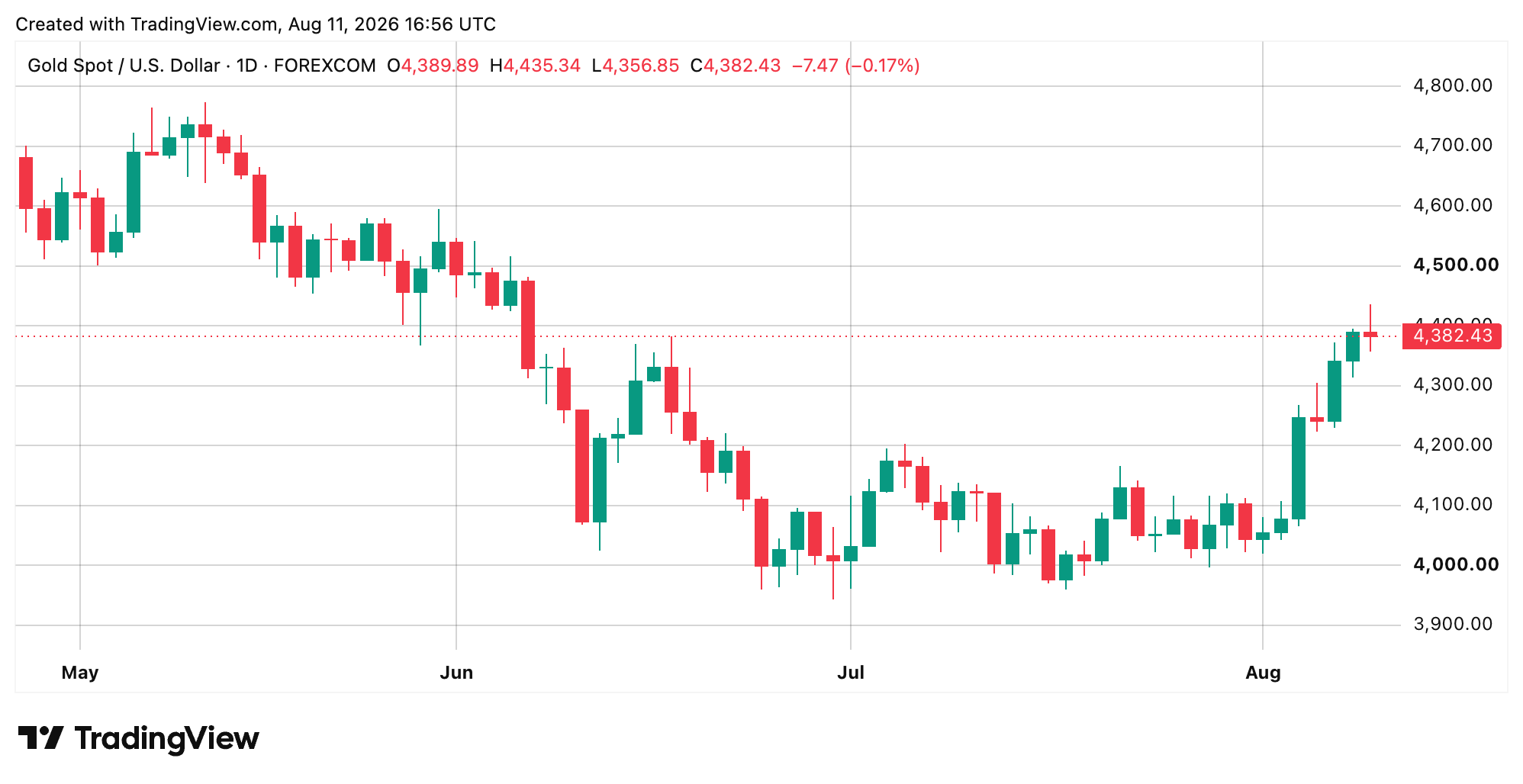
Gold Chart on August 11, 2026, at 1:00 PM Eastern Time (EDT).

The price rise also allowed gold to decisively break through the 100-day moving average—a technical indicator that traders closely watch. Breaking this barrier attracted new buyers to the market after the price of gold had tumbled to $3,966 during the summer correction.

China Continues to Accumulate Gold

Another powerful supporting factor was China. In July, the People's Bank of China extended its gold-buying campaign to 21 consecutive months, purchasing about 20 metric tons, or roughly 640,000 ounces.

By the end of July, China's official gold reserves had grown to approximately 76.08 million ounces. Chinese gold-backed exchange-traded funds also attracted new investments, leading to increased investor demand in addition to the central bank's persistent accumulation.

Central banks value gold for its independence from other governments or currency issuers. This steady institutional demand has repeatedly provided support for prices, even when a strengthening U.S. dollar should have exerted more downward pressure on gold prices.

Geopolitical Risks Keep Buyers in the Market

Ongoing tensions between the U.S. and Iran added another reason to keep gold on hand, especially since a conflict in the Strait of Hormuz could disrupt global oil supplies and rekindle inflation fears.

As a result, gold finds itself in the familiar situation of dual pressures. Expensive oil could revive inflation and lead to tighter monetary policy, which would hurt the gold price, while geopolitical instability simultaneously sends safe-haven capital rushing straight to the metal. Gold advocate and economist Peter Schiff believes this trend will continue.

"Gold and silver prices rose today alongside a 5% rise in oil prices," Schiff wrote on social media platform X. "The metals are shedding the recently established negative correlation with oil. Gold and oil should rise together as inflation pushes the consumer price index and bond yields higher, while the U.S. economy weakens as jobs are cut."

In another post on X, Schiff continued:

"Gold is now above $4,400. Silver is approaching $66. The market is signaling something to you. Are you listening?"

Inflation Data Could Either Bolster or Derail the Rally

The next decisive moment will be the U.S. inflation data. A more moderate Consumer Price Index (CPI) could further weaken the case for Fed tightening and give gold another chance to turn the recent breakout zone into sustainable support.

Higher readings could quickly unravel this situation, pushing Treasury yields and the U.S. dollar higher. Traders are now watching the $4,500 level and gold's 200-day moving average to see whether this recovery will continue or become another failed breakout after a rapid rally.

end-content

相關問答

QWhat was the key factor that triggered the recent rise in gold prices according to the article?

AThe key trigger was the disappointing U.S. July employment report, which showed a loss of 23,000 jobs against expectations of a gain, leading traders to scale back expectations for near-term Fed rate hikes.

QHow has China's behavior contributed to the support for gold prices?

AChina's central bank has extended its gold-buying campaign for 21 consecutive months, purchasing around 20 tons in July. Official reserves have grown to approximately 76.08 million ounces, providing consistent institutional demand.

QWhat technical level did gold break through, attracting new buyers to the market?

AGold confidently broke through the 100-day moving average, a key technical indicator watched by traders, attracting new buyers after a summer correction.

QWhat geopolitical risk is mentioned as a reason for investors to hold gold?

AOngoing U.S.-Iran tensions in the Strait of Hormuz region are cited, as a potential disruption to global oil supplies could reignite inflation fears and drive safe-haven capital into gold.

QAccording to the article, what upcoming U.S. data could either reinforce or derail the gold rally?

AUpcoming U.S. inflation (CPI) data is the next critical test. A more moderate CPI could weaken the case for Fed tightening, while higher figures could push Treasury yields and the dollar up, threatening the rally.

你可能也喜歡

文生图Scaling新变量,被字节Seed团队发现了

字节Seed团队研究发现,文生图模型的性能提升不仅依赖于模型、数据和算力的扩展,更关键的是训练图像所配文本描述(Caption)中携带的、可被模型有效利用的视觉信息量。传统上增加描述长度并不能持续提升模型表现,因为新增文本常为解释或改写,并未增加明确的视觉监督信息。 团队提出两个衡量Caption信息量的指标:Grounded Perplexity Gain(GPG,衡量图像对文本预测能力的提升)和Effective Detailness(ED,衡量文本对图像属性的准确覆盖)。实验表明,在固定训练设置下,扩散模型的最终训练损失与Caption的GPG和ED值呈现高度相关的规律性,而非与文本长度相关。 基于此,团队设计了结构化提示(Structured Prompt, SP),以JSON格式明确组织图像的全局信息、元素细节及其相互关系,减少了自然语言描述中的歧义,提升了文本条件向模型传递视觉信息的能力(即Diffusability)。同时,他们通过训练大型语言模型(LLM)作为Prompter,使其能将用户简短指令转化为高质量的结构化提示(即提升Promptability),并辅以迭代修正循环来优化生成结果。 最终,在相同骨干模型(Qwen-Image)和训练资源下,采用结构化提示接口的系统在复杂组合、空间关系和世界知识等生成任务上显著优于仅使用自然语言描述的训练方式。这项工作表明,提升文本条件的信息含量和组织明确性,是推动文生图模型能力前进的一个重要新维度。

marsbit8 分鐘前

文生图Scaling新变量,被字节Seed团队发现了

marsbit8 分鐘前

加密市场降温,Neutrl 如何将代币化股票变成新「收益矿场」?

加密市场降温时,稳定币需求增加,但合成美元(如Ethena等)的收益往往因依赖加密投机活动(资金费率、基差等)而收窄。Neutrl协议试图解决这一结构性错配,将其市场中性(delta-neutral)策略延伸至代币化股票和上市前股份领域。 核心逻辑在于:股票锁仓(如IPO前股份、员工解锁等)的供给节奏独立于加密市场周期,且存在折价交易机会。随着股票永续合约市场快速发展(日成交量从8400万美元飙升至55亿美元),为这些锁仓股份提供了流动性对冲工具,使得折价套利成为可能。 一笔典型交易示例:以约15%的折价买入锁仓股票(锁定期约6个月),同时做空等额的股票永续合约对冲方向性风险。持有期间,空头仓位可获得资金费率收益(观测期内年化约10.9%)。六个月持有期整体收益约20.5个百分点(15%来自入场折价,5.5%来自资金费率),且不依赖股价涨跌。 当前,符合条件的股票锁仓市场规模巨大(估计达482亿至1.74万亿美元),远大于加密解锁市场,且股票永续市场尚处早期,套利机会丰厚。未来,这一套利框架可扩展至其他能生长出流动性做空工具的市场(如商品、利率等),随着资产代币化进程持续获得收益。Neutrl的策略旨在在加密市场平静期,为稳定币持有者提供独立于加密周期的收益来源。

marsbit32 分鐘前

加密市场降温,Neutrl 如何将代币化股票变成新「收益矿场」?

marsbit32 分鐘前

交易

現貨
活动图片