Author: Wang Lijie
We are standing at multiple historical inflection points, witnessing the arrival of a new normal that is more intense and disruptive than we imagined. The three pillars that have supported global economic prosperity over the past forty years—demographic dividend, globalized division of labor, and inclusive technological progress—are simultaneously collapsing before our eyes. This is not alarmism but a reality we must confront. The next decade, from 2026 to 2035, will bring earth-shattering changes that will profoundly impact our wealth landscape and investment strategies.
"4B Movement" and "Birth Strike": Deep Cracks in the Social Fabric
Let's first examine a startling phenomenon: the cliff-like decline in global fertility rates. This is not merely a numerical change but a signal of profound transformation in the social structure.
Take South Korea as an example. In 2023, its total fertility rate plummeted to a staggering `0.72`. This means that, on average, each woman gives birth to only `0.72` children in her lifetime. This level of decline far exceeds normal fertility rate fluctuations and points directly to a shaking of the societal foundations. The situation in neighboring Japan is also concerning. Although its fertility rate is slightly higher than South Korea's, its projected number of births in 2025 is expected to fall below `670,000`, the lowest since records began in 1899, and the decline is happening much faster than the government's most pessimistic predictions.
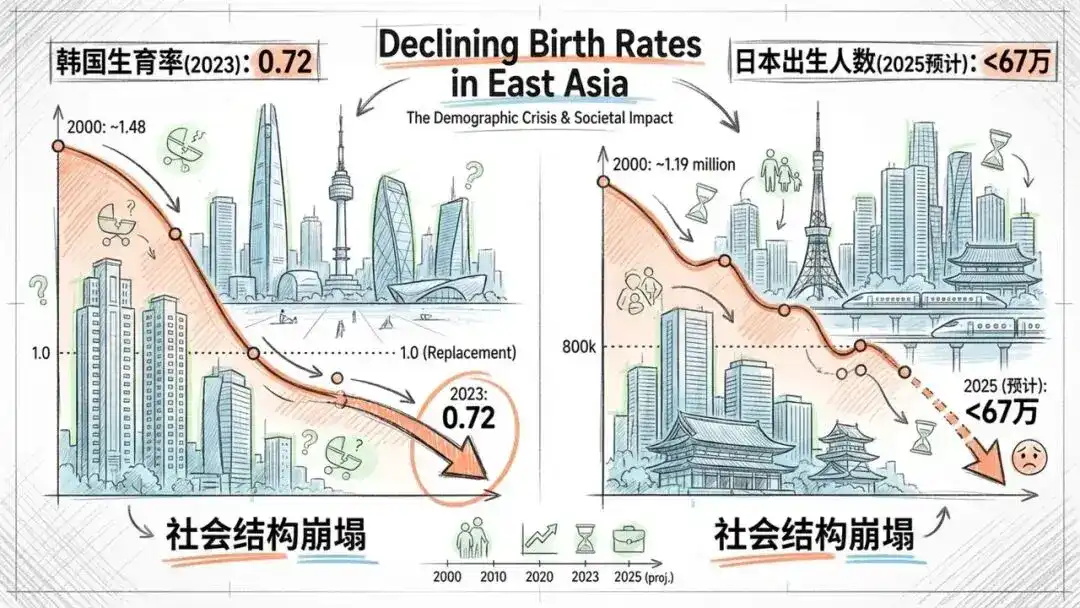
Behind this trend lies a complex interplay of socio-economic factors. In South Korea, young women have launched a significant "4B Movement"—meaning "No dating, no sex, no marriage, no children". This sounds like a plot from a science fiction novel, yet it is happening right now.
This "4B Movement" is essentially a "reproductive strike" against the patriarchal capitalist society. Under the multiple pressures of workplace gender discrimination, "widower-style parenting," and social stereotypes, South Korea's young women have chosen this form of rebellion. When they believe that upward mobility is impossible and even maintaining a decent life is difficult, "cutting off the lineage" becomes a rational, final act of defiance.
The consequences of this phenomenon are devastating. South Korea's aging rate is the fastest in the world, with projections indicating that people aged 65 and over will make up half the population by 2065. This not only means immense pressure on the pension system but will also deal a comprehensive blow to national finances, the healthcare system, and even defense manpower. In Japan, young people are generally in a state of "low desire"—not marrying, not having children, no longer believing that hard work leads to a good life, and instead pursuing low-cost personal entertainment. This is a form of "gentle despair," a Buddhist-like lying flat (acceptance) attitude towards life.
Economic Nihilism and Climate Anxiety: Reshaping the Life Outlook of the Younger Generation
You might think this is unique to East Asian countries. However, Western developed nations are also experiencing similar demographic trends, albeit for slightly different reasons.
熱門幣種推薦












相關問答
QWhat is the '4B Movement' in South Korea and what are its underlying causes?
AThe '4B Movement' in South Korea is a social phenomenon where young women are choosing 'no dating, no sex, no marriage, and no children'. It is essentially a 'reproductive strike' against a patriarchal capitalist society. The underlying causes include workplace gender discrimination, the burden of 'widow-style parenting' (where fathers are absent from childcare responsibilities), and rigid social stereotypes. Faced with these pressures and the difficulty of achieving upward mobility or even a decent standard of living, many young women see forgoing family life as a rational form of protest.
QAccording to the article, why will the massive intergenerational wealth transfer benefit digital assets like cryptocurrency?
AThe article argues that an estimated $84 trillion will transfer from the Baby Boomer generation to Millennials and Gen Z. Unlike their parents, who invested in real estate and blue-chip stocks, the younger generation are 'digital natives' who distrust the traditional financial system due to experiences like the 2008 crisis and quantitative easing. They view assets like Bitcoin as a hedge against fiat currency devaluation and a form of 'silent protest'. With high-risk appetites and a desire for life-changing returns, they are more likely to channel this inherited wealth into digital assets, which offer liquidity, global access, and high growth potential, unlike the unaffordable traditional real estate market.
QWhat is the 'Technological Cantillon Effect' mentioned in the context of AI advancement?
AThe 'Technological Cantillon Effect' describes how the wealth generated by AI and robotics will not be distributed equally but will instead disproportionately to those who own the core means of production—the tech giants and early investors who control computing power, proprietary data, and algorithm models. Similar to how new money from a central bank benefits those closest to it first, the 'new wealth' from AI-driven productivity gains will first manifest as soaring profits and stock prices for these companies. This creates a 'capital-biased technological progress' where the return on capital far exceeds the return on labor, exacerbating social inequality as wages fail to keep up with the inflation of assets.
QHow are prediction markets like Polymarket and Kalshi changing financial strategies?
APrediction markets are transforming financial strategies by shifting focus from traditional 'value investing' to 'event博弈' (speculative gaming). They allow users to place bets on real-world events like election outcomes or Fed decisions. For institutions, they serve as precise hedging tools; for example, an investor worried about a candidate's impact on a sector can hedge by betting on that candidate's victory. These markets also act as powerful information discovery mechanisms, aggregating collective wisdom through real-money bets, often proving more accurate than polls. However, they also pose risks of 'financial nihilism', where capital flows into zero-sum gambling instead of productive enterprise, and 'reflexivity', where large bets could potentially manipulate real-world outcomes.
QWhat is the recommended 'Extreme Barbell Strategy' for asset allocation in the coming decade?
AThe recommended 'Extreme Barbell Strategy' involves a highly polarized allocation to navigate the anticipated volatility. On the offensive end, it advises going long on 'technological monopoly' and 'digital scarcity': investing in tech giants that control AI infrastructure (compute, data, models) and core digital assets like Bitcoin to capture the 'Technological Cantillon Effect' and generational wealth transfer. It also suggests looking for residual 'demographic dividends' in emerging markets like India. On the defensive end, it requires hedging against 'chaos' and 'event risk': using prediction markets for targeted hedging of geopolitical events, holding physical assets like prime real estate in supply-constrained cities as a safe haven for 'old wealth', and maintaining gold reserves to hedge against sovereign debt crises. The strategy explicitly advises avoiding labor-intensive service sectors and traditional consumer stocks reliant on population growth.
你可能也喜歡



交易
熱門文章
什麼是 USDC(WORMHOLE)
USD Coin (Wormhole):全面概述 介紹 在快速發展的加密貨幣世界中,USD Coin (Wormhole),簡稱$USDC(Wormhole),在DeFi(去中心化金融)領域中脫穎而出,成為一項開創性解決方案。USD Coin (Wormhole)在包括Solana在內的多個區塊鏈平台上運行,不僅僅是美國美元的數字代表。它體現了現代金融的創新精神,通過先進的Wormhole協議實現無縫的跨鏈交易和各類區塊鏈生態系統之間的增強互操作性。 什麼是USD Coin (Wormhole)? USD Coin (Wormhole)是一種美國美元的代幣化版本,旨在促進不同區塊鏈網絡之間無摩擦的交易。其主要目的是增強流動性並提升DeFi生態系統的功能。通過利用Wormhole協議,建立一個穩固的跨鏈通信網絡,使用者可以輕鬆地在各個平台之間轉移USDC代幣。這一跨鏈能力標誌著加密貨幣使用上的重大進步,促進了一個更聯繫緊密且高效的生態系統,使資產能在不同區塊鏈之間自由流動。 USD Coin (Wormhole)的價值主張不僅在於其與美國美元掛鉤的穩定性,還在於其能夠填補不同區塊鏈環境之間的鴻溝。這一創新方式促進了用戶和開發者更高水平的參與,為去中心化金融中的新興應用鋪平了道路。 誰是USD Coin (Wormhole)的創造者? USD Coin (Wormhole)的起源與Wormhole網絡密切相關,該網絡由Jump Crypto開發。雖然具體的個別創造者並未廣泛記錄,但Jump Crypto在推進區塊鏈技術及其在金融領域應用方面的參與是值得注意的。通過創建Wormhole網絡,Jump Crypto在促進跨鏈資產轉移方面發揮了重要作用,提升了加密貨幣使用的效率和多樣性。 誰是USD Coin (Wormhole)的投資者? USD Coin (Wormhole)的成功得到了幾個著名基金和組織在加密貨幣領域的投資支持。主要投資者包括: Coinbase Ventures:這是一個由業界領先的加密貨幣交易所Coinbase支持的併購風險投資部門,為有前景的區塊鏈項目提供必要的資本和戰略支持。 Arrington XRP Capital:專注於數位資產,Arrington XRP Capital認識到像USD Coin (Wormhole)這樣的創新項目的潛力,並相應地進行了投資以支持其發展。 Jump Trading:作為Jump Crypto的母公司,Jump Trading不僅帶來投資,還為Wormhole項目提供了豐富的交易技術和市場動態專業知識。 USD Coin (Wormhole)是如何工作的? USD Coin (Wormhole)的運作框架設計精巧,以促進有效的跨鏈交易,最大化安全性和效率。以下是它的簡化工作概述: 資產鎖定:當用戶希望將USDC從一個區塊鏈轉移到另一個區塊鏈時,他們首先會在源區塊鏈上鎖定其代幣。此過程確保資產安全,並為後續的燃燒或移動做好準備。 代幣鑄造:在鎖定代幣後,目的區塊鏈上會鑄造出等量的USDC。這使得用戶可以在新平台上訪問其資金,體現了Wormhole協議所實現的靈活性。 跨鏈轉移:Wormhole協議有效促進整個轉移過程。它確保一旦在目標鏈上鑄造USDC,等量的代幣會在源鏈上被燃燒。結果是在兩個不同的區塊鏈環境之間無縫轉移價值。 這種跨鏈方法論確保交易保持安全和透明,顯著提高了不同DeFi生態系統的流動性。 USD Coin (Wormhole)的時間軸 了解USD Coin (Wormhole)的演變為其在加密貨幣領域的意義提供了重要背景。以下是該項目歷史上的重要里程碑: 2021年:Wormhole項目啟動,建立了跨鏈資產轉移的框架,為USD Coin (Wormhole)的發展奠定了基礎。 2022年:Wormhole網絡遭遇重大挑戰,由於安全漏洞導致3.25億美元的盜竊。然而,該事件在稍後由Jump Crypto解決並退還,展示了該項目對安全性和透明度的承諾。 2023年:USD Coin (Wormhole)與Circle的跨鏈轉移協議(CCTP)整合,提高了其跨鏈轉移的能力,進一步鞏固了其在DeFi生態系統中的地位。 2024年:Wormhole網絡的持續開發和擴展仍在進行,旨在提高USD Coin (Wormhole)的實用性和覆蓋範圍,以及增強其運作框架。 主要特徵 USD Coin (Wormhole)的成功可歸因於幾個使其與其他加密貨幣產品區分開來的關鍵特徵: 跨鏈互操作性 USD Coin (Wormhole)的核心是其促進多個區塊鏈網絡之間無縫轉移的能力。這種互操作性是去中心化金融的基石,使各種平台能相互交互,從而加速金融服務的進化。 安全性 Wormhole部署了一個設計精良的Guardian Network,由節點驗證者組成,以確保安全的跨鏈交易。這種集體監督減少了欺詐風險,並為用戶提供信心,保證其資產在跨鏈轉移過程中受到保護。 流動性增強 通過使USDC在不同區塊鏈之間自由流通,USD Coin (Wormhole)增強了DeFi生態系統的流動性。這種增強的流動性可以促進更高效的交易,改善定價策略,並改善涵蓋各種數位資產的市場動態。 結論 USD Coin (Wormhole)是區塊鏈領域的一項關鍵創新,增強了去中心化金融(DeFi)的能力,並建立了更緊密的金融生態系統。憑藉其穩健的跨鏈交易框架、安全性特徵以及來自知名投資者的強力支持,USD Coin (Wormhole)在加密貨幣的未來中注定要發揮關鍵作用。 隨著數字金融格局的持續演變,USD Coin (Wormhole)不僅擁抱區塊鏈網絡之間互聯互通的未來,還重申了代幣化和區塊鏈技術在轉變我們對數位世界中的價值認知和利用的力量。通過駕馭跨鏈功能的複雜性,它展現了在加密貨幣世界中促進金融包容性和創新的精緻方法。
352 人學過發佈於 2024.04.03更新於 2024.12.03

什麼是 W$C
World$tateCoin ($W$C):新興加密貨幣項目的全面探索 介紹 在不斷演變的加密貨幣風景中,World$tateCoin ($W$C)作為一個旨在利用web3技術打造獨特數字生態系統的項目悄然崛起。隨著傳統的在線互動模型經歷重大轉變,World$tateCoin力求在這個新興的第三代互聯網中樹立自己的地位。本文將深入探討World$tateCoin的細節,提供該項目的概述、目標及其對web3空間的潛在影響。 什麼是World$tateCoin ($W$C)? World$tateCoin ($W$C)被設計為一種加密貨幣,可以促進web3環境中的無縫交易。該項目旨在創建一個去中心化的平台,以便用戶能夠與各種web3應用相互作用,$W$C意在簡化用戶體驗並提高數位服務的可及性。儘管該項目渴望成為web3生態系統的核心部分,但對其具體目標和用例的詳細見解仍然有限,這引發了對其在快速發展的數字背景下的潛在角色和效用的質疑。 web3的本質圍繞著去中心化和賦予用戶更大的控制權,讓他們能夠更好地進行在線互動。World$tateCoin意圖與這些原則保持一致,儘管貨幣的具體應用和功能仍在社區內討論之中。 World$tateCoin ($W$C)的創始人是誰? 在探索World$tateCoin的起源時,關於其創始人的信息仍然難以捉摸。截至目前,沒有公開的資料能夠識別出項目背後的個人或組織。這種不明朗可能會對該項目的可信度造成陰影,但在加密貨幣框架內對創新的承諾可能會成為其未來採用的驅動力。 缺乏可識別的領導層可能會導致與信任和透明度相關的障礙,而這些元素對於在加密空間建立強大社區至關重要。 World$tateCoin ($W$C)的投資者是誰? 目前的研究未揭示任何具體的投資者或支持組織參與World$tateCoin。新興的加密貨幣項目通常會吸引隱秘的投資,或者在其初期階段以簡約的財務結構運作。圍繞投資支持和資金方法的模糊性可能會影響該項目的可持續性和增長前景。 在評估加密貨幣領域的新項目時,投資者通常會尋求有關財務支持和來自已建立實體的透明度。缺乏這些信息可能會使潛在用戶和對World$tateCoin未來感興趣的利益相關者需要採取謹慎的態度。 World$tateCoin ($W$C)是如何運作的? World$tateCoin的運作機制基於去中心化的原則,這是web3技術的標誌。通過直接促進用戶之間的交易,而不需要中介的介入,$W$C旨在增強信任和效率。 然而,詳細說明World$tateCoin與其他加密貨幣區別開來的獨特功能和運作框架的文檔顯著稀少。這種信息的缺乏使得理解$W$C在更廣泛的web3生態系統中的運作及其所能為用戶和開發者帶來的獨特建議變得困難。 儘管如此,允許去中心化交易的基本目標仍然帶來了一個更自由的金融環境的希望,前提是該項目能實現其在實施健全機制和用戶友好界面方面的期望。 World$tateCoin ($W$C)的時間表 構建一個涵蓋World$tateCoin歷史進展的時間表存在挑戰,因為缺乏關鍵事件和里程碑的重要文檔。儘管如此,可以想像出一個假設性的階段的大致序列,構成該項目的前進道路: 初步概念(日期未知):在web3技術的更廣泛背景下,概念化World$tateCoin框架。 開發階段(日期未知):技術開發和編碼過程的開始。 社區參與(日期未知):通過外展活動吸引潛在用戶和利益相關者,以促進對該項目的社區興趣。 啟動目標(日期未知):宣布預期的啟動日期,這取決於開發和測試階段的進展。 由於缺乏有根據的日期和圍繞這些階段的細節,利益相關者需要保持警惕並與該項目的通訊保持聯繫,以獲取有關其發展軌跡的最新信息。 關於World$tateCoin ($W$C)的關鍵主題 隨著該項目的展開,某些關鍵主題凸顯出World$tateCoin的潛力和抱負: 去中心化:推動該項目的核心理念,旨在促進用戶之間的直接互動。 Web3整合:目標是反映web3原則,使用戶能夠無縫訪問一系列數字服務。 數字貨幣:作為一種促進基於互聯網的交易的貨幣,World$tateCoin旨在向web3市場注入額外的流動性。 信息匱乏的挑戰:有關該項目的基礎、創始人和運作方法的詳細信息顯著缺乏,這要求開發者提高透明度,以增強社區的信任。 結論 World$tateCoin ($W$C)在加密貨幣和web3整合的刺激但不確定的領域內定下了基礎。雖然它旨在培養去中心化的環境,但有關其創始人、投資者和具體功能的有限信息為潛在的利益相關者和用戶帶來挑戰。 在動態的加密貨幣世界中,透明度、參與度和結構良好的通訊對World$tateCoin等項目成功至關重要。隨著環境持續演變,利益相關者將期待該項目如何穩固其在web3敘事中的地位,並為數字生態系統的持續變革作出貢獻。
301 人學過發佈於 2024.04.05更新於 2024.12.03
如何購買W
歡迎來到HTX.com!在這裡,購買Wormhole (W)變得簡單而便捷。跟隨我們的逐步指南,放心開始您的加密貨幣之旅。第一步:創建您的HTX帳戶使用您的 Email、手機號碼在HTX註冊一個免費帳戶。體驗無憂的註冊過程並解鎖所有平台功能。立即註冊第二步:前往買幣頁面,選擇您的支付方式信用卡/金融卡購買:使用您的Visa或Mastercard即時購買Wormhole (W)。餘額購買:使用您HTX帳戶餘額中的資金進行無縫交易。第三方購買:探索諸如Google Pay或Apple Pay等流行支付方式以增加便利性。C2C購買:在HTX平台上直接與其他用戶交易。HTX 場外交易 (OTC) 購買:為大量交易者提供個性化服務和競爭性匯率。第三步:存儲您的Wormhole (W)購買Wormhole (W)後,將其存儲在您的HTX帳戶中。您也可以透過區塊鏈轉帳將其發送到其他地址或者用於交易其他加密貨幣。第四步:交易Wormhole (W)在HTX的現貨市場輕鬆交易Wormhole (W)。前往您的帳戶,選擇交易對,執行交易,並即時監控。HTX為初學者和經驗豐富的交易者提供了友好的用戶體驗。
672 人學過發佈於 2024.12.10更新於 2026.06.02

相關討論

