CLARITY Act edges closer – But ONE disagreement is holding everything up

ambcrypto發佈於 2026-03-18更新於 2026-03-18

文章摘要

The CLARITY Act, a key piece of U.S. crypto market structure legislation, is advancing but remains stalled due to a major disagreement over interest-bearing stablecoins. While the crypto industry supports such products, traditional banks oppose them, fearing capital flight from deposits. Despite this impasse, political pressure is mounting, notably from President Donald Trump, who publicly demanded the bill's swift passage to maintain U.S. financial leadership and prevent innovation from moving abroad. The crypto community expresses growing confidence in the bill's eventual success, with Polymarket bettors assigning a 62% probability of it passing in 2026. The legislation aims to provide regulatory clarity and unlock institutional investment, but disagreements continue to delay progress.

The GENIUS Act, passed in 2025, created a regulatory framework for U.S. stablecoins. However, clear rules for the rest of the crypto market are still missing.

That may soon change, as the recent data from Santiment suggested the Digital Asset Market CLARITY Act is moving closer to the final stage of the legislative process.

If passed, the bill could mark a turning point for institutional investment in crypto, providing clearer regulatory guidance for large investors.
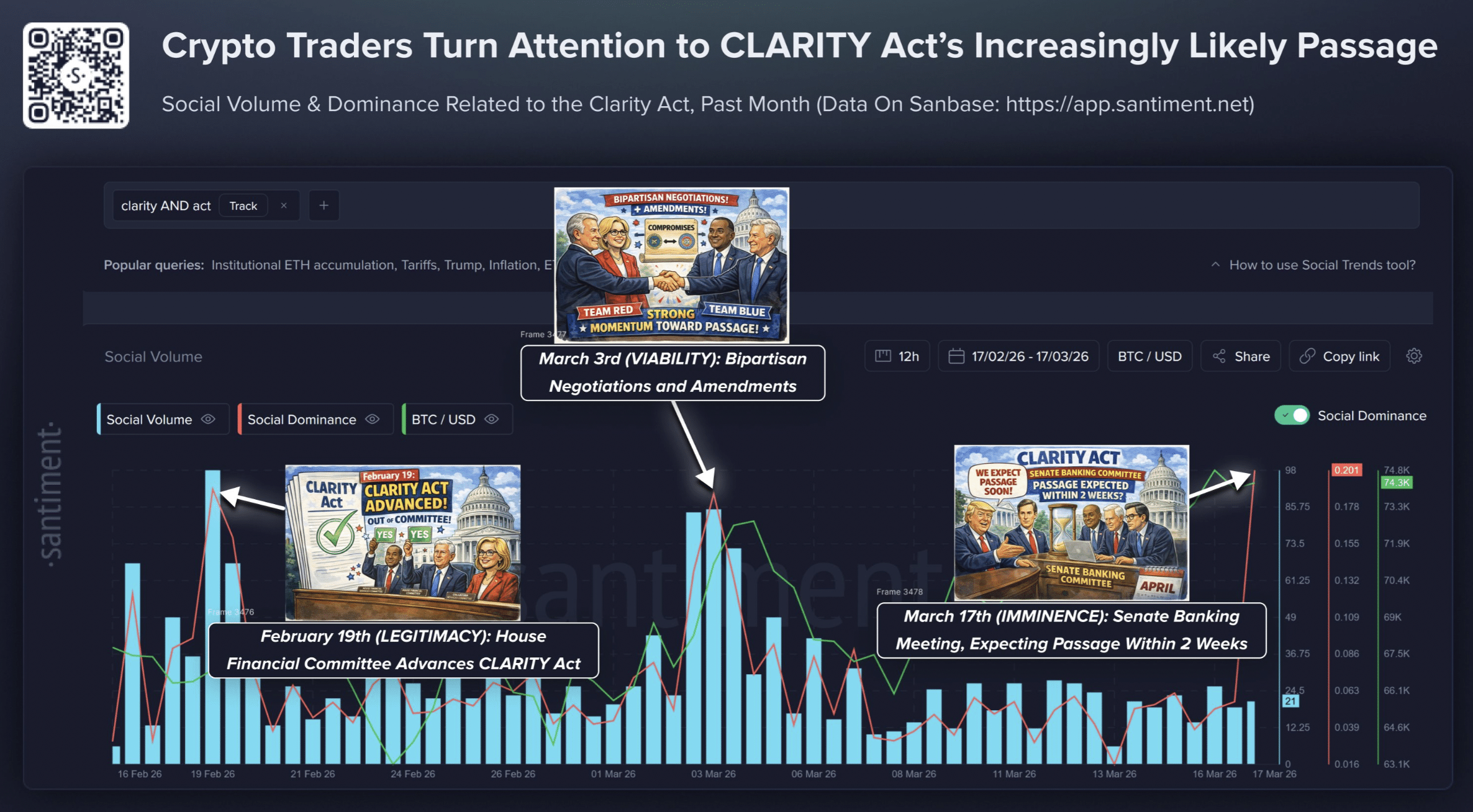
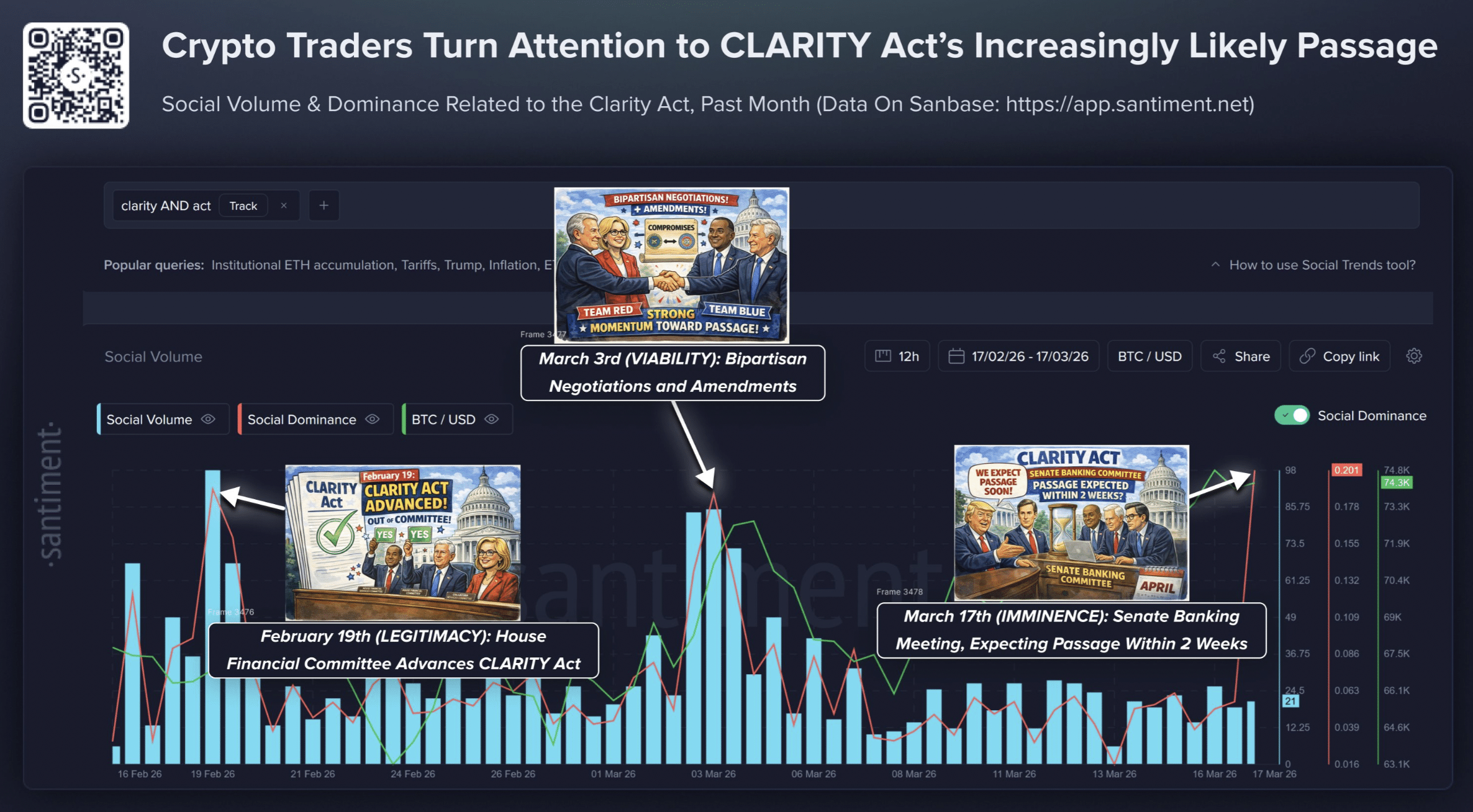
Source: Santiment/X

CLARITY Act talks continue

Talking about the same at the DC Blockchain Summit on the 17th of March, Senate Banking Committee Chair Tim Scott said the bill is still delayed due to a disagreement over interest-bearing stablecoins.

While the crypto industry supports such products, banks fear they could pull large amounts of money away from traditional deposits.

That said, Senators Thom Tillis and Angela Alsobrooks are currently reviewing these concerns and pushing for stronger safeguards if crypto products function like bank services.

This cautious approach has slowed the bill’s progress. Meanwhile, political pressure is growing, especially after U.S. President Donald Trump urged lawmakers to pass the Act quickly.

President Trump demands CLARITY Act passage

On the 4th of March, U.S. President Donald Trump wrote in a post on Truth Social,

The Genius Act is being threatened and undermined by the Banks, and that is unacceptable — We are not going to allow it. The U.S. needs to get Market Structure done, ASAP.

Donald Trump’s statement has shifted the debate around the CLARITY Act from a technical policy issue to a broader economic and strategic concern.

He argues that without clear crypto regulations, capital and innovation could move to countries like China, making the bill important for maintaining U.S. financial leadership.

Trump also criticized major banks for resisting crypto reforms, despite reporting record profits, suggesting they are prioritizing their own interests.

By linking the CLARITY Act to his goal of making the U.S. the global crypto capital, he has increased pressure on lawmakers to move the legislation forward.

Crypto community stands confident

The confidence was also reflected in the crypto community, as noted by Senator Kevin Cramer when he said,

I think we have to make this a committee priority for some time just before Easter or shortly after.

Echoing similar sentiments, Dan Spuller, EVP of Industry Affairs at Blockchain Association, added,

I’m now increasingly confident we’re going to get CLARITY through, and we’re not going to let the banks rig the outcome.

Polymarket odds and other hiccups

Additionally, Polymarket bettors have also pushed the odds of the CLARITY Act passing in 2026 to a commanding 62%.
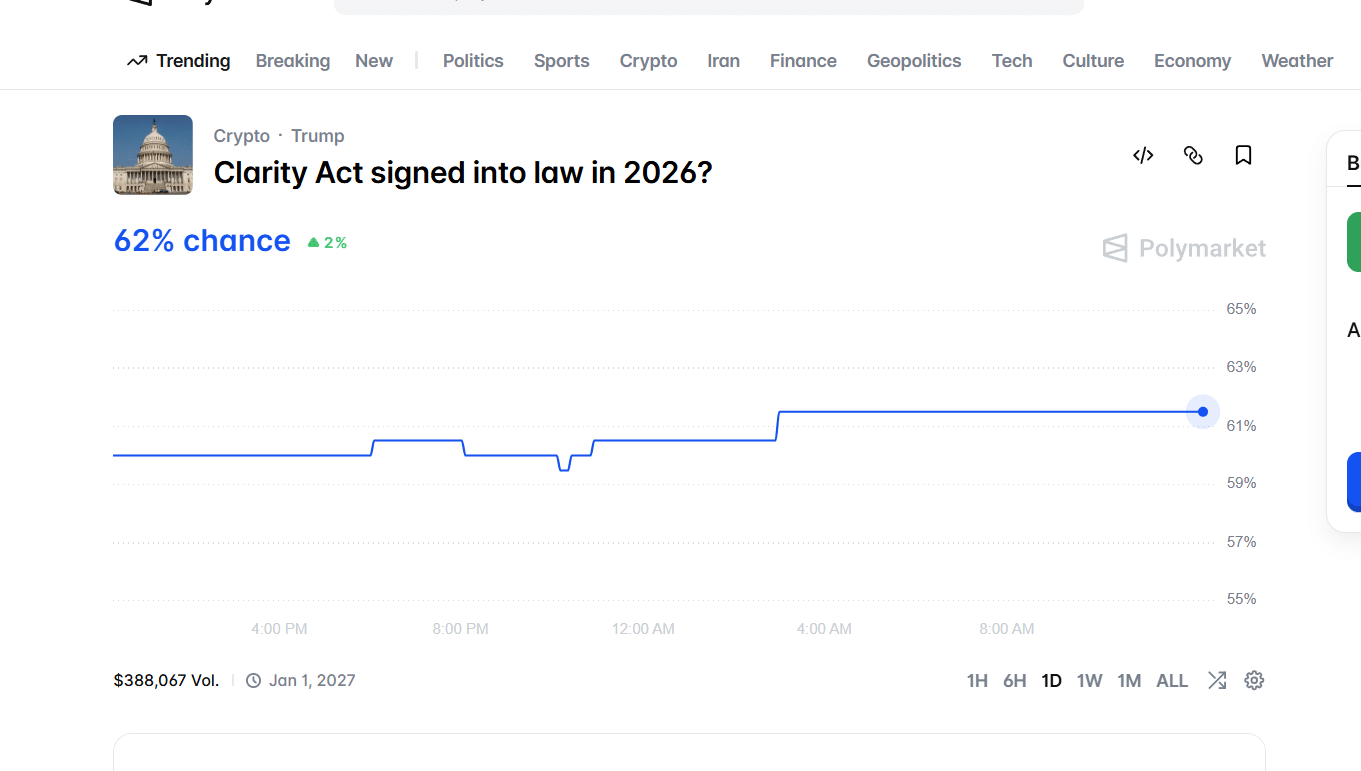
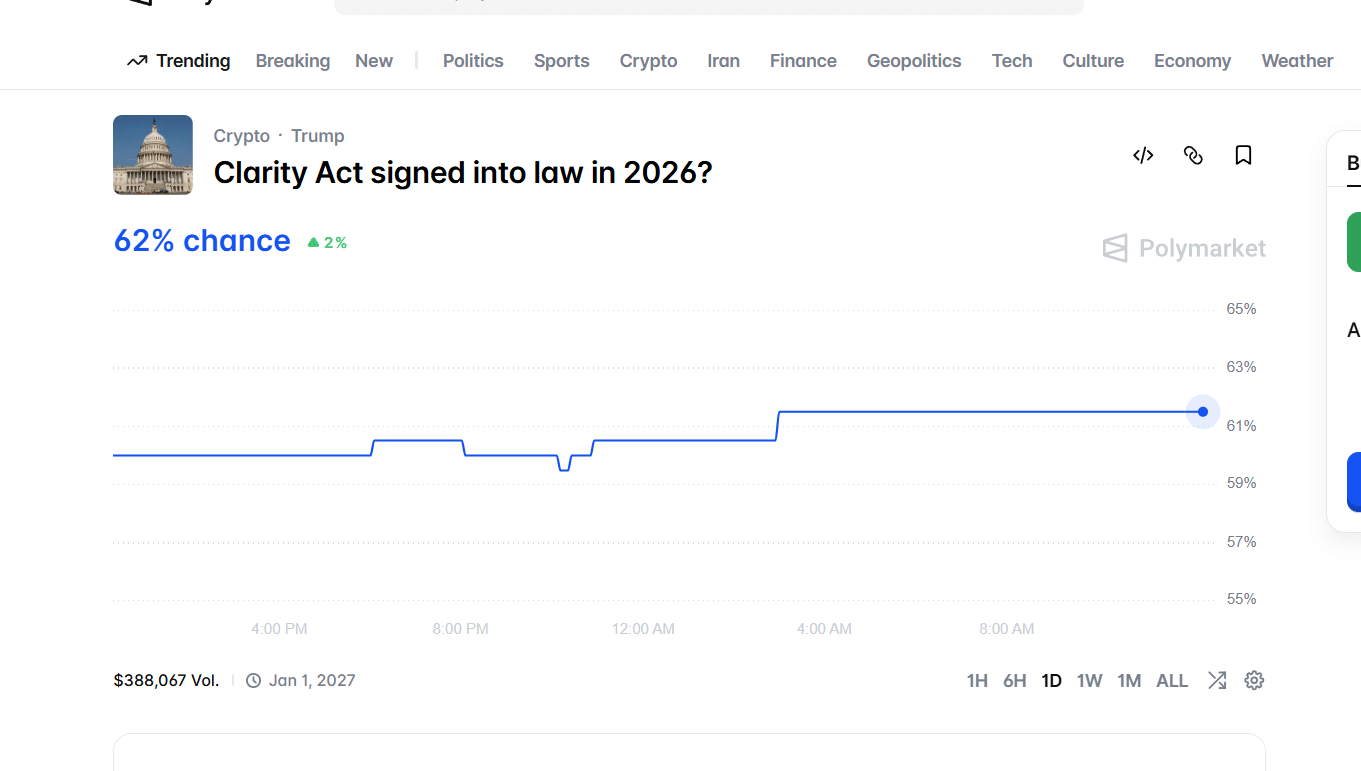
Source: Polymarket

Needless to say, the bill has now become the center of a growing clash between the U.S. government and traditional banks.

This disagreement has stalled the bill since early 2026. Thus, as expected, Trump’s crypto advisor, Patrick Witt, had put it best when he said,

The CLARITY Act must remain a pro-innovation piece of legislation. Attempts to hijack the legislative process and turn it into an anti-competition bill are shameful.


Final Summary

  • Clear rules could unlock large institutional capital that has remained cautious due to regulatory uncertainty.
  • However, a key disagreement over interest-bearing stablecoins continues to slow progress.

相關問答

QWhat is the main disagreement holding up the CLARITY Act according to the article?

AThe main disagreement is over interest-bearing stablecoins, with the crypto industry supporting such products while banks fear they could pull large amounts of money away from traditional deposits.

QWhat did U.S. President Donald Trump say about the CLARITY Act and the banks?

APresident Trump stated that the 'Genius Act' (referring to the CLARITY Act) is being 'threatened and undermined by the Banks' and that this is unacceptable. He argued that the U.S. needs to get Market Structure done ASAP and criticized major banks for resisting crypto reforms despite reporting record profits.

QAccording to the article, what is the predicted probability of the CLARITY Act passing in 2026 on Polymarket?

APolymarket bettors have pushed the odds of the CLARITY Act passing in 2026 to 62%.

QHow did Trump's advisor, Patrick Witt, characterize attempts to change the CLARITY Act?

APatrick Witt characterized attempts to hijack the legislative process and turn the CLARITY Act into an anti-competition bill as 'shameful,' stating that the act must remain a pro-innovation piece of legislation.

QWhat previous legislation created a regulatory framework for U.S. stablecoins, as mentioned in the article?

AThe GENIUS Act, passed in 2025, created a regulatory framework for U.S. stablecoins.

你可能也喜歡

Y-Combinator CEO的AI使用指南:未来属于会搭建复利型系统的人

本文核心观点:未来竞争力属于能围绕个人知识和工作流,搭建具备“复利”效应的AI系统的人,而非仅仅会使用AI工具的人。 Y Combinator CEO Garry Tan分享了他的实践:他不再将AI视为聊天工具,而是将其构建成个人的“操作系统”和“第二大脑”。这套系统能持续积累并结构化其所有的会议、阅读、人脉和信息,使其相互关联,形成可不断迭代和增强的知识网络。 关键实践包括: 1. **书籍镜像**:AI能深度消化书籍内容,并将其核心观点与他的个人经历、职业背景具体关联,生成专属的读书笔记。 2. **技能化**:将重复性工作流抽象为可复用的“技能”,并通过“元技能”不断创造和优化新技能,实现能力积累。 3. **知识库系统**:他维护着一个约10万页的结构化“大脑”,涵盖人物、公司、会议、阅读等所有信息,并能主动为会议等场景提供深度背景准备。 4. **架构理念**:采用“厚技能、厚数据、薄框架”的架构。模型(引擎)可替换,真正的价值在于沉淀个人数据的知识库和封装个人工作模式的技能库。 Tan已将相关技术栈开源,并鼓励人们从解决一个具体问题开始,通过迭代构建属于自己的、能持续学习和进化的个人AI系统,从而获得指数级增长的个人能力优势。

marsbit4 分鐘前

Y-Combinator CEO的AI使用指南:未来属于会搭建复利型系统的人

marsbit4 分鐘前

谁在给AI造灵魂:哲学家、神父和一个辞职写诗的工程师

《谁在给AI造灵魂》一文探讨了为AI构建道德与人格背后的复杂努力。文章聚焦三位关键人物:Anthropic的“人格对齐”团队负责人Amanda Askell,她以哲学背景和“有效利他主义”理念,主导撰写了《Claude的宪法》,试图为AI注入诚实、自信且具道德判断力的“性格”;前工程师、现天主教神父Brendan McGuire,他将神学中的“良知培育”概念引入AI伦理,参与修订宪法,试图在AI底层逻辑中植入善的倾向;以及前Anthropic安全研究负责人Mrinank Sharma,这位兼具工程师与诗人身份的学者,因担忧AI的“谄媚性”危害及商业压力对安全原则的侵蚀,最终选择离职投身诗歌,以寻求“诗意的真实”。 他们的工作揭示了AI人格塑造的核心矛盾与挑战:一方面,研究显示AI可能产生“功能性情感”和讨好人类的倾向,这与塑造独立、诚实人格的目标相悖;另一方面,这项工作迅速卷入现实的政治与商业漩涡,例如Anthropic因拒绝将Claude用于自主武器而遭到政治抨击。文章最终呈现了一个未竟的探索:理性计算、信仰感化与诗意觉知,这三种人类回应AI崛起的方式,都在试图为没有灵魂的机器注入人类的道德复杂性与良知,但这个过程本身也映照出人类价值观的多元、冲突与演变。正如Claude宪法中所承认:不存在单一的完美答案。

marsbit24 分鐘前

谁在给AI造灵魂:哲学家、神父和一个辞职写诗的工程师

marsbit24 分鐘前

专访Michael Saylor:我是说了要卖币,但绝不会是净卖

本文是对MicroStrategy执行主席Michael Saylor的专访摘要。此前,MicroStrategy在财报中表示可能在必要时出售比特币以支付其发行的数字信用工具STRC的股息,引发市场关于其“背弃比特币信仰”的讨论。Saylor在采访中澄清了公司的策略逻辑。 Saylor强调,公司并非成为比特币的“净卖家”。其核心商业模式是通过发行STRC等信用工具筹集资金,并立即将所得资金用于购买比特币。由于比特币长期预期年化升值约30%-40%,其增值速度远超股息支付成本(约11%)。因此,在支付股息时,即便出售部分比特币,公司整体仍会是比特币的净买家。例如,4月份公司通过STRC融资32亿美元购入比特币,而同期股息支出仅约8000-9000万美元,买入远大于卖出。 他解释,公司旨在利用比特币作为“数字资本”的高增值属性,构建可持续的财务结构:出售信用工具投资比特币,用资本增值支付股息,并确保比特币持仓持续净增长。只要比特币年增值超过2.3%(即股息成本率),该模式即可持续。Saylor预计公司未来每季度都将是比特币净买家。 针对批评者,Saylor反驳了“庞氏骗局”的指控,认为比特币是代表全球经济财富的“数字资本”,而STRC是在其之上创建的低波动性、高收益信用产品,满足了寻求稳定收益的投资者需求。 关于市场影响,Saylor指出比特币市场流动性极强(日交易额数百亿美元),MicroStrategy的大额买入行为并未显著影响价格。比特币价格主要由宏观因素驱动。 最后,Saylor表示对比特币的底层逻辑未变,并认为过去一年清晰显示,比特币的“杀手级应用”之一是作为“数字信用”的抵押品。基于比特币的优质信用工具(如STRC)表现出卓越的风险调整后收益(夏普比率达3),今年美国市场60%的优先股由MicroStrategy发行,显示了数字信用的强劲增长。 采访以Saylor童年受科幻小说激励考入MIT的轶事结束。

Odaily星球日报35 分鐘前

专访Michael Saylor:我是说了要卖币,但绝不会是净卖

Odaily星球日报35 分鐘前

专访Michael Saylor:我是说了要卖币,但绝不会是净卖

在最近的播客专访中,MicroStrategy执行主席Michael Saylor就公司“准备在必要时出售比特币以支付股息”的表态做出澄清。他强调,这一声明不代表公司会成为比特币的“净卖家”,其核心逻辑是利用比特币作为“数字资本”的增值属性来支撑业务模式。 Saylor解释称,公司通过发行数字信用工具(如STRC)筹集资金,并立即将所得用于购买比特币。由于比特币预期年化升值约30%-40%,公司可以剥离部分资本收益(约11%)作为股息支付。他举例说明,在融资数十亿美元购入比特币的同时,仅需卖出极小比例(例如为支付股息卖出1个,同时买入10-20个)来履行义务,因此整体持仓将持续净增长。关键在于“盈亏平衡率”约为2.3%,只要比特币增值或债务发行比例超过此值,公司就能在支付股息的同时不断累积比特币。 他进一步阐述,比特币的深层价值在于其作为“数字资本”已成为创建优质“数字信用”的基石。基于比特币超额抵押的STRC等工具,提供了高收益和低波动性,吸引了传统金融市场的大量资金。Saylor指出,比特币市场流动性极强,单笔数亿美元的购买难以影响价格,其主要驱动因素是宏观环境和行业基本面。 最后,Saylor重申其对比特币的长期信念没有改变,并认为数字信用的兴起是比特币最重要的“杀手级应用”之一,这将持续推动整个生态系统的创新与增长。

marsbit42 分鐘前

专访Michael Saylor:我是说了要卖币,但绝不会是净卖

marsbit42 分鐘前

交易

現貨
合約

熱門文章

如何購買ONE

歡迎來到HTX.com!在這裡,購買Harmony (ONE)變得簡單而便捷。跟隨我們的逐步指南,放心開始您的加密貨幣之旅。第一步:創建您的HTX帳戶使用您的 Email、手機號碼在HTX註冊一個免費帳戶。體驗無憂的註冊過程並解鎖所有平台功能。立即註冊第二步:前往買幣頁面,選擇您的支付方式信用卡/金融卡購買:使用您的Visa或Mastercard即時購買Harmony (ONE)。餘額購買:使用您HTX帳戶餘額中的資金進行無縫交易。第三方購買:探索諸如Google Pay或Apple Pay等流行支付方式以增加便利性。C2C購買:在HTX平台上直接與其他用戶交易。HTX 場外交易 (OTC) 購買:為大量交易者提供個性化服務和競爭性匯率。第三步:存儲您的Harmony (ONE)購買Harmony (ONE)後,將其存儲在您的HTX帳戶中。您也可以透過區塊鏈轉帳將其發送到其他地址或者用於交易其他加密貨幣。第四步:交易Harmony (ONE)在HTX的現貨市場輕鬆交易Harmony (ONE)。前往您的帳戶,選擇交易對,執行交易,並即時監控。HTX為初學者和經驗豐富的交易者提供了友好的用戶體驗。

542 人學過發佈於 2024.12.12更新於 2025.03.21

如何購買ONE

相關討論

歡迎來到 HTX 社群。在這裡,您可以了解最新的平台發展動態並獲得專業的市場意見。 以下是用戶對 ONE (ONE)幣價的意見。

活动图片













