Anthropic's Revenue Surpasses $30 Billion, Signs 3.5 Gigawatt Computing Power Agreement with Google and Broadcom

marsbit發佈於 2026-04-07更新於 2026-04-07

文章摘要

Anthropic announced its annualized revenue has surpassed $30 billion, a more than threefold increase from $9 billion at the end of 2025. The number of enterprise customers spending over $1 million annually doubled to 1,000 in less than two months. Growth is largely driven by Claude Code, launched in May 2025, which reached over $2.5 billion in annualized revenue by February 2026. In a related move, Broadcom disclosed in an SEC filing that Anthropic will secure approximately 3.5 gigawatts of next-generation TPU compute power starting in 2027, marking its largest single compute commitment to date. This is part of an expanded partnership involving Google and Broadcom, which will design and supply the new TPUs. Unlike OpenAI’s capital-intensive Stargate project, which involves building owned-and-operated data centers, Anthropic adopts a capital-light strategy—relying on long-term compute agreements with cloud providers (AWS, Google Cloud, and Microsoft Azure) without owning physical infrastructure. This multi-cloud, multi-chip approach offers flexibility but may entail higher long-term costs. Anthropic expects a $14 billion loss in 2026 despite ~40% gross margins.

Author: Deep Tide TechFlow

Deep Tide Introduction: On April 6, Anthropic disclosed that its annualized revenue exceeded $30 billion, more than doubling from $9 billion at the end of 2025. The number of enterprise customers with annual spending exceeding $1 million doubled from 500 to 1000 within two months. On the same day, Broadcom's SEC filing confirmed that Anthropic will acquire approximately 3.5 gigawatts of next-generation TPU computing power starting in 2027, marking its largest single computing power commitment to date.

Anthropic released two significant figures on the same day.

According to Anthropic's official blog on April 6, the company's annualized revenue has surpassed $30 billion, more than doubling from approximately $9 billion at the end of 2025. On the same day, Broadcom's SEC filing disclosed that Anthropic will acquire about 3.5 gigawatts (GW) of next-generation TPU computing power through Broadcom starting in 2027, as part of an expanded collaboration among the three parties (Broadcom, Google, and Anthropic).

Broadcom's stock rose approximately 3% in after-hours trading.
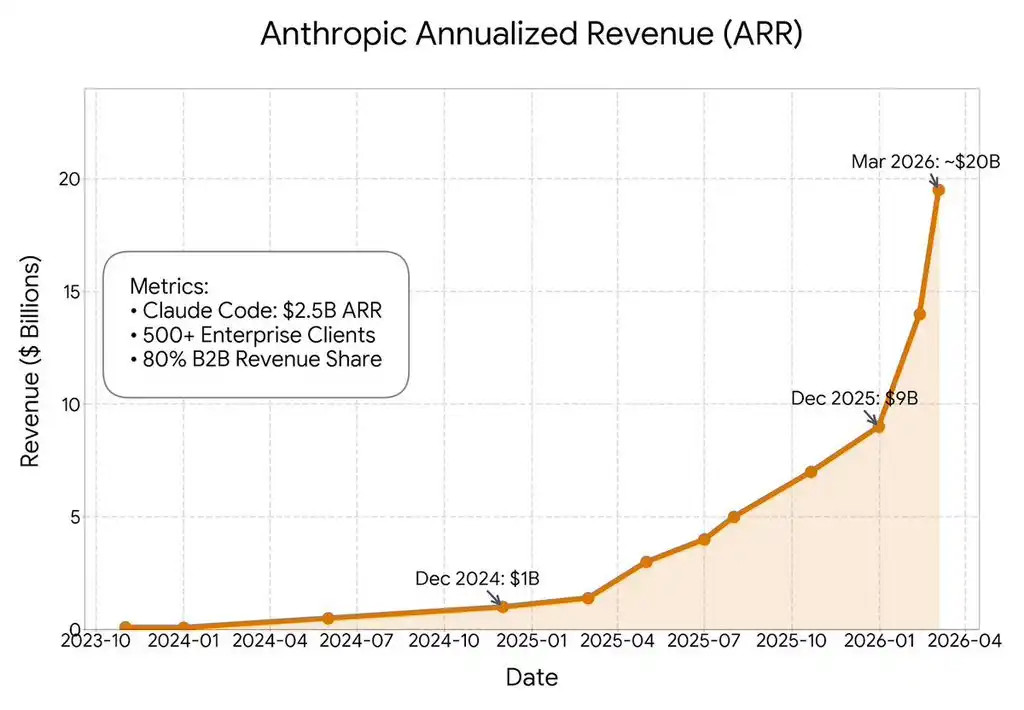
(Image source: X user @damianplayer)

From $1 Billion to $30 Billion in 14 Months: Claude Code Is the Core Engine

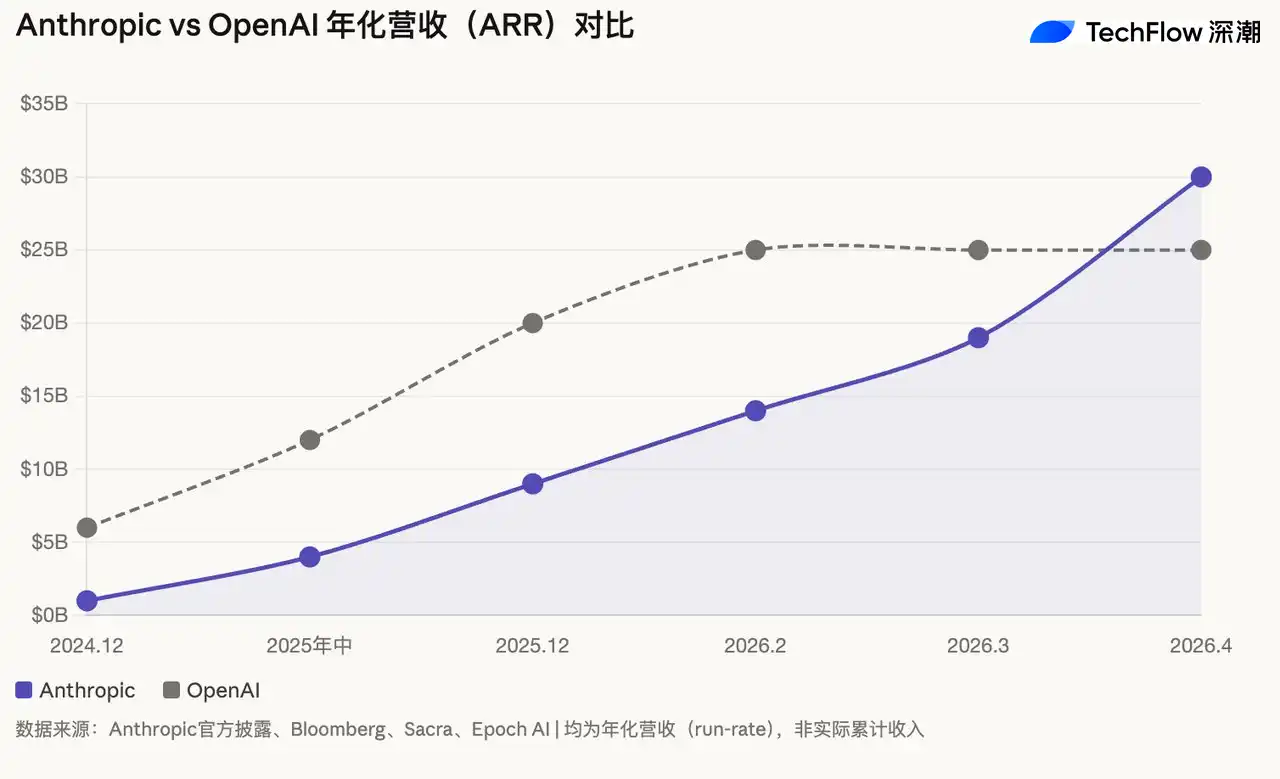
Anthropic's revenue growth curve is unprecedented in the AI industry. According to publicly disclosed information and reports from Bloomberg and other media outlets, the timeline is as follows: approximately $1 billion in December 2024, about $4 billion in mid-2025, around $9 billion at the end of 2025, roughly $14 billion in February 2026, nearly $19 billion in early March, and officially confirmed to exceed $30 billion on April 6.

Anthropic CFO Krishna Rao stated in a declaration that the company is making "its most significant computing power commitment to date to match unprecedented growth."

Client-side data is equally impressive. During the Series G financing in February, there were 500 enterprise customers with annualized spending exceeding $1 million. In less than two months, this number doubled to over 1000. According to Anthropic's previous disclosures, the core driver of this growth is Claude Code, which was launched in May 2025 and reached an annualized revenue of over $2.5 billion by February 2026.

For reference, OpenAI's annualized revenue is estimated by Sacra to be approximately $25 billion (as of February 2026). According to Epoch AI analysis, Anthropic's annualized growth rate since surpassing $1 billion in revenue is about 10x, while OpenAI's is around 3.4x during the same period. At this rate, the revenue crossover point between the two may occur in mid-2026.

Note: The above figures are annualized revenue (run-rate revenue), which is an estimate of recent monthly revenue multiplied by 12, not actual cumulative revenue.

3.5 Gigawatt TPU Agreement: The Latest Piece of Anthropic's Computing Power Strategy

According to Broadcom's SEC filing, the core content of the agreement is as follows: Broadcom will design and supply next-generation TPU chips for Google, with the supply relationship extending to 2031. Anthropic will acquire approximately 3.5 gigawatts of next-generation TPU computing power through Broadcom starting in 2027, as part of its "multi-gigawatt" computing power expansion plan.

Broadcom added a key qualification in the filing: "Anthropic's consumption of expanded computing power depends on its continued commercial success." The three parties are also discussing deployment support with "operational and financial partners."

This is not Anthropic's first large-scale computing power agreement. In October 2025, Anthropic signed a cooperation agreement with Google Cloud, gaining access to up to 1 million TPUs, expected to deliver over 1 gigawatt of computing power in 2026. Broadcom CEO Hock Tan confirmed in a December 2025 earnings call that Anthropic had placed two TPU orders worth $10 billion and $11 billion, respectively. In a March earnings call, Tan further stated that Broadcom expects to generate approximately $21 billion in AI revenue from Anthropic in 2026 and over $42 billion in 2027 (according to Mizuho analyst estimates).

On the AWS side, Project Rainier went live in October 2025, deploying nearly 500,000 Trainium2 chips across multiple data centers in the United States. Amazon has invested a total of $8 billion in Anthropic. Anthropic engineers are directly involved in the development of Trainium's underlying kernels and have provided design input for the next-generation Trainium3 chips.
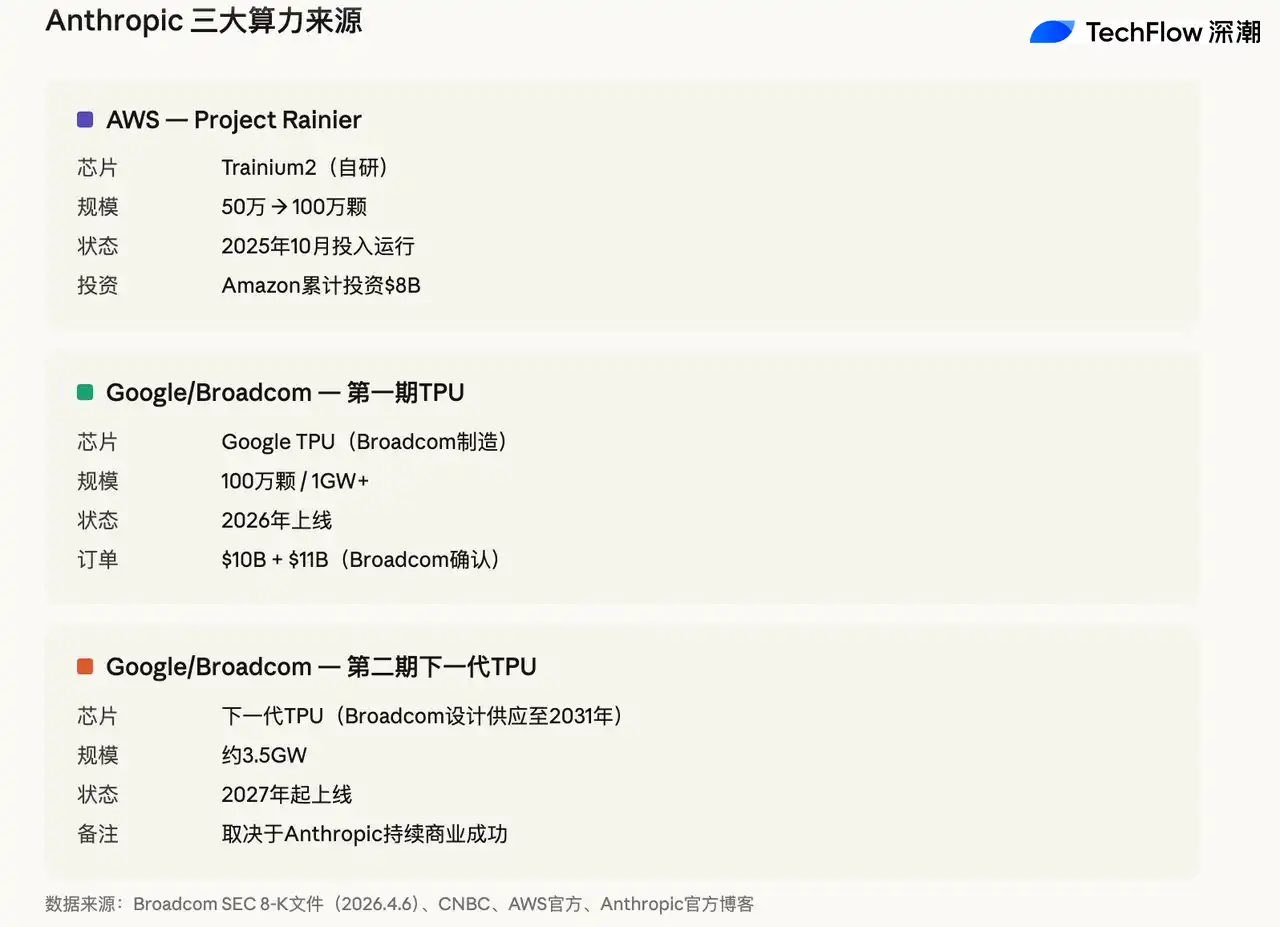
Thus, Anthropic's computing power sources cover three chip routes (AWS Trainium, Google TPU, and NVIDIA GPU) and three major cloud platforms (AWS, Google Cloud, and Microsoft Azure). Anthropic specifically emphasized in its blog that Claude is "the only frontier AI model available on all three major global cloud platforms."

Diverging Paths from OpenAI's Stargate

Anthropic's computing power model contrasts sharply with OpenAI's.
OpenAI has chosen a capital-intensive route: in January 2025, it co-founded Stargate LLC with SoftBank and Oracle, aiming to invest $500 billion over four years to build 10 gigawatts of AI infrastructure. OpenAI holds operational responsibility and design control, Oracle is responsible for construction, and SoftBank bears financial responsibility. To date, Stargate's planned computing power is close to 7 gigawatts, with cumulative investment commitments exceeding $400 billion.

However, Stargate's progress has been marred by control disputes among partners. According to a Tom's Hardware report in February, disagreements over data center ownership between OpenAI, Oracle, and SoftBank have caused delays in some projects. Additionally, OpenAI's total cloud service procurement commitments exceed $500 billion ($250 billion with Microsoft, approximately $300 billion with Oracle, and about $50 billion with AWS). It is estimated that OpenAI will burn through approximately $17 billion in cash in 2026 and may not achieve positive cash flow until 2030 at the earliest.

Anthropic follows a "no data centers, no chip purchases" asset-light model. Capital expenditures are borne by cloud service providers, while Anthropic, as a customer, locks in capacity and prices through long-term agreements, retaining flexibility to switch between multiple chip routes. The trade-off is that it does not own the infrastructure, potentially leading to higher long-term unit costs. According to reports, Anthropic's gross margin is about 40%, with an estimated loss of approximately $14 billion in 2026.

The superiority of either model remains undetermined. OpenAI is betting on economies of scale and infrastructure autonomy, while Anthropic is betting on supply chain flexibility and capital efficiency. However, one fact is clear: in the AI computing power arms race, long-term computing power agreements are becoming as critical a competitive factor as funding and technology.


相關問答

QWhat is Anthropic's annualized revenue as of April 6, and how much has it grown since the end of 2025?

AAnthropic's annualized revenue has surpassed $30 billion as of April 6, representing a growth of over two times from the approximately $9 billion at the end of 2025.

QWhat major compute power agreement did Broadcom's SEC filing confirm with Anthropic and Google?

ABroadcom's SEC filing confirmed that Anthropic will gain access to approximately 3.5 gigawatts of next-generation TPU compute power starting in 2027, as part of an expanded collaboration between Broadcom, Google, and Anthropic.

QWhat is cited as the core driver of Anthropic's rapid revenue growth?

AThe core driver of Anthropic's rapid revenue growth is Claude Code, a product launched in May 2025, which had an annualized revenue exceeding $2.5 billion by February 2026.

QHow does Anthropic's approach to securing compute power (its 'asset-light' model) differ from OpenAI's 'Stargate' project?

AAnthropic uses an 'asset-light' model where cloud providers bear the capital expenditure, and Anthropic secures capacity and pricing through long-term agreements, maintaining flexibility. In contrast, OpenAI's Stargate project is a capital-intensive approach where it takes on operational responsibility and design control to build and own massive AI infrastructure.

QAcross which three major cloud platforms is Claude available as a frontier AI model?

AClaude is available as a frontier AI model on all three major cloud platforms: AWS, Google Cloud, and Microsoft Azure.

你可能也喜歡

Michael Saylor:我确实说要卖比特币,但我是为了买更多

微策略公司执行主席迈克尔·塞勒在近期播客访谈中,澄清了公司关于可能出售比特币以支付STRC优先股股息的决定。他强调,此举并非“净卖出”,公司始终是比特币的净累积者。微策略通过发行STRC等数字信用工具筹集资金,转而购买更多比特币,利用比特币作为“数字资本”的高增值属性(预期年升值约30-40%)来覆盖股息支付(约11%),从而实现持仓规模的持续净增长。例如,公司在一个月内融资30亿美元购买比特币,仅需支付约8000万至9000万美元股息,本质是“买入30个,卖出1个”。 塞勒解释,该商业模式类似于房地产开发公司:发行信用工具投资资产,资产增值后变现部分收益。他强调,只要公司持续增长且比特币年度增值超过2.3%,就能永久支付股息并保持净买入。他重申,个人投资者也应成为比特币的“净累积者”,每年持仓应增加。 访谈还提及,比特币作为表现最佳的资本资产,其杀手级应用之一是作为数字信用的抵押品。STRC因此成为市场上夏普比率最高、流动性最强的优先股之一,推动了数字信用生态发展。塞勒认为,比特币市场流动性极强,单一实体无法显著影响其价格,主要驱动力在于全球宏观因素。尽管存在地缘政治等逆风,比特币仍会因持续的资金流入和有限供应而缓慢上涨。

marsbit5 分鐘前

Michael Saylor:我确实说要卖比特币,但我是为了买更多

marsbit5 分鐘前

从生存到加速发展:ZODL创始人亲述Zcash三年崛起之路

Zcash(ZEC)在经历三年深度调整后,从治理僵局与增长困境中强势崛起,实现了从生存到加速发展的转变。其创始人回顾了关键突破点: 首先,治理枷锁被打破。旧有模式将20%区块奖励固定分配给少数机构,导致激励扭曲。随着ECC主动放弃直接资助并推动NU6升级,资金分配改为社区主导的追溯性模式,同时商标协议终止,治理垄断被彻底破除。 其次,产品战略转向用户增长。团队从专注底层技术研发,转向开发用户真正需要的产品,如默认匿名、易用的Zodl钱包。这直接推动了匿名池资产占比从11%大幅增长至31%,匿名交易占比达到86.5%,体现了真实用户对隐私自托管的信任。 再者,叙事定位得以重塑。Zcash摆脱了易受监管打击的“隐私币”标签,重新定位为“隐私货币”,构建了协议、资产、应用门户的“三位一体”清晰框架,为其获得更广泛的交易所、ETF及机构支持铺平了道路。 最后,组织架构完成蜕变。原ECC团队脱离非营利组织的束缚,成立ZODL并成功融资2500万美元,以创业公司模式加速产品开发与规模化。 目前,ZEC价格与市场情绪显著提升,社区讨论焦点已转向产品与技术。未来工作将集中于提升钱包用户体验、通过Tachyon项目实现高可扩展性,以及推进后量子安全准备,致力于使Zcash更快、更易用且更具未来安全性。

marsbit17 分鐘前

从生存到加速发展:ZODL创始人亲述Zcash三年崛起之路

marsbit17 分鐘前

五种对手方风险架构:加密交易所TradFi五模型分类的结算层方法论

本报告是币贝研究院此前发布的《加密交易所 TradFi 扩张:五模型分类框架》的伴侣篇,将分析焦点转向五种架构中“对手方风险持有者”这一核心维度。报告旨在揭示,在不同压力情境下,损失由谁的资产负债表首先吸收,这是评估各类架构稳健性的根本问题。 报告逐一剖析了五种对手方风险架构及其对应的历史失败模式: 1. **模型1:稳定币发行方与CEX自持仓**。用户面临稳定币(如USDT)发行方储备挤兑风险与交易所自身偿付能力的双重考验。 2. **模型2:CFD经纪商资产负债表**。在B-book模式下,经纪商是用户直接对手方。不同监管辖区(如ESMA强制负余额保护,而毛里求斯FSC不强制)决定了损失由经纪商承担还是转嫁给客户。 3. **模型3:链下托管与转让代理链**。资产实际由链下实体持有,其资产负债表健康状况、公司治理及用户协议条款(如Celsius案中明确转移资产所有权的条款)是用户能否取回资产的关键。 4. **模型4:DEX保险基金与被动减仓(ADL)机制**。协议无传统对手方,损失由预存的保险基金承担,不足时通过ADL机制强制平仓盈利方头寸来分摊,其稳健性取决于预言机设计和规则参数。 5. **模型5:受监管中央对手方(CCP)**。制度化程度最高,拥有多层预存资源(如违约基金)和清晰的损失分担流程,但在极端压力下仍可能动用撤销交易(如LME镍事件)或支持负价格结算(如CME原油事件)等非典型工具。 报告强调,监管差异与对手方风险分配是同一制度选择的两种表述,并非简单的因果关系。最后,报告为每种架构提炼出一组可观察的结构性指标(观察清单),用于在压力事件发生时进行归因分析,而非预测具体失败概率。本研究不构成投资建议。

marsbit34 分鐘前

五种对手方风险架构:加密交易所TradFi五模型分类的结算层方法论

marsbit34 分鐘前

交易

現貨
合約

熱門文章

什麼是 $S$

理解 SPERO:全面概述 SPERO 簡介 隨著創新領域的不斷演變,web3 技術和加密貨幣項目的出現在塑造數字未來中扮演著關鍵角色。在這個動態領域中,SPERO(標記為 SPERO,$$s$)是一個引起關注的項目。本文旨在收集並呈現有關 SPERO 的詳細信息,以幫助愛好者和投資者理解其基礎、目標和在 web3 和加密領域內的創新。 SPERO,$$s$ 是什麼? SPERO,$$s$ 是加密空間中的一個獨特項目,旨在利用去中心化和區塊鏈技術的原則,創建一個促進參與、實用性和金融包容性的生態系統。該項目旨在以新的方式促進點對點互動,為用戶提供創新的金融解決方案和服務。 SPERO,$$s$ 的核心目標是通過提供增強用戶體驗的工具和平台來賦能個人。這包括使交易方式更加靈活、促進社區驅動的倡議,以及通過去中心化應用程序(dApps)創造金融機會的途徑。SPERO,$$s$ 的基本願景圍繞包容性展開,旨在彌合傳統金融中的差距,同時利用區塊鏈技術的優勢。 誰是 SPERO,$$s$ 的創建者? SPERO,$$s$ 的創建者身份仍然有些模糊,因為公開可用的資源對其創始人提供的詳細背景信息有限。這種缺乏透明度可能源於該項目對去中心化的承諾——這是一種許多 web3 項目所共享的精神,優先考慮集體貢獻而非個人認可。 通過將討論重心放在社區及其共同目標上,SPERO,$$s$ 體現了賦能的本質,而不特別突出某些個體。因此,理解 SPERO 的精神和使命比識別單一創建者更為重要。 誰是 SPERO,$$s$ 的投資者? SPERO,$$s$ 得到了來自風險投資家到天使投資者的多樣化投資者的支持,他們致力於促進加密領域的創新。這些投資者的關注點通常與 SPERO 的使命一致——優先考慮那些承諾社會技術進步、金融包容性和去中心化治理的項目。 這些投資者通常對不僅提供創新產品,還對區塊鏈社區及其生態系統做出積極貢獻的項目感興趣。這些投資者的支持強化了 SPERO,$$s$ 作為快速發展的加密項目領域中的一個重要競爭者。 SPERO,$$s$ 如何運作? SPERO,$$s$ 採用多面向的框架,使其與傳統的加密貨幣項目區別開來。以下是一些突顯其獨特性和創新的關鍵特徵: 去中心化治理:SPERO,$$s$ 整合了去中心化治理模型,賦予用戶積極參與決策過程的權力,關於項目的未來。這種方法促進了社區成員之間的擁有感和責任感。 代幣實用性:SPERO,$$s$ 使用其自己的加密貨幣代幣,旨在在生態系統內部提供多種功能。這些代幣使交易、獎勵和平台上提供的服務得以促進,增強了整體參與度和實用性。 分層架構:SPERO,$$s$ 的技術架構支持模塊化和可擴展性,允許在項目發展過程中無縫整合額外的功能和應用。這種適應性對於在不斷變化的加密環境中保持相關性至關重要。 社區參與:該項目強調社區驅動的倡議,採用激勵合作和反饋的機制。通過培養強大的社區,SPERO,$$s$ 能夠更好地滿足用戶需求並適應市場趨勢。 專注於包容性:通過提供低交易費用和用戶友好的界面,SPERO,$$s$ 旨在吸引多樣化的用戶群體,包括那些以前可能未曾參與加密領域的個體。這種對包容性的承諾與其通過可及性賦能的總體使命相一致。 SPERO,$$s$ 的時間線 理解一個項目的歷史提供了對其發展軌跡和里程碑的關鍵見解。以下是建議的時間線,映射 SPERO,$$s$ 演變中的重要事件: 概念化和構思階段:形成 SPERO,$$s$ 基礎的初步想法被提出,與區塊鏈行業內的去中心化和社區聚焦原則密切相關。 項目白皮書的發布:在概念階段之後,發布了一份全面的白皮書,詳細說明了 SPERO,$$s$ 的願景、目標和技術基礎設施,以吸引社區的興趣和反饋。 社區建設和早期參與:積極進行外展工作,建立早期採用者和潛在投資者的社區,促進圍繞項目目標的討論並獲得支持。 代幣生成事件:SPERO,$$s$ 進行了一次代幣生成事件(TGE),向早期支持者分發其原生代幣,並在生態系統內建立初步流動性。 首次 dApp 上線:與 SPERO,$$s$ 相關的第一個去中心化應用程序(dApp)上線,允許用戶參與平台的核心功能。 持續發展和夥伴關係:對項目產品的持續更新和增強,包括與區塊鏈領域其他參與者的戰略夥伴關係,使 SPERO,$$s$ 成為加密市場中一個具有競爭力和不斷演變的參與者。 結論 SPERO,$$s$ 是 web3 和加密貨幣潛力的見證,能夠徹底改變金融系統並賦能個人。憑藉對去中心化治理、社區參與和創新設計功能的承諾,它為更具包容性的金融環境鋪平了道路。 與任何在快速發展的加密領域中的投資一樣,潛在的投資者和用戶都被鼓勵進行徹底研究,並對 SPERO,$$s$ 的持續發展進行深思熟慮的參與。該項目展示了加密行業的創新精神,邀請人們進一步探索其無數可能性。儘管 SPERO,$$s$ 的旅程仍在展開,但其基礎原則確實可能影響我們在互聯網數字生態系統中如何與技術、金融和彼此互動的未來。

85 人學過發佈於 2024.12.17更新於 2024.12.17

什麼是 $S$

什麼是 AGENT S

Agent S:Web3中自主互動的未來 介紹 在不斷演變的Web3和加密貨幣領域,創新不斷重新定義個人如何與數字平台互動。Agent S是一個開創性的項目,承諾通過其開放的代理框架徹底改變人機互動。Agent S旨在簡化複雜任務,為人工智能(AI)提供變革性的應用,鋪平自主互動的道路。本詳細探索將深入研究該項目的複雜性、其獨特特徵以及對加密貨幣領域的影響。 什麼是Agent S? Agent S是一個突破性的開放代理框架,專門設計用來解決計算機任務自動化中的三個基本挑戰: 獲取特定領域知識:該框架智能地從各種外部知識來源和內部經驗中學習。這種雙重方法使其能夠建立豐富的特定領域知識庫,提升其在任務執行中的表現。 長期任務規劃:Agent S採用經驗增強的分層規劃,這是一種戰略方法,可以有效地分解和執行複雜任務。此特徵顯著提升了其高效和有效地管理多個子任務的能力。 處理動態、不均勻的界面:該項目引入了代理-計算機界面(ACI),這是一種創新的解決方案,增強了代理和用戶之間的互動。利用多模態大型語言模型(MLLMs),Agent S能夠無縫導航和操作各種圖形用戶界面。 通過這些開創性特徵,Agent S提供了一個強大的框架,解決了自動化人機互動中涉及的複雜性,為AI及其他領域的無數應用奠定了基礎。 誰是Agent S的創建者? 儘管Agent S的概念根本上是創新的,但有關其創建者的具體信息仍然難以捉摸。創建者目前尚不清楚,這突顯了該項目的初期階段或戰略選擇將創始成員保密。無論是否匿名,重點仍然在於框架的能力和潛力。 誰是Agent S的投資者? 由於Agent S在加密生態系統中相對較新,關於其投資者和財務支持者的詳細信息並未明確記錄。缺乏對支持該項目的投資基礎或組織的公開見解,引發了對其資金結構和發展路線圖的質疑。了解其支持背景對於評估該項目的可持續性和潛在市場影響至關重要。 Agent S如何運作? Agent S的核心是尖端技術,使其能夠在多種環境中有效運作。其運營模型圍繞幾個關鍵特徵構建: 類人計算機互動:該框架提供先進的AI規劃,力求使與計算機的互動更加直觀。通過模仿人類在任務執行中的行為,承諾提升用戶體驗。 敘事記憶:用於利用高級經驗,Agent S利用敘事記憶來跟蹤任務歷史,從而增強其決策過程。 情節記憶:此特徵為用戶提供逐步指導,使框架能夠在任務展開時提供上下文支持。 支持OpenACI:Agent S能夠在本地運行,使用戶能夠控制其互動和工作流程,與Web3的去中心化理念相一致。 與外部API的輕鬆集成:其多功能性和與各種AI平台的兼容性確保了Agent S能夠無縫融入現有技術生態系統,成為開發者和組織的理想選擇。 這些功能共同促成了Agent S在加密領域的獨特地位,因為它以最小的人類干預自動化複雜的多步任務。隨著項目的發展,其在Web3中的潛在應用可能重新定義數字互動的展開方式。 Agent S的時間線 Agent S的發展和里程碑可以用一個時間線來概括,突顯其重要事件: 2024年9月27日:Agent S的概念在一篇名為《一個像人類一樣使用計算機的開放代理框架》的綜合研究論文中推出,展示了該項目的基礎工作。 2024年10月10日:該研究論文在arXiv上公開,提供了對框架及其基於OSWorld基準的性能評估的深入探索。 2024年10月12日:發布了一個視頻演示,提供了對Agent S能力和特徵的視覺洞察,進一步吸引潛在用戶和投資者。 這些時間線上的標記不僅展示了Agent S的進展,還表明了其對透明度和社區參與的承諾。 有關Agent S的要點 隨著Agent S框架的持續演變,幾個關鍵特徵脫穎而出,強調其創新性和潛力: 創新框架:旨在提供類似人類互動的直觀計算機使用,Agent S為任務自動化帶來了新穎的方法。 自主互動:通過GUI自主與計算機互動的能力標誌著向更智能和高效的計算解決方案邁進了一步。 複雜任務自動化:憑藉其強大的方法論,能夠自動化複雜的多步任務,使過程更快且更少出錯。 持續改進:學習機制使Agent S能夠從過去的經驗中改進,不斷提升其性能和效率。 多功能性:其在OSWorld和WindowsAgentArena等不同操作環境中的適應性確保了它能夠服務於廣泛的應用。 隨著Agent S在Web3和加密領域中的定位,其增強互動能力和自動化過程的潛力標誌著AI技術的一次重大進步。通過其創新框架,Agent S展現了數字互動的未來,為各行各業的用戶承諾提供更無縫和高效的體驗。 結論 Agent S代表了AI與Web3結合的一次大膽飛躍,具有重新定義我們與技術互動方式的能力。儘管仍處於早期階段,但其應用的可能性廣泛且引人入勝。通過其全面的框架解決關鍵挑戰,Agent S旨在將自主互動帶到數字體驗的最前沿。隨著我們深入加密貨幣和去中心化的領域,像Agent S這樣的項目無疑將在塑造技術和人機協作的未來中發揮關鍵作用。

736 人學過發佈於 2025.01.14更新於 2025.01.14

什麼是 AGENT S

如何購買S

歡迎來到HTX.com!在這裡,購買Sonic (S)變得簡單而便捷。跟隨我們的逐步指南,放心開始您的加密貨幣之旅。第一步:創建您的HTX帳戶使用您的 Email、手機號碼在HTX註冊一個免費帳戶。體驗無憂的註冊過程並解鎖所有平台功能。立即註冊第二步:前往買幣頁面,選擇您的支付方式信用卡/金融卡購買:使用您的Visa或Mastercard即時購買Sonic (S)。餘額購買:使用您HTX帳戶餘額中的資金進行無縫交易。第三方購買:探索諸如Google Pay或Apple Pay等流行支付方式以增加便利性。C2C購買:在HTX平台上直接與其他用戶交易。HTX 場外交易 (OTC) 購買:為大量交易者提供個性化服務和競爭性匯率。第三步:存儲您的Sonic (S)購買Sonic (S)後,將其存儲在您的HTX帳戶中。您也可以透過區塊鏈轉帳將其發送到其他地址或者用於交易其他加密貨幣。第四步:交易Sonic (S)在HTX的現貨市場輕鬆交易Sonic (S)。前往您的帳戶,選擇交易對,執行交易,並即時監控。HTX為初學者和經驗豐富的交易者提供了友好的用戶體驗。

1.5k 人學過發佈於 2025.01.15更新於 2025.03.21

如何購買S

相關討論

歡迎來到 HTX 社群。在這裡,您可以了解最新的平台發展動態並獲得專業的市場意見。 以下是用戶對 S (S)幣價的意見。

活动图片













