After Institutional Support and Price Surge, Revisiting the True Value of Bittensor's 128 Subnets

marsbit發佈於 2026-03-17更新於 2026-03-17

文章摘要

After removing institutional support and price increases, this article re-evaluates the real value of Bittensor's 128 subnets. Bittensor operates as a decentralized AI ecosystem where each subnet functions like an independent startup with its own token (Alpha), revenue model, and team. There are two primary ways to earn: TAO emissions (protocol subsidies based on staking inflows) and Alpha token PnL (capital gains from subnet performance). Since the Taoflow update in November 2025, subnets with negative net staking flow receive zero emissions, creating a competitive environment. Approximately 3,600 TAO (around $960k daily) is distributed, with the top 10 subnets controlling 56% of emissions. Key case studies include Chutes (SN64), which demonstrates product-market fit with 400k users and 9.1 trillion tokens processed at 85% lower cost than AWS, and Templar (SN3), which offers asymmetric upside by training frontier LLMs in a fully decentralized manner. The investment framework positions TAO as an index fund for the entire network, while Alpha staking represents concentrated bets on specific subnets. The ecosystem is attracting institutional interest, with significant holdings from DCG and Polychain Capital. The conclusion emphasizes evaluating subnets based on product utility, staking flow, team execution, organic demand, and liquidity conditions.

Author: Kaff

Compiled by: Yuliya, PANews

TL;DR

  • Bittensor consists of 128 independent subnets, each operating like a startup with its own token (Alpha), revenue model, and team.

  • There are two ways to make money: TAO emissions (protocol subsidies from staking inflows) and Alpha token PnL (capital gains from subnet performance).

  • Since Taoflow in November 2025, subnets with negative net staking inflows receive zero emissions—forcing them to either succeed or die.

  • Approximately 3,600 TAO (~$960k) is distributed daily across all subnets, with the top ten controlling ~56% of the share.

  • Chutes (SN64) is the clearest example of product-market fit: 400k+ users, 9.1T tokens processed, 85% cheaper than AWS.

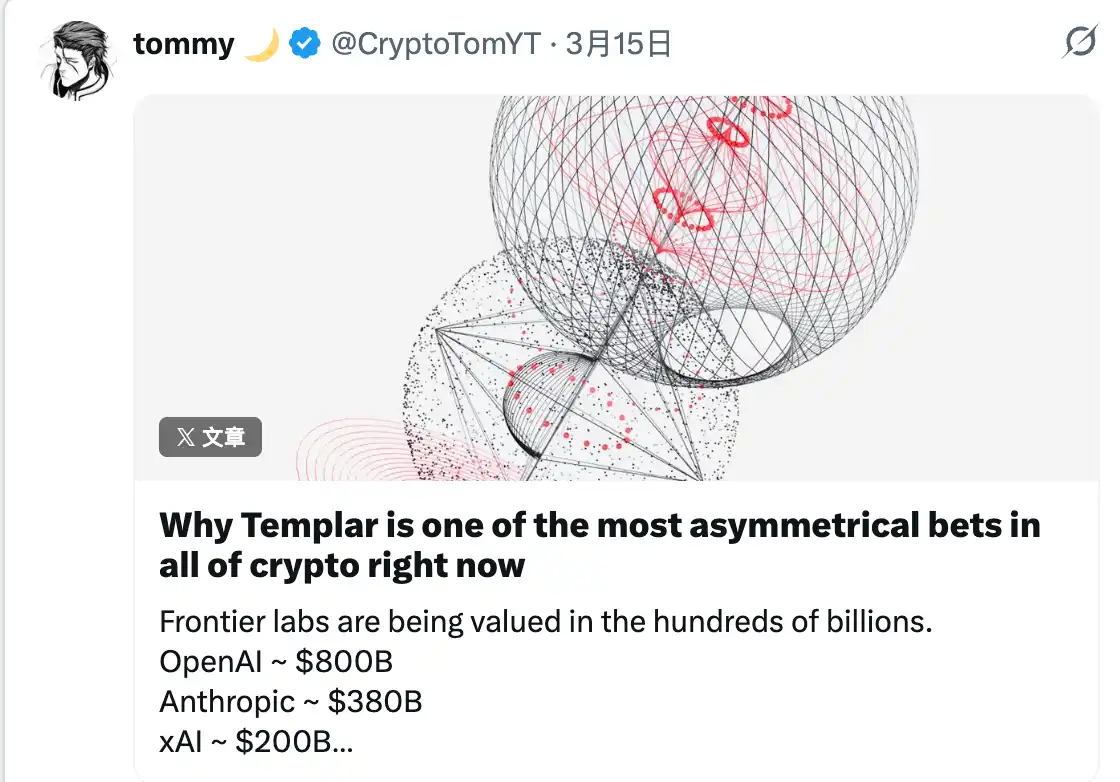
  • Templar (SN3) is the most asymmetric bet: fully decentralized training of frontier LLMs with a ~$60M market cap vs. OpenAI’s $800B.

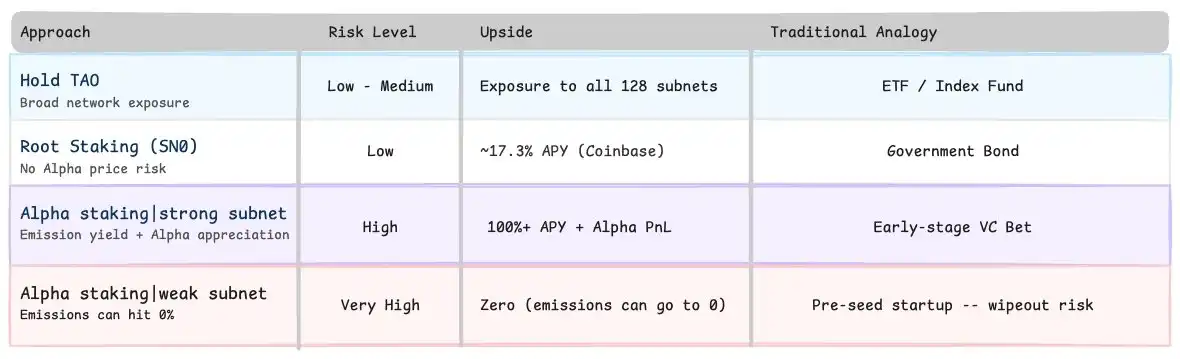
  • TAO = broad index fund to the entire network, while Alpha staking = concentrated investment in specific startups—with 100%+ APY potential but real risk.

  • Alpha tokens carry no formal yield promise; their value depends entirely on market dynamics and team execution.

1. Subnet Structure: Who Does What?

When people think of Bittensor, the most common mental model is: this is a decentralized AI project. While true, it’s incomplete.

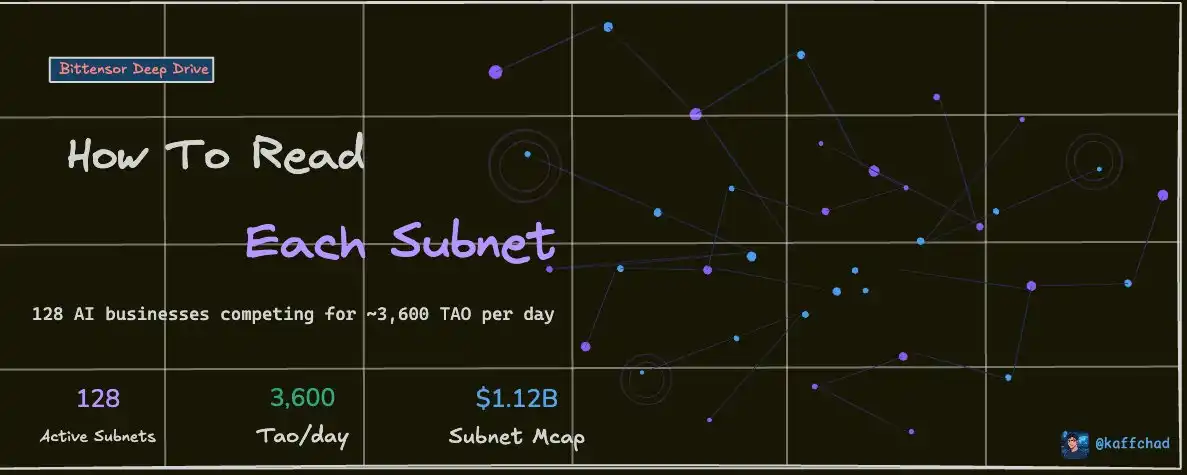
In reality, Bittensor is 128 independent AI startups competing in a brutal economic system, each with its own token, revenue model, and struggle for survival. By March 2026, the total market cap of all subnet tokens was ~$1.12B, equivalent to 27% of TAO’s own market cap. Grayscale calls it “Y Combinator for decentralized AI.” Except instead of a committee deciding who gets funded, the market decides.

Understanding this mechanism allows you to evaluate which subnets are creating real value and which are dying.

Each subnet is an incentive-based competitive market producing specific digital goods—AI inference, GPU compute, model training, financial data analysis, and more.

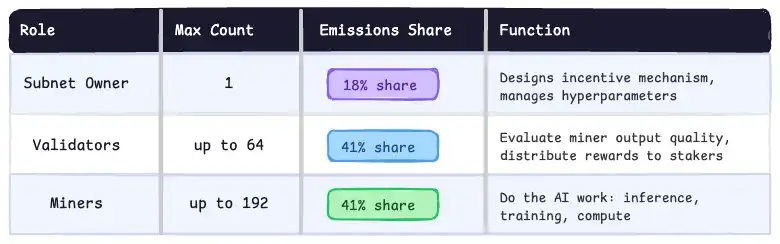
Each subnet is driven by three roles: subnet owner, validators, and miners:
Alpha Tokens: Equity in the Subnet

When you stake TAO to a subnet, your TAO enters an on-chain AMM pool (similar to Uniswap V2 mechanics). In return, you receive Alpha tokens. The price formula is:

Alpha Price = TAO in Pool ÷ Alpha in Pool

Alpha tokens have a hard cap of 21M (echoing TAO’s supply), and they auto-compound every ~72 minutes (one “tempo” = 360 blocks).

2. Two Revenue Streams and Why They’re Overlooked

In Bittensor, there are two completely separate ways to make money:

Revenue Stream 1: TAO Emissions via Taoflow

Since November 2025, Bittensor adopted the Taoflow model, a fundamental shift in how emissions are allocated.

Previously, emissions were calculated based on token price. This created a loophole: projects could artificially inflate their token price to capture emissions, build a “TAO treasury,” and slowly dump while still collecting rewards.

Taoflow fixed this by tracking net staking flow of TAO: staking inflows minus unstaking outflows. The mechanism runs in four steps:
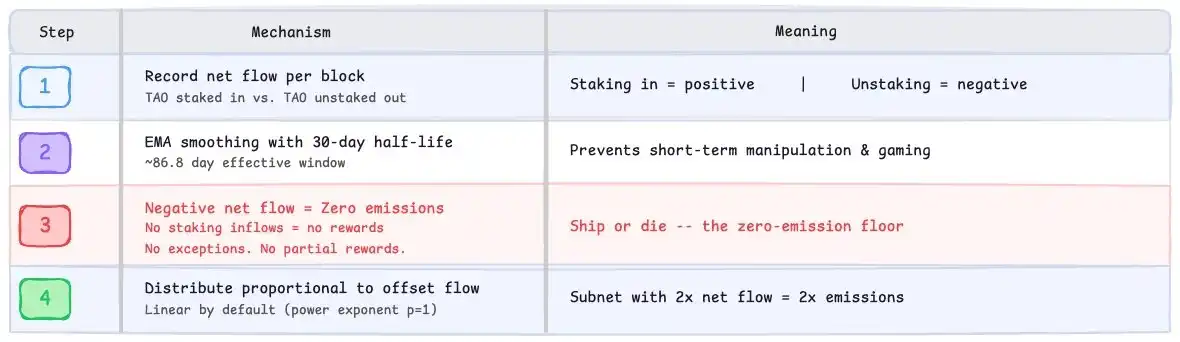
After TAO’s first halving on Dec 14, 2025, block rewards dropped from 1 TAO to 0.5 TAO/block. Currently, ~3,600 TAO (~$960k at current prices) is distributed daily across 128 subnets. DCG estimates over $100M flows into the ecosystem annually.

Revenue Stream 2: Alpha Token PnL

This is the part most TAO holders aren’t tracking.

If a subnet performs well, Alpha’s price (denominated in TAO) rises. When you unstake, you receive more TAO than you initially put in. This is Alpha PnL = capital gains from holding a specific subnet’s token.

Taoflow creates a powerful flywheel effect:

  • Great product → more people stake TAO → positive net flow

  • Positive flow → more emissions → deeper liquidity pool

  • Deeper liquidity → lower slippage → attracts more capital

  • More capital → Alpha price rises → Alpha PnL increases for existing holders

The reverse is also true, and equally brutal. Sustained negative flow subnets → zero emissions → stakers continuously withdraw → death spiral.

3. Which Subnets Are Winning and Why?

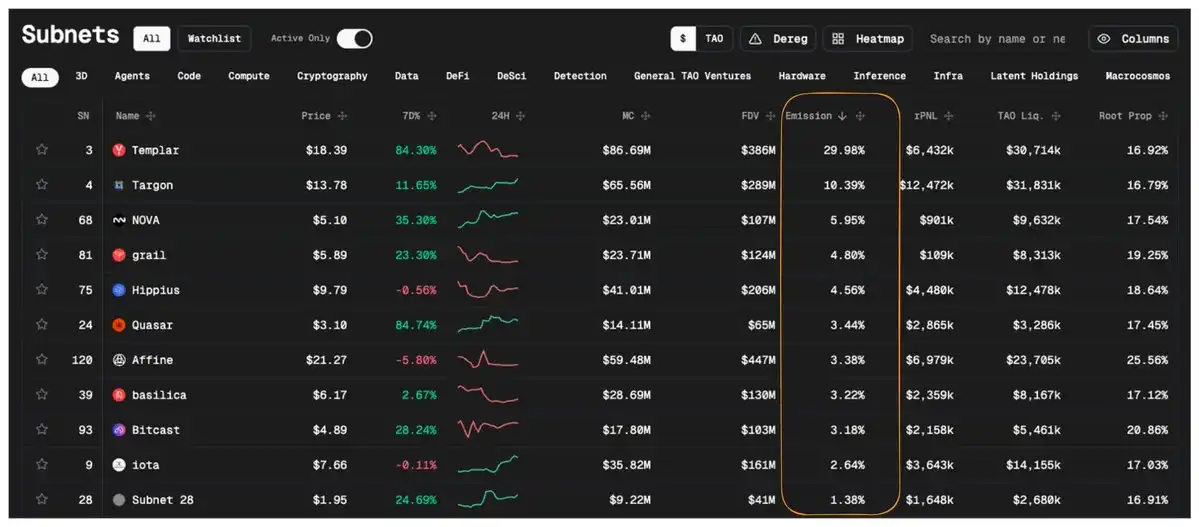
Here’s a snapshot of leading subnets ranked by emission dominance and realized PnL (rPnL):

  • SN3| templar: Large-scale LLM pre-training | Emission Share: 30.39% | rPnL: $6.43M

  • SN4| Targon: AI inference market—hosting and serving AI models for real-time predictions | Emission Share: 10.39% | rPnL: $12.47M

  • SN68| METANOVA: AI drug discovery company developing therapies to reprogram body and mind | Emission Share: 5.95% | rPnL: $900k

  • SN81| grail: Verifiable LLM post-training processing | Emission Share: 4.8% | rPnL: $109k

  • SN75| Hippius: Decentralized storage and web infrastructure with IP management | Emission Share: 4.56% | rPnL: $4.48M

The top 10 subnets control ~56% of the total daily emissions.
Case Study: Chutes, The Textbook Example of Product-Market Fit (PMF)

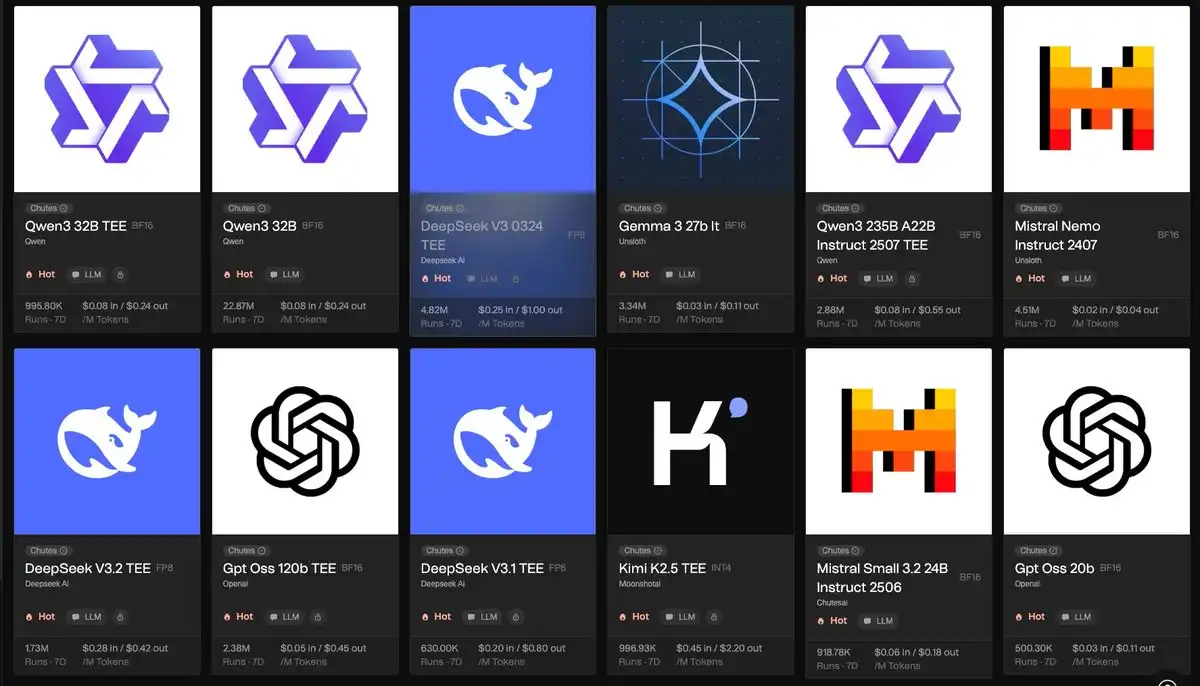
Built by Rayon Labs, Chutes is a decentralized serverless AI inference market, a Web3 alternative to OpenAI API and AWS for model deployment.

What stands out about Chutes:

  • Processed 9.1T tokens since late 2024

  • 400k+ users (100k+ via API)

  • 85% cheaper AI model deployment costs vs. AWS

  • Models supported: DeepSeek, Mistral, LLaMA, and dozens more

  • Platform revenue auto-staked → buys back Alpha tokens → organic demand flywheel

During a spike in February 2026, Chutes attracted over 2,740 TAO in just 9 hours. Alpha tokens peaked at $99.94 (0.225 TAO), with an FDV of 2.05M TAO (~$518M at TAO’s peak).

Rayon Labs also operates SN56 (Gradients—model training) and SN19 (Nineteen—high-frequency inference), collectively commanding over 23% of total emissions at their peak.
Case Study: Templar (SN3), The Most Asymmetric Bet in the Subnet Ecosystem

On March 10, 2026, Templar (SN3) completed Covenant-72B, a 72B parameter model hailed as the largest decentralized pre-training run in history.
4. The Mechanics Behind It: Registration, Yuma Consensus, and Competitive Pressure

Registration, A Competitive Arena

Not everyone can open a subnet. Registration uses a dynamic burn pricing mechanism: the cost doubles with each new subnet registration and halves linearly over 28,800 blocks (~4 days) with no new registrations.

When all 128 slots are full, new subnets must replace the worst-performing existing subnet (measured by lowest EMA price). Newly registered subnets get a 4-month grace period before being eligible for deregistration. The network is expected to expand to 256 subnets in 2026.

Yuma Consensus, Automated Independent Auditing

Within each subnet, Yuma consensus transforms validators' subjective assessments into objective reward distribution:

  • Validators submit weight vectors, scoring each miner they evaluate

  • The blockchain calculates the stake-weighted median for each miner (kappa=0.5)

  • Weights above the median are clipped—to prevent collusion and over-evaluation

  • Validators use a commit-reveal mechanism—submitting sealed weights, revealed only after a set number of blocks—to prevent weight copying

  • Validators who identify good miners early and evaluate consistently build stronger bonded positions and earn larger dividend shares

The result: No subnet owner can unilaterally change who gets rewards. This is the fundamental difference between Bittensor and typical crypto “AI projects.”

5. Investment Framework: TAO = Index Fund, Alpha Staking = Startup Bet

Auditless Research summarized it perfectly: “TAO is effectively more of an options token—a call option that can be pointed at the emissions of whatever Alpha token looks undervalued.”
How to Read a Subnet Like a Balance Sheet

  • Emissions = Protocol subsidies - network revenue, similar to government grants or accelerator funding

  • Alpha PnL = Market cap signal - the market is pricing the subnet’s true value

  • Net staking flow = Revenue growth indicator - positive flow = “product sells,” negative flow = churning customers

  • Subnet owner = Founder quality - communication frequency, delivery speed, and product roadmap are things to track

  • Number of validators = Board quality - more independent validators = less chance of manipulated scoring

Institutional Signals Are Growing

This is no longer just a retail story:

  • DCG holds over 500k TAO (~2.4% of total supply)

  • Polychain Capital holds ~$200M worth of TAO

  • Grayscale GTAO Trust listed on NYSE on January 6, 2026

  • Stillcore Capital (co-founded by Jason Calacanis) launched a fund dedicated to subnet tokens

6. Conclusion: A Starter Framework

Bittensor has created a structure unique in crypto: 128 AI businesses competing for a shared ~3,600 TAO (~$960k) daily, where capital allocation is determined solely by staker behavior.

When evaluating a subnet, ask these five questions:

  • Product: What does this subnet offer? Is there real demand for it?

  • Flow: Is net staking flow positive or negative? What’s the 30-day trend?

  • Team: Is the subnet owner communicating and delivering consistently?

  • Flywheel: Does revenue create organic demand for Alpha, or is it pure speculation?

  • Exit: Is the liquidity pool deep enough to exit without significant slippage?

TAO gives you broad exposure to the entire ecosystem. Alpha staking gives you a concentrated bet on a specific “startup”—with all the accompanying upside potential and downside risk.


相關問答

QWhat are the two primary ways to generate income within the Bittensor subnet ecosystem?

AThe two primary ways to generate income are: 1) TAO emissions (protocol subsidies based on staking inflow) and 2) Alpha token PnL (capital gains from the performance of the specific subnet).

QWhat is the Taoflow model and what fundamental change did it introduce in November 2025?

AThe Taoflow model is a fundamental shift in how emissions are distributed. It tracks the net staking flow of TAO (staking inflow minus unstaking outflow) into a subnet. Subnets with negative net flow receive zero emissions, forcing them to either perform or be eliminated.

QWhich subnet is highlighted as the clearest example of product-market fit (PMF) and what are its key metrics?

AChutes (SN64) is highlighted as the clearest example of PMF. Its key metrics include processing over 9.1 trillion tokens, having over 400,000 users (100,000+ via API), and offering AI model deployment at an 85% lower cost than AWS.

QHow does the investment exposure of holding TAO differ from staking for an Alpha token?

AHolding TAO provides broad, index fund-like exposure to the entire Bittensor network. Staking for an Alpha token is a concentrated investment in a specific 'startup' subnet, offering higher potential returns (100%+ APY) but also carrying significant risk.

QWhat mechanism ensures that no single subnet owner can unilaterally change who gets rewards, and how does it work?

AThe Yuma Consensus ensures this. Validators submit weight vectors rating miners, the blockchain calculates a median score, and weights above the median are clipped to prevent collusion and over-evaluation. A commit-reveal mechanism prevents copying weights, making the system an automated, independent audit.

你可能也喜歡

谷歌847亿美元融资后市场就调整,AI 估值开始看回本速度

过去几年,市场对AI估值的核心逻辑是相信AI将改变世界,因此愿意给予高估值。但近期市场情绪发生变化,部分半导体和AI软件股票回调,资金转向现金流更稳定的方向。与此同时,谷歌(Alphabet)宣布大规模股权融资并上调资本开支指引,这促使市场重新审视AI投资逻辑。 市场的关注点正从“增长叙事”转向“资本效率”。AI发展需要巨额资本投入于芯片、数据中心、电力和网络等基础设施,这更像一场重资产的基础设施周期,而非轻资产的软件扩张。投资者开始更关注三个问题:资金从哪来、成本有多高、以及多久能回本。 谷歌的融资行为虽不直接意味着危机,但凸显了AI建设的资本密集特性。市场担心,不仅是大科技公司,前沿AI模型公司、数据中心运营商和电力公司都将争夺同一资金池,这可能推高整体融资成本,并考验各参与方的资本回报能力。 在此背景下,估值逻辑发生切换。高估值、依赖远期增长故事的公司面临压力,而订单清晰、现金流稳定的硬件、数据中心等“卖铲子”类资产则获得相对支撑。投资者开始更挑剔地审视AI投资的真实经济回报。 展望未来,AI板块的表现将取决于几个关键验证点:各公司资本开支指引是否持续上调、AI相关收入能否快速兑现以覆盖成本,以及资本市场能否持续消化大规模融资。虽然AI的长期前景依然被看好,但市场对其的估值已进入一个更注重现实回报和资本效率的新阶段。

marsbit56 分鐘前

谷歌847亿美元融资后市场就调整,AI 估值开始看回本速度

marsbit56 分鐘前

Orbs 推出面向机构的 DeFi 交易基础设施

Orbs今日推出了专为机构设计的DeFi交易基础设施“Orbs Institutional”,旨在为交易台、OTC公司、资金部门、托管方和金融平台提供直接访问其链上执行基础设施的渠道。该服务基于Orbs自2023年以来已处理超过25亿美元现货交易量的技术,此前已通过PancakeSwap等知名去中心化交易平台提供,现直接面向机构市场参与者开放。 随着机构对去中心化金融接受度提高,企业正越来越多地将链上执行纳入交易运营,但许多机构在去中心化市场中仍面临执行质量、托管要求和透明度等挑战。Orbs首席商务官Ran Hammer表示,机构不应在去中心化市场的效率与专业交易基础设施标准之间做选择,Orbs Institutional正是为提供透明、具有价格竞争力且资产完全可控的链上执行而设计。 该服务的核心是Orbs的流动性聚合协议Liquidity Hub,它通过私有询价层从专业做市商和去中心化交易所获取流动性,旨在提升执行质量并降低MEV和抢先交易风险。同时,机构还可使用dTWAP、dLIMIT等执行工具。订单支持符合EIP-712标准的现有托管或MPC基础设施签名,资产在整个执行周期中均由客户控制,且协议自2017年运行以来未出现已知漏洞。 Orbs Institutional提供两种主要集成方式:机构客户可通过API直接接入执行栈;钱包、托管方、交易所等则可选择白标或联合品牌方案,将Orbs执行能力集成至现有产品。随着机构在数字资产市场的参与度提升,Orbs预计市场对透明、自托管且自动化的执行基础设施需求将增长,并认为专业机构直接接入链上流动性和执行工具将推动DeFi下一阶段采用。 Orbs是一个专为高级链上交易设计的去中心化Layer3区块链,采用权益证明共识,支持传统智能合约无法实现的复杂逻辑与脚本,通过dLIMIT、Liquidity Hub等协议为去中心化市场带来媲美中心化金融的执行水平。

TheNewsCrypto1 小時前

Orbs 推出面向机构的 DeFi 交易基础设施

TheNewsCrypto1 小時前

管理近万亿估值公司,Anthropic CEO却只有一个直接下属

彭博社报道,Anthropic首席执行官达里奥·阿莫代采取了一种极为罕见的领导模式:作为一家估值近万亿美元的AI公司CEO,他只有一位直接下属——他的幕僚长。公司所有其他高管(如CFO、CCO)均向其姐姐、总裁丹妮拉·阿莫代汇报。丹妮拉负责日常运营并对董事会负责,这使得达里奥能完全专注于“远焦”事务,如战略方向、研究判断、组织文化和思考AI对人类文明的影响。 达里奥认为,CEO最大的价值在于需要大块不被打断时间进行深度思考的事务,而日常管理会切碎时间。因此,他将两者彻底分离。他大约一半时间用于文化建设,通过每两周一次的全员大会和撰写长篇备忘录来主动塑造和巩固公司文化,防止在快速扩张至2500人规模时,来自大公司的员工稀释原有文化。其余时间则用于研究方向和撰写深度文章。 哈佛商学院教授拉法埃拉·萨顿对此分析指出,管理幅度取决于公司面临问题的性质。若公司不断面对全新、高风险、无现成答案的问题(如Anthropic),CEO就需要更窄的管理幅度,将最稀缺的时间资源留给最高层的战略判断。这种姐弟分工基于两人背景的互补:达里奥是研究出身,丹妮拉则擅长运营和人事管理。值得注意的是,Anthropic全部七位联合创始人至今仍在公司,这被姐弟俩视为公司文化凝聚力的证明。

marsbit1 小時前

管理近万亿估值公司,Anthropic CEO却只有一个直接下属

marsbit1 小時前

交易

現貨
合約

熱門文章

什麼是 $S$

理解 SPERO:全面概述 SPERO 簡介 隨著創新領域的不斷演變,web3 技術和加密貨幣項目的出現在塑造數字未來中扮演著關鍵角色。在這個動態領域中,SPERO(標記為 SPERO,$$s$)是一個引起關注的項目。本文旨在收集並呈現有關 SPERO 的詳細信息,以幫助愛好者和投資者理解其基礎、目標和在 web3 和加密領域內的創新。 SPERO,$$s$ 是什麼? SPERO,$$s$ 是加密空間中的一個獨特項目,旨在利用去中心化和區塊鏈技術的原則,創建一個促進參與、實用性和金融包容性的生態系統。該項目旨在以新的方式促進點對點互動,為用戶提供創新的金融解決方案和服務。 SPERO,$$s$ 的核心目標是通過提供增強用戶體驗的工具和平台來賦能個人。這包括使交易方式更加靈活、促進社區驅動的倡議,以及通過去中心化應用程序(dApps)創造金融機會的途徑。SPERO,$$s$ 的基本願景圍繞包容性展開,旨在彌合傳統金融中的差距,同時利用區塊鏈技術的優勢。 誰是 SPERO,$$s$ 的創建者? SPERO,$$s$ 的創建者身份仍然有些模糊,因為公開可用的資源對其創始人提供的詳細背景信息有限。這種缺乏透明度可能源於該項目對去中心化的承諾——這是一種許多 web3 項目所共享的精神,優先考慮集體貢獻而非個人認可。 通過將討論重心放在社區及其共同目標上,SPERO,$$s$ 體現了賦能的本質,而不特別突出某些個體。因此,理解 SPERO 的精神和使命比識別單一創建者更為重要。 誰是 SPERO,$$s$ 的投資者? SPERO,$$s$ 得到了來自風險投資家到天使投資者的多樣化投資者的支持,他們致力於促進加密領域的創新。這些投資者的關注點通常與 SPERO 的使命一致——優先考慮那些承諾社會技術進步、金融包容性和去中心化治理的項目。 這些投資者通常對不僅提供創新產品,還對區塊鏈社區及其生態系統做出積極貢獻的項目感興趣。這些投資者的支持強化了 SPERO,$$s$ 作為快速發展的加密項目領域中的一個重要競爭者。 SPERO,$$s$ 如何運作? SPERO,$$s$ 採用多面向的框架,使其與傳統的加密貨幣項目區別開來。以下是一些突顯其獨特性和創新的關鍵特徵: 去中心化治理:SPERO,$$s$ 整合了去中心化治理模型,賦予用戶積極參與決策過程的權力,關於項目的未來。這種方法促進了社區成員之間的擁有感和責任感。 代幣實用性:SPERO,$$s$ 使用其自己的加密貨幣代幣,旨在在生態系統內部提供多種功能。這些代幣使交易、獎勵和平台上提供的服務得以促進,增強了整體參與度和實用性。 分層架構:SPERO,$$s$ 的技術架構支持模塊化和可擴展性,允許在項目發展過程中無縫整合額外的功能和應用。這種適應性對於在不斷變化的加密環境中保持相關性至關重要。 社區參與:該項目強調社區驅動的倡議,採用激勵合作和反饋的機制。通過培養強大的社區,SPERO,$$s$ 能夠更好地滿足用戶需求並適應市場趨勢。 專注於包容性:通過提供低交易費用和用戶友好的界面,SPERO,$$s$ 旨在吸引多樣化的用戶群體,包括那些以前可能未曾參與加密領域的個體。這種對包容性的承諾與其通過可及性賦能的總體使命相一致。 SPERO,$$s$ 的時間線 理解一個項目的歷史提供了對其發展軌跡和里程碑的關鍵見解。以下是建議的時間線,映射 SPERO,$$s$ 演變中的重要事件: 概念化和構思階段:形成 SPERO,$$s$ 基礎的初步想法被提出,與區塊鏈行業內的去中心化和社區聚焦原則密切相關。 項目白皮書的發布:在概念階段之後,發布了一份全面的白皮書,詳細說明了 SPERO,$$s$ 的願景、目標和技術基礎設施,以吸引社區的興趣和反饋。 社區建設和早期參與:積極進行外展工作,建立早期採用者和潛在投資者的社區,促進圍繞項目目標的討論並獲得支持。 代幣生成事件:SPERO,$$s$ 進行了一次代幣生成事件(TGE),向早期支持者分發其原生代幣,並在生態系統內建立初步流動性。 首次 dApp 上線:與 SPERO,$$s$ 相關的第一個去中心化應用程序(dApp)上線,允許用戶參與平台的核心功能。 持續發展和夥伴關係:對項目產品的持續更新和增強,包括與區塊鏈領域其他參與者的戰略夥伴關係,使 SPERO,$$s$ 成為加密市場中一個具有競爭力和不斷演變的參與者。 結論 SPERO,$$s$ 是 web3 和加密貨幣潛力的見證,能夠徹底改變金融系統並賦能個人。憑藉對去中心化治理、社區參與和創新設計功能的承諾,它為更具包容性的金融環境鋪平了道路。 與任何在快速發展的加密領域中的投資一樣,潛在的投資者和用戶都被鼓勵進行徹底研究,並對 SPERO,$$s$ 的持續發展進行深思熟慮的參與。該項目展示了加密行業的創新精神,邀請人們進一步探索其無數可能性。儘管 SPERO,$$s$ 的旅程仍在展開,但其基礎原則確實可能影響我們在互聯網數字生態系統中如何與技術、金融和彼此互動的未來。

85 人學過發佈於 2024.12.17更新於 2024.12.17

什麼是 $S$

什麼是 AGENT S

Agent S:Web3中自主互動的未來 介紹 在不斷演變的Web3和加密貨幣領域,創新不斷重新定義個人如何與數字平台互動。Agent S是一個開創性的項目,承諾通過其開放的代理框架徹底改變人機互動。Agent S旨在簡化複雜任務,為人工智能(AI)提供變革性的應用,鋪平自主互動的道路。本詳細探索將深入研究該項目的複雜性、其獨特特徵以及對加密貨幣領域的影響。 什麼是Agent S? Agent S是一個突破性的開放代理框架,專門設計用來解決計算機任務自動化中的三個基本挑戰: 獲取特定領域知識:該框架智能地從各種外部知識來源和內部經驗中學習。這種雙重方法使其能夠建立豐富的特定領域知識庫,提升其在任務執行中的表現。 長期任務規劃:Agent S採用經驗增強的分層規劃,這是一種戰略方法,可以有效地分解和執行複雜任務。此特徵顯著提升了其高效和有效地管理多個子任務的能力。 處理動態、不均勻的界面:該項目引入了代理-計算機界面(ACI),這是一種創新的解決方案,增強了代理和用戶之間的互動。利用多模態大型語言模型(MLLMs),Agent S能夠無縫導航和操作各種圖形用戶界面。 通過這些開創性特徵,Agent S提供了一個強大的框架,解決了自動化人機互動中涉及的複雜性,為AI及其他領域的無數應用奠定了基礎。 誰是Agent S的創建者? 儘管Agent S的概念根本上是創新的,但有關其創建者的具體信息仍然難以捉摸。創建者目前尚不清楚,這突顯了該項目的初期階段或戰略選擇將創始成員保密。無論是否匿名,重點仍然在於框架的能力和潛力。 誰是Agent S的投資者? 由於Agent S在加密生態系統中相對較新,關於其投資者和財務支持者的詳細信息並未明確記錄。缺乏對支持該項目的投資基礎或組織的公開見解,引發了對其資金結構和發展路線圖的質疑。了解其支持背景對於評估該項目的可持續性和潛在市場影響至關重要。 Agent S如何運作? Agent S的核心是尖端技術,使其能夠在多種環境中有效運作。其運營模型圍繞幾個關鍵特徵構建: 類人計算機互動:該框架提供先進的AI規劃,力求使與計算機的互動更加直觀。通過模仿人類在任務執行中的行為,承諾提升用戶體驗。 敘事記憶:用於利用高級經驗,Agent S利用敘事記憶來跟蹤任務歷史,從而增強其決策過程。 情節記憶:此特徵為用戶提供逐步指導,使框架能夠在任務展開時提供上下文支持。 支持OpenACI:Agent S能夠在本地運行,使用戶能夠控制其互動和工作流程,與Web3的去中心化理念相一致。 與外部API的輕鬆集成:其多功能性和與各種AI平台的兼容性確保了Agent S能夠無縫融入現有技術生態系統,成為開發者和組織的理想選擇。 這些功能共同促成了Agent S在加密領域的獨特地位,因為它以最小的人類干預自動化複雜的多步任務。隨著項目的發展,其在Web3中的潛在應用可能重新定義數字互動的展開方式。 Agent S的時間線 Agent S的發展和里程碑可以用一個時間線來概括,突顯其重要事件: 2024年9月27日:Agent S的概念在一篇名為《一個像人類一樣使用計算機的開放代理框架》的綜合研究論文中推出,展示了該項目的基礎工作。 2024年10月10日:該研究論文在arXiv上公開,提供了對框架及其基於OSWorld基準的性能評估的深入探索。 2024年10月12日:發布了一個視頻演示,提供了對Agent S能力和特徵的視覺洞察,進一步吸引潛在用戶和投資者。 這些時間線上的標記不僅展示了Agent S的進展,還表明了其對透明度和社區參與的承諾。 有關Agent S的要點 隨著Agent S框架的持續演變,幾個關鍵特徵脫穎而出,強調其創新性和潛力: 創新框架:旨在提供類似人類互動的直觀計算機使用,Agent S為任務自動化帶來了新穎的方法。 自主互動:通過GUI自主與計算機互動的能力標誌著向更智能和高效的計算解決方案邁進了一步。 複雜任務自動化:憑藉其強大的方法論,能夠自動化複雜的多步任務,使過程更快且更少出錯。 持續改進:學習機制使Agent S能夠從過去的經驗中改進,不斷提升其性能和效率。 多功能性:其在OSWorld和WindowsAgentArena等不同操作環境中的適應性確保了它能夠服務於廣泛的應用。 隨著Agent S在Web3和加密領域中的定位,其增強互動能力和自動化過程的潛力標誌著AI技術的一次重大進步。通過其創新框架,Agent S展現了數字互動的未來,為各行各業的用戶承諾提供更無縫和高效的體驗。 結論 Agent S代表了AI與Web3結合的一次大膽飛躍,具有重新定義我們與技術互動方式的能力。儘管仍處於早期階段,但其應用的可能性廣泛且引人入勝。通過其全面的框架解決關鍵挑戰,Agent S旨在將自主互動帶到數字體驗的最前沿。隨著我們深入加密貨幣和去中心化的領域,像Agent S這樣的項目無疑將在塑造技術和人機協作的未來中發揮關鍵作用。

839 人學過發佈於 2025.01.14更新於 2025.01.14

什麼是 AGENT S

如何購買S

歡迎來到HTX.com!在這裡,購買Sonic (S)變得簡單而便捷。跟隨我們的逐步指南,放心開始您的加密貨幣之旅。第一步:創建您的HTX帳戶使用您的 Email、手機號碼在HTX註冊一個免費帳戶。體驗無憂的註冊過程並解鎖所有平台功能。立即註冊第二步:前往買幣頁面,選擇您的支付方式信用卡/金融卡購買:使用您的Visa或Mastercard即時購買Sonic (S)。餘額購買:使用您HTX帳戶餘額中的資金進行無縫交易。第三方購買:探索諸如Google Pay或Apple Pay等流行支付方式以增加便利性。C2C購買:在HTX平台上直接與其他用戶交易。HTX 場外交易 (OTC) 購買:為大量交易者提供個性化服務和競爭性匯率。第三步:存儲您的Sonic (S)購買Sonic (S)後,將其存儲在您的HTX帳戶中。您也可以透過區塊鏈轉帳將其發送到其他地址或者用於交易其他加密貨幣。第四步:交易Sonic (S)在HTX的現貨市場輕鬆交易Sonic (S)。前往您的帳戶,選擇交易對,執行交易,並即時監控。HTX為初學者和經驗豐富的交易者提供了友好的用戶體驗。

1.8k 人學過發佈於 2025.01.15更新於 2026.06.02

如何購買S

相關討論

歡迎來到 HTX 社群。在這裡,您可以了解最新的平台發展動態並獲得專業的市場意見。 以下是用戶對 S (S)幣價的意見。

活动图片













