73 Sell Trades, 0 Buy Trades: Is This the 'Long-termism' of Circle's Management?

marsbit發佈於 2026-07-20更新於 2026-07-20

文章摘要

**Title: "73 Sales, 0 Buys: Is This Circle Management's 'Long-Termism'?"** In July, Circle President Heath Tarbert claimed the company was "playing the long game" and its stock price would "take care of itself." However, an analysis of SEC Form 4 filings reveals a contrasting picture: since CRCL's IPO, Circle's top executives and board members have consistently sold shares while making zero purchases. Key insiders, including CEO Jeremy Allaire, multiple board members, the CFO, CPTO, CAO, and President Tarbert himself, have executed a total of 73 sell transactions, collectively cashing out approximately $664 million. Tarbert alone has sold 10 times for about $30.77 million. While insider sales can be routine for diversification, the complete absence of any buys—especially after CRCL's ~70% price drop from its highs—raises questions. This one-sided trading pattern seems at odds with management's public assurances of long-term confidence and suggests they may not view the depressed stock as a compelling buying opportunity. The article argues this activity amplifies existing market doubts. Investors are reevaluating whether Circle's valuation is justified, questioning if it is truly a future financial infrastructure platform or remains primarily dependent on USDC's scale and the interest rate environment. Ultimately, Circle will need to demonstrate its long-term narrative through tangible business performance.

Author | Azuma(@azuma_eth)
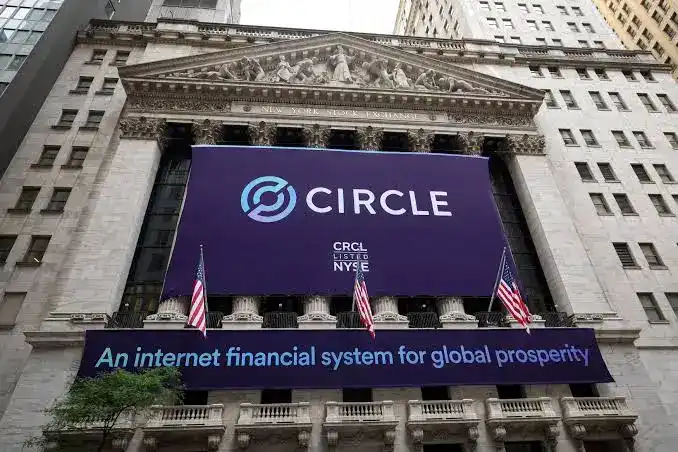
"Circle is focused on the long term (playing the long game)... If we can achieve the mission of building full-stack internet platform infrastructure, the stock price will naturally take care of itself in the long run (the stock is going to take care of itself)."

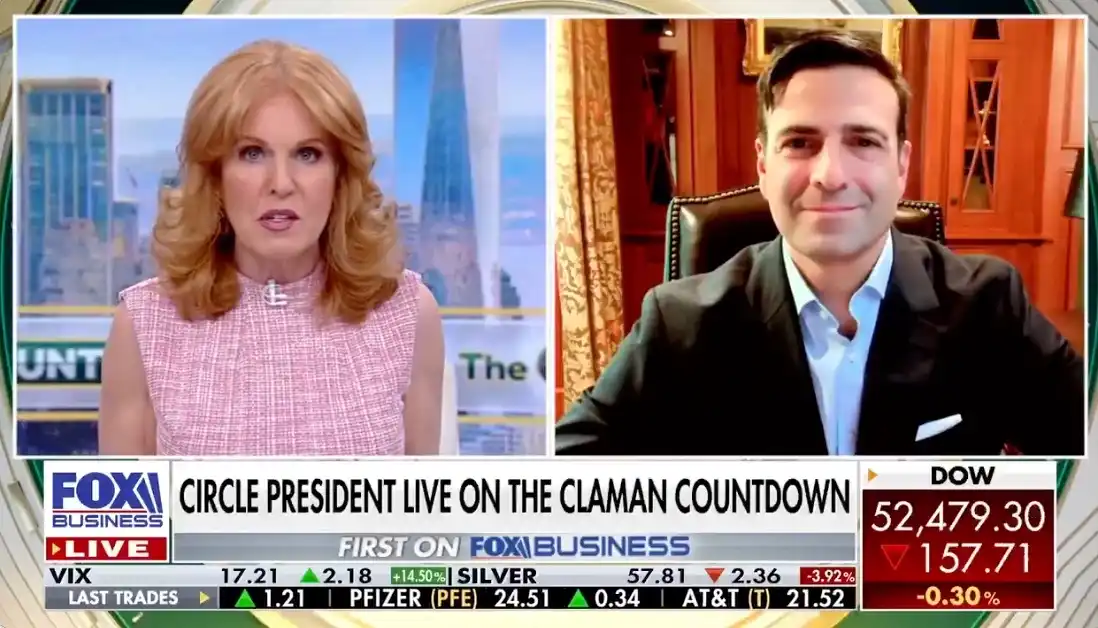
On July 14th, Circle President Heath Tarbert appeared in a live interview with FOX Business. When answering the host's question about "CRCL has fallen from a high of $260 to $62, what do you want to say to trapped investors?", Tarbert gave the above response.
Chanting "long-term value" seems to be the answer every company gives during periods of depressed stock prices. But to verify the credibility of this answer, we cannot simply look at how management describes the future, but rather whether they are willing to continue betting on the future with their own money.

After all, management is often the group that knows the company's situation best. They possess the company's operational data, strategic plans, and future growth trajectory. If they truly believe the current stock price is undervalued, then a significant price correction should theoretically present a rare buying opportunity.

However, for Circle, the actions of management may reveal a different answer.

73 Sell Trades, 0 Buy Trades: Is This the So-called Long-term Value?

After Tarbert raised the banner of "long term," CRCL investors reviewed Circle's Form 4 filings submitted to the U.S. Securities and Exchange Commission (SEC) and discovered a rather interesting fact — this very president who just conveyed long-term confidence to the market has been consistently selling company stock since CRCL went public.

  • Odaily Note: Form 4 is a securities transaction report that insiders of U.S. public companies must file with the SEC, used to disclose the buying and selling of company stock by directors, executives, and shareholders holding more than 10% of shares. Compared to ordinary investors who can only see public market price changes, Form 4 provides an important window into how insiders view the company's value.
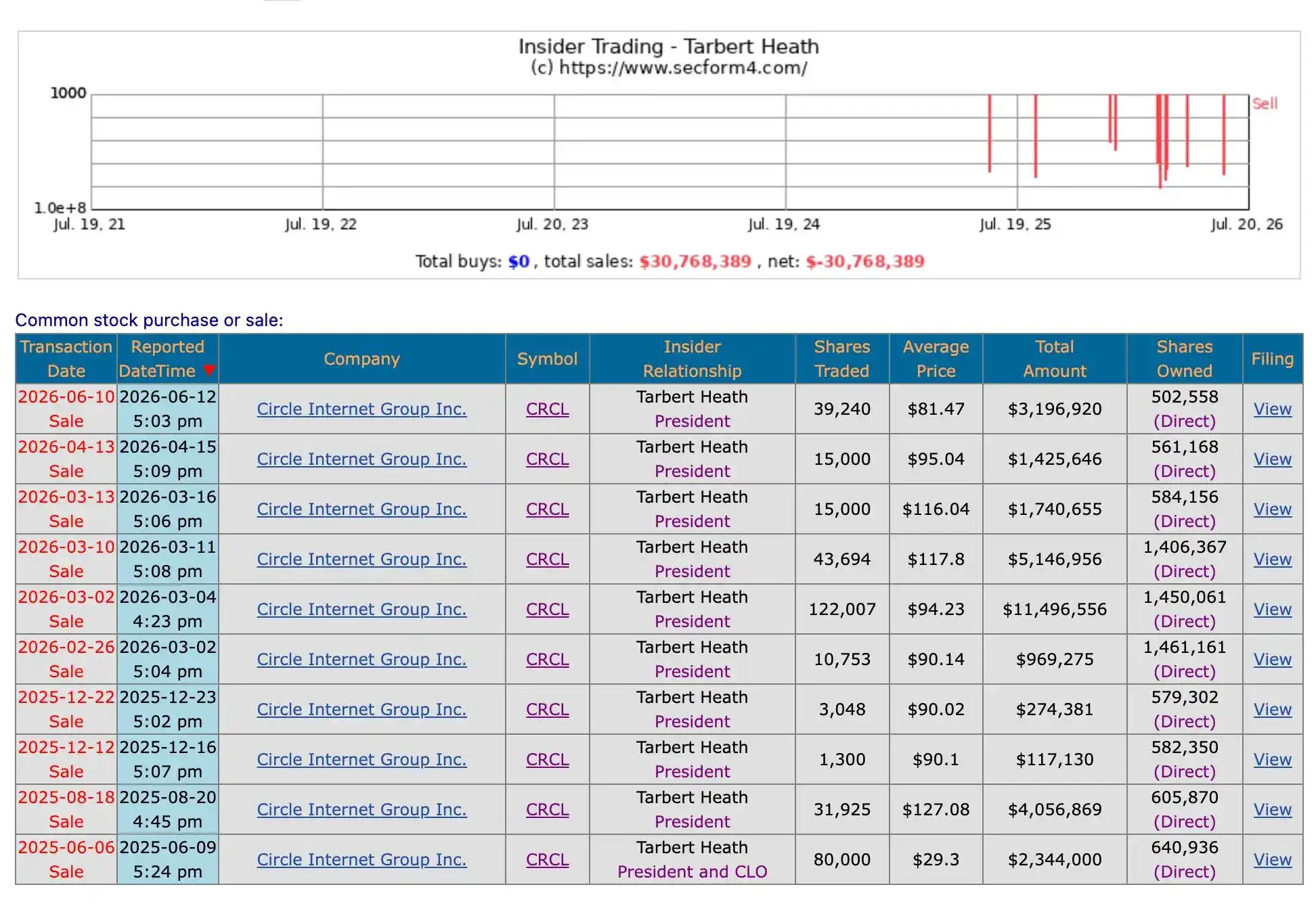
Circle's Form 4 filings show that since Tarbert's first sale of CRCL in June 2025, he has cumulatively sold CRCL 10 times, cashing out approximately $30.77 million in total, and has never made any purchases to increase his holdings.

If it were just Tarbert alone consistently selling stock, that might be one thing. However, further review of all insider transaction records for Circle reveals that things are not that simple — from the founder and CEO, to the Chief Financial Officer (CFO), to the Chief Product and Technology Officer (CPTO), to the Chief Accounting Officer (CAO), to board members... multiple key insiders at Circle have been selling stock, totaling 73 sell trades, 0 buy trades, with a total cash-out of approximately $664 million.
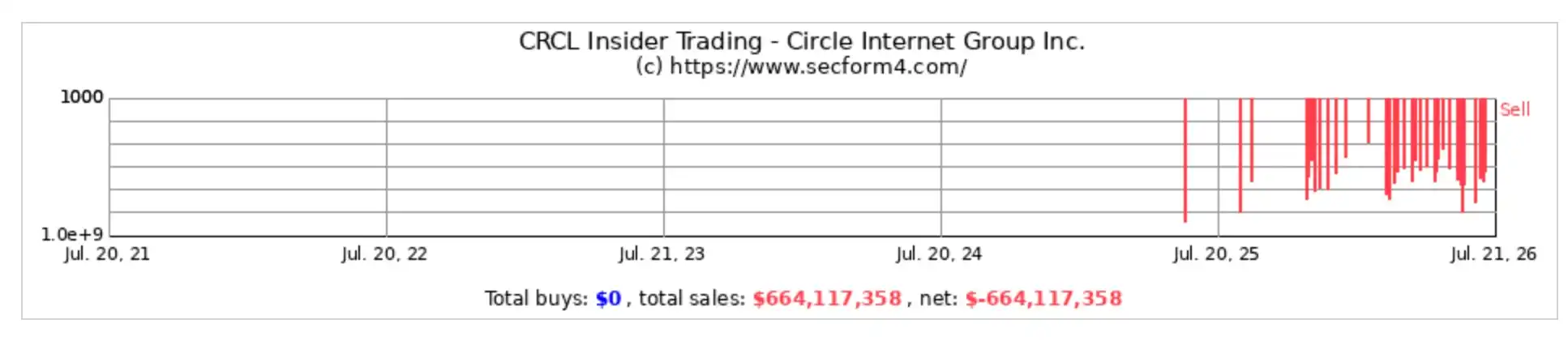
A brief summary of the stock sale data for these key insiders:

  • Founder and CEO Jeremy Allaire: 9 sell trades, 0 buy trades, cashed out $139 million in total;
  • Board member Burns M Michele: 12 sell trades, 0 buy trades, cashed out $276 million in total;
  • Board member Neville Patrick Sean: 13 sell trades, 0 buy trades, cashed out $181 million in total;
  • Chief Financial Officer (CFO) Fox-Geen Jeremy: 9 sell trades, 0 buy trades, cashed out $22.45 million in total;
  • Chief Product and Technology Officer (CPTO) Chandhok Nikhil: 12 sell trades, 0 buy trades, cashed out $69.21 million in total;
  • Chief Accounting Officer (CAO) Schulz Tamara: 9 sell trades, 0 buy trades, cashed out $1.21 million in total;
  • President Heath Tarbert: 10 sell trades, 0 buy trades, cashed out $30.77 million in total...

Clearly, as the CRCL stock price fell over 70% from its high and the market began re-evaluating Circle's long-term value, the group closest to the company's business itself did not choose to express confidence in future growth by buying more shares.

Executive Stock Sales Are Common, But the Trading Structure Is Too "One-Sided"

It should be noted that insider stock sales cannot simply be equated with them being bearish on the company's future.

For the management of public companies, stock sales themselves are not uncommon. Especially after an IPO, founders, executives, and early investors often hold large amounts of equity. Selling some shares to achieve wealth diversification, tax planning, or personal asset allocation are all normal phenomena.

Therefore, simply seeing one or even multiple executives selling stock is not enough to prove they are not optimistic about the company's future. The real key issue is — after a significant stock price correction, is anyone willing to buy back in?

For Circle, the controversy lies precisely here.

CRCL rose quickly after its listing to above $260, then fell all the way down. It has currently fallen over 70% from its high. Although there was a brief rebound some time ago, it did not last long before falling again. According to traditional investment logic, if management truly believes the company's long-term value has not changed, or even believes the market underestimates Circle's future, then the significantly corrected stock price should provide a highly attractive buying opportunity.

After all, compared to ordinary investors, these insiders naturally possess absolute information advantages. They know the growth of USDC, the progress of the company's customer expansion, future product roadmaps, and the company's true position in the stablecoin competition... However, judging from the publicly disclosed Form 4 data, Circle's core management has not made any purchases at the lower stock price levels but has been continuously selling and cashing out.

This highly "one-sided" trading structure makes it difficult to convey to the market a level of long-term confidence that matches the "playing the long game" rhetoric from the interview.

Re-evaluating CRCL's Value: Does the Long-term Narrative Match the Current Valuation?

Of course, even if insiders are continuously selling stock, it cannot be completely equated with "Circle lacks long-term value," but it can easily further strengthen the market's pessimistic expectations about the company.

Especially against the backdrop of CRCL's continuously declining stock price, the market's perception of Circle already has a huge divergence — Is Circle a future financial infrastructure company, or an issuer dependent on stablecoin scale and the interest rate environment?

In the early days of the IPO, the high valuation the market gave Circle bet on a grander story — as stablecoins become global digital payment infrastructure, Circle has the opportunity to become an important gateway connecting traditional finance and the crypto world.

However, as the stock price fell from its highs, investors have begun to re-examine this logic. On one hand, Circle's current revenue still heavily relies on returns from USDC reserve assets. Whether profitability can maintain high-speed growth during a rate-cutting cycle has become a market concern. On the other hand, during a downturn in the crypto market, whether USDC's growth potential can still meet previous expectations is also uncertain. Furthermore, as more financial institutions and crypto enterprises enter the stablecoin field, Circle's once greatest compliance advantage is also being re-evaluated.

Therefore, the current downturn of CRCL can essentially be understood as the market re-evaluating its value — whether the growth of the stablecoin industry and Circle's own business conditions are sufficient to support the high-growth valuation once assigned to CRCL.

In the future, Circle will still need to answer this question with actual performance.

熱門幣種推薦

相關問答

QAccording to the article, what is the key evidence that contradicts Circle management's claim of 'playing the long game'?

AThe key contradictory evidence is the disclosed Form 4 filings, which show that Circle's core internal personnel, including the President, CEO, CFO, and board members, have collectively executed 73 sales of CRCL stock with 0 purchases since its IPO, totaling approximately $664 million in proceeds. This 'one-sided' trading pattern occurred as the stock price fell over 70% from its high, despite public statements about long-term value.

QWhat specific data is provided regarding Circle President Heath Tarbert's stock transactions?

AThe article states that Circle President Heath Tarbert has made 10 separate sales of CRCL stock since his first sale in June 2025, collectively cashing out approximately $30.77 million, with zero purchase transactions recorded.

QHow does the article describe the market's core concern regarding Circle's business model and valuation?

AThe article describes the market's core concern as a fundamental reevaluation of whether Circle is a future financial infrastructure company or primarily an issuer dependent on the scale of its stablecoin (USDC) and the interest rate environment. Investors are questioning if the growth of the stablecoin industry and Circle's operations can justify the high-growth valuation it previously held, especially given its revenue's heavy reliance on USDC reserve asset earnings.

QWhat is the significance of the SEC Form 4 filings mentioned in the article?

ASEC Form 4 filings are mandatory disclosure documents for trades made by corporate insiders like directors, officers, and major shareholders. The article highlights them as a crucial 'window' for observing how insiders perceive the company's value, providing information that contrasts with the long-term confidence publicly expressed by management.

QWhat rationale does the article provide for why insider stock sales alone might not indicate a lack of confidence in the company?

AThe article notes that insider stock sales are not uncommon, especially post-IPO, as founders and executives may sell for reasons like wealth diversification, tax planning, or personal asset allocation. Therefore, sales by one or several individuals do not definitively prove bearishness. The critical issue identified is the complete absence of any insider purchases during the significant stock price decline, which fails to signal confidence in a buying opportunity.

你可能也喜歡

加密法案 Clarity 闯关记:美国两党妥协之路布满荆棘

美国国会两党正推进加密市场结构立法“Clarity法案”,但其立法进程充满挑战。今年1月,因Coinbase CEO的干预,参议院银行委员会已达成的两党协议被推翻。四个月后,法案凭借两党在“收益”问题上的妥协重回议程,但“伦理条款”成为民主党的核心诉求。5月委员会投票时,仅两位民主党参议员支持,并明确后续支持取决于伦理问题的解决。最终该法案在参议院农业委员会以党派投票通过,未获任何民主党人支持。 7月,共和党人急于推动全体投票,但伦理条款争议扩大,部分共和党人也转向支持大银行立场,执法机构则对开发者保护条款表示反对。非法金融和消费者保护仍是焦点,两位资深参议员分别强调了法案的执法工具价值和谨慎立法的必要性。 目前,两党虽认同需要市场结构立法,但在关键条款上难以妥协。近期有议员与白宫会面讨论伦理条款,但民主党人对其版本不满。行业期待两院委员会的和解文本,但其能否获得足够两党支持仍存疑。 可能的路径包括:8月休会前进行象征性投票;争取在2026年前完成立法;或达成包含伦理等条款的妥协框架。尽管障碍重重,加密行业仍需通过传统的逐票争取方式,在漫长立法过程中寻求突破。

Foresight News1 小時前

加密法案 Clarity 闯关记:美国两党妥协之路布满荆棘

Foresight News1 小時前

交易

現貨

熱門文章

什麼是 $S$

理解 SPERO:全面概述 SPERO 簡介 隨著創新領域的不斷演變,web3 技術和加密貨幣項目的出現在塑造數字未來中扮演著關鍵角色。在這個動態領域中,SPERO(標記為 SPERO,$$s$)是一個引起關注的項目。本文旨在收集並呈現有關 SPERO 的詳細信息,以幫助愛好者和投資者理解其基礎、目標和在 web3 和加密領域內的創新。 SPERO,$$s$ 是什麼? SPERO,$$s$ 是加密空間中的一個獨特項目,旨在利用去中心化和區塊鏈技術的原則,創建一個促進參與、實用性和金融包容性的生態系統。該項目旨在以新的方式促進點對點互動,為用戶提供創新的金融解決方案和服務。 SPERO,$$s$ 的核心目標是通過提供增強用戶體驗的工具和平台來賦能個人。這包括使交易方式更加靈活、促進社區驅動的倡議,以及通過去中心化應用程序(dApps)創造金融機會的途徑。SPERO,$$s$ 的基本願景圍繞包容性展開,旨在彌合傳統金融中的差距,同時利用區塊鏈技術的優勢。 誰是 SPERO,$$s$ 的創建者? SPERO,$$s$ 的創建者身份仍然有些模糊,因為公開可用的資源對其創始人提供的詳細背景信息有限。這種缺乏透明度可能源於該項目對去中心化的承諾——這是一種許多 web3 項目所共享的精神,優先考慮集體貢獻而非個人認可。 通過將討論重心放在社區及其共同目標上,SPERO,$$s$ 體現了賦能的本質,而不特別突出某些個體。因此,理解 SPERO 的精神和使命比識別單一創建者更為重要。 誰是 SPERO,$$s$ 的投資者? SPERO,$$s$ 得到了來自風險投資家到天使投資者的多樣化投資者的支持,他們致力於促進加密領域的創新。這些投資者的關注點通常與 SPERO 的使命一致——優先考慮那些承諾社會技術進步、金融包容性和去中心化治理的項目。 這些投資者通常對不僅提供創新產品,還對區塊鏈社區及其生態系統做出積極貢獻的項目感興趣。這些投資者的支持強化了 SPERO,$$s$ 作為快速發展的加密項目領域中的一個重要競爭者。 SPERO,$$s$ 如何運作? SPERO,$$s$ 採用多面向的框架,使其與傳統的加密貨幣項目區別開來。以下是一些突顯其獨特性和創新的關鍵特徵: 去中心化治理:SPERO,$$s$ 整合了去中心化治理模型,賦予用戶積極參與決策過程的權力,關於項目的未來。這種方法促進了社區成員之間的擁有感和責任感。 代幣實用性:SPERO,$$s$ 使用其自己的加密貨幣代幣,旨在在生態系統內部提供多種功能。這些代幣使交易、獎勵和平台上提供的服務得以促進,增強了整體參與度和實用性。 分層架構:SPERO,$$s$ 的技術架構支持模塊化和可擴展性,允許在項目發展過程中無縫整合額外的功能和應用。這種適應性對於在不斷變化的加密環境中保持相關性至關重要。 社區參與:該項目強調社區驅動的倡議,採用激勵合作和反饋的機制。通過培養強大的社區,SPERO,$$s$ 能夠更好地滿足用戶需求並適應市場趨勢。 專注於包容性:通過提供低交易費用和用戶友好的界面,SPERO,$$s$ 旨在吸引多樣化的用戶群體,包括那些以前可能未曾參與加密領域的個體。這種對包容性的承諾與其通過可及性賦能的總體使命相一致。 SPERO,$$s$ 的時間線 理解一個項目的歷史提供了對其發展軌跡和里程碑的關鍵見解。以下是建議的時間線,映射 SPERO,$$s$ 演變中的重要事件: 概念化和構思階段:形成 SPERO,$$s$ 基礎的初步想法被提出,與區塊鏈行業內的去中心化和社區聚焦原則密切相關。 項目白皮書的發布:在概念階段之後,發布了一份全面的白皮書,詳細說明了 SPERO,$$s$ 的願景、目標和技術基礎設施,以吸引社區的興趣和反饋。 社區建設和早期參與:積極進行外展工作,建立早期採用者和潛在投資者的社區,促進圍繞項目目標的討論並獲得支持。 代幣生成事件:SPERO,$$s$ 進行了一次代幣生成事件(TGE),向早期支持者分發其原生代幣,並在生態系統內建立初步流動性。 首次 dApp 上線:與 SPERO,$$s$ 相關的第一個去中心化應用程序(dApp)上線,允許用戶參與平台的核心功能。 持續發展和夥伴關係:對項目產品的持續更新和增強,包括與區塊鏈領域其他參與者的戰略夥伴關係,使 SPERO,$$s$ 成為加密市場中一個具有競爭力和不斷演變的參與者。 結論 SPERO,$$s$ 是 web3 和加密貨幣潛力的見證,能夠徹底改變金融系統並賦能個人。憑藉對去中心化治理、社區參與和創新設計功能的承諾,它為更具包容性的金融環境鋪平了道路。 與任何在快速發展的加密領域中的投資一樣,潛在的投資者和用戶都被鼓勵進行徹底研究,並對 SPERO,$$s$ 的持續發展進行深思熟慮的參與。該項目展示了加密行業的創新精神,邀請人們進一步探索其無數可能性。儘管 SPERO,$$s$ 的旅程仍在展開,但其基礎原則確實可能影響我們在互聯網數字生態系統中如何與技術、金融和彼此互動的未來。

272 人學過發佈於 2024.12.17更新於 2024.12.17

什麼是 $S$

什麼是 AGENT S

Agent S:Web3中自主互動的未來 介紹 在不斷演變的Web3和加密貨幣領域,創新不斷重新定義個人如何與數字平台互動。Agent S是一個開創性的項目,承諾通過其開放的代理框架徹底改變人機互動。Agent S旨在簡化複雜任務,為人工智能(AI)提供變革性的應用,鋪平自主互動的道路。本詳細探索將深入研究該項目的複雜性、其獨特特徵以及對加密貨幣領域的影響。 什麼是Agent S? Agent S是一個突破性的開放代理框架,專門設計用來解決計算機任務自動化中的三個基本挑戰: 獲取特定領域知識:該框架智能地從各種外部知識來源和內部經驗中學習。這種雙重方法使其能夠建立豐富的特定領域知識庫,提升其在任務執行中的表現。 長期任務規劃:Agent S採用經驗增強的分層規劃,這是一種戰略方法,可以有效地分解和執行複雜任務。此特徵顯著提升了其高效和有效地管理多個子任務的能力。 處理動態、不均勻的界面:該項目引入了代理-計算機界面(ACI),這是一種創新的解決方案,增強了代理和用戶之間的互動。利用多模態大型語言模型(MLLMs),Agent S能夠無縫導航和操作各種圖形用戶界面。 通過這些開創性特徵,Agent S提供了一個強大的框架,解決了自動化人機互動中涉及的複雜性,為AI及其他領域的無數應用奠定了基礎。 誰是Agent S的創建者? 儘管Agent S的概念根本上是創新的,但有關其創建者的具體信息仍然難以捉摸。創建者目前尚不清楚,這突顯了該項目的初期階段或戰略選擇將創始成員保密。無論是否匿名,重點仍然在於框架的能力和潛力。 誰是Agent S的投資者? 由於Agent S在加密生態系統中相對較新,關於其投資者和財務支持者的詳細信息並未明確記錄。缺乏對支持該項目的投資基礎或組織的公開見解,引發了對其資金結構和發展路線圖的質疑。了解其支持背景對於評估該項目的可持續性和潛在市場影響至關重要。 Agent S如何運作? Agent S的核心是尖端技術,使其能夠在多種環境中有效運作。其運營模型圍繞幾個關鍵特徵構建: 類人計算機互動:該框架提供先進的AI規劃,力求使與計算機的互動更加直觀。通過模仿人類在任務執行中的行為,承諾提升用戶體驗。 敘事記憶:用於利用高級經驗,Agent S利用敘事記憶來跟蹤任務歷史,從而增強其決策過程。 情節記憶:此特徵為用戶提供逐步指導,使框架能夠在任務展開時提供上下文支持。 支持OpenACI:Agent S能夠在本地運行,使用戶能夠控制其互動和工作流程,與Web3的去中心化理念相一致。 與外部API的輕鬆集成:其多功能性和與各種AI平台的兼容性確保了Agent S能夠無縫融入現有技術生態系統,成為開發者和組織的理想選擇。 這些功能共同促成了Agent S在加密領域的獨特地位,因為它以最小的人類干預自動化複雜的多步任務。隨著項目的發展,其在Web3中的潛在應用可能重新定義數字互動的展開方式。 Agent S的時間線 Agent S的發展和里程碑可以用一個時間線來概括,突顯其重要事件: 2024年9月27日:Agent S的概念在一篇名為《一個像人類一樣使用計算機的開放代理框架》的綜合研究論文中推出,展示了該項目的基礎工作。 2024年10月10日:該研究論文在arXiv上公開,提供了對框架及其基於OSWorld基準的性能評估的深入探索。 2024年10月12日:發布了一個視頻演示,提供了對Agent S能力和特徵的視覺洞察,進一步吸引潛在用戶和投資者。 這些時間線上的標記不僅展示了Agent S的進展,還表明了其對透明度和社區參與的承諾。 有關Agent S的要點 隨著Agent S框架的持續演變,幾個關鍵特徵脫穎而出,強調其創新性和潛力: 創新框架:旨在提供類似人類互動的直觀計算機使用,Agent S為任務自動化帶來了新穎的方法。 自主互動:通過GUI自主與計算機互動的能力標誌著向更智能和高效的計算解決方案邁進了一步。 複雜任務自動化:憑藉其強大的方法論,能夠自動化複雜的多步任務,使過程更快且更少出錯。 持續改進:學習機制使Agent S能夠從過去的經驗中改進,不斷提升其性能和效率。 多功能性:其在OSWorld和WindowsAgentArena等不同操作環境中的適應性確保了它能夠服務於廣泛的應用。 隨著Agent S在Web3和加密領域中的定位,其增強互動能力和自動化過程的潛力標誌著AI技術的一次重大進步。通過其創新框架,Agent S展現了數字互動的未來,為各行各業的用戶承諾提供更無縫和高效的體驗。 結論 Agent S代表了AI與Web3結合的一次大膽飛躍,具有重新定義我們與技術互動方式的能力。儘管仍處於早期階段,但其應用的可能性廣泛且引人入勝。通過其全面的框架解決關鍵挑戰,Agent S旨在將自主互動帶到數字體驗的最前沿。隨著我們深入加密貨幣和去中心化的領域,像Agent S這樣的項目無疑將在塑造技術和人機協作的未來中發揮關鍵作用。

1.0k 人學過發佈於 2025.01.14更新於 2025.01.14

什麼是 AGENT S

如何購買S

歡迎來到HTX.com!在這裡,購買Sonic (S)變得簡單而便捷。跟隨我們的逐步指南,放心開始您的加密貨幣之旅。第一步:創建您的HTX帳戶使用您的 Email、手機號碼在HTX註冊一個免費帳戶。體驗無憂的註冊過程並解鎖所有平台功能。立即註冊第二步:前往買幣頁面,選擇您的支付方式信用卡/金融卡購買:使用您的Visa或Mastercard即時購買Sonic (S)。餘額購買:使用您HTX帳戶餘額中的資金進行無縫交易。第三方購買:探索諸如Google Pay或Apple Pay等流行支付方式以增加便利性。C2C購買:在HTX平台上直接與其他用戶交易。HTX 場外交易 (OTC) 購買:為大量交易者提供個性化服務和競爭性匯率。第三步:存儲您的Sonic (S)購買Sonic (S)後,將其存儲在您的HTX帳戶中。您也可以透過區塊鏈轉帳將其發送到其他地址或者用於交易其他加密貨幣。第四步:交易Sonic (S)在HTX的現貨市場輕鬆交易Sonic (S)。前往您的帳戶,選擇交易對,執行交易,並即時監控。HTX為初學者和經驗豐富的交易者提供了友好的用戶體驗。

2.2k 人學過發佈於 2025.01.15更新於 2026.06.02

如何購買S

相關討論

歡迎來到 HTX 社群。在這裡,您可以了解最新的平台發展動態並獲得專業的市場意見。 以下是用戶對 S (S)幣價的意見。

活动图片