Recently, two very interesting numbers have emerged in Ethereum Staking.
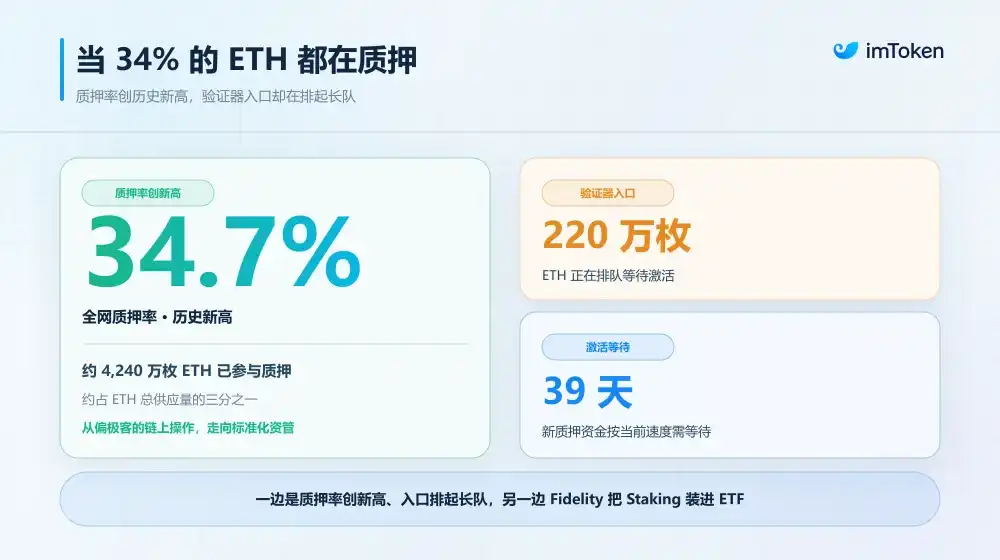
One is 34.7%.
As of late August, approximately 42.4 million ETH have been staked across the Ethereum network, accounting for about 34.7% of the total supply, reaching a record high. Even more striking is that there are still over 2.2 million ETH queued at the validator entry point. At the current rate, new staking funds need to wait nearly 39 days to be formally activated.
Another change comes from traditional finance.
In August, Fidelity further advanced the Staking arrangements for its Ethereum fund, FETH. It has not only signed relevant custody agreements with Anchorage Digital and BitGo but also clearly designed a staking reward distribution mechanism.
These two seemingly unrelated changes are actually a microcosm of a larger trend: in the past six months, Ethereum staking has accelerated its shift from a niche on-chain operation favored by geeks to an increasingly standardized asset management method.
For ordinary ETH holders, a more practical question than "whether to stake" is now emerging:
If you decide to stake, should you run your own node, choose Native Staking, Lido, or simply stake on an exchange?
1. Staking Is No Longer Just About 'Locking Up Assets to Earn Yield'
Let's start with the basics.
After Ethereum completed The Merge, the network no longer relies on miners using computing power to maintain the network. Instead, validator nodes maintain consensus and validate blocks by staking ETH.
The most basic threshold to become an independent validator node is 32 ETH.
Validators receive consensus layer rewards from the Ethereum protocol for staying online, correctly submitting attestations, and participating in block proposals. Conversely, being offline for extended periods incurs penalties, and serious violations like double-signing may lead to Slashing.
From this perspective, staking rewards are not "interest" magically generated out of thin air, but protocol rewards users earn by using their ETH to provide economic security for the Ethereum network.
But over the past few years, there has been a somewhat counterintuitive issue with Staking: rewards don't naturally compound.
In traditional 0x01 validators, even if they earn an extra 0.5 ETH or 1 ETH in consensus layer rewards, any amount exceeding 32 ETH is periodically and automatically withdrawn by the network to the withdrawal address, and does not continue to participate in the next round of staking.
To make this ETH generate rewards again, one would need to gather enough for a new staking amount and deploy it again.
Pectra changes this.
The new 0x02 validator has its maximum effective balance increased to 2048 ETH. Moreover, after exceeding 32 ETH, the balance can continue to gradually increase the effective staking amount according to protocol rules. For long-term stakers, the previous process of "earning rewards -> withdrawing them -> redeploying" can now, for the first time, be automated within the native Ethereum protocol (Extended reading: When 8 Million ETH Starts 'Moving': In the Post-Pectra Era, Staking Undergoes a Structural Transformation?).
If we look at the timeline over the past six months, we find that ETH staking is evolving from a relatively crude early-stage "lock 32 ETH for yield" model into a more sophisticated asset management mechanism.
Fidelity adding staking yield to its ETF addresses the question of "who stakes for me" for traditional finance users; Pectra addresses capital efficiency at the validator level; liquid staking protocols like Lido address liquidity; and professional node operators are beginning to separate operational maintenance from asset control.
Therefore, when comparing staking options today, the focus should no longer be solely on APR, but on comprehensive trade-offs.
2. They're All Staking, But What's the Difference?
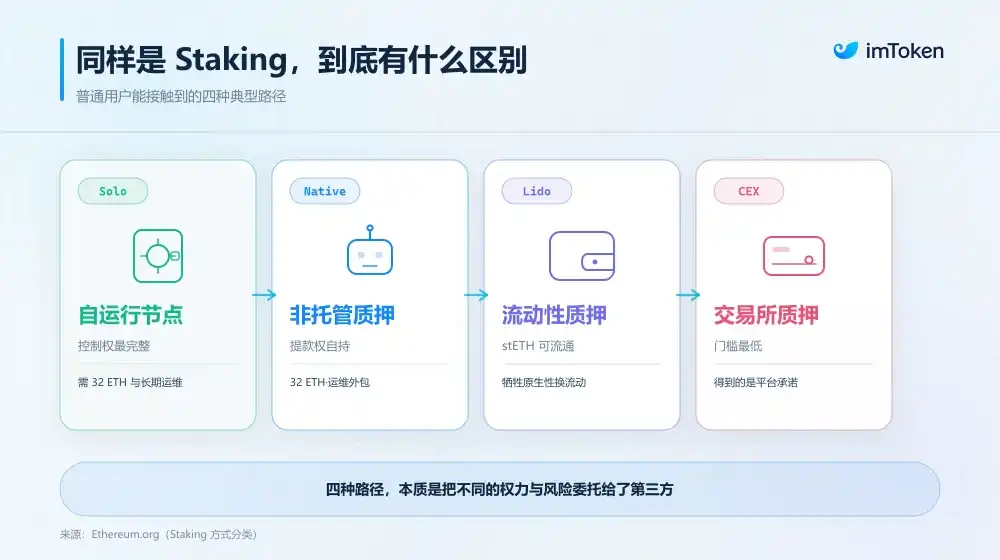
Overall, the typical ETH staking paths accessible to ordinary users today can be broadly categorized into four types.
On the surface, they might seem like just four methods to earn the same yield, but the core difference between these paths lies in which part of the power and risk the user chooses to delegate to a third party.
1. Running Your Own Node: The Most 'Native' Yield, and the Most Complete Control
The purest form of ETH staking is preparing 32 ETH yourself, running execution and consensus layer clients, and maintaining your own validator node.
In this method, everything—from how the node is deployed, which clients are run, to when to exit—is decided by you. The protocol-generated rewards also don't need to be shared with a liquid staking protocol or exchange.
However, the barriers are higher because you need at least 32 ETH, a stably running device, good network conditions, and must continuously maintain client versions, node status, and key security.
Ultimately, running your own node trades the highest level of control and more complete rewards for higher technical and operational costs.
2. Native Staking: Control Your Assets, Outsource the 'Operations'
The second method can be understood as a middle ground between Solo Staking and fully custodial solutions.
The user still uses their own 32 ETH to create an independent validator. The ETH ultimately still enters the native Ethereum staking system and is not exchanged for another token, but the node operation is handled by a professional service provider.
The most important distinction is the separation between withdrawal rights and node operation rights.
The validator itself uses different keys. The Signing Key, used for daily node signatures and block validation, can be managed by a professional node service provider. However, the Withdrawal Credential, which ultimately determines the destination of the principal and rewards, can remain in the hands of the user.
This is also a crucial dividing line between non-custodial Native Staking and custodial exchange staking. For example, imToken's current non-custodial ETH staking service is designed with this concept in mind (Extended reading: What is imToken's Non-Custodial ETH Staking Service?):
Users holding 32 ETH or more can create independent validators. The withdrawal keys are controlled by the user, node operation is handled by professional infrastructure, and different choices like compound validator and auto-withdrawal validator are already available.
This is suitable for users who have at least 32 ETH, want to earn native staking rewards, value self-custody, but don't want to maintain a validator themselves daily.
Of course, "non-custodial" does not mean "no third-party risk." Node operators can still experience downtime, configuration errors, or even Slashing. Therefore, what's transferred here is not asset ownership, but node operational risk.
3. Lido: Sacrifice a Bit of 'Nativity' for Liquidity
If you don't have 32 ETH, or simply don't want your ETH stuck in a validator exit queue for a long time, then liquid staking represents a completely different route.
Lido is the most typical example. Users deposit ETH into Lido, and the protocol allocates the funds to node operators to participate in Ethereum staking, while issuing stETH to the user.
Thus, ETH that was originally staked and couldn't be directly transferred is wrapped into a chain asset that remains liquid. Users can still transfer, trade, and use stETH, or further participate in DeFi scenarios like lending and liquidity provision.
To exit, users can either follow Lido's protocol redemption process to swap back to ETH, or directly sell stETH for ETH on a DEX. The latter doesn't even require waiting for the validator to actually exit, but the trade-off is bearing the current market price and potential slippage.
Simultaneously, stETH continuously reflects the staking rewards earned by the user through mechanisms like Rebase. Therefore, for ordinary users, there's basically no need to handle the issue of "claiming rewards and then re-staking" themselves.
The flip side of convenience is an additional layer of risk. Lido currently charges a protocol fee, distributed among node operators, the DAO Treasury, etc., with users receiving the remainder. More importantly, it introduces additional risks such as Lido's smart contracts, protocol governance, node operator risk, and stETH secondary market liquidity.
It's important to note that there is no forced "1:1 peg" between stETH and ETH like with fiat-backed stablecoins. If the market is eager to sell stETH in the short term, it could very well trade at a discount to ETH. If you then use that stETH to participate in more DeFi protocols, you further layer on new smart contract and liquidation risks.
Currently, imToken's ETH staking portal has also integrated Lido, allowing users to directly participate in liquid staking and hold stETH without needing 32 ETH.
4. Exchange Staking: The Lowest Barrier, But What You Own is a 'Platform Promise'
The last method might be the most familiar for many new users: depositing ETH on an exchange and clicking "Staking."
In terms of user experience, this is undoubtedly the simplest.
No need to have 32 ETH, no need to understand validator nodes, no need to manage Signing Keys or Withdrawal Keys, and no worries about server uptime.
The exchange aggregates ETH from many users to run validators, then credits a portion of the rewards to user accounts according to its own rules.
But precisely because of this, this method requires the most trust. What a user sees as "1 ETH staked" is often first and foremost a record in the exchange's internal accounting system. How validators are deployed at the underlying level, how much asset is actually staked, how rewards are reinvested, what percentage the platform takes, and how liquidity is managed when users request redemption—all depend on the specific platform's product design.
More importantly, the assets themselves are primarily under the custody of a centralized platform. This doesn't necessarily mean exchange staking is "bad." For newcomers who already keep their ETH on an exchange long-term and don't plan to manage an on-chain wallet themselves, it might still be the method with the lowest operational barrier.
It's just that the convenience you gain essentially comes from handing over asset custody, node operation, reward distribution, and even the exit process to the platform.
3. There's No 'Highest Yield' Staking, Only the Right Combination of Risks for You
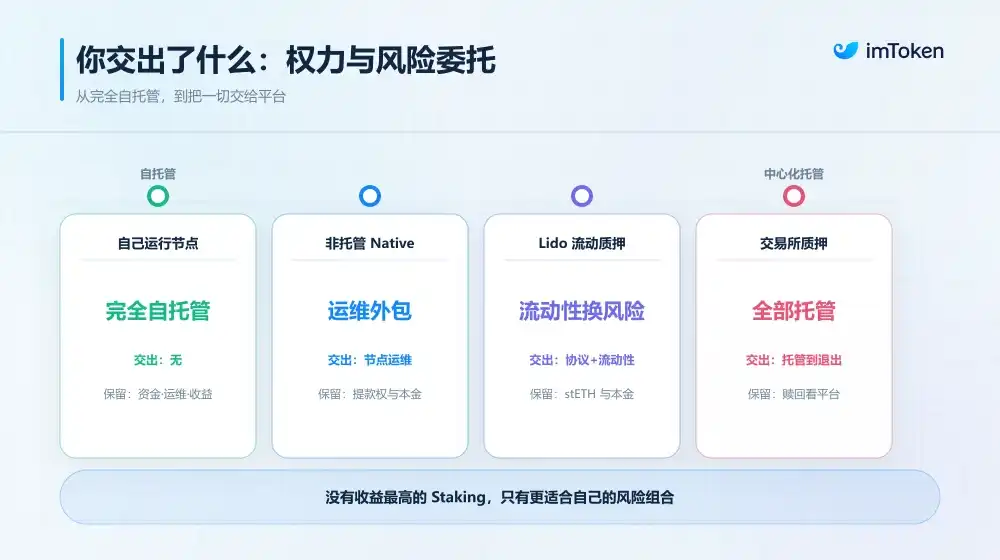
Placing all four methods side by side reveals an interesting phenomenon.
The evolution of Ethereum staking products isn't all solutions converging towards the same endpoint, but rather a continuous process of differentiating the capabilities that different users actually need.
- Running your own node maximizes control;
- Native Staking separates "fund ownership" and "node operations";
- Lido recombines "staking yield" and "fund liquidity";
- Exchanges further hide complexity, trading centralized custody for the lowest usage barrier;
And Fidelity planning to package Staking into an ETF takes yet another step forward—investors don't even need to hold on-chain ETH or understand how validators work; traditional financial products can handle custody, node operation, yield acquisition, and even final distribution for them.
From this viewpoint, Staking is increasingly resembling a mature financial infrastructure service.
So how should ordinary users choose?
If you have at least 32 ETH, possess some technical skills, highly value self-sovereignty, and wish to directly participate in the Ethereum network, running your own validator is still the choice with the most complete control.
If you also have 32 ETH but don't want to bear the long-term burden of node operation, while still wanting to firmly control withdrawal permissions, non-custodial Native Staking is a natural compromise.
If you hold less than 32 ETH, or have ongoing needs for trading, lending, and other DeFi activities, then Liquid Staking, as represented by Lido, trades an additional layer of protocol risk for significantly greater capital flexibility.
As for exchange Staking, it's more suitable for users who already accept centralized custody and wish to minimize operational barriers, provided they understand that platform risk doesn't disappear just because there's a "Staking" button.
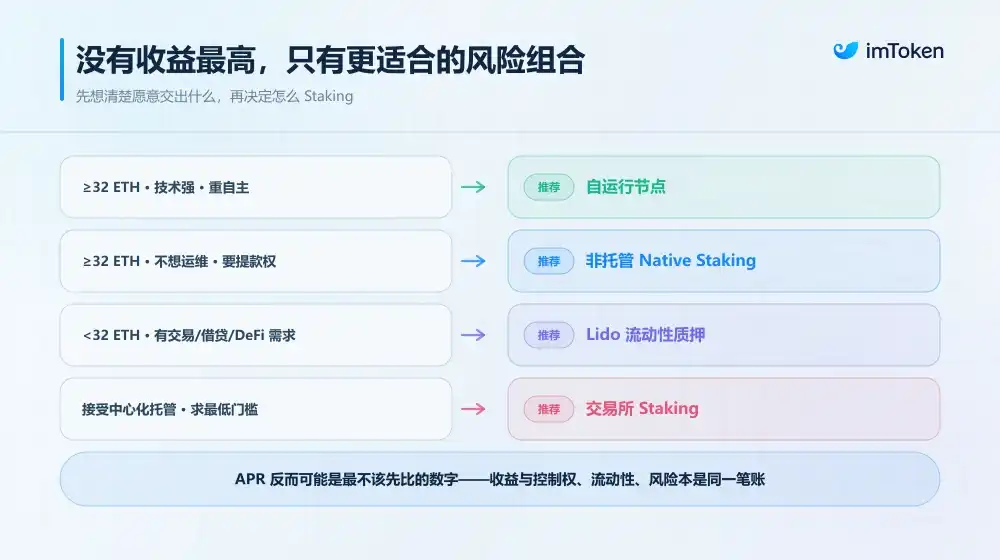
Therefore, looking at Ethereum staking today, APR might actually be the least important number to compare first.
If two products differ by only a few tenths of a percentage point in annualized yield, but one requires handing over assets completely to a third party while the other lets you control withdrawal rights; one requires waiting in the validator exit queue to withdraw, while the other allows selling the LST on the market anytime; one enables native compounding directly, while the other depends on how the platform handles rewards—these differences are often far more significant than the surface-level APR.
After all, staking rewards never exist in isolation.
How much yield you earn, and how much liquidity, control, and additional risk you give up for that yield, are ultimately all part of the same calculation.