GPT-5.6 Sol Major Price Cut: OpenAI Brings Price War to Its Flagship Model

marsbit發佈於 2026-08-24更新於 2026-08-24

文章摘要

OpenAI has slashed the API pricing for its flagship model GPT-5.6 Sol by over 20%, effective immediately. Input token costs dropped from $5 to $4 per million, while output tokens saw a more significant 33% reduction from $30 to $20 per million. This makes high-volume API users, especially those with output-heavy workloads like code generation, the biggest beneficiaries, with potential savings exceeding 30%. The price cut applies to API and credit-based usage, but subscription plans (Pro, Plus, Business) and their included allowances remain unchanged. OpenAI attributes the降价 to improved model efficiency and infrastructure scale, citing a 20% reduction in end-to-end service costs. Industry analysts view this move as a strategic play in the competitive AI landscape. It is seen as direct pressure on rival Anthropic, which is currently in its IPO roadshow phase aiming for a late 2024 listing. Simultaneously, it serves as a defensive response against aggressively priced models from Chinese competitors like DeepSeek. In related news, OpenAI's coding assistant Codex surpassed 20 million weekly active users. To mark the milestone, users received a one-time credit reset. The company also clarified policies against reselling or sharing subscription API quotas.

Within the next three months, both API prices and credit prices (the pay-as-you-go usage beyond the plan's included quotas) will be reduced by over 20%.

Currently, the price cuts on the API side have taken immediate effect. Eligible ChatGPT Work and Codex credits are being rolled out progressively.
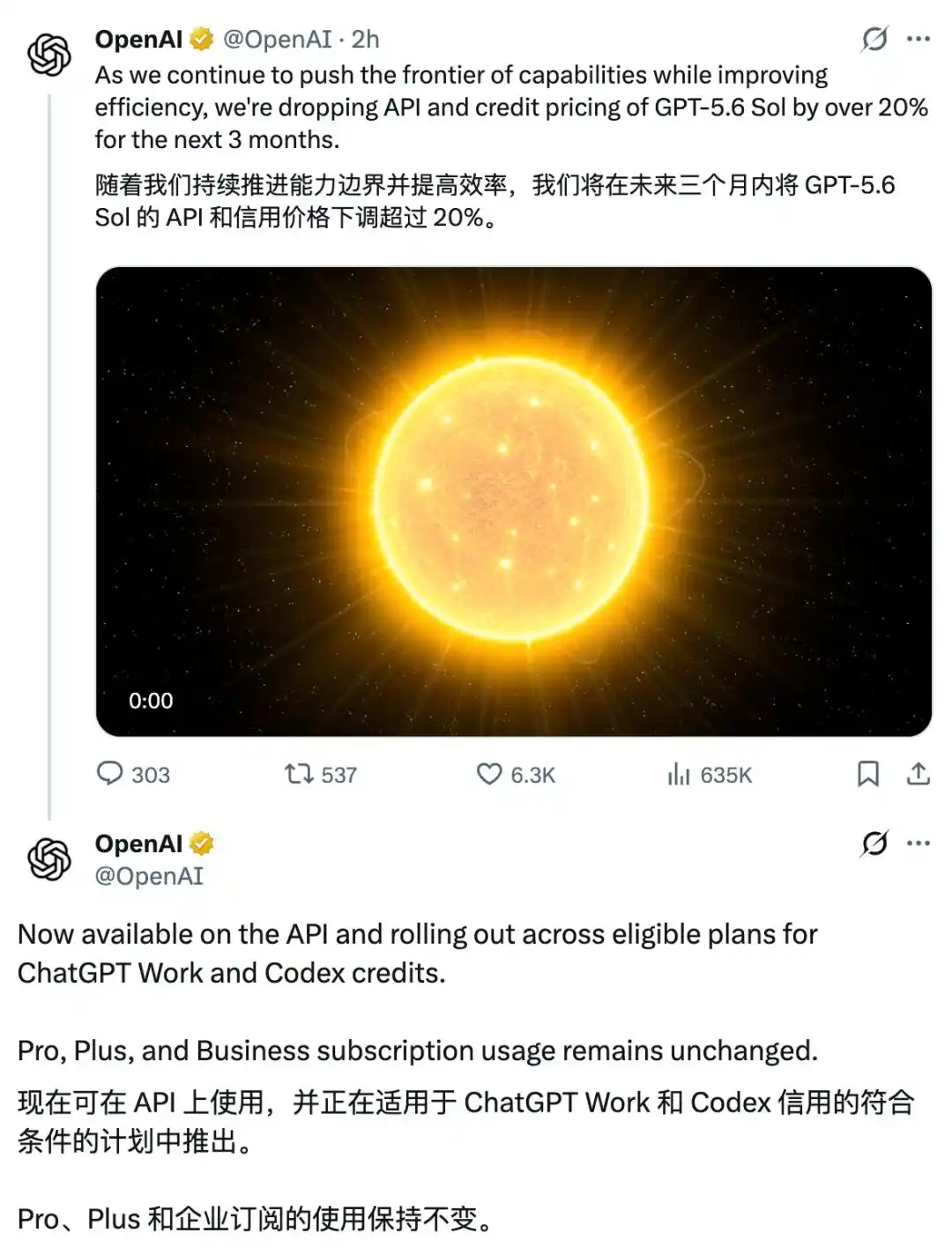
However, the prices for the Pro, Plus, and Business subscription tiers remain unchanged. The usage included in these plans has also not been increased.

The cuts are applied entirely to the token-based billing portion. This means the more API calls you make, the more you save.

How Much Can You Actually Save?

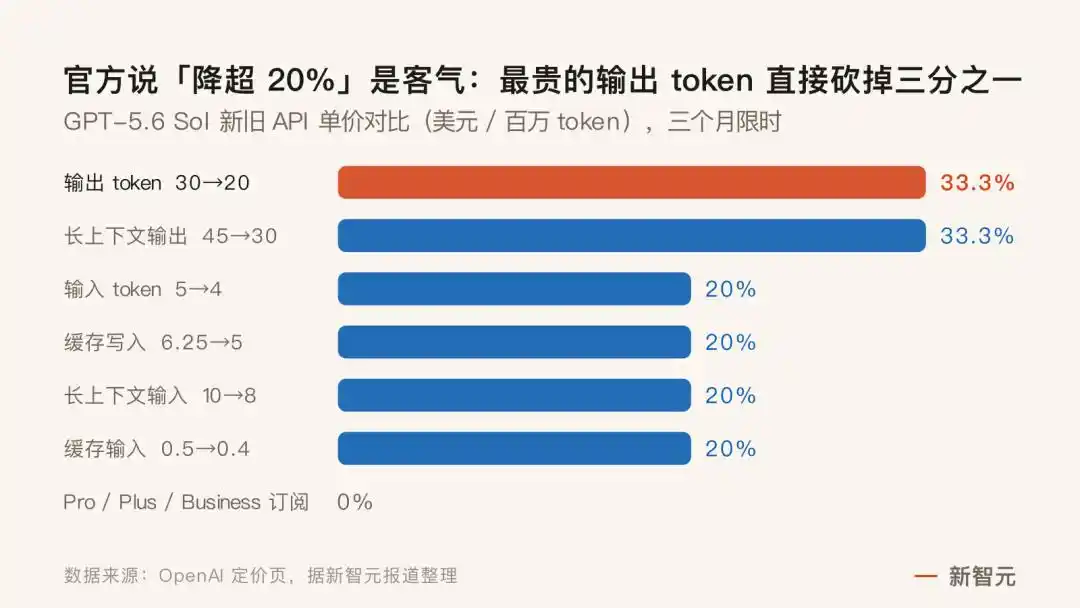
Previously, Sol's API pricing was $5 per million input tokens and $30 per million output tokens, making it the most expensive in the GPT-5.6 family.

Now, looking at the pricing page, it's $4 for input and $20 for output.

The input price dropped by 20%, which is straightforward. But the output price was slashed from $30 to $20, a full one-third reduction.
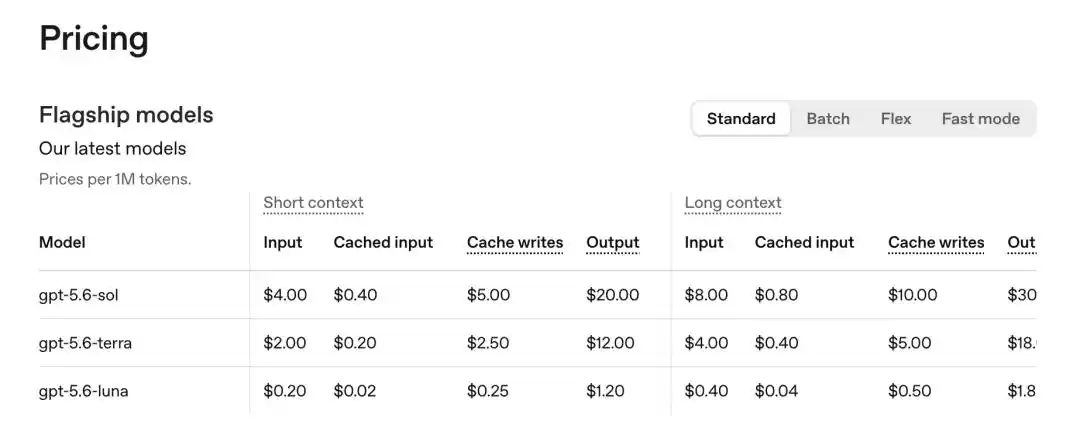
So, the official "over 20%" price cut statement is quite conservative. The truly expensive output tokens saw a 33% reduction.

Assuming a large-scale Agent consumes 100 million input tokens and 20 million output tokens per month, the cost would have been $1100. Now it's $800, a comprehensive reduction of approximately 27.3%.

How much you save specifically depends entirely on your input-to-output ratio. For input-heavy tasks like batch document processing, savings are around 20% or more. For scenarios like Codex, where code generation is intensive and output dominates, savings can exceed 30%.
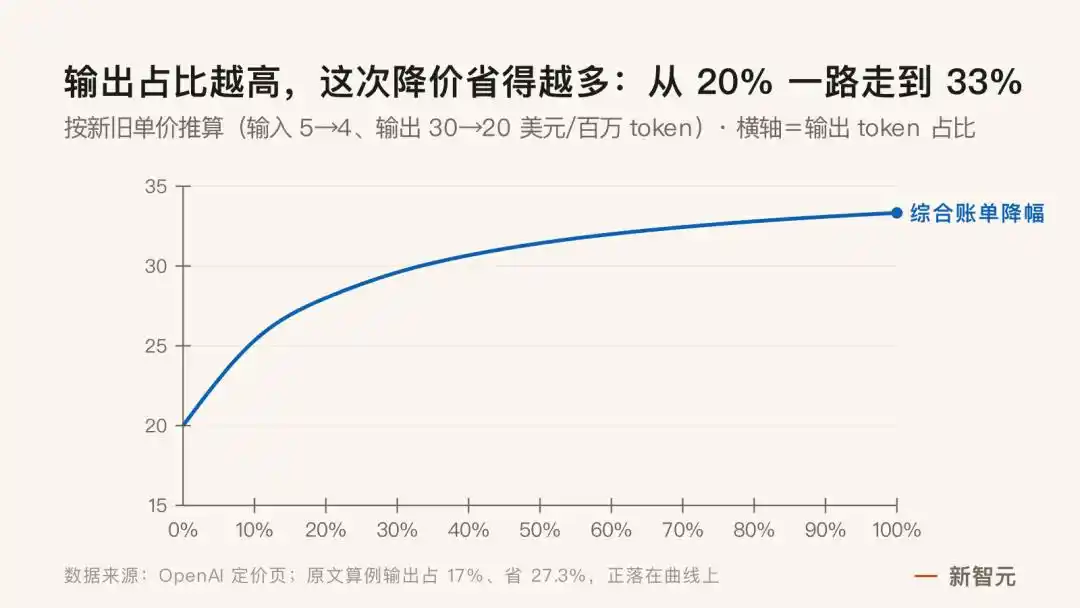
In short, the more you treat Sol as a productivity tool and push it to its limits, the more you save this time.

The cached tier has also been adjusted: cached input dropped from $0.5 to $0.4 per million tokens, and cached writes from $6.25 to $5 per million tokens. The long context window prices were similarly reduced: input from $10 to $8, output from $45 to $30 per million tokens.
OpenAI Developers subsequently posted, stating that the price reduction is possible because Sol now runs more efficiently.
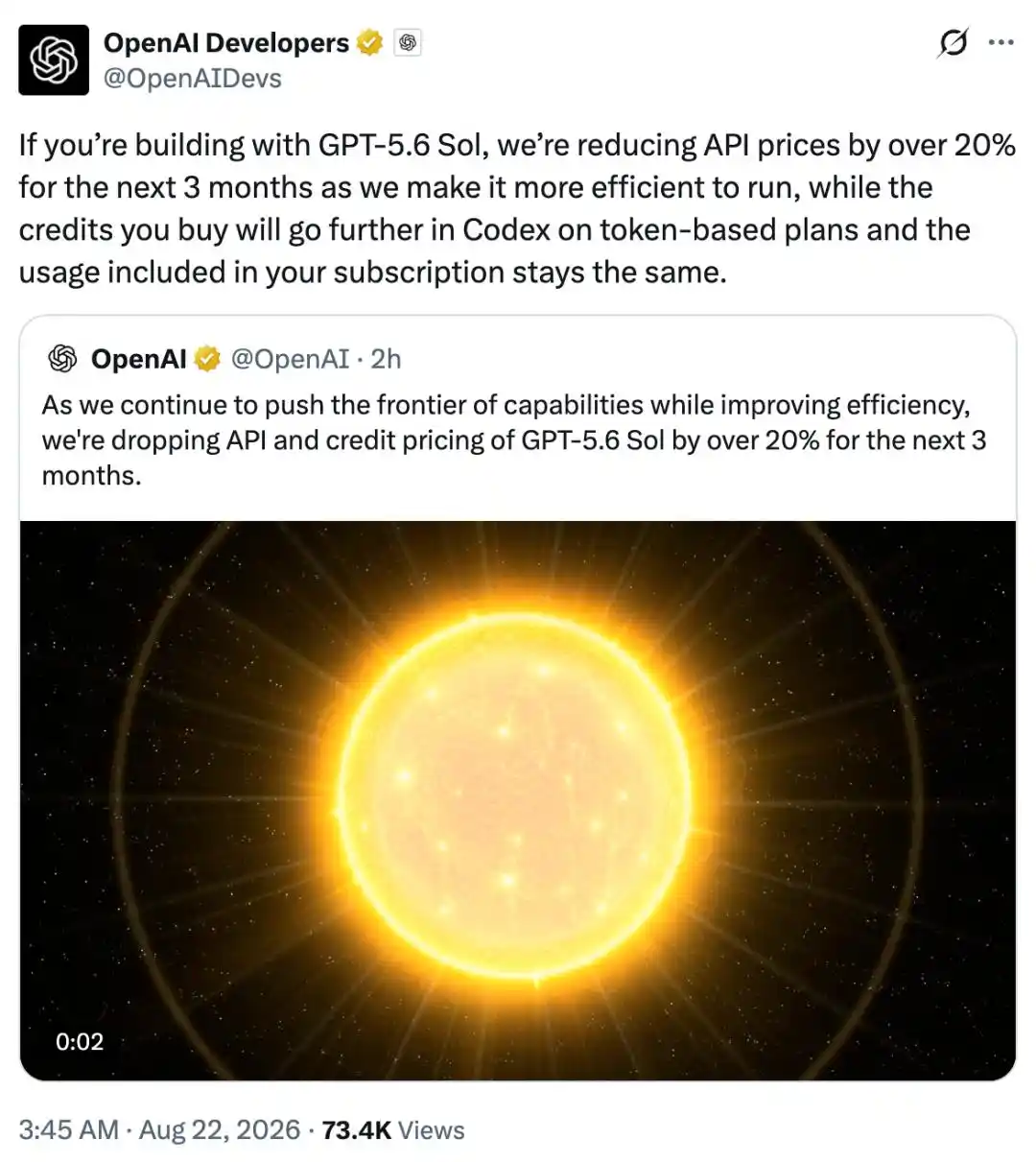
The ASI Duel Finals: Price Becomes the Second Battlefield

In OpenAI's previous round of price cuts, Sol was the only model that remained unchanged.

Luna was cut by 80%, the mainstay Terra by 20%. Only the flagship Sol held its original price, merely adding a free Fast mode for acceleration.

At that time, OpenAI's strategy was clear: cheaper models drive volume, while the most expensive card maintains prestige.

This time, Sol itself is entering the fray. And at this particular moment, it doesn't seem like a coincidence.

The tech influencer Chubby's assessment is direct: This is clearly aimed at Anthropic.

Anthropic is currently facing challenges. Negative feedback on Opus 5 hasn't been fully digested, and users are complaining about the rate limits of the Fable 5 subscription plan.

OpenAI's major price cut now is an attempt to poach Anthropic's users.

Tech journalist Tae Kim put it even more sharply: OpenAI is employing some business tactics during Anthropic's IPO roadshow.
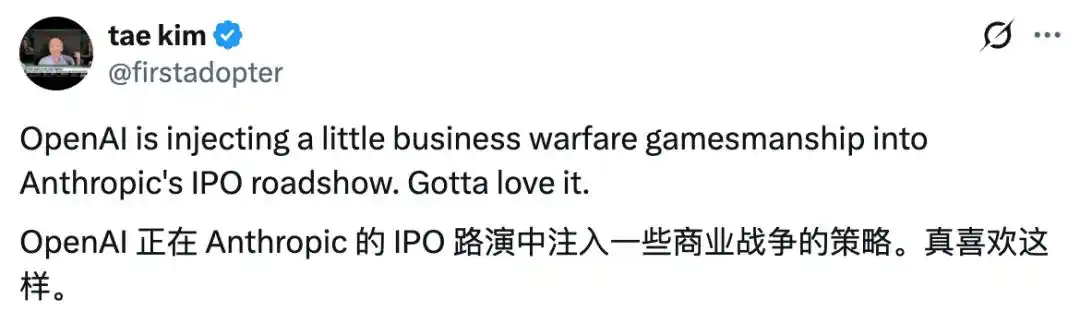
This isn't baseless speculation.

Anthropic filed a confidential S-1 with the SEC on June 1st this year, formally initiating the IPO process. According to multiple media reports, underwriters began arranging meetings between management and potential investors from mid-July, with the roadshow window precisely covering August to September.

Target listing time: As early as October, on NASDAQ, with a valuation targeting $2 trillion.

During a roadshow, the last thing a company wants is competitors causing trouble.

After the benchmarks battle, price has become the second battlefield in the ASI duel finals.

OpenAI's willingness to slash prices drastically isn't an impulsive move either.

Their earlier aggressive investments in building their own computing power and betting on more efficient model architectures are now paying off.

Just days ago, OpenAI announced securing approximately 8 IT-GW of computing power at the PORTS-Pike complex in Pike County, Ohio, signing a 20-year lease; NVIDIA is exclusively providing the AI computing infrastructure.

Previously, OpenAI also reached a five-year agreement with Oracle worth over $300 billion, corresponding to up to 4.5GW of new capacity, and signed a 6GW GPU deployment deal with AMD.

OpenAI confirmed in April this year that it had locked in over 10GW of AI infrastructure capacity, aiming to expand to 30GW by 2030.

The more developed the infrastructure, the lower the marginal cost, and the greater the room for price reductions. This creates a positive flywheel: Model efficiency improves → Inference costs drop → Price reduction space is created → Users flock in → Revenue grows → Reinvest in infrastructure.
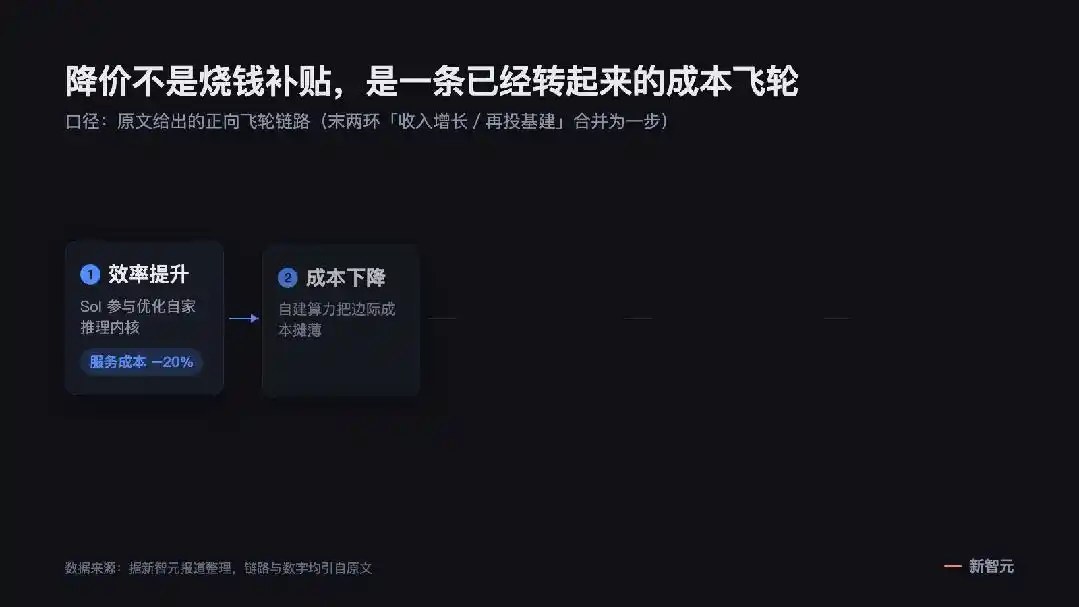
It can be said that OpenAI's flywheel is taking off. They themselves stated that GPT-5.6 Sol participated in optimizing its own production inference kernel, reducing end-to-end service costs by 20% and improving token generation efficiency by over 15%.

However, besides proactively creating pressure, this price cut also has a defensive element.

DeepSeek V4 Flash was officially released on July 31st, with pricing that seems almost free.

Even more stimulating is a mysterious model codenamed "Ox Alpha" that emerged two days ago. It boasts a 1M context window, supports text, image, and video input, and offers a week of free usage.

Now, Chinese open-source models are not only cheap but also steadily approaching the capabilities of frontier models.

Therefore, Sol's price cut is both an offensive move against Anthropic and a defensive counterattack against low-cost Chinese models.

Codex Surpasses 20 Million

Another set of numbers was announced on the same day.

Codex lead Tibo announced that Codex active users surpassed 20 million this week.
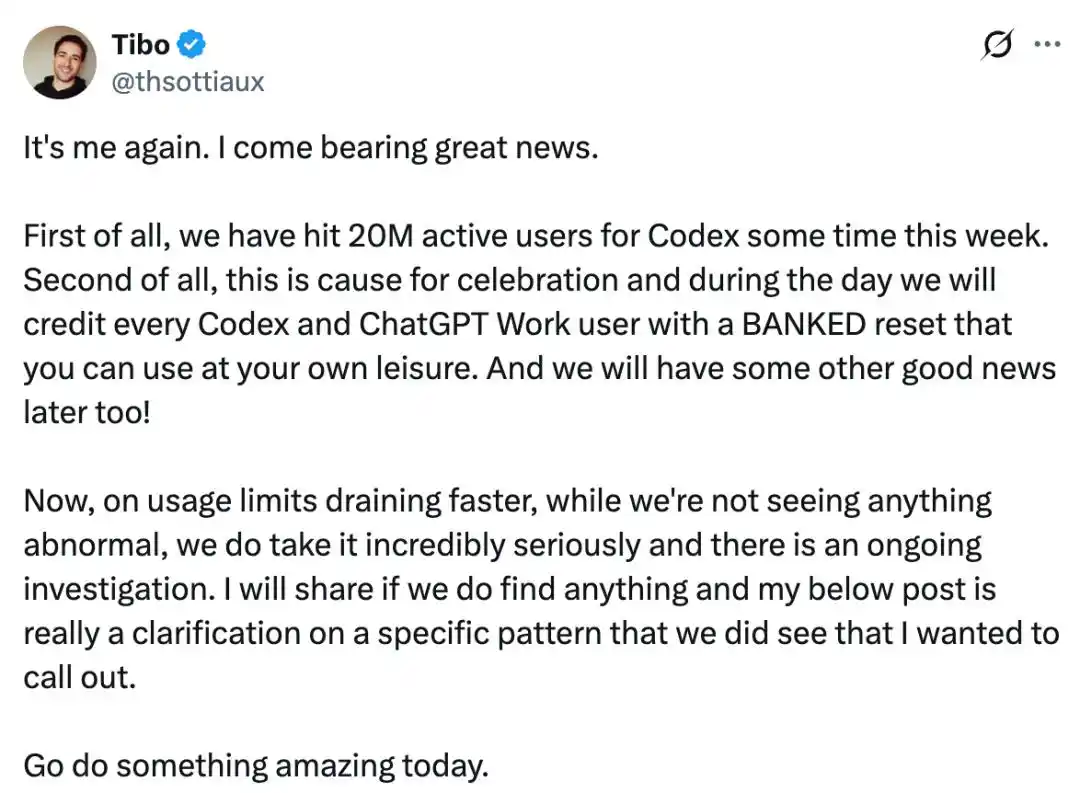
To celebrate this milestone, the team issued a one-time BANKED credit reset to all Codex and ChatGPT Work users.

However, regarding community feedback about credit consumption being too fast, Tibo said no abnormalities have been found so far, but a formal investigation has been launched, and results will be shared promptly.

He also drew a line: Officially, converting subscription accounts into API traffic via methods like sub2api for resale or multi-person sharing is not supported. Such usage patterns will be directly flagged by the risk control system.

The path of splitting a monthly subscription account to sell to a hundred people is blocked.

Using official clients, or open-source clients like Pi or OpenCode normally, is completely fine.

References:

https://x.com/OpenAI/status/2090885187634905500

https://x.com/OpenAI/status/2090885188897460249

https://x.com/kimmonismus/status/2090890956287492564

https://x.com/rohanpaul_ai/status/2090885980849050036

https://x.com/rohanpaul_ai/status/2090891370663989566

https://x.com/thsottiaux/status/2090766694897619318

This article is from the WeChat public account "新智元", author: ASI启示录, editor: Solomon

熱門幣種推薦

相關問答

QWhat are the key price reductions announced for the GPT-5.6 Sol API, and how do they compare to the previous pricing?

AOpenAI has reduced the GPT-5.6 Sol API pricing from $5 per million input tokens to $4 (a 20% cut) and from $30 per million output tokens to $20 (a 33% cut). Cached input tokens dropped from $0.5 to $0.4, cached writes from $6.25 to $5, long-context input from $10 to $8, and long-context output from $45 to $30.

QAccording to the article, what is the primary reason OpenAI gives for being able to reduce the prices of its flagship model?

AOpenAI states that the price reductions are possible because the GPT-5.6 Sol model now runs more efficiently. The company has optimized its production inference kernel, reducing end-to-end service costs by 20% and improving token generation efficiency by over 15%.

QWho are the two main competitors the article suggests OpenAI is targeting with this price cut, and what are the strategic contexts for each?

AThe article suggests OpenAI is targeting two main competitors: 1) Anthropic, by applying pressure during its critical IPO roadshow period (aiming for a Nasdaq listing around October). 2) Low-cost Chinese models like DeepSeek V4 Flash and the mysterious 'Ox Alpha', as a defensive move against their aggressive pricing and improving capabilities.

QWhat major milestone did Codex announce, and what accompanying measure was taken for its users?

ACodex announced that its weekly active users surpassed 20 million. To celebrate this milestone, the team issued a one-time BANKED reset for all Codex and ChatGPT Work users.

QHow does the article describe OpenAI's long-term strategy involving infrastructure investment and its impact on pricing?

AThe article describes a 'positive flywheel' strategy: OpenAI's aggressive investment in its own compute infrastructure (locking over 10GW capacity, targeting 30GW by 2030) lowers marginal costs. This creates pricing room, attracts more users, increases revenue, and allows for further infrastructure investment, creating a self-reinforcing cycle of growth and cost efficiency.

你可能也喜歡

加州理工用AI攻克量子化学60年难题,1块显卡做完7800块的活

加州理工学院Anima Anandkumar团队利用人工智能攻克了量子化学领域存在60年的计算瓶颈。他们开发的AI模型“Kohn-Sham FNO”将密度泛函理论(DFT)的计算复杂度从传统的立方级降低至近线性级,实现了革命性突破。 传统DFT计算随体系增大,计算量呈立方增长,难以模拟大分子体系。该团队创新性地采用傅里叶神经算子,在DFT的迭代求解流程中替代了最耗时的核心计算步骤,而非直接预测最终结果。这种“思维链”式的分步迭代方法保证了计算的稳定性和外推能力,即使模型输出有误,后续迭代也能纠正,并能在超出能力范围时通过发散发出警报。 该模型仅用8504个结构进行训练,便能同时处理分子和固体材料,覆盖元素周期表前五行元素,展现出优异的泛化能力。在外推至训练集未见的大型药物分子时,其误差远低于直接预测模型。 实际验证中,该模型在单块NVIDIA B300 GPU上成功完成了包含8250个原子(82500个价电子)的金属缺陷模拟,计算完美收敛。相比之下,2019年一项对类似规模体系的全量DFT计算动用了约7800块GPU。实测计算缩放指数为1.03(近线性),而传统方法为3.37(立方级),意味着体系越大,效率优势越显著。 这项研究标志着AI开始替代物理计算中最耗时的重复运算部分。团队已基于此创立公司,并计划进一步完善模型以覆盖完整能量计算流程,未来在药物研发、电池材料设计等领域具有巨大应用潜力。

marsbit32 分鐘前

加州理工用AI攻克量子化学60年难题,1块显卡做完7800块的活

marsbit32 分鐘前

交易

現貨

熱門文章

什麼是 SOLANA

HarryPotterWifHatMyroWynn10Inu,$solana: 一窺這個潮流迷因幣項目 介紹 在不斷演變的加密貨幣世界中,創新的項目層出不窮,吸引著投資者和愛好者的想像。其中一個項目是 HarryPotterWifHatMyroWynn10Inu,$solana,一個已經開始在加密社區中佔有一席之地的迷因幣。本文章旨在為您提供有關該項目的全面概述,闡明其目的、架構、創建者、投資者以及在發展過程中的重要里程碑。 什麼是 HarryPotterWifHatMyroWynn10Inu,$solana? 概述 HarryPotterWifHatMyroWynn10Inu,$solana 是一個基於 Solana 區塊鏈的迷因幣項目—這是一個以其擴展性和速度而著稱的平台。該項目旨在為加密空間帶來快樂和創意,不僅作為交易代幣,還作為生成和分享迷因內容的催化劑。其核心的社區受到鼓勵參與,提供一個動態生態系統,在這裡創造力和協作得以蓬勃發展。 目標和宗旨 該項目的本質是培養一個讓迷因愛好者聚集、分享和創作新穎迷因內容的環境。這種以敘事為驅動的方式在社區中注入了興奮感,推動了參與,同時展示了 Solana 區塊鏈內在的強大功能。通過建立一個以社區為中心的項目,HarryPotterWifHatMyroWynn10Inu,$solana 亦希望探討數字貨幣作為表達手段的社會影響。 HarryPotterWifHatMyroWynn10Inu,$solana 的創建者是誰? HarryPotterWifHatMyroWynn10Inu,$solana 的創建者身份仍然神秘莫測。該項目的結構是以放棄所有權的方式設計的,因此它作為一個由社區主導的倡議蓬勃發展。這種去中心化促進了所有利益相關者之間的透明性和民主參與。在迷因幣的世界中,這種方法越來越受歡迎,因為社區參與是至高無上的。 HarryPotterWifHatMyroWynn10Inu,$solana 的投資者是誰? 截至目前,沒有公開可得的關於支持 HarryPotterWifHatMyroWynn10Inu,$solana 的具體投資者或基金會的信息。知名投資者的缺席進一步強調了該項目的以社區為導向的精神,它獨立於傳統金融框架。這種獨立性使項目能夠在沒有外部壓力的情況下發展其身份,而是依賴於用戶基礎的集體興趣。 HarryPotterWifHatMyroWynn10Inu,$solana 如何運作? 經濟模型 該項目采用了一種獨特的經濟模型,支撐其功能性和用戶參與。HarryPotterWifHatMyroWynn10Inu,$solana 內部的交易旨在對所有參與方都有益。每一筆交易都會收取費用,這些費用隨後會在現有持有者中重新分配,同時增強流動性池。 這一模型的關鍵組成部分包括: 反射機制:交易費用的一部分會返回給持有者,促進對代幣的長期投資。 流動性池獲取:資金被分配以增強流動性,確保買賣操作可以順利執行。 燒毀機制:部分代幣可能會被燒毀以創造稀缺性,隨著需求的上升可能會增加價值。 這種設計鼓勵了一個自我維持的生態系統,在這裡社區互動和投資得以繁榮。 社區參與 HarryPotterWifHatMyroWynn10Inu,$solana 的核心價值在於社區參與。通過使用戶能夠通過創作迷因和促銷等各種活動參與項目的發展,該項目培育了一個充滿活力的生態系統,讓創造力得以蓬勃發展。 HarryPotterWifHatMyroWynn10Inu,$solana 的時間軸 HarryPotterWifHatMyroWynn10Inu,$solana 的發展軌跡上有多個值得注意的事件,塑造了它在加密社區中的當前地位: 創建:具體的創建日期仍未披露,但該項目的起源植根於貫穿數位時代的迷因文化之中。 社區接管:在創建者放棄所有權後,該項目過渡為由社區主導的模式,讓所有參與者都有份於它的成功。 審計和 NFT 收藏:為了增強可信度,該項目完成了一次徹底的審計,同時推出了一個 NFT 收藏,體現其以迷因為中心的精神。 夥伴關係和發展:該項目目前正在尋找潛在的夥伴關係,並組織基於其傳奇迷因的獨特網站和商品選項的發展。 要點 總結而言,HarryPotterWifHatMyroWynn10Inu,$solana 在加密貨幣的迷因幣領域中是一個值得注意的參與者。以下是一些關鍵要點: 社區主導的倡議:該項目作為一項合作努力蓬勃發展,鼓勵社區成員積極貢獻,同時與所有權聲索分離。 創新的經濟模型:利用反射、流動性獲取和燒毀機制,為用戶創建一個強大而引人入勝的財務環境。 NFT 和商品參與:通過推出 NFT 收藏,該項目旨在深化社區參與,強化迷因文化與數字貨幣之間的聯繫。 探索夥伴關係:該倡議並非靜止不前—持續的發展和潛在的夥伴關係表明了一種面向未來的增長取向。 結論 隨著 HarryPotterWifHatMyroWynn10Inu,$solana 在加密貨幣領域中不斷擴展,其獨特的社區參與、創新經濟結構以及迷因文化的融合勾勒出其未來的潛在路徑。即使其起源和投資者關係仍帶有神秘色彩,該項目卻講述了一個富有魅力的故事,體現去中心化創新的本質。在一個加密貨幣往往被視為純金融視角的世界中,HarryPotterWifHatMyroWynn10Inu,$solana 展示了加密運動融合了創造力、社區和合作的特性。無論您是經驗豐富的投資者還是新手,這個迷因幣項目的發展過程無疑是一個值得關注的迷人案例。

1.7k 人學過發佈於 2024.04.04更新於 2024.12.03

什麼是 SOLANA

什麼是 SOLANA 2.0

BarbieCrashBandicootRFK777Inu, $SOLANA 2.0:加密貨幣界的新玩家 BarbieCrashBandicootRFK777Inu, $SOLANA 2.0 介紹 在不斷演變的加密貨幣市場中,新興項目不斷吸引著投資者和愛好者的注意。在這些新興項目中,有一個名為BarbieCrashBandicootRFK777Inu,以加密貨幣符號$SOLANA 2.0代表。這個獨特的計劃結合了魅力、冒險和迷因文化的元素,旨在在高度競爭的領域中挑戰預期。這個項目抱有增長和創新的願景,捕捉到一種努力對抗已建立的巨頭的精神。 BarbieCrashBandicootRFK777Inu, $SOLANA 2.0 是什麼? 在其核心,BarbieCrashBandicootRFK777Inu是一個受到多種標誌性文化參考啟發的加密貨幣項目。它包括與Barbie相關的優雅和魅力,Crash Bandicoot的動感能量,以及RFK所代表的堅韌驅動,該項目的目標是在加密貨幣的世界中提供多面化的體驗。 BarbieCrashBandicootRFK777Inu項目的主要目標是將這些不同的元素融合成一個吸引廣泛受眾的凝聚生態系統。通過擁抱迷因文化的奇想,同時堅守去中心化和財務賦權的原則,該項目已定位為對於成熟投資者和加密世界的新手都具有吸引力的選擇。 BarbieCrashBandicootRFK777Inu, $SOLANA 2.0 的創造者是誰? 儘管對BarbieCrashBandicootRFK777Inu的關注不斷增長,關於其創造者的信息仍然 largely未知。創始人或開發團隊的匿名性引發了對項目結構和治理的疑問。在加密貨幣的世界中,項目沒有公開創始人是很常見的。這一缺乏信息可能會使某些潛在投資者卻步,而其他人則可能將其視為擁抱許多加密貨幣項目所基礎的去中心化精神的機會。 BarbieCrashBandicootRFK777Inu, $SOLANA 2.0 的投資者是誰? 目前,關於支持BarbieCrashBandicootRFK777Inu的投資基金或機構的信息相對較少。項目缺乏詳細的投資支持突顯了許多加密貨幣的獨立性。在這種情況下,項目的資金是否來自基層社群的支持或更大金融實體的支持,仍有待觀察。 BarbieCrashBandicootRFK777Inu, $SOLANA 2.0 如何運作? BarbieCrashBandicootRFK777Inu設計了多項功能,使其在擁擠的加密空間中獨具一格。雖然具體的技術細節仍然保密,但該項目預計將融入旨在增強用戶參與度和促進社區增長的功能。從時尚和冒險到遊戲的多樣影響力的結合,促進了一種迎合多樣興趣的包容氛圍。 此外,該項目與$SOLANA 2.0生態系統的聯繫暗示著潛在的技術優勢。這可能包括創新的交易速度、可擴展性和成本效益,與Solana區塊鏈的技術能力相一致。項目的創始人似乎正在依靠這一技術基礎,以創建持久的社區體驗和實質性的產品供應。 BarbieCrashBandicootRFK777Inu, $SOLANA 2.0 的時間表 BarbieCrashBandicootRFK777Inu的旅程包含幾個關鍵里程碑,提供了該項目迄今為止的發展見解: 項目概念化:最初的想法圍繞著魅力、冒險和迷因文化的融合,為項目的獨特概念提供了框架。 代幣創建:象徵性的$SOLANA 2.0代幣建立,旨在體現項目的願景並吸引潛在投資者的興趣。 項目開發:目前,該項目正進行進一步開發,重點是挑戰加密空間中的現有玩家並提供創新的產品。 這些里程碑反映了項目的增長軌跡,同時突顯了其致力於開發一個開創性的加密貨幣體驗的承諾。 關於BarbieCrashBandicootRFK777Inu, $SOLANA 2.0 的要點 獨特概念:BarbieCrashBandicootRFK777Inu通過將魅力、冒險和迷因文化的元素融合到一個加密貨幣項目中而脫穎而出。 弱者精神:該項目擁抱弱者的角色,旨在挑戰現有的加密貨幣項目並在行業中開闢一塊市場。 開發階段:正在進行積極的開發工作,旨在提供符合社區和投資者期望的新鮮和創新的產品。 結論 BarbieCrashBandicootRFK777Inu,以符號$SOLANA 2.0呈現,是加密貨幣市場中一個引人入勝的新進者。其獨特的文化參考混合和雄心勃勃的願景,可能引起尋求在加密領域尋找替代項目價值的人的共鳴。 雖然創始人和投資者的未知狀態可能會引發疑問,但該項目對魅力和冒險的重視展現了擴展加密貨幣可能體現的界限的迷人敘事。隨著項目的持續發展,觀察其在更廣泛的加密市場中的演變及其如何在競爭對手中定位自己,將會非常有趣。對於那些參與者來說,BarbieCrashBandicootRFK777Inu可能會解鎖重新定義與數字資產互動的驚喜體驗。 目前,隨著項目的推進,其旅程提醒著我們,加密空間的創新沒有界限,提供了一切從興奮和娛樂到財務賦權的潛力。

389 人學過發佈於 2024.04.05更新於 2024.12.03

什麼是 SOLANA 2.0

如何購買SOL

歡迎來到HTX.com!在這裡,購買Solana (SOL)變得簡單而便捷。跟隨我們的逐步指南,放心開始您的加密貨幣之旅。第一步:創建您的HTX帳戶使用您的 Email、手機號碼在HTX註冊一個免費帳戶。體驗無憂的註冊過程並解鎖所有平台功能。立即註冊第二步:前往買幣頁面,選擇您的支付方式信用卡/金融卡購買:使用您的Visa或Mastercard即時購買Solana (SOL)。餘額購買:使用您HTX帳戶餘額中的資金進行無縫交易。第三方購買:探索諸如Google Pay或Apple Pay等流行支付方式以增加便利性。C2C購買:在HTX平台上直接與其他用戶交易。HTX 場外交易 (OTC) 購買:為大量交易者提供個性化服務和競爭性匯率。第三步:存儲您的Solana (SOL)購買Solana (SOL)後,將其存儲在您的HTX帳戶中。您也可以透過區塊鏈轉帳將其發送到其他地址或者用於交易其他加密貨幣。第四步:交易Solana (SOL)在HTX的現貨市場輕鬆交易Solana (SOL)。前往您的帳戶,選擇交易對,執行交易,並即時監控。HTX為初學者和經驗豐富的交易者提供了友好的用戶體驗。

3.1k 人學過發佈於 2024.12.12更新於 2026.06.02

如何購買SOL

相關討論

歡迎來到 HTX 社群。在這裡,您可以了解最新的平台發展動態並獲得專業的市場意見。 以下是用戶對 SOL (SOL)幣價的意見。

活动图片